

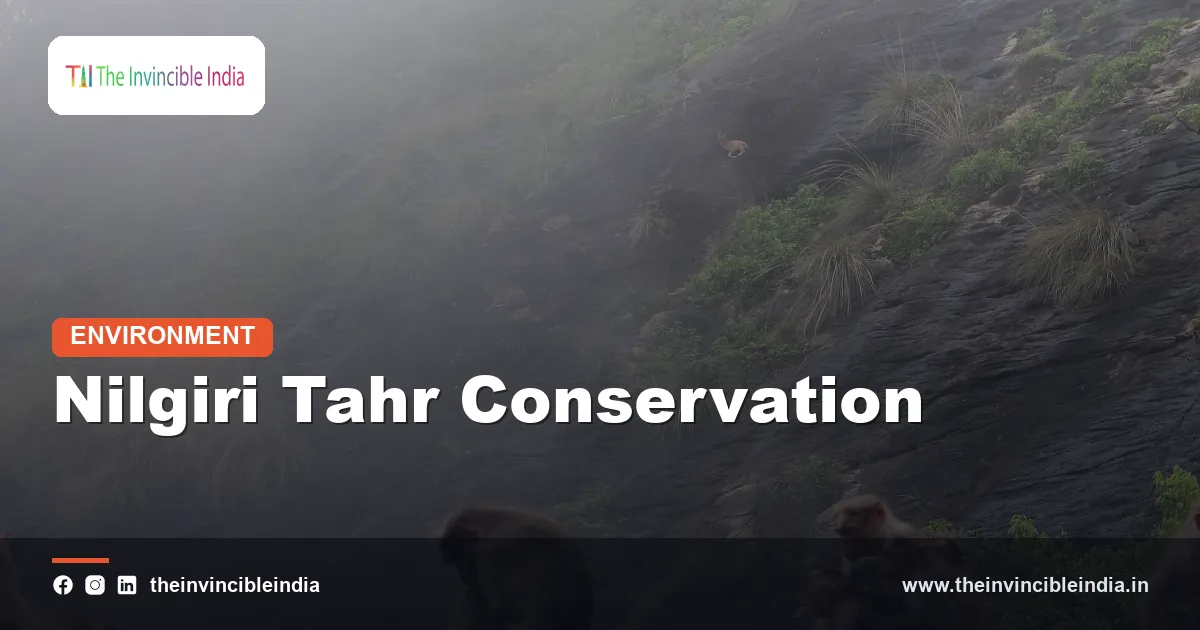
The Nilgiri Tahr (Nilgiritragus hylocrius) is a sturdy, sure-footed mountain goat that lives on the steep grassy slopes and rocky cliffs of the southern Western Ghats. It is found nowhere else in the world, which makes it one of the most important endemic mammals of peninsular India. Locally it is called “varaiaadu”, meaning “cliff goat” in Tamil, and it is the official state animal of Tamil Nadu. For many visitors to the hills of Kerala and Tamil Nadu, it is the animal that stands for the high-altitude grasslands themselves.
Despite its fame, the species is classified as Endangered, and its entire global population is confined to a narrow, fragmented chain of hill ranges. A century and a half ago, tahr were hunted in large numbers; later, their grasslands were converted into plantations and reservoirs. Today, conservation depends on a small number of well-protected strongholds, careful monitoring, habitat restoration and community support. This explainer covers the animal, its habitat, the history of its decline, the legal and field measures that protect it, and why its survival matters for the whole mountain ecosystem.
Quick Facts
| Feature | Details |
|---|---|
| Common name | Nilgiri Tahr (local name: Varaiaadu) |
| Scientific name | Nilgiritragus hylocrius |
| Family | Bovidae, subfamily Caprinae (goat-antelopes) |
| Range | Southern Western Ghats in Kerala and Tamil Nadu |
| Habitat | High-altitude montane grasslands, rocky cliffs and shola forest edges |
| IUCN status | Endangered |
| Legal status in India | Schedule I, Wildlife (Protection) Act, 1972 |
| Principal stronghold | Eravikulam National Park, Idukki district, Kerala |
| State animal of | Tamil Nadu |
What Is the Nilgiri Tahr?
The Nilgiri Tahr belongs to the Caprinae, the group of hoofed mammals that includes wild goats, sheep and ibex. Its closest relatives among the tahrs are the Himalayan tahr and the Arabian tahr, but the three live in widely separated regions and have long followed their own evolutionary paths. Taxonomists once placed all tahrs in a single genus; the Nilgiri Tahr is now generally assigned to its own genus, Nilgiritragus, reflecting its distinct ancestry.
The name “Nilgiri” can mislead, because the species is not restricted to the Nilgiri hills proper. It occurs across a series of high ranges in the southern Western Ghats, from the Nilgiris in the north to the Agasthyamalai hills in the south. English-speaking colonial naturalists often called it the “Nilgiri ibex” or “wild goat”, and old hunting accounts use these names. The word “tahr” itself comes from a Himalayan language and was applied to this animal by Europeans because of its resemblance to the Himalayan species.
A species of the high ground
What defines the Nilgiri Tahr is its attachment to elevation. It is typically seen on open slopes at roughly 1,200 to 2,600 metres above sea level, where cool, misty weather and short grass dominate. Below that, the dense evergreen forest is unsuitable; above it, few peaks exist in peninsular India. The animal therefore lives on “sky islands”, isolated high plateaus separated by warmer, lower valleys that it rarely crosses.
Appearance and Behaviour
The Nilgiri Tahr is a stocky animal with a short, coarse, brownish coat and a short, flattened tail. Both males and females carry curved horns that sweep backward, although those of males are thicker and longer. Horns are never shed, and the ridges that form on them can be used to estimate an animal’s age. Adult males are noticeably larger than females and darken with age. Mature, dominant males develop a pale grey patch of fur on the back, and are called “saddlebacks” by field biologists and local people alike.
Social life
Tahr are social animals that live in herds. Females, juveniles and young males form larger nursery groups, while adult males often live singly or in small bachelor groups for much of the year. During the breeding season, males compete for access to females, and the saddleback males become more prominent. Females usually give birth to a single kid after a gestation of about six months. The kid is able to follow its mother over steep ground within a very short time, an essential trait in a landscape with sheer drops.
Diet and daily rhythm
The tahr is a grazer. It feeds primarily on tussock grasses, along with some herbs and shrubs, and often rests on ledges or in the shade of rock faces in the middle of the day. Its hooves have a hard rim and soft, rubbery centre, which provides grip on wet rock. In misty weather, herds are sometimes seen standing motionless on a ridgeline, which is how many tourists first spot them.
Habitat: Cliffs, Grasslands and Shola Forests
The tahr’s landscape is a patchwork known as the shola-grassland mosaic. The grasslands are open, wind-swept expanses of tussock grass, often with scattered rocky outcrops. Tucked into folds and valleys between them are shola forests, stunted evergreen woodlands that survive in sheltered, moist depressions. This pattern is characteristic of the high ranges of the southern Western Ghats and is considered one of India’s most distinctive ecosystems.
For the tahr, each part of the mosaic serves a purpose.
- Grasslands supply the main food and are the area where herds graze in the morning and late afternoon.
- Cliffs and rock faces provide a refuge from predators and a safe place for females to give birth.
- Shola edges offer shelter from wind and heavy rain, and occasional browse.
Why the landscape is fragile
These high grasslands have evolved under cool, wet conditions and are sensitive to change. Planting trees on grassland, introducing exotic species, regular burning or heavy livestock grazing can alter their structure quickly. Once the grass cover is lost, it is slow to return. As a result, protecting the tahr in practice means protecting the whole mosaic, including the watershed that it forms for the rivers of the region.
Range across the Western Ghats
The Nilgiri Tahr’s historical range stretched along the Western Ghats south of the Palghat Gap, a low pass that interrupts the mountain chain. Today it survives in a series of disconnected pockets. The most significant lie within the following broad areas.
| Region | Notable protected areas |
|---|---|
| Nilgiri hills | Mukurthi National Park, Silent Valley National Park |
| Anamalai and Palani hills | Eravikulam National Park, Anamalai Tiger Reserve, Palani hills |
| Periyar and Cardamom hills | Periyar Tiger Reserve and adjoining forests |
| Agasthyamalai hills | Kalakkad Mundanthurai Tiger Reserve, Agasthyamalai Biosphere Reserve and nearby forests of Kerala and Tamil Nadu |
Population estimates vary between surveys, and tahr numbers in each pocket can change from year to year. What is stable is the pattern: a few relatively large groups in well-protected parks and a larger number of small, isolated groups elsewhere. Some of these small groups are vulnerable to local extinction because they have no easy way to exchange individuals with their neighbours.
Eravikulam National Park: The Stronghold
If the Nilgiri Tahr has a heartland, it is Eravikulam National Park in Idukki district of Kerala, near the hill town of Munnar. The area was declared a wildlife sanctuary in 1975 and upgraded to a national park in 1978, mainly to protect the tahr. It encloses a high, rolling plateau of grassland and shola forest, and it contains Anamudi, the highest peak in India south of the Himalayas, which rises to about 2,695 metres.
Eravikulam is globally known for two reasons. The first is its tahr, which here are so accustomed to people that visitors can see herds from a short distance, particularly around the Rajamalai area at the tourist zone of the park. The second is the Neelakurinji, a shrub that flowers en masse roughly once every twelve years and turns entire hillsides purple. Both attractions depend on the same open grassland habitat.
Management of the park
The park is managed by the Kerala Forest Department, with controlled tourist access and a ban on grazing and plantations within its core area. Visitor numbers are regulated, and the tourism zone is separated from the remote areas where the animals can range undisturbed. Because the park holds one of the largest single concentrations of the species, wildlife managers treat it as the main insurance against the loss of the tahr. Periodic counts conducted by the Forest Department and partner institutions use direct observation of herds on open slopes, which is possible because of the open terrain.
Historical Decline: Hunting and Habitat Loss
The Nilgiri Tahr was once much more widespread and abundant. During the nineteenth century, colonial-era hunters and sportsmen regarded it as a trophy animal, and accounts from the period mention herds shot in considerable numbers. Hunting continued with limited restraint into the twentieth century, and local people also took the animal for meat and skins. By the time protective laws were introduced, many local populations had already vanished.
Alongside hunting, the transformation of the high ranges played a major role.
- Large areas of montane grassland were converted to tea, coffee and cardamom estates from the nineteenth century onwards.
- Exotic trees such as wattle, eucalyptus and pine were planted extensively on former grassland, particularly in the Nilgiris and Palani hills.
- Hydroelectric and irrigation reservoirs, along with roads and settlements, flooded or fragmented valleys and plateaus.
The bottleneck effect
By the middle of the twentieth century, naturalists were worried that the animal might be heading towards extinction. The decline left a species with a patchy distribution and small populations, which carry their own risks. Small groups lose genetic diversity, and a single disease outbreak, drought or fire could affect a disproportionate share of the animals.
Threats Facing the Tahr Today
Poaching has fallen sharply compared to the historical period, but it has not disappeared entirely, and several other pressures remain. Conservation scientists usually group them as follows.
- Habitat fragmentation: isolated populations cannot easily move or exchange genes, and ranges are separated by plantations, roads and settlements.
- Invasive plants and plantations: exotic trees and weeds spread into grassland, reducing the area available for grazing.
- Livestock grazing: in some areas outside the strictly protected core, cattle and goats compete for forage and may spread disease.
- Fire: uncontrolled fires during the dry season can destroy grass cover and shola margins.
- Disease and small population size: an outbreak in a limited group can have severe effects.
- Climate change: because the tahr lives close to the summits of its mountains, warming could shrink the cool habitat it depends on, with little room to move upward.
Natural predators
Leopards, dholes (Asiatic wild dogs) and, in some places, tigers prey on tahr. This is part of the natural food chain and is not a primary conservation concern in large populations, but in small, isolated groups predation can add to other stresses.
Legal Protection and Conservation Status
The Nilgiri Tahr is listed as Endangered on the IUCN Red List. In India it is protected under Schedule I of the Wildlife (Protection) Act, 1972, which affords the highest level of legal protection and prescribes severe penalties for hunting or trade. Schedule I also places the species among those for which recovery programmes are given priority.
A number of the tahr’s strongholds are national parks, tiger reserves or sanctuaries, which provide an additional layer of protection. Many of the surrounding forests fall within the Western Ghats, which are recognised as a global biodiversity hotspot and a UNESCO World Heritage Site. This overlap of protections is important, since the tahr’s range crosses state boundaries, administrative units and several kinds of land use.
Roles of different agencies
Conservation of the species involves several organisations: the state forest departments of Tamil Nadu and Kerala, the central environment ministry, research institutions such as the Wildlife Institute of India, and conservation groups and local communities. Joint surveys, shared protocols and exchange of data are increasingly needed since the animal does not recognise state borders.
Project Nilgiri Tahr
In 2022, the Tamil Nadu government announced Project Nilgiri Tahr, a dedicated, multi-year initiative to protect the animal. It was timed around the state’s recognition of the species as its state animal, and it is often compared in spirit with earlier species-specific efforts such as Project Tiger. The project is coordinated by the Tamil Nadu Forest Department and covers the animal’s habitats in the state, which include the Nilgiris, the Anamalai, Palani and Agasthyamalai ranges.
The programme’s main strands, as publicly described, are the following.
- Scientific surveys and monitoring to estimate numbers, understand distribution and track threats.
- Habitat restoration, including the removal of invasive species and exotic plantations, and the revival of native grassland and shola forest.
- Research on genetics, ecology and disease, with the help of scientific institutions.
- Reintroduction and translocation in suitable habitats from which the animal has disappeared, preceded by careful assessment.
- Awareness and community engagement, particularly with people who live near tahr habitats, so that conservation becomes a shared goal.
Because it is a long-term effort, the success of such a project is judged over many years through population trends and the recovery of habitat rather than short-term numbers. Its significance lies in the fact that it creates a dedicated framework, staff and budget for a species that was once handled as one among many in forest-division plans.
Ecological Significance of the Tahr
The tahr’s importance goes well beyond its own survival. As a grazer, it forms part of the web of life in the high-altitude grasslands, helping to shape the structure of the vegetation and supporting predators such as leopards and dholes. It is also an umbrella species: protecting enough habitat for the tahr protects countless other organisms that share the same cliffs and meadows.
Linked species and services
The shola-grassland ecosystem is home to many species found nowhere else, including endemic plants, amphibians, birds such as the Nilgiri pipit and the Nilgiri wood-pigeon, and the Nilgiri marten. The high-altitude grasslands also act like natural sponges. They capture monsoon rain and mist, release water slowly into streams, and feed rivers such as the Periyar, the Bhavani and the Pambar that supply downstream farms and towns. Safeguarding the tahr’s habitat therefore also protects the water security of millions of people.
An indicator of ecosystem health
Because the tahr needs intact grassland, safe cliffs and low disturbance, its numbers are a convenient indicator of the condition of the wider ecosystem. A stable or recovering tahr population suggests that the habitat is functioning well, while local declines can serve as an early warning of encroachment, fire or disease.
Cultural Importance and Public Awareness
The Nilgiri Tahr has a place in the culture of the hills. Communities such as the Todas of the Nilgiris, who have lived in the high grasslands for centuries, share the landscape with the animal, and the tahr appears in local names, folk accounts and regional symbolism. Its designation as the state animal of Tamil Nadu gives it official recognition, and its image is used in conservation messaging, forest department logos and the emblems of some institutions.
Eco-tourism has also made the animal a source of local livelihood. Guides, drivers and small businesses near Munnar and the Nilgiris benefit from visitors who come to see tahr and flowering grasslands. If properly regulated, this gives communities a stake in keeping the habitat intact.
What responsible visitors can do
- Follow park rules and stay on designated trails and in permitted areas.
- Never feed wild animals; human food can change their behaviour and harm their health.
- Avoid plastic waste and open fires in the high ranges.
- Keep a respectful distance, particularly from females with young kids.
Conclusion
The Nilgiri Tahr is a small mountain animal with large implications. Its history, from abundant game to endangered symbol, mirrors the story of many Indian species whose habitats were transformed within a few generations. Its present, with protected strongholds such as Eravikulam, a dedicated state programme and growing public interest, offers cautious optimism. The tahr will only continue to survive if grasslands remain open, fragmented populations are reconnected where possible, and local communities continue to be partners in conservation. Protecting the tahr ultimately means protecting the high, misty meadows of the Western Ghats and the rivers that flow from them.
Frequently Asked Questions
What is the Nilgiri Tahr and where is it found?
The Nilgiri Tahr is a wild mountain goat that is endemic to the southern Western Ghats of Kerala and Tamil Nadu. It lives on high-altitude grasslands and cliffs, mostly between about 1,200 and 2,600 metres. It is found nowhere else in the world.
Why is the Nilgiri Tahr endangered?
The animal was heavily hunted in the colonial era and lost much of its habitat to plantations, exotic trees, reservoirs and settlements. Its remaining populations are small and isolated, which makes them vulnerable to disease, fire and climate change. It is listed as Endangered by the IUCN.
Where can I see the Nilgiri Tahr in India?
Eravikulam National Park near Munnar in Kerala is the best-known place, where herds are often visible from the tourist zone. Other habitats include Mukurthi National Park in the Nilgiris, the Anamalai hills, the Palani hills, Periyar and the Agasthyamalai range.
What is Project Nilgiri Tahr?
Project Nilgiri Tahr is a multi-year conservation initiative announced by the Tamil Nadu government in 2022. It focuses on scientific monitoring, habitat restoration, research, possible reintroductions and community awareness in the state’s tahr habitats.
Is the Nilgiri Tahr the state animal of any state?
Yes, it is the state animal of Tamil Nadu. It is also protected under Schedule I of the Wildlife (Protection) Act, 1972, which gives it the highest level of legal protection in India.
How is the Nilgiri Tahr different from the Himalayan Tahr?
The two species live in completely different regions, the Western Ghats and the Himalaya respectively. The Nilgiri Tahr has a short, coarse coat and curved horns present in both sexes, and mature males develop a grey saddle. It is now placed in its own genus, Nilgiritragus, separate from the Himalayan species.
{“@context”:”https://schema.org”,”@graph”:[{“@type”:”FAQPage”,”mainEntity”:[{“@type”:”Question”,”name”:”What is the Nilgiri Tahr and where is it found?”,”acceptedAnswer”:{“@type”:”Answer”,”text”:”The Nilgiri Tahr is a wild mountain goat that is endemic to the southern Western Ghats of Kerala and Tamil Nadu. It lives on high-altitude grasslands and cliffs, mostly between about 1,200 and 2,600 metres. It is found nowhere else in the world.”}},{“@type”:”Question”,”name”:”Why is the Nilgiri Tahr endangered?”,”acceptedAnswer”:{“@type”:”Answer”,”text”:”The animal was heavily hunted in the colonial era and lost much of its habitat to plantations, exotic trees, reservoirs and settlements. Its remaining populations are small and isolated, which makes them vulnerable to disease, fire and climate change. It is listed as Endangered by the IUCN.”}},{“@type”:”Question”,”name”:”Where can I see the Nilgiri Tahr in India?”,”acceptedAnswer”:{“@type”:”Answer”,”text”:”Eravikulam National Park near Munnar in Kerala is the best-known place, where herds are often visible from the tourist zone. Other habitats include Mukurthi National Park in the Nilgiris, the Anamalai hills, the Palani hills, Periyar and the Agasthyamalai range.”}},{“@type”:”Question”,”name”:”What is Project Nilgiri Tahr?”,”acceptedAnswer”:{“@type”:”Answer”,”text”:”Project Nilgiri Tahr is a multi-year conservation initiative announced by the Tamil Nadu government in 2022. It focuses on scientific monitoring, habitat restoration, research, possible reintroductions and community awareness in the state’s tahr habitats.”}},{“@type”:”Question”,”name”:”Is the Nilgiri Tahr the state animal of any state?”,”acceptedAnswer”:{“@type”:”Answer”,”text”:”Yes, it is the state animal of Tamil Nadu. It is also protected under Schedule I of the Wildlife (Protection) Act, 1972, which gives it the highest level of legal protection in India.”}},{“@type”:”Question”,”name”:”How is the Nilgiri Tahr different from the Himalayan Tahr?”,”acceptedAnswer”:{“@type”:”Answer”,”text”:”The two species live in completely different regions, the Western Ghats and the Himalaya respectively. The Nilgiri Tahr has a short, coarse coat and curved horns present in both sexes, and mature males develop a grey saddle. It is now placed in its own genus, Nilgiritragus, separate from the Himalayan species.”}}]}]}


