

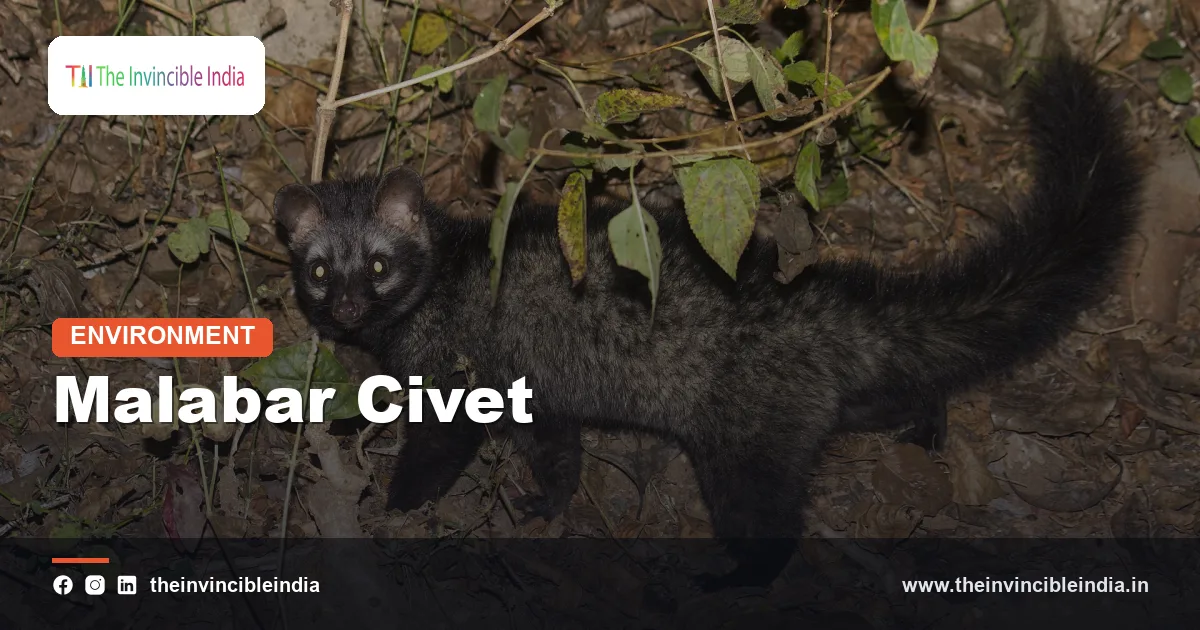
Malabar civet conservation is the effort to protect and locate the Malabar civet (Viverra civettina), a critically endangered carnivore found only in the coastal lowlands and foothills of the Western Ghats in Kerala and Karnataka, which may already be extinct in the wild. The animal has not been confirmed by modern, verifiable records for many years, and scientists still debate whether any population survives.
The Malabar civet is often called one of the rarest mammals in the world and one of the most mysterious carnivores in India. Its story combines historical hunting for perfume, the conversion of lowland forest to plantations, and a continuing search by field researchers using camera traps and interviews with local communities.
| Scientific name | Viverra civettina |
|---|---|
| Family | Viverridae (civets, genets and relatives) |
| Also called | Malabar large-spotted civet |
| Range | Western Ghats foothills and coastal lowlands of Kerala and Karnataka (endemic to India) |
| IUCN status | Critically Endangered, with a note that it may be extinct |
| Legal protection in India | Listed under the Wildlife (Protection) Act, 1972 as a species given the highest protection; check the current Schedule |
| First scientific description | By the zoologist Edward Blyth in the 19th century |
| Habitat | Low-elevation moist forest, scrub, swamp edges and, reportedly, cashew and other plantations |
| Main threats | Habitat conversion to plantations and settlements, historical trapping for civet musk, and small population size |
Key Takeaways
- The Malabar civet (Viverra civettina) is endemic to the Western Ghats and adjoining coastal plains of Kerala and Karnataka, and is found nowhere else in the world.
- The IUCN classifies the Malabar civet as Critically Endangered, and conservationists debate whether the species is already extinct in the wild.
- The animal was considered lost for decades in the 20th century before reports in the late 1980s suggested it had survived.
- Conversion of lowland forest to plantations, farmland and settlements has destroyed most of the civet’s coastal habitat in the Malabar region.
- Civets were once trapped and farmed in Malabar for civetone, a musky secretion used in perfumery, which added to the pressure on wild animals.
- No reliable estimate of the number of surviving Malabar civets exists, and conservation currently focuses on searching, surveying and protecting remaining lowland habitat.
What is the Malabar civet?
The Malabar civet is a large, nocturnal, long-bodied carnivore of the civet family (Viverridae) with a dark-spotted and banded coat, a black-and-white ringed tail and a crest of erect black hair running down its back. It is closely related to the large-spotted civet (Viverra megaspila) of Southeast Asia and has sometimes been treated as a distinct species and sometimes as a related form.
The animal is roughly the size of a large domestic cat or small dog, with a body length of well under a metre plus a long tail. It has a pointed muzzle, short legs and retractable claws, which suggests a ground-dwelling life.
Almost nothing is known of its diet, behaviour and breeding in the wild. Civets of the same genus are omnivorous, eating small vertebrates, insects, eggs, fruit and roots, and the Malabar civet is assumed to have a similar diet.
Why is it called the Malabar civet?
The animal is called the Malabar civet because its historical range lay along the Malabar coast, the strip of land between the Western Ghats and the Arabian Sea in present-day Kerala and southwestern Karnataka. The species name civettina refers to its resemblance to the civet.
Where does the Malabar civet live?
The Malabar civet lives, or lived, in the lowland and foothill forests of the Western Ghats up to roughly a thousand metres in altitude, mostly in the districts of coastal Kerala and the neighbouring coastal region of Karnataka. Historical records come from areas such as Kozhikode, Kannur, Malappuram, Wayanad foothills, Thrissur and Kasaragod in Kerala.
The Western Ghats are a UNESCO World Heritage Site (since 2012) and one of the recognised global biodiversity hotspots, but the lowlands at their base are among the most heavily altered parts of the range. The forest that once covered the coastal plain has been replaced in large part by farms, coconut groves, cashew plantations, rubber estates, towns and roads.
Field reports have sometimes placed the civet in partly wooded plantations, including cashew, rather than in intact forest. Researchers regard such reports with interest but caution, since a civet seen in a plantation may be another species, such as the common palm civet or the small Indian civet.
Is the Malabar civet extinct?
Whether the Malabar civet is extinct is not settled, because there has been no recent, fully verified confirmation of a living animal, yet researchers have not been able to prove that the species has disappeared. The IUCN lists the species as Critically Endangered, and uses the qualifier possibly extinct to indicate that survivors, if any, are very few.
The species was once thought to have vanished in the early 20th century, after which few specimens were reported. In the late 1980s a skin and a few reports from Kerala suggested a surviving population, and the animal was described as having been rediscovered. Later claims, including interviews with villagers and some sightings, have not yielded clear photographic or genetic proof.
The lack of evidence cuts both ways. A secretive nocturnal animal in dense lowland forest is hard to record, but it is also true that decades of targeted searches have failed to produce a confirmed modern record.
What counts as proof of survival?
Proof of survival would require a clear photograph from a camera trap, a captured or dead animal, or a DNA sample such as scat or hair confirmed by genetic testing. Anecdotal reports from local people are valuable leads but cannot confirm the species on their own.
How did the Malabar civet become so rare?
The Malabar civet became rare because its preferred lowland habitat was cleared for plantations and settlement and because the animal was trapped for centuries for the musk produced in its scent glands. Both pressures worked on a species that was never numerous and has a narrow range.
The civet’s coastal strip is one of the most densely populated parts of India. Land use here changed rapidly during the 19th and 20th centuries as forests gave way to coffee, tea, rubber, coconut and cashew, and later to roads and villages.
Because the species depends on a thin band of lowland, even modest habitat loss can remove a large share of its range. The animal may also be vulnerable to domestic dogs, snares set for other animals and road traffic.
What was the civet musk trade?
The civet musk trade was a long-standing practice in which civets were kept in captivity and their glandular secretion, called civetone or civet, was scraped for use as a perfume fixative. In Malabar, wild civets were reportedly captured and kept in cages for this purpose, and the practice is blamed for taking many animals from the wild. The trade declined as synthetic substitutes became available and as legal protection was introduced.
| Period | Event |
|---|---|
| 19th century | The species is scientifically described, with specimens from the Malabar region |
| Early 20th century | Records decline, and the animal is increasingly regarded as very rare or lost |
| 1972 | The Wildlife (Protection) Act is enacted, giving legal protection to many Indian carnivores |
| Late 1980s | Reports from Kerala suggest the species has survived |
| 1990s onward | Surveys continue with scattered local reports but little verified evidence |
| 2000s onward | Camera trapping and community interviews are used in targeted searches |
Why is the Malabar civet hard to find?
The Malabar civet is hard to find because it is nocturnal, shy, probably occurs at very low density and lives in a landscape of dense vegetation mixed with human settlement. Even common civets are rarely seen in daylight, and a rare species is much harder to document.
Searches face practical challenges. Camera traps must be placed in the right micro-habitat for long periods, the animal may avoid trails, and many records from plantations involve similar-looking species. Identification depends on distinguishing features such as the dorsal crest, the tail rings and the spot pattern.
Confusion with other species is a recurring problem. The small Indian civet, the common palm civet and the brown palm civet all occur in Kerala, and a poor photograph of any of these can be mistaken for the rarer animal.
How is the Malabar civet protected in India?
The Malabar civet is protected in India under the Wildlife (Protection) Act, 1972, which gives it the highest level of legal protection and prohibits hunting, trapping and trade. The Act was amended in 2022, and the schedules were reorganised, so readers should check the current schedule listing when citing legal details.
The species is also covered by international listings, and its range overlaps with protected areas of the Western Ghats in Kerala and Karnataka. However, much of the civet’s likely habitat lies outside protected areas, on private land, plantations and revenue land that has little formal protection.
State forest departments in Kerala and Karnataka, with research institutions and conservation organisations, have taken part in surveys. The Kerala Forest Department and research bodies such as the Kerala Forest Research Institute have been involved in biodiversity work in the region, and the species is often listed among priority species for recovery planning in India.
What conservation actions are proposed?
Proposed conservation actions for the Malabar civet focus first on confirming whether the species survives, and then on protecting the habitat where it occurs. Without a confirmed population, it is difficult to design a recovery plan or justify the cost of large interventions.
- Systematic surveys: Use camera traps in lowland forest fragments, sacred groves and plantation edges across coastal Kerala and Karnataka.
- Community engagement: Work with local residents, plantation workers and forest staff, who are the most likely to see the animal, and train them to report sightings with photographs.
- Genetic methods: Collect scat and hair for DNA analysis to identify species without having to see the animal.
- Habitat protection: Secure lowland forest patches, sacred groves and corridors, and encourage wildlife-friendly practices on plantations.
- Legal enforcement: Prevent hunting, snaring and capture, including the illegal wildlife trade.
- Contingency planning: Prepare protocols for rescue and, if animals are found, for possible captive breeding on the advice of specialists.
Should resources go to a species that may not exist?
Whether to spend scarce conservation funds on a species that may be extinct is a genuine debate. Supporters of continued effort argue that a species should not be declared extinct without a thorough search and that lowland forest protection benefits many other species. Critics note that money is limited and that chasing a possibly extinct animal could divert resources from threatened species with known populations. Many scientists take a middle path: fund targeted, time-limited searches while protecting habitat that has wider value.
What can the Malabar civet teach us about lowland forests?
The Malabar civet shows that lowland and coastal forests of the Western Ghats are as valuable and as threatened as the better-known high-elevation forests. Conservation attention in the Ghats has often focused on the hill forests and large protected areas, while the lowlands have been converted faster.
Lowland forest fragments, sacred groves and mixed plantations may serve as the last refuges for several species. Protecting them requires working with private landowners and farmers rather than relying only on notified reserves.
The civet is also an example of an umbrella species for the region. Efforts to find it could reveal other poorly known animals, and protecting its habitat would help amphibians, birds, reptiles and plants that share the same fragments.
What is the way forward?
The way forward for the Malabar civet is to run well-designed, long-duration surveys using several methods, to protect any remaining lowland habitat and to be honest about uncertainty. A survey that finds nothing is still useful, because it narrows the range of possibilities and directs resources elsewhere.
If a population is confirmed, rapid action would be needed: legal protection of the site, community-based monitoring, study of the animal’s ecology and possible support from conservation breeding. If no population is found after thorough search, the species may eventually be declared extinct, a painful but important recognition of what has been lost.
Bottom Line
The Malabar civet is a reminder of how little is known about even large mammals in India’s most densely settled biodiversity hotspot. Whether it survives is still unproven, but the search itself is driving better protection of lowland forests in Kerala and Karnataka.
Frequently Asked Questions
Is the Malabar civet extinct?
The Malabar civet has not been declared extinct, but it may be. The IUCN lists it as Critically Endangered with the possibility that it no longer exists in the wild. No recent, fully verified record exists, and surveys continue to look for it.
Where was the Malabar civet found?
The Malabar civet was found in the coastal lowlands and foothills of the Western Ghats in Kerala and southwestern Karnataka. It is endemic to India. Historical records mention districts of the Malabar region, though much of the original forest there has been converted to plantations and settlements.
Why was the Malabar civet hunted?
The Malabar civet was trapped because civets produce a musky secretion, civetone, which was used in perfumery. Animals were captured and kept in cages so the secretion could be collected. The trade added to pressure on a species that was already rare and had a small range.
How is the Malabar civet different from other civets?
The Malabar civet is larger than the common palm civet and the small Indian civet, with a spotted and banded coat, a ringed tail and a dark crest along the back. It is endemic to the Western Ghats region, whereas the other species are more widespread. Because the species look similar, camera-trap photographs are often misidentified.
Is the Malabar civet legally protected?
The Malabar civet is legally protected in India under the Wildlife (Protection) Act, 1972, which prohibits hunting, capture and trade. The Act was amended in 2022 and the schedules were revised, so the current schedule should be checked for exact details. Much of its possible habitat is outside protected areas, which limits practical protection.
How can the Malabar civet be saved?
Saving the Malabar civet depends first on confirming whether any population survives, using camera traps, genetic sampling and community reports. If a population is found, protecting its lowland habitat and preventing hunting would be the priorities. Even if none is found, protecting lowland forest patches benefits many other species.
{“@context”:”https://schema.org”,”@graph”:[{“@type”:”FAQPage”,”mainEntity”:[{“@type”:”Question”,”name”:”Is the Malabar civet extinct?”,”acceptedAnswer”:{“@type”:”Answer”,”text”:”The Malabar civet has not been declared extinct, but it may be. The IUCN lists it as Critically Endangered with the possibility that it no longer exists in the wild. No recent, fully verified record exists, and surveys continue to look for it.”}},{“@type”:”Question”,”name”:”Where was the Malabar civet found?”,”acceptedAnswer”:{“@type”:”Answer”,”text”:”The Malabar civet was found in the coastal lowlands and foothills of the Western Ghats in Kerala and southwestern Karnataka. It is endemic to India. Historical records mention districts of the Malabar region, though much of the original forest there has been converted to plantations and settlements.”}},{“@type”:”Question”,”name”:”Why was the Malabar civet hunted?”,”acceptedAnswer”:{“@type”:”Answer”,”text”:”The Malabar civet was trapped because civets produce a musky secretion, civetone, which was used in perfumery. Animals were captured and kept in cages so the secretion could be collected. The trade added to pressure on a species that was already rare and had a small range.”}},{“@type”:”Question”,”name”:”How is the Malabar civet different from other civets?”,”acceptedAnswer”:{“@type”:”Answer”,”text”:”The Malabar civet is larger than the common palm civet and the small Indian civet, with a spotted and banded coat, a ringed tail and a dark crest along the back. It is endemic to the Western Ghats region, whereas the other species are more widespread. Because the species look similar, camera-trap photographs are often misidentified.”}},{“@type”:”Question”,”name”:”Is the Malabar civet legally protected?”,”acceptedAnswer”:{“@type”:”Answer”,”text”:”The Malabar civet is legally protected in India under the Wildlife (Protection) Act, 1972, which prohibits hunting, capture and trade. The Act was amended in 2022 and the schedules were revised, so the current schedule should be checked for exact details. Much of its possible habitat is outside protected areas, which limits practical protection.”}},{“@type”:”Question”,”name”:”How can the Malabar civet be saved?”,”acceptedAnswer”:{“@type”:”Answer”,”text”:”Saving the Malabar civet depends first on confirming whether any population survives, using camera traps, genetic sampling and community reports. If a population is found, protecting its lowland habitat and preventing hunting would be the priorities. Even if none is found, protecting lowland forest patches benefits many other species.”}}]}]}


