

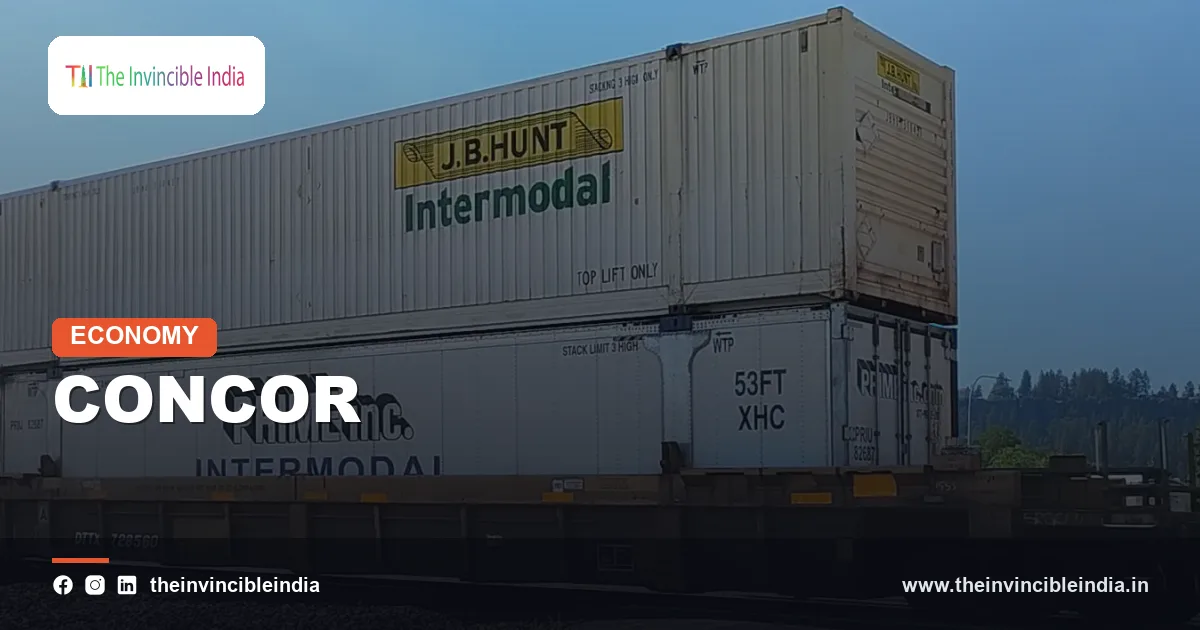
The Container Corporation of India (CONCOR) is a Navratna public sector enterprise under the Ministry of Railways that moves containerised cargo by rail and runs a large network of inland container depots (ICDs), also called dry ports, across the country. CONCOR was incorporated in 1988 to modernise Indian freight by shifting international and domestic cargo into standard steel containers that can travel seamlessly between ships, trains and trucks.
Today CONCOR is the best-known rail-based container logistics operator in India, handling a large share of the country’s export-import (EXIM) containers by rail. This explainer covers how the company works, what its terminals do, how the Dedicated Freight Corridors affect its business, and why the proposed strategic disinvestment has remained a recurring topic of debate. Numbers are given as rounded, hedged indications because terminal counts and volumes change often.
Quick Facts: CONCOR at a Glance
| Attribute | Detail |
|---|---|
| Full name | Container Corporation of India Limited (CONCOR or CCIL) |
| Incorporated | 1988, as a public sector company under the Ministry of Railways; operations began in the late 1980s |
| Administrative ministry | Ministry of Railways, Government of India |
| Status | Navratna central public sector enterprise; listed on Indian stock exchanges |
| Headquarters | New Delhi |
| Core business | Rail-based container transport, inland container depots, port-connected terminals and warehousing |
| Network | Dozens of terminals across India, typically described as more than 60 (approximate) |
| Key segments | EXIM (export-import) containers and domestic containers, plus cold-chain and warehousing services |
| Major policy issue | Proposed strategic disinvestment with transfer of management control, announced in 2019 and not completed as of the last widely reported update |
Key Takeaways
- The Container Corporation of India (CONCOR) was incorporated in 1988 and is a Navratna public sector enterprise under the Ministry of Railways.
- CONCOR operates a nationwide network of rail terminals and inland container depots (ICDs) that connect ports such as Jawaharlal Nehru Port and Mundra with the Indian hinterland.
- CONCOR’s business is divided into EXIM containers, which serve international trade, and domestic containers, which serve long-distance internal cargo.
- The Dedicated Freight Corridors (DFCs), especially the Western DFC, can allow longer, faster and double-stacked container trains, which is a major growth opportunity for CONCOR.
- CONCOR lost its legal monopoly on container rail transport in 2006, when the Ministry of Railways allowed other private operators to run container trains.
- The Government of India announced a strategic disinvestment of CONCOR in 2019, but the transaction has been delayed by questions about land licence fees and valuation.
What is the Container Corporation of India (CONCOR)?
The Container Corporation of India (CONCOR) is a public sector logistics company that moves standard shipping containers by rail and operates the terminals where those containers are loaded, unloaded, stored and customs-cleared. It was carved out of Indian Railways as a separate corporation to bring commercial management to a business that required speed, customer service and specialised handling.
The company does not make trains or tracks. Instead, it hires wagons and haulage capacity from Indian Railways, collects containers from exporters, importers and shipping lines, and runs full container trains between port terminals and inland depots. It then arranges delivery by road for the first and last stage of the journey, which is why CONCOR is often described as an end-to-end multimodal logistics provider.
CONCOR’s customers include exporters, importers, freight forwarders, shipping lines, manufacturers and retailers who need predictable movement of goods.
When and why was CONCOR created?
CONCOR was created in 1988 to bring containerisation into the Indian freight system and to relieve the pressure on road transport by moving more cargo onto rail. In the 1980s, Indian ports were handling growing volumes of general cargo that was slow to handle, prone to damage and expensive to transport.
Containerisation had already transformed global trade, but India lacked the rail infrastructure and inland terminals to carry boxes efficiently inland. The Ministry of Railways therefore set up a dedicated company which could build terminals, procure container handling equipment and run block container trains. CONCOR began operating around the end of the 1980s, starting with a small number of terminals near major ports and metropolitan areas.
The company was listed in the early 1990s phase of economic reforms and later received Navratna status, which gave it greater independence in making investment and joint-venture decisions.
What are inland container depots (ICDs) and dry ports?
An inland container depot (ICD), also called a dry port, is a customs-notified facility away from the coast where containers can be stuffed, cleared, stored and moved onward by rail or road. An ICD effectively acts as an extension of a seaport, allowing customs formalities to be completed inland instead of at a congested port.
Exporters in Punjab, Haryana, Uttar Pradesh or Rajasthan, for example, can load goods into a container at a nearby ICD, have it sealed by customs, and send it by rail to Mundra or the Jawaharlal Nehru Port (JNPT) in Maharashtra. Importers do the reverse: containers arrive at the port and travel by rail to an ICD close to the factory or market.
CONCOR is the largest operator of such facilities in India. Well-known examples include terminals at Tughlakabad and Dadri near Delhi, Ludhiana, Kanpur, Nagpur, Bengaluru, Hyderabad and several others. Services at an ICD typically include customs clearance, bonded warehousing, empty container storage and reefer (refrigerated) plugs.
How does CONCOR move containers by rail?
CONCOR moves containers by assembling them into block trains that run on Indian Railways tracks between port terminals and inland depots, with wagons and locomotives provided under a haulage arrangement. The company pays a haulage charge to Indian Railways and earns revenue from customers through a combined price covering rail, terminal handling and storage.
The basic logistics chain
- A container is stuffed at a factory or at an ICD and sealed under customs supervision.
- It is loaded on a container flat wagon and joins a train headed to a seaport terminal.
- At the port, the container is transferred to a ship; for imports, the process runs in reverse.
- Road trucks handle the short local legs, often called first-mile and last-mile delivery.
Why rail matters
Rail is generally cheaper per tonne-kilometre than road over long distances and produces fewer emissions per unit of cargo. For a country with heavy road congestion and a growing logistics bill, shifting boxes to rail has economic and environmental benefits, and this shift is a stated policy goal.
What is the difference between EXIM and domestic container traffic?
EXIM traffic consists of containers carrying export and import cargo to and from seaports, while domestic traffic consists of containers moving between two points inside India. Both segments are important to CONCOR, but they behave differently.
EXIM traffic is closely tied to international trade and port performance. It tends to be higher volume, benefits from customs-bonded inland terminals and is influenced by shipping-line schedules, global demand and exchange rates. Domestic traffic covers goods such as cement, steel products, fertilisers, FMCG items, auto components and consumer durables, and it is more sensitive to Indian Railways tariffs and to competition from road transport.
CONCOR also offers specialised services including refrigerated containers for perishables, cold-chain warehousing and general warehousing. Subsidiary and joint-venture entities have been used for some of these businesses, though structures change over time.
How do the Dedicated Freight Corridors affect CONCOR?
The Dedicated Freight Corridors (DFCs) affect CONCOR by creating freight-only tracks that allow faster, longer and heavier trains, including double-stacked container trains that carry twice as many boxes per train. The two major corridors are the Western DFC, running from Dadri in Uttar Pradesh to the Jawaharlal Nehru Port in Maharashtra, and the Eastern DFC, running from Ludhiana in Punjab toward Dankuni in West Bengal.
For CONCOR, the Western DFC is especially important because it connects the northern industrial belt with the western ports of JNPT and Mundra, which handle a large share of India’s container trade. Faster transit times, higher axle loads and better reliability can make rail more competitive against trucks.
However, the DFCs are open to other container train operators, so the benefits are shared among competitors. CONCOR’s advantage comes from its existing terminal network, customer relationships and experience, but it must continue to invest in terminals, rolling stock and digital services to retain its position.
Who competes with CONCOR?
CONCOR competes with private container train operators, port-based logistics companies and road transporters. Until 2006, CONCOR was the only company authorised to operate container trains on Indian Railways. In that year the Ministry of Railways opened the segment, and a group of private rail container operators were licensed.
The new operators, which include logistics arms of port groups and large transport companies, have built their own terminals and run trains from major ports. They have gained market share in selected corridors, particularly around the western ports.
| Competitive factor | CONCOR position |
|---|---|
| Terminal network | Largest national network of ICDs and port-connected terminals |
| Rail access | Long-standing relationship with Indian Railways, though other operators now use the same tracks |
| Land | Many terminals are on railway land under a licence arrangement, which makes the licence fee policy significant |
| Competition | Private container train operators, direct port-to-factory trucking and coastal shipping |
| Service range | EXIM, domestic, cold chain and warehousing under one brand |
Why is CONCOR’s disinvestment debated?
CONCOR’s disinvestment is debated because the Government of India announced in 2019 that it would sell a significant stake with a transfer of management control, a plan that has been repeatedly affected by questions about land and valuation. The Cabinet Committee on Economic Affairs approved the strategic sale of the government’s holding, with the aim of retaining a smaller residual stake.
Supporters argue that private management could raise efficiency, speed up investment and let the company compete more flexibly. Critics note that CONCOR’s terminals sit largely on railway land, that the company is profitable and pays dividends, and that the strategic position of rail logistics is a public asset.
A central sticking point has been the land licence fee (LLF) policy for railway land, since the fee affects the value of the business. Changes to the policy and the pace of decisions have meant the process has not been completed as of the last widely reported update, so readers should check current government announcements.
What challenges and opportunities does CONCOR face?
CONCOR faces the challenge of defending its market share against private operators while seizing the opportunity created by new freight infrastructure and policy support for logistics. The National Logistics Policy and the PM Gati Shakti initiative aim to cut logistics costs and improve multimodal connectivity, which could increase rail container volumes.
- Opportunities: DFC connectivity, double-stack trains, growth in EXIM trade, more cold-chain demand and digital tracking.
- Challenges: competition, dependence on railway infrastructure and tariffs, land licence issues and cyclical trade volumes.
- Transition factors: moves toward cleaner transport and greener logistics reward rail-based solutions.
Execution on terminal efficiency, such as faster turnaround and better customs coordination, will be as important as capacity expansion.
Bottom Line
The Container Corporation of India (CONCOR) remains the backbone of rail container logistics in India, built on a network of ICDs and port-connected terminals. Its future depends on how well it uses the Dedicated Freight Corridors, how it competes with private operators, and how the long-pending disinvestment is resolved. For exporters, importers and anyone studying Indian logistics, CONCOR is a core institution.
Frequently Asked Questions
What does CONCOR do?
CONCOR moves shipping containers by rail and operates inland container depots and port terminals where containers are handled and cleared. It serves exporters, importers and domestic shippers with end-to-end logistics.
Is CONCOR a government company?
Yes, the Container Corporation of India is a Navratna public sector enterprise under the Ministry of Railways, with the Government of India holding a majority stake. It is also listed on stock exchanges, so a share of its capital is held by public investors.
What is an inland container depot (ICD)?
An ICD is an inland facility, often called a dry port, where containers can be loaded, cleared by customs and stored away from the coast. CONCOR operates many ICDs that connect Indian industrial regions with seaports.
How are the Dedicated Freight Corridors important to CONCOR?
The Dedicated Freight Corridors provide freight-only tracks that support faster, longer and double-stacked container trains, which can lower costs and transit times for CONCOR. The Western DFC between Dadri and JNPT is particularly valuable because it links northern India with major western ports.
Does CONCOR have competitors?
Yes, since 2006 the Ministry of Railways has allowed private companies to operate container trains alongside CONCOR. These operators compete on several corridors, especially around the western ports, as well as with road transport.
Is CONCOR being privatised?
The government announced a strategic disinvestment of CONCOR in 2019 involving a sale of a significant stake with transfer of management control. The process has been delayed by issues such as railway land licence fees, so its status should be checked in current government announcements.
{“@context”:”https://schema.org”,”@graph”:[{“@type”:”FAQPage”,”mainEntity”:[{“@type”:”Question”,”name”:”What does CONCOR do?”,”acceptedAnswer”:{“@type”:”Answer”,”text”:”CONCOR moves shipping containers by rail and operates inland container depots and port terminals where containers are handled and cleared. It serves exporters, importers and domestic shippers with end-to-end logistics.”}},{“@type”:”Question”,”name”:”Is CONCOR a government company?”,”acceptedAnswer”:{“@type”:”Answer”,”text”:”Yes, the Container Corporation of India is a Navratna public sector enterprise under the Ministry of Railways, with the Government of India holding a majority stake. It is also listed on stock exchanges, so a share of its capital is held by public investors.”}},{“@type”:”Question”,”name”:”What is an inland container depot (ICD)?”,”acceptedAnswer”:{“@type”:”Answer”,”text”:”An ICD is an inland facility, often called a dry port, where containers can be loaded, cleared by customs and stored away from the coast. CONCOR operates many ICDs that connect Indian industrial regions with seaports.”}},{“@type”:”Question”,”name”:”How are the Dedicated Freight Corridors important to CONCOR?”,”acceptedAnswer”:{“@type”:”Answer”,”text”:”The Dedicated Freight Corridors provide freight-only tracks that support faster, longer and double-stacked container trains, which can lower costs and transit times for CONCOR. The Western DFC between Dadri and JNPT is particularly valuable because it links northern India with major western ports.”}},{“@type”:”Question”,”name”:”Does CONCOR have competitors?”,”acceptedAnswer”:{“@type”:”Answer”,”text”:”Yes, since 2006 the Ministry of Railways has allowed private companies to operate container trains alongside CONCOR. These operators compete on several corridors, especially around the western ports, as well as with road transport.”}},{“@type”:”Question”,”name”:”Is CONCOR being privatised?”,”acceptedAnswer”:{“@type”:”Answer”,”text”:”The government announced a strategic disinvestment of CONCOR in 2019 involving a sale of a significant stake with transfer of management control. The process has been delayed by issues such as railway land licence fees, so its status should be checked in current government announcements.”}}]}]}


