

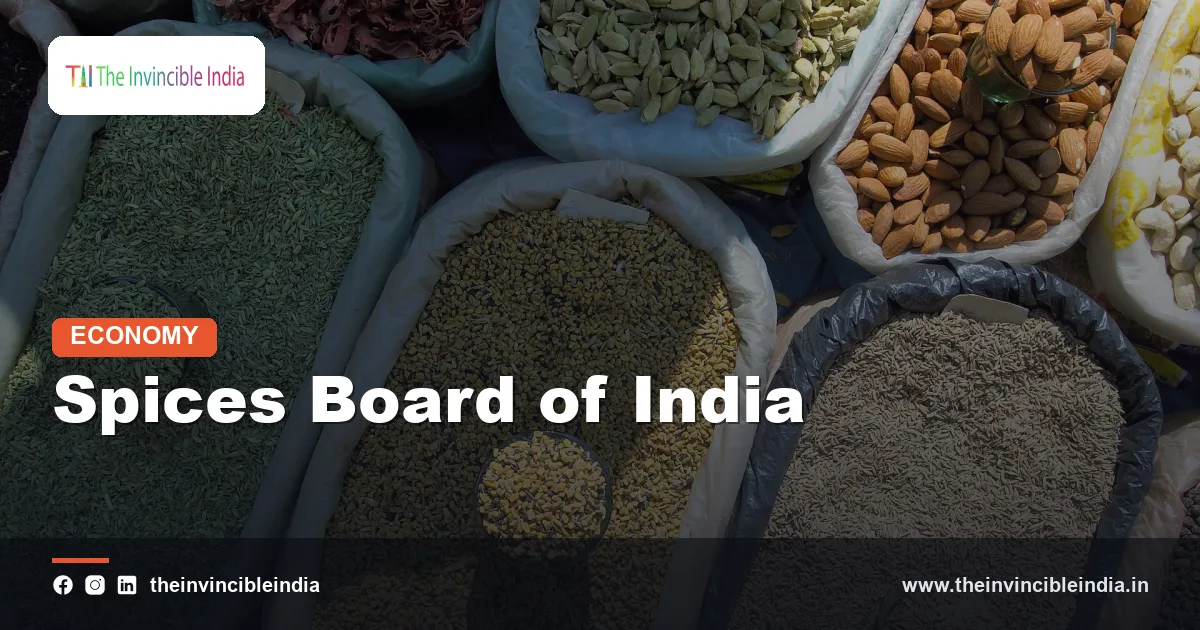
The Spices Board of India is the statutory body, set up in 1987 under the Ministry of Commerce and Industry, that develops, regulates and promotes the production and export of Indian spices. Headquartered in Kochi, Kerala, the Spices Board of India works as both a facilitator for growers and processors and a registering and quality-monitoring authority for exporters of the spices listed under its parent Act.
India is widely described as the largest producer, consumer and exporter of spices in the world, and the Spices Board of India sits at the centre of that trade. This explainer sets out what the Board is, how it was formed, what it does for farmers and exporters, how the Spices Park model works, and how its work connects to geographical indications and quality standards. Last reviewed: 19 October 2026.
| Attribute | Details |
|---|---|
| Full name | Spices Board of India (commonly shortened to Spices Board) |
| Established | 1987, formed by merging the Cardamom Board and the Spices Export Promotion Council |
| Governing law | Spices Board Act, 1986 |
| Parent ministry | Ministry of Commerce and Industry, Government of India |
| Type | Statutory export-promotion and regulatory body |
| Headquarters | Kochi, Kerala |
| Spices covered | Over 50 scheduled spices (the number has been revised by notification over time) |
| Key functions | Exporter registration, quality control, research, plantation development, Spices Parks, promotion |
| Brand identity | Promotes Indian spices under quality-assurance and origin-branding initiatives |
Key Takeaways
- The Spices Board of India was constituted in 1987 under the Spices Board Act, 1986, and functions under the Ministry of Commerce and Industry.
- The Spices Board of India is headquartered in Kochi, Kerala, and was created by merging the Cardamom Board with the Spices Export Promotion Council.
- Exporters of scheduled spices must register with the Spices Board of India and obtain a Registration-cum-Membership Certificate (RCMC) to export those products.
- The Spices Board of India supports growers of black pepper, cardamom, chilli, turmeric, ginger and other spices through research, planting-material and post-harvest assistance.
- The Spices Park model, run by the Spices Board of India in several states, offers shared processing, grading and packing infrastructure close to growing areas.
- The Spices Board of India works alongside geographical indication (GI) protection for spices such as Alleppey Green Cardamom, Malabar Pepper and Lakadong turmeric to strengthen origin branding.
What is the Spices Board of India?
The Spices Board of India is a statutory body of the Government of India that has the dual mandate of developing spice production and promoting the export of Indian spices. It was established in 1987 under the Spices Board Act, 1986, and reports to the Ministry of Commerce and Industry, which also oversees other commodity boards for tea, coffee and rubber.
The Spices Board of India is sometimes described as a “flagship organisation” for spice exports because it combines several roles in one institution. It promotes Indian spices abroad, registers and regulates exporters, supports farmers with research and development, and monitors quality so that Indian consignments meet the standards of importing countries. The Act defines a list of scheduled spices, which includes well-known items such as black pepper, small and large cardamom, chilli, ginger, turmeric, cumin, coriander, fennel, fenugreek, cinnamon, clove, nutmeg, saffron, vanilla and tamarind, among many others.
The Board has a chairperson and a secretary, and its governing body includes representatives of growers, the trade, Parliament, state governments and relevant ministries. Its operations are spread across Kerala, Tamil Nadu, Karnataka, Andhra Pradesh, Telangana, Gujarat, Rajasthan, Madhya Pradesh and the North East, with a research and extension presence in the cardamom-growing hills of Idukki.
When and why was the Spices Board of India created?
The Spices Board of India was created in 1987 to bring spice development and spice export promotion under a single statutory authority. Before that, two separate bodies handled different parts of the sector: the Cardamom Board, established in 1965 for cardamom, and the Spices Export Promotion Council, set up in 1960 to promote exports of other spices.
Having separate organisations meant that cardamom, which is both a high-value crop and a distinctive growing system, was managed apart from other spices. The Spices Board Act, 1986, merged these two institutions and widened the scope to cover all the major spices that India grows and trades. The government’s reasoning was that production, processing, quality control and marketing form one chain, and that a single body could plan across that chain.
The decades since have seen the Board’s role grow from mainly promotion to a broader mix of standards, research and infrastructure. Changes in global food-safety rules, shifts in consumer demand towards organic and traceable products, and competition from other producing countries such as Vietnam, Indonesia and Guatemala have all shaped how the Board works today.
What does the Spices Board of India do?
The Spices Board of India carries out five broad kinds of work: export promotion and exporter registration, quality control and certification, research and development, plantation and farm-level support, and the creation of shared infrastructure such as Spices Parks. These activities are interlinked, and the Board often combines them in schemes aimed at specific crops or regions.
Export promotion and marketing
The Board takes Indian spices to international trade fairs, organises buyer-seller meets, publishes information on markets and prices, and supports exporters who want to enter new countries. It also runs brand-building activity to present Indian spices as safe, flavourful and traceable.
Quality and regulation
The Board sets and monitors quality standards for the spices it covers, operates laboratories for testing, and supports exporters in meeting residue, contamination and labelling requirements in importing countries. It works with other agencies, including the Food Safety and Standards Authority of India (FSSAI), the Export Inspection Council (EIC) and the Agricultural and Processed Food Products Export Development Authority (APEDA), which each have distinct roles in food regulation and trade.
Research and development
The Board maintains the Indian Cardamom Research Institute at Myladumpara in Idukki district, Kerala, which focuses on cardamom varieties, pests and agronomy. Broader spice research in India is also carried out by institutions under the Indian Council of Agricultural Research (ICAR), such as the Indian Institute of Spices Research in Kozhikode, and the Board coordinates with them.
Support for growers
Schemes under the Board have historically offered assistance for replanting, rejuvenation of old plantations, irrigation, solar or mechanical dryers, storage, and training in good agricultural practices. The exact subsidy structure and eligibility change with each scheme cycle, so growers should consult the Board’s current notifications.
Who must register with the Spices Board of India?
Anyone who wants to export scheduled spices from India must register with the Spices Board of India and obtain a Registration-cum-Membership Certificate (RCMC), which acts as proof of membership of the Board and is required for export clearance of those products. This requirement is one of the Board’s key regulatory functions and gives it a record of who is exporting what.
The registration process involves applying with business documents such as the Importer-Exporter Code (IEC) issued by the Directorate General of Foreign Trade (DGFT), identity and address proof, details of premises and, for processors, information on facilities. The Board may inspect premises and can suspend or cancel registration where there are serious quality or compliance failures. Registered exporters can then access promotional schemes, participate in Board-supported fairs and receive trade intelligence.
Registration should not be confused with licences from other regulators. Food business operators also need an FSSAI licence for domestic food safety compliance, and exporters may need additional approvals depending on the product and destination. The Spices Board RCMC is one part of this larger compliance picture.
What is the Spices Park model?
A Spices Park is a common-facility cluster developed by the Spices Board of India near a major spice-growing area, giving growers, traders and processors shared access to cleaning, grading, sterilisation, grinding, packing, storage and testing. The idea is to shorten the path from farm to export-ready product and to reduce the contamination and wastage that arise when spices are dried and handled in unsuitable conditions.
Each park is typically developed around crops that are strong in its region. Spices Parks have been developed or proposed in locations across several states, for example around cardamom and pepper in the high ranges of Kerala, chilli in Andhra Pradesh and Tamil Nadu, and seed spices such as cumin and coriander in Rajasthan, Gujarat and Madhya Pradesh. The specific list and operational status of parks change over time, so readers should check the Board’s current information before relying on any one location.
Spice Parks are designed to let small and medium enterprises and farmer groups use equipment they could not afford alone. They also help aggregate volumes, which strengthens bargaining power with buyers and makes traceability easier. The model has links to the broader government push for value addition and agri-export clusters.
Which spices does the Spices Board of India support most closely?
The Spices Board of India supports all scheduled spices, but black pepper, cardamom, chilli, turmeric, ginger and seed spices such as cumin and coriander receive the most visible attention because of their volume or value in trade. Each has its own regional base and its own set of challenges, which is why the Board designs crop-specific programmes.
| Spice | Main growing regions | Typical Board focus |
|---|---|---|
| Black pepper | Kerala, Karnataka, Tamil Nadu | Replanting, disease management, quality and traceability |
| Small cardamom | Kerala (Idukki), Karnataka, Tamil Nadu | Research, auctions, drying and quality |
| Large cardamom | Sikkim, Darjeeling hills | Plantation rejuvenation, curing and marketing support |
| Chilli | Andhra Pradesh, Telangana, Karnataka, Madhya Pradesh | Aflatoxin and pesticide-residue control, drying, grading |
| Turmeric | Telangana, Maharashtra, Tamil Nadu, Odisha, Meghalaya | Curcumin quality, processing, certified planting material |
| Cumin and coriander | Gujarat, Rajasthan, Madhya Pradesh | Cleaning, grading, shared processing and storage |
| Saffron | Jammu and Kashmir | Quality testing, authentication and market support |
For pepper and cardamom, the Board has a long institutional history because of the older Cardamom Board and because of the importance of these crops to Kerala’s hill economy. Cardamom is sold through auctions in which the Board plays a regulatory and facilitating role, a system that helps growers discover prices in a transparent way.
How does the Spices Board of India relate to GI spices?
The Spices Board of India supports geographical indication (GI) protection for Indian spices by assisting with documentation, awareness and promotion, while the legal registration of a GI is handled under the Geographical Indications of Goods (Registration and Protection) Act, 1999, through the GI Registry. A GI tag identifies a product whose quality or reputation is linked to a particular place.
Examples of Indian spices that carry GI status include Alleppey Green Cardamom from Kerala, Malabar Pepper, Guntur Sannam chilli from Andhra Pradesh, Byadgi chilli from Karnataka, Naga Mircha (Naga chilli), Lakadong turmeric from Meghalaya and Kashmir saffron. These tags allow growers of the region to market their produce as distinct from generic products and protect the name from misuse.
The Board’s role is promotional and developmental: it can highlight these origins in marketing campaigns, link them with quality seals, and help farmer groups register as authorised users. This supports higher prices and brand recognition in international markets where buyers pay attention to origin and authenticity.
How does the Spices Board of India ensure spice quality and safety?
The Spices Board of India ensures quality mainly through laboratory testing, standards for exporters, training for growers on good agricultural and manufacturing practices, and certification schemes, and it works with FSSAI, EIC and importing-country authorities when residue or contamination issues arise. Quality is central because importing markets such as the European Union, the United States and the Gulf set strict limits on pesticide residues, aflatoxins, heavy metals and microbial contamination.
The Board operates quality evaluation laboratories, including at Kochi, and encourages exporters to use accredited laboratories for testing. It runs awareness drives on safe drying, removal of foreign matter and the proper use of agrochemicals. It also supports voluntary systems such as organic certification and traceability tools that let a buyer follow a consignment back to its farm or group.
When a destination country flags concerns about a particular chemical or contaminant, the Board and other government agencies typically issue advisories, seek corrective action from exporters and sometimes tighten testing for affected products. These episodes illustrate that spice quality management is a shared responsibility across several regulators, not a single agency’s task.
Why does the Spices Board of India matter to the economy?
The Spices Board of India matters because spices are a significant agricultural export, a major source of income for millions of small farmers, and a product category in which India has a strong global brand. Spice exports have grown over the decades in both volume and value, and the sector supports livelihoods in many ecologically fragile and rural regions.
Spices are grown largely by smallholders on modest plots. Their incomes depend on price swings, weather, pests and compliance with export norms. By offering research, infrastructure and market linkages, the Spices Board of India reduces some of these risks and helps farmers capture more of the value that is otherwise lost in unprocessed trade.
The Board also supports India’s wider trade objectives, since spices are a visible, culturally rooted export that opens doors to broader food and agri-product trade. At the same time, the sector faces challenges, including climate-related yield variability, labour shortages in plantations, adulteration concerns in the domestic market and the need to keep pace with evolving residue limits abroad.
What are the milestones in the history of the Spices Board of India?
The history of the Spices Board of India runs from the post-independence period, when separate cardamom and spice promotion bodies were created, to the 1987 merger and the later expansion into Spices Parks and quality programmes. The table below summarises the milestones in broad terms.
| Period | Development |
|---|---|
| 1960 | Spices Export Promotion Council set up to promote spice exports |
| 1965 | Cardamom Board established to develop and promote cardamom |
| 1986 | Spices Board Act passed by Parliament |
| 1987 | Spices Board of India constituted, merging the two earlier bodies |
| 1990s | Growth of quality labs, exporter registration and organic and residue-focused initiatives |
| 2000s | Launch of the Spices Park concept and wider use of GI-linked promotion |
| 2010s onwards | Emphasis on traceability, digital services, value addition and food-safety compliance |
This sequence shows how the Board moved from a narrow export-promotion role to one that touches farm-level productivity, standards and shared infrastructure. Each phase responded to a specific need, whether competition from other producers, new buyer expectations or changes in regulation.
Bottom Line
The Spices Board of India is the central statutory agency for India’s spice sector, combining exporter registration, quality oversight, research and farm-level support under the Ministry of Commerce and Industry. For anyone exporting spices, growing them, or simply trying to understand why Indian spices carry a global reputation, the Board is the institution to know.
Frequently Asked Questions
What is the Spices Board of India?
The Spices Board of India is a statutory body under the Ministry of Commerce and Industry that develops and promotes Indian spices and their exports. It was constituted in 1987 under the Spices Board Act, 1986, and is headquartered in Kochi, Kerala. It registers exporters, supports quality and research, and runs infrastructure such as Spices Parks.
When was the Spices Board of India established?
The Spices Board of India was established in 1987. It was formed by merging the Cardamom Board, which dated from 1965, with the Spices Export Promotion Council, which was set up in 1960. The enabling law is the Spices Board Act, 1986.
Do I need to register with the Spices Board of India to export spices?
Yes, exporters of scheduled spices need to register with the Spices Board of India and hold a Registration-cum-Membership Certificate (RCMC). Applicants usually also need an Importer-Exporter Code (IEC) from the DGFT and must meet food-safety and premises requirements. Requirements and fees are updated from time to time, so applicants should check the Board’s current guidelines.
What is a Spices Park?
A Spices Park is a shared-infrastructure cluster developed by the Spices Board of India near a spice-growing region. It offers common facilities for cleaning, grading, processing, packing, storage and testing so that small farmers and enterprises can produce export-quality spices. Parks are usually organised around the crops that dominate the local area.
Which spices come under the Spices Board of India?
The Spices Board of India covers the spices scheduled under the Spices Board Act, which number over 50 and include black pepper, cardamom, chilli, turmeric, ginger, cumin, coriander, fennel, clove, cinnamon, nutmeg and saffron. The list can be revised by government notification. The Board gives particular attention to pepper, cardamom, chilli, turmeric and seed spices.
How does the Spices Board of India help farmers?
The Spices Board of India helps farmers through research, training, support for replanting and post-harvest equipment, and access to shared processing and market information. It also promotes Indian spice origins and GI products, which can improve the prices farmers receive. Specific schemes and subsidies vary by year and crop.
{“@context”:”https://schema.org”,”@graph”:[{“@type”:”FAQPage”,”mainEntity”:[{“@type”:”Question”,”name”:”What is the Spices Board of India?”,”acceptedAnswer”:{“@type”:”Answer”,”text”:”The Spices Board of India is a statutory body under the Ministry of Commerce and Industry that develops and promotes Indian spices and their exports. It was constituted in 1987 under the Spices Board Act, 1986, and is headquartered in Kochi, Kerala. It registers exporters, supports quality and research, and runs infrastructure such as Spices Parks.”}},{“@type”:”Question”,”name”:”When was the Spices Board of India established?”,”acceptedAnswer”:{“@type”:”Answer”,”text”:”The Spices Board of India was established in 1987. It was formed by merging the Cardamom Board, which dated from 1965, with the Spices Export Promotion Council, which was set up in 1960. The enabling law is the Spices Board Act, 1986.”}},{“@type”:”Question”,”name”:”Do I need to register with the Spices Board of India to export spices?”,”acceptedAnswer”:{“@type”:”Answer”,”text”:”Yes, exporters of scheduled spices need to register with the Spices Board of India and hold a Registration-cum-Membership Certificate (RCMC). Applicants usually also need an Importer-Exporter Code (IEC) from the DGFT and must meet food-safety and premises requirements. Requirements and fees are updated from time to time, so applicants should check the Board’s current guidelines.”}},{“@type”:”Question”,”name”:”What is a Spices Park?”,”acceptedAnswer”:{“@type”:”Answer”,”text”:”A Spices Park is a shared-infrastructure cluster developed by the Spices Board of India near a spice-growing region. It offers common facilities for cleaning, grading, processing, packing, storage and testing so that small farmers and enterprises can produce export-quality spices. Parks are usually organised around the crops that dominate the local area.”}},{“@type”:”Question”,”name”:”Which spices come under the Spices Board of India?”,”acceptedAnswer”:{“@type”:”Answer”,”text”:”The Spices Board of India covers the spices scheduled under the Spices Board Act, which number over 50 and include black pepper, cardamom, chilli, turmeric, ginger, cumin, coriander, fennel, clove, cinnamon, nutmeg and saffron. The list can be revised by government notification. The Board gives particular attention to pepper, cardamom, chilli, turmeric and seed spices.”}},{“@type”:”Question”,”name”:”How does the Spices Board of India help farmers?”,”acceptedAnswer”:{“@type”:”Answer”,”text”:”The Spices Board of India helps farmers through research, training, support for replanting and post-harvest equipment, and access to shared processing and market information. It also promotes Indian spice origins and GI products, which can improve the prices farmers receive. Specific schemes and subsidies vary by year and crop.”}}]}]}


