

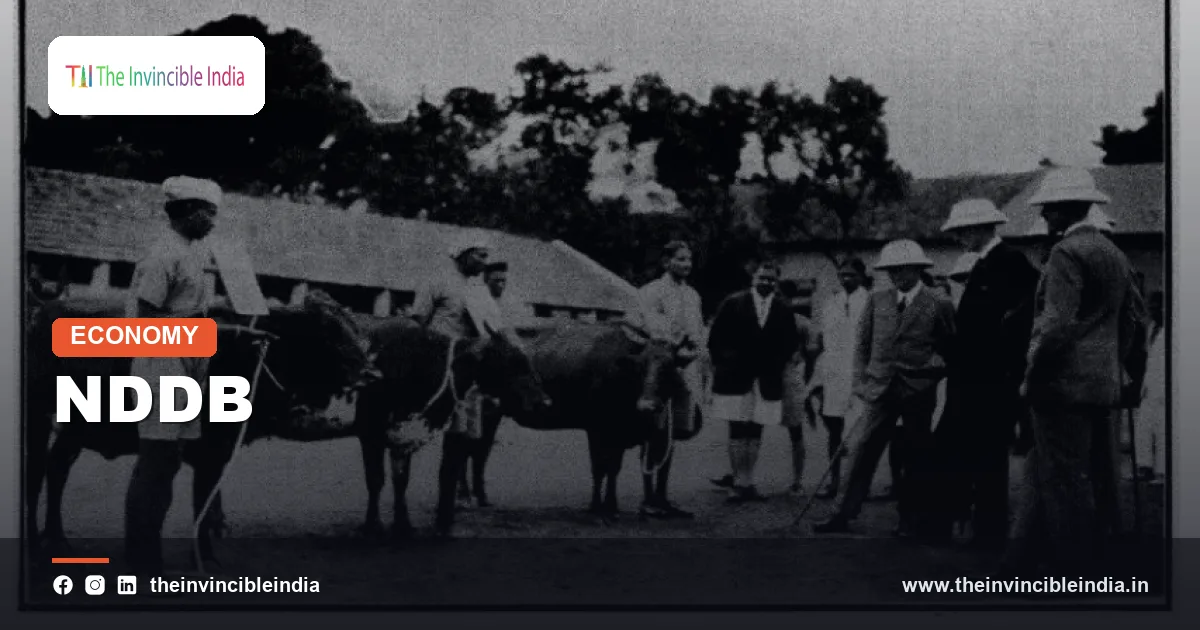
The National Dairy Development Board (NDDB) is the statutory body, founded in 1965 and headquartered at Anand in Gujarat, that planned and led Operation Flood and built the cooperative dairy network that turned India into the world’s largest milk producer. The National Dairy Development Board works on the Anand pattern of farmer-owned cooperatives, in which millions of small milk producers pool their milk and share the benefits of processing and marketing.
Today the National Dairy Development Board is an institution of national importance under the Department of Animal Husbandry and Dairying, with responsibilities covering dairy cooperatives, cattle breeding, animal nutrition, animal health and dairy-related technology. This explainer sets out what the National Dairy Development Board is, how it began, how Operation Flood and the three-tier cooperative model work, and which programmes it runs today. Last reviewed: 19 October 2026.
| Attribute | Details |
|---|---|
| Full name | National Dairy Development Board (NDDB) |
| Established | 1965 (founded at Anand); given statutory status as an institution of national importance by the NDDB Act, 1987 |
| Founding chairman | Dr Verghese Kurien, widely called the father of the White Revolution |
| Headquarters | Anand, Gujarat |
| Administrative ministry | Department of Animal Husbandry and Dairying, Ministry of Fisheries, Animal Husbandry and Dairying |
| Type | Statutory body and institution of national importance |
| Signature programme | Operation Flood (launched 1970), also called the White Revolution |
| Model | Anand pattern: three-tier dairy cooperatives (village, district, state) |
| Associated entities | Mother Dairy (Delhi), Indian Immunologicals Ltd, NDDB Dairy Services and others |
Key Takeaways
- The National Dairy Development Board was founded in 1965 at Anand, Gujarat, with Dr Verghese Kurien as its first chairman, and was given statutory status by the National Dairy Development Board Act, 1987.
- The National Dairy Development Board replicated the Anand (Amul) cooperative model across India through Operation Flood, which began in 1970 and ran for about 26 years in three phases.
- The Anand pattern is a three-tier structure of village dairy cooperative societies, district milk unions and state cooperative milk federations, owned by milk producers.
- India became the world’s largest milk-producing country in the late 1990s, and the National Dairy Development Board’s cooperative network is widely credited as a central factor in that rise.
- The National Dairy Development Board works today on breeding, animal nutrition, dairy infrastructure and cooperative strengthening, through programmes such as the National Dairy Plan.
- National Milk Day is observed in India on 26 November, the birth anniversary of Dr Verghese Kurien.
What is the National Dairy Development Board?
The National Dairy Development Board (NDDB) is a statutory body and institution of national importance, created to promote, finance and support producer-owned dairy organisations and related livestock and agricultural activity in India. It was set up in 1965 and has its headquarters at Anand, a small town in Gujarat that became the heart of the Indian cooperative dairy movement.
The National Dairy Development Board is governed by the National Dairy Development Board Act, 1987, which merged the original society with a statutory body so that it could work with greater authority and national reach. It is overseen by the Department of Animal Husbandry and Dairying. Its board includes a chairman, representatives of the government, dairy cooperatives and other stakeholders.
Its guiding idea is that rural prosperity is best built when farmers, not intermediaries, own the processing and marketing of their produce. The National Dairy Development Board has therefore supported cooperatives with technical, financial and managerial help, rather than running dairies as a conventional government enterprise.
How did the National Dairy Development Board begin?
The National Dairy Development Board began in 1965 at the request of Prime Minister Lal Bahadur Shastri, who visited Anand in 1964 and wanted the successful Amul experience replicated across the country. Dr Verghese Kurien, who had been managing the Kaira District Cooperative Milk Producers’ Union, was asked to lead the new organisation.
The story begins earlier, in 1946, when farmers in the Kaira district of Gujarat, frustrated by low prices paid by a private dairy in the region, organised under the guidance of Sardar Vallabhbhai Patel and Tribhuvandas Patel to form a cooperative. This became the Kaira District Cooperative Milk Producers’ Union, later known by its brand Amul. Kurien, an engineer who had trained in dairy technology, joined and helped build its processing capacity, including innovations in making milk powder and cheese from buffalo milk.
When the National Dairy Development Board was created, the idea was to take that experience to other districts and states. Anand remained the headquarters, which kept the institution close to the cooperative that inspired it.
What is Operation Flood?
Operation Flood was the world’s largest dairy development programme, launched by the National Dairy Development Board in 1970, with the aim of creating a national milk grid linking rural milk producers to urban consumers. It is also called the White Revolution, a name echoing the Green Revolution in grain.
The programme was funded in part through the sale of donated skim milk powder and butter oil from the European Economic Community, channelled through the World Food Programme, and supported by World Bank loans. The proceeds helped pay for dairy plants, chilling centres, veterinary services and cooperatives. Operation Flood ran in three phases, covering roughly the 1970s to the mid-1990s.
| Phase | Approximate period | Main emphasis |
|---|---|---|
| Operation Flood I | 1970 to 1980 | Linking milk sheds in several states to the four metros: Delhi, Mumbai, Kolkata and Chennai |
| Operation Flood II | 1981 to 1985 | Expansion of the milk shed and the number of cooperative societies and markets |
| Operation Flood III | 1985 to 1996 | Consolidation, productivity, animal health, breeding, and strengthening cooperatives |
The result was a nationwide network of village societies, chilling centres and processing plants that gave farmers an assured market for their milk, regular payments and access to veterinary and breeding services. It transformed milk from a localised, seasonal and informal commodity into a regular source of rural income.
How does the three-tier cooperative structure work?
The three-tier cooperative structure used by the National Dairy Development Board works by organising dairy farmers into village-level societies that collect milk, district-level unions that process it, and state-level federations that market it, with each tier owned by the one below. This design is known as the Anand pattern.
Tier 1: Village dairy cooperative society
Farmers in a village bring milk to a society twice a day. The milk is tested for fat content and quantity, and the farmer is paid on the basis of quality, often through a transparent and automated system. Members elect a managing committee, and profits are shared through bonuses and services.
Tier 2: District milk union
A union owned by the village societies in a district operates chilling centres and processing plants. It provides inputs such as cattle feed, veterinary care and artificial insemination to its members.
Tier 3: State cooperative milk federation
A federation, owned by the district unions, markets milk and milk products under a common brand. A well-known example is the Gujarat Cooperative Milk Marketing Federation (GCMMF), set up in 1973, which sells products under the Amul brand. Other states have their own federations, such as Karnataka’s Nandini and Tamil Nadu’s Aavin.
The strength of the model is that the farmer is both supplier and owner. Decisions are made by elected representatives, and surpluses are returned to the producers rather than extracted by outside owners.
What is the relationship between the National Dairy Development Board, Amul and Mother Dairy?
The National Dairy Development Board is the national promoter of the Anand pattern, Amul is the brand of the Gujarat cooperative federation that first proved the model, and Mother Dairy is a dairy company established by the National Dairy Development Board in Delhi in 1974 to supply the capital region. They are separate organisations with related origins.
Amul belongs to the Gujarat Cooperative Milk Marketing Federation, which is owned by lakhs of milk producers in Gujarat. It is not a subsidiary of the National Dairy Development Board. The Board’s role was to learn from Amul, train people and replicate the structure elsewhere.
Mother Dairy was set up to implement Operation Flood in Delhi, supplying milk to the city and procuring from rural cooperatives. It later expanded into fruit and vegetable retailing, edible oils and other products. The Board has also established or promoted other entities, such as Indian Immunologicals Ltd, which produces animal and human vaccines, and NDDB Dairy Services.
Why did Operation Flood make India the world’s largest milk producer?
Operation Flood made India the world’s largest milk producer by creating a reliable market for small farmers, which encouraged them to invest in animals and productivity, and by building the infrastructure to move milk from villages to cities. Around the end of the 1990s, India overtook the United States in total milk production, and it has remained the leader since, producing roughly a quarter of the world’s milk according to widely cited estimates.
Several features explain the outcome. Farmers received regular payments and fair prices. Veterinary care, artificial insemination and balanced feed improved herd productivity. Chilling and processing reduced losses, allowing milk from remote areas to reach cities. The cooperative form also built social capital, and women’s participation in village societies grew over time.
It is worth noting that India’s milk production is still based on very small herds, often one to three animals per household, and per-animal yields remain below those of many developed dairy countries. The National Dairy Development Board’s current programmes try to improve these yields.
What programmes does the National Dairy Development Board run today?
The National Dairy Development Board runs programmes on cattle breeding, animal nutrition, dairy infrastructure, cooperative strengthening and rural livelihoods, often in partnership with the Government of India, state governments and cooperatives. Its portfolio has broadened since Operation Flood to reflect new priorities.
- National Dairy Plan: a long-term programme begun in the early 2010s to raise the productivity of milch animals and strengthen village-level milk procurement systems.
- Breeding and genetics: promotion of high-quality semen production, sex-sorted semen, progeny testing and artificial insemination services for cows and buffaloes.
- Animal nutrition: ration balancing, fodder development and mineral mixture programmes to improve feed efficiency and reduce methane emissions.
- Dairy infrastructure and technology: support for processing plants, chilling centres, automated milk collection and quality testing.
- Animal health: vaccines and diagnostics, including those from Indian Immunologicals Ltd, for diseases such as foot-and-mouth disease.
- Cooperative strengthening: governance training, digitisation, and expansion into areas with few cooperatives.
- Allied initiatives: work on bio-gas and waste management, renewable energy at dairy sites and support for livelihood diversification.
Exact scheme names, budgets and coverage change with government decisions, so readers should consult the Board’s current publications for up-to-date details.
Who was Dr Verghese Kurien?
Dr Verghese Kurien (1921 to 2012) was the Indian engineer and social entrepreneur who founded the National Dairy Development Board, led it for decades and is regarded as the architect of Operation Flood. He is often called the father of the White Revolution in India, and his birth anniversary, 26 November, is observed as National Milk Day.
Kurien trained as an engineer with a specialisation in dairy engineering, and was sent to Anand in the late 1940s. Rather than leave for a private career, he stayed to work with the farmers’ cooperative. He championed professional management in cooperatives and helped establish the Institute of Rural Management Anand (IRMA) to train managers for rural enterprises.
He received many honours, including the Padma Vibhushan and the World Food Prize in 1989. His legacy continues to be discussed, including debates about the cooperative model and the role of government, but the outcomes of the Anand pattern remain a landmark in rural development.
Bottom Line
The National Dairy Development Board is the institution that carried the Anand cooperative model across India and turned dairying into a major source of rural income. Through Operation Flood and its present programmes in breeding, nutrition and cooperative strengthening, the National Dairy Development Board remains the national anchor of India’s dairy sector.
Frequently Asked Questions
What is the National Dairy Development Board?
The National Dairy Development Board (NDDB) is a statutory body and institution of national importance that promotes producer-owned dairy cooperatives in India. It was founded in 1965 at Anand, Gujarat, and given statutory status by the NDDB Act, 1987. It led Operation Flood and now works on breeding, nutrition, infrastructure and cooperative strengthening.
Who founded the National Dairy Development Board?
Dr Verghese Kurien founded the National Dairy Development Board in 1965 and served as its first chairman. The institution was created at the request of Prime Minister Lal Bahadur Shastri, who wanted the Amul cooperative model replicated nationwide. Kurien is widely known as the father of the White Revolution.
What was Operation Flood?
Operation Flood was a dairy development programme launched by the National Dairy Development Board in 1970 to create a national milk grid linking rural producers to urban consumers. Also called the White Revolution, it ran in three phases until the mid-1990s. It helped make India the world’s largest milk producer.
What is the Anand pattern of dairy cooperatives?
The Anand pattern is a three-tier cooperative structure made up of village dairy cooperative societies, district milk unions and state milk federations. Farmers own each tier, supply the milk and share the profits. The model was developed at Amul in Anand, Gujarat, and spread nationally by the National Dairy Development Board.
Is Amul part of the National Dairy Development Board?
No, Amul is not part of the National Dairy Development Board. Amul is the brand of the Gujarat Cooperative Milk Marketing Federation, which is owned by milk producers in Gujarat. The Board drew on the Amul experience to build cooperatives elsewhere, while Mother Dairy in Delhi was established by the Board.
When did India become the world’s largest milk producer?
India became the world’s largest milk producer in the late 1990s, overtaking the United States. The growth is widely linked to Operation Flood and the cooperative network built by the National Dairy Development Board. India has remained the leading producer since, accounting for roughly a quarter of global milk output.
{“@context”:”https://schema.org”,”@graph”:[{“@type”:”FAQPage”,”mainEntity”:[{“@type”:”Question”,”name”:”What is the National Dairy Development Board?”,”acceptedAnswer”:{“@type”:”Answer”,”text”:”The National Dairy Development Board (NDDB) is a statutory body and institution of national importance that promotes producer-owned dairy cooperatives in India. It was founded in 1965 at Anand, Gujarat, and given statutory status by the NDDB Act, 1987. It led Operation Flood and now works on breeding, nutrition, infrastructure and cooperative strengthening.”}},{“@type”:”Question”,”name”:”Who founded the National Dairy Development Board?”,”acceptedAnswer”:{“@type”:”Answer”,”text”:”Dr Verghese Kurien founded the National Dairy Development Board in 1965 and served as its first chairman. The institution was created at the request of Prime Minister Lal Bahadur Shastri, who wanted the Amul cooperative model replicated nationwide. Kurien is widely known as the father of the White Revolution.”}},{“@type”:”Question”,”name”:”What was Operation Flood?”,”acceptedAnswer”:{“@type”:”Answer”,”text”:”Operation Flood was a dairy development programme launched by the National Dairy Development Board in 1970 to create a national milk grid linking rural producers to urban consumers. Also called the White Revolution, it ran in three phases until the mid-1990s. It helped make India the world’s largest milk producer.”}},{“@type”:”Question”,”name”:”What is the Anand pattern of dairy cooperatives?”,”acceptedAnswer”:{“@type”:”Answer”,”text”:”The Anand pattern is a three-tier cooperative structure made up of village dairy cooperative societies, district milk unions and state milk federations. Farmers own each tier, supply the milk and share the profits. The model was developed at Amul in Anand, Gujarat, and spread nationally by the National Dairy Development Board.”}},{“@type”:”Question”,”name”:”Is Amul part of the National Dairy Development Board?”,”acceptedAnswer”:{“@type”:”Answer”,”text”:”No, Amul is not part of the National Dairy Development Board. Amul is the brand of the Gujarat Cooperative Milk Marketing Federation, which is owned by milk producers in Gujarat. The Board drew on the Amul experience to build cooperatives elsewhere, while Mother Dairy in Delhi was established by the Board.”}},{“@type”:”Question”,”name”:”When did India become the world’s largest milk producer?”,”acceptedAnswer”:{“@type”:”Answer”,”text”:”India became the world’s largest milk producer in the late 1990s, overtaking the United States. The growth is widely linked to Operation Flood and the cooperative network built by the National Dairy Development Board. India has remained the leading producer since, accounting for roughly a quarter of global milk output.”}}]}]}


