

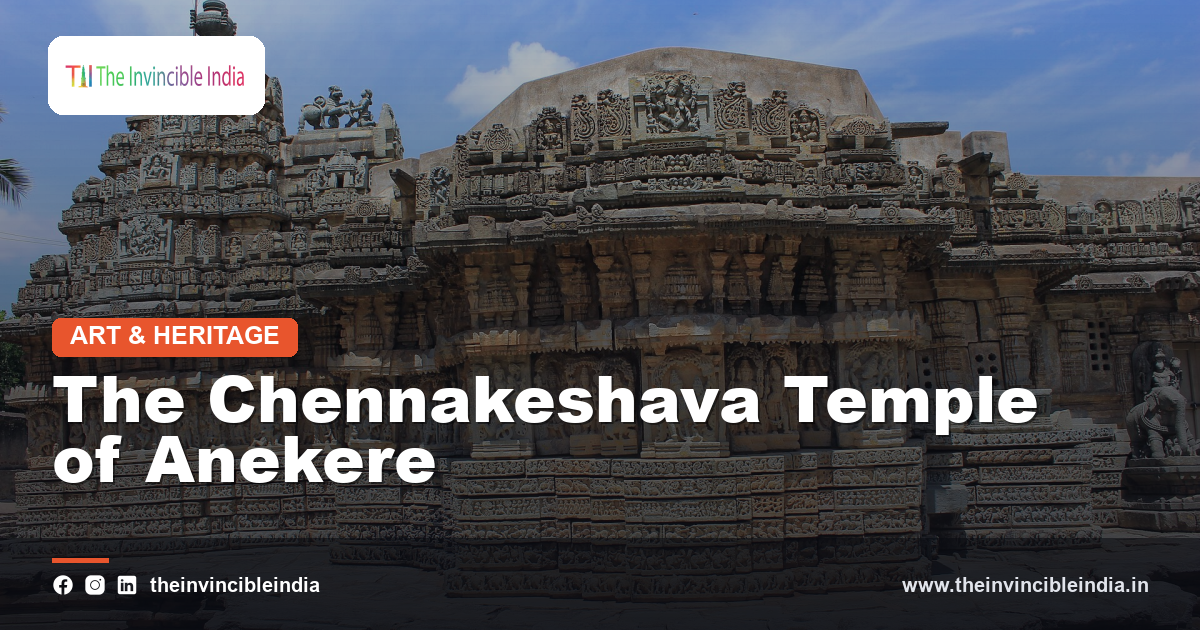
The Chennakeshava temple at Anekere, also written Chennakesava or Chennakeshwara, is a Hoysala temple in the village of Anekere, near the town of Channarayapatna in Hassan district, Karnataka. It is dedicated to Vishnu, worshipped as Chennakeshava, a well-known form of the god whose name may be rendered as the handsome or beautiful Keshava. Belonging to the Hoysala tradition and generally placed around the thirteenth to fourteenth century, it carries the distinctive stone architecture and carving of the dynasty. Its design belongs to the Hoysala tradition, part of the broader story told in the guide to Indian temple architecture. This article explains its location, history, architecture, sculpture and living significance within the rich landscape of Hoysala monuments in the Hassan region of southern Karnataka, keeping to general and well-established description where details are uncertain.
Quick answer: The Chennakeshava temple is a Hoysala Vishnu temple in the village of Anekere, near Channarayapatna, in Hassan district, Karnataka, India. Dedicated to Vishnu in the form of Chennakeshava, it is generally placed around the thirteenth to fourteenth century and carries the distinctive stone architecture and carving of the Hoysala dynasty. The temple remains a protected heritage monument and a place of Vaishnava worship in the Hoysala heartland of southern Karnataka.
Key Takeaways
- The Chennakeshava temple is a Hoysala Vishnu shrine at Anekere, near Channarayapatna, in Hassan district, Karnataka.
- It is dedicated to Vishnu, worshipped in the form of Chennakeshava, a well-known form of the god.
- It belongs to the Hoysala tradition and is generally placed around the thirteenth to fourteenth century.
- The name Chennakeshava may be rendered as the handsome or beautiful Keshava.
- It carries the distinctive stone architecture and fine carving of the Hoysala dynasty.
- It remains a protected heritage monument in the Hoysala heartland around Hassan.
The sections below explain where the temple stands, how it was built and what a visitor can still see today.
Quick Facts
| Detail | Information |
|---|---|
| Location | Anekere, near Channarayapatna, Hassan district, Karnataka |
| Also known as | Chennakesava temple, Chennakeshwara |
| Dynasty | Hoysala |
| Period | Generally placed around the 13th to 14th century |
| Dedication | Vishnu, worshipped as Chennakeshava |
| Material | Chloritic schist (soapstone), dressed and carved |
| Protected status | Recognised heritage monument |
| Nearest town | Channarayapatna, Hassan district |
| Nearest city | Hassan, near Belur and Halebidu |
What Is the Chennakeshava Temple of Anekere?
The Chennakeshava temple of Anekere is a Hoysala temple regarded as a genuine example of the dynasty’s stone architecture in the Hassan region of Karnataka. It stands in the village of Anekere, near the town of Channarayapatna, and is dedicated to Vishnu, worshipped in the form of Chennakeshava, a well-known form of the god. What distinguishes the temple is its Hoysala plan and carving, in the manner of the many shrines that fill this part of southern Karnataka. Belonging to the Hoysala tradition, it is generally placed around the thirteenth to fourteenth century. The design joins an ordered plan to finely carved surfaces in the Hoysala manner. Because detailed records of the temple are limited, descriptions are best kept general. The Chennakeshava temple is therefore best understood as both a living Vaishnava shrine and a valuable example for the study of Hoysala temple architecture in southern Karnataka.
Where Is Anekere Located?
Anekere is located near the town of Channarayapatna in Hassan district, in the southern part of Karnataka, in the heartland of the Hoysala dynasty. The village lies in a region of farmland and historic settlements, within reach of Channarayapatna, the town of Hassan and the celebrated Hoysala temple towns of Belur and Halebidu. Hassan district is among the richest areas in India for Hoysala monuments, so the surrounding countryside is dotted with shrines of the period. Roads connect Anekere with Channarayapatna and the larger cities of the region, making it accessible to travellers exploring the Hoysala heritage. The surrounding landscape reflects a long history of settlement, cultivation and devotion. The location of Anekere therefore places the Chennakeshava temple in the heart of the Hoysala world, among the many village and town shrines of the Hassan region that preserve the art of the dynasty in southern Karnataka.
Who Is Chennakeshava, the Deity?
Chennakeshava is a well-known form of Vishnu, the great preserver god of the Hindu tradition, and the name may be rendered as the handsome or beautiful Keshava, Keshava being one of the many names of Vishnu. The form is honoured at several temples across Karnataka, the most famous being the great Chennakeshava temple at Belur, and at Anekere it identifies the form under which the god is worshipped. Vishnu is revered as the preserver who maintains the order of the universe, and is worshipped in many forms and avatars across India. The dedication to Chennakeshava gives the temple its Vaishnava character, connecting it to the wider worship of Vishnu in the region. The honouring of Chennakeshava as the deity of the Anekere temple therefore defines its dedication, uniting the worship of Vishnu in this beloved form with the fine stone art of the Hoysala age in southern Karnataka.
When Was the Temple Built?
The Chennakeshava temple at Anekere is generally placed around the thirteenth to fourteenth century, within the Hoysala period, though precise dating is difficult for a lesser-documented shrine. Many temples were built, altered and added to over long periods, and inscriptions, where they survive, often record particular gifts rather than the full history of a building. For this reason the temple is best described as a work of the Hoysala tradition rather than assigned to a single exact year. Its style, including its stone carving and plan, is consistent with the later Hoysala period. Some features may reflect later repair or addition over the long life of the shrine. Because firm documentation is limited, caution is appropriate, and claims about it should stay general. The building of the Chennakeshava temple therefore reflects the sustained devotion and craftsmanship of the Hoysala age in the Hassan region of Karnataka.
Who Built the Chennakeshava Temple?
The Chennakeshava temple is attributed to the Hoysala period and reflects the common pattern by which temples were founded through the patronage of rulers, officials, merchants and local communities. Temples of this age were raised as acts of devotion and as marks of status, often with the support of the court or of prominent patrons, while the actual building was carried out by guilds of skilled masons and sculptors. For a shrine of this kind, inscriptions, where they survive, help establish its period and patronage, though the full details and the names of the craftsmen are often known only in part. Attribution therefore rests on inscriptions, tradition and architectural style. The building of the Chennakeshava temple reflects the devotion and resources of the Hoysala world, and the skill of the craftsmen who served it, in the Anekere area near Channarayapatna in the Hassan region of Karnataka.
What Is the Layout of the Temple?
The layout of the Chennakeshava temple follows the familiar pattern of Hoysala shrines, with a sanctum, a vestibule and a pillared hall arranged along a central axis, typically set upon a raised platform. The sanctum, or garbhagriha, is a chamber meant for the principal image of Chennakeshava, while the vestibule links it to the larger hall. The hall, or mandapa, is carried on lathe-turned pillars and opens the interior to worshippers, with ceilings divided into carved bays in the Hoysala manner. The temple stands on a moulded base that lifts it above the ground and provides a surface for carved friezes, with outer walls divided into projections and recesses. This arrangement leads a worshipper from the open hall through gradually more sacred spaces toward the sanctum. The layout of the Chennakeshava temple therefore balances ritual logic with the carved setting characteristic of Hoysala architecture in southern Karnataka.
Who Is Worshipped at the Temple?
The Chennakeshava temple is dedicated to Vishnu, worshipped in the sanctum in the form of Chennakeshava, the beautiful Keshava, a beloved form of the great preserver god. The shrine follows the customary pattern of a Vaishnava temple, with worship that includes offerings, lamps and the recitation of sacred formulas, in keeping with long-established tradition. Carved images of deities, guardians and celestial attendants often accompany the principal shrine in temples of this kind, so that a visitor may see representations of Vishnu, his avatars and other gods. As a village temple, it has long served the devotional life of the local community. The devotional life of the temple connects it to the wider Vaishnava worship of the region. The dedication of the Chennakeshava temple to Vishnu therefore defines both its religious character and its place within the broad tradition of Vaishnava worship that flourished across the Hassan region of southern Karnataka under the Hoysalas.
What Do the Carvings Show?
The carvings of the Chennakeshava temple display the figure work and ornament characteristic of Hoysala stonework, treating the surfaces of walls, pillars and ceilings as fields for sacred imagery and decoration. In the Hoysala manner, the outer walls may be divided into horizontal bands and vertical projections, carrying sculpted figures, miniature towers and running friezes, while the ceilings of the hall are worked with ornamental designs. Carved panels typically represent forms of Vishnu and his avatars, fitting for a Vaishnava shrine, together with other deities, guardians and decorative motifs. The fine-grained soapstone allowed sharp, delicate detail, though weathering has softened some surfaces over the centuries. The carving served devotion first, while also preserving examples of Hoysala art. Visitors should look closely to appreciate the original delicacy. The carvings of the Chennakeshava temple therefore combine religious purpose with lasting artistic value across the shrine, reflecting the Hoysala manner.
What Materials and Techniques Were Used?
The Chennakeshava temple was built chiefly of chloritic schist, the soft soapstone favoured by Hoysala craftsmen because it was easy to carve when freshly quarried and hardened on exposure to air. This material allowed the sharp, delicate detail seen in the pillars, friezes and outer walls. The stone was dressed into blocks and assembled in the traditional Indian manner, with elements fitted closely together without mortar. Pillars were turned on a lathe to a smooth, rounded profile before being set upright, a hallmark of Hoysala building, while masons worked the walls and ceilings with chisels to produce the layered ornament. The construction of even a modest temple demanded careful planning so that each element matched the whole. These methods, common to the Hoysala temples of the region, have allowed the shrine to survive for centuries. The materials and techniques of the Chennakeshava temple therefore demonstrate the skill of Hoysala craftsmanship in southern Karnataka.
How Does the Temple Fit the Hoysala Tradition?
The Chennakeshava temple fits the Hoysala tradition as a characteristic example of the dynasty’s distinctive architecture, which flourished in the Karnataka region between roughly the eleventh and fourteenth centuries. Hoysala temples are known for their raised platforms, finely carved outer walls, lathe-turned pillars and sculpted friezes, together with their dedications to both Shiva and Vishnu. The Chennakeshava temple shares these features, expressed in its plan, its carved stonework and its Vaishnava dedication. The Hoysalas spread this manner across many towns and villages of their realm, leaving a dense concentration of temples, including many in the Hassan district. Studying this temple alongside others reveals how the tradition developed through sustained patronage. The Chennakeshava temple therefore serves as a clear illustration of Hoysala architectural principles, demonstrating the style’s blend of ordered structure and carved ornament in the village of Anekere near Channarayapatna in the Hassan region of Karnataka.
How Does It Compare With Other Hoysala Temples?
The Chennakeshava temple at Anekere compares with other Hoysala temples of the Hassan region as a member of the same celebrated family of monuments noted for their carving and ordered plans. The Hoysala tradition produced many temples, from the great Chennakeshava temple at Belur and the shrines of Halebidu to the many village and town temples scattered across the region. The Anekere temple, sharing the dedication to Chennakeshava, offers a quieter counterpart to the famous Belur shrine, allowing visitors to appreciate the same form of Vishnu in a modest village setting. Comparing it with the grander temples shows both the shared features of the style and the range of its scale. It also reminds visitors how widely the tradition spread. The Chennakeshava temple at Anekere therefore complements the other Hoysala monuments of the region, forming part of the dense concentration of medieval temple art that distinguishes the Hassan district of Karnataka.
What Is the Setting of the Temple?
The setting of the Chennakeshava temple adds to its interest, as it stands within the historic village of Anekere amid the farmland and old settlements of the Hassan region in southern Karnataka. Part of the living fabric of the village rather than an isolated ruin, the temple remains connected to the daily life and devotion of the surrounding community. The region around Anekere is among the richest in India for Hoysala heritage, near the town of Channarayapatna and the celebrated temple towns of Belur and Halebidu, so the temple can be seen as one link in a chain of monuments across the Hoysala heartland. The precinct offers a dignified space for worship and study. The rural setting means the temple retains a quiet atmosphere. The setting of the Chennakeshava temple therefore combines architectural value with the character of a historic Hoysala village in southern Karnataka.
How Is the Temple Protected and Preserved?
The Chennakeshava temple is preserved through official heritage protection together with local devotion, as with many historic monuments in Karnataka. Archaeological authorities are responsible for documenting, conserving and safeguarding notable temples, while worshippers and local committees maintain ritual and basic upkeep. Challenges include the weathering of the soft soapstone, moisture, the growth of vegetation and the wear caused by visitors and the passage of time. Conservation work aims to stabilise the structure and clean surfaces without altering the original design, using methods that respect historic materials. Because the precise arrangements and status of a monument can change, readers are advised to consult current information from official heritage bodies. Respectful visitor behaviour, including not touching the carvings, also helps protect the delicate stonework. The preservation of the Chennakeshava temple depends on cooperation between officials, worshippers and visitors who value its place in the Hoysala architectural record of southern Karnataka.
How Can Visitors Plan a Trip to Anekere?
Visitors can plan a trip to Anekere most easily by basing themselves in the town of Channarayapatna or the city of Hassan and travelling by road to the village, often as part of a wider tour of the Hoysala temples that includes Belur and Halebidu. The cooler months from about October to February are generally the most comfortable for travel, while the summer on the Deccan plateau is hot. Modest clothing is appropriate, and footwear is removed before entering the temple. It is wise to carry water and allow unhurried time to study the plan and carving of the shrine, which reward close attention. Combining a visit with the great temples of the region makes for a rewarding heritage itinerary. Checking current timings and asking local residents for directions can help, as village temples may open only at set hours. A well prepared visit allows the temple to be enjoyed calmly and with respect.
The Chennakeshava Temple Today
The Chennakeshava temple of Anekere today remains both a living Vaishnava shrine and a valued example of Hoysala art in the Hassan region. Its stone architecture and carving, together with its dedication to Vishnu as Chennakeshava and its place in the Hoysala tradition, continue to draw devotees and travellers exploring the heritage of southern Karnataka. Though far less famous than the great Chennakeshava temple at Belur, the shrine is a genuine work of the same tradition and a reminder of how widely the Hoysala style reached. Continued conservation, respectful tourism and scholarly study help ensure that it endures for future generations. For those exploring the dense concentration of Hoysala monuments around Hassan and Channarayapatna, it makes a rewarding stop. The Chennakeshava temple thus stands as a lasting witness to the faith, skill and artistry of the Hoysala age in the village of Anekere in southern Karnataka.
Sources & Further Reading
- Archaeological Survey of India (asi.nic.in).
- Department of Tourism, Government of Karnataka (karnatakatourism.org).
Frequently Asked Questions
Where is the Chennakeshava temple at Anekere located?
The Chennakeshava temple is located in the village of Anekere, near the town of Channarayapatna, in Hassan district of southern Karnataka. It is reached by road and lies within reach of the famous Hoysala temple towns of Belur and Halebidu.
Who is Chennakeshava, the deity of the temple?
Chennakeshava is a well-known form of Vishnu, the great preserver god, whose name may be rendered as the handsome or beautiful Keshava. The same form is honoured at the famous Chennakeshava temple at Belur in the same district.
Which dynasty built the Chennakeshava temple?
The temple belongs to the Hoysala tradition, which flourished in the Karnataka region between roughly the eleventh and fourteenth centuries. The Hassan district, where it stands, is among the richest areas in India for Hoysala monuments.
When was the Chennakeshava temple built?
The temple is generally placed around the thirteenth to fourteenth century, within the Hoysala period. Because it is a lesser-documented shrine, it is best described in general terms rather than assigned to an exact year.
Who is worshipped at the Chennakeshava temple?
The temple is dedicated to Vishnu, worshipped in the form of Chennakeshava. Worship follows the customary rites of a Vaishnava shrine, with offerings, lamps and sacred recitation.
What is the best time to visit Anekere?
The best time to visit is the cooler season from about October to February. These months are more comfortable for travel than the hot summer on the Deccan plateau.


