

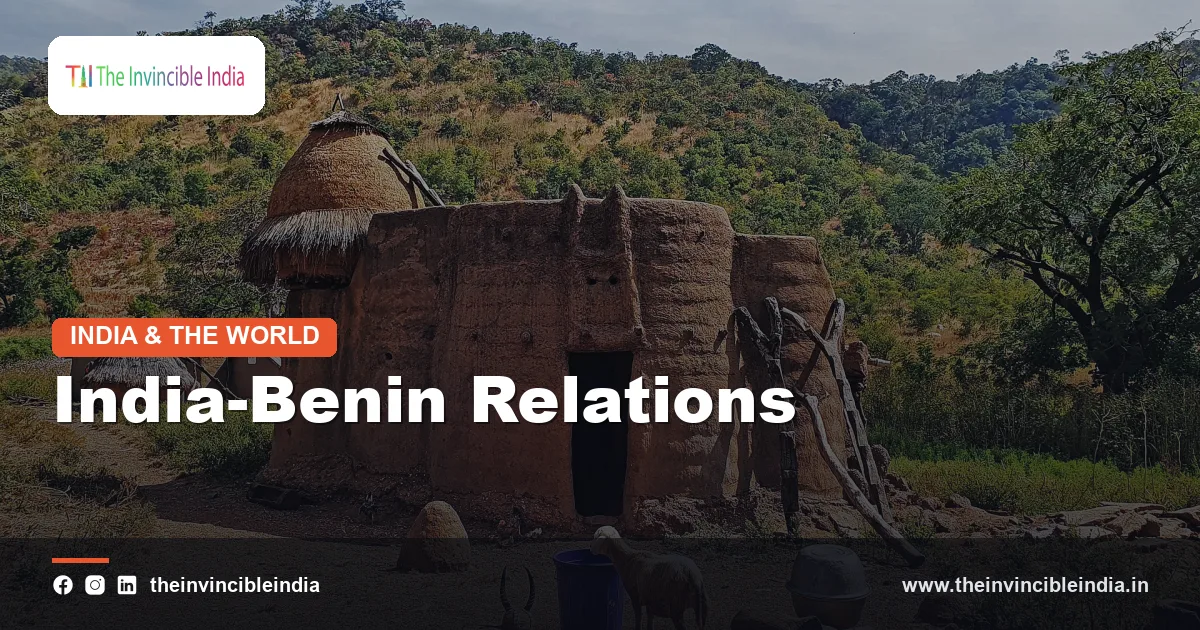
India-Benin relations are the friendly, development-focused ties between the Republic of India and the Republic of Benin, a French-speaking West African country on the Gulf of Guinea. The relationship is built mainly on commerce, with India a significant buyer of Benin’s raw cotton and cashew nuts, and on Indian development partnership in the form of concessional lines of credit, training and capacity-building.
Benin offers India a source of agricultural raw materials and a useful gateway to the wider West African market through the Port of Cotonou, while India offers Benin finance, technology, affordable medicines and training. The two countries also cooperate in multilateral settings such as the United Nations, the International Solar Alliance and the India-Africa Forum Summit process.
| Attribute | Details |
|---|---|
| Bilateral relationship | India-Benin relations (Republic of India and Republic of Benin) |
| Benin’s location | West Africa, bordering Togo, Nigeria, Niger and Burkina Faso, with a short coastline on the Gulf of Guinea |
| Capitals | Porto-Novo (official capital); Cotonou (seat of government and main commercial city) |
| Benin’s independence | 1 August 1960, from France (then known as Dahomey; renamed Benin in 1975) |
| Official language and currency | French; West African CFA franc (XOF), pegged to the euro |
| Key Indian imports from Benin | Raw cotton, cashew nuts and some other agricultural products |
| Key Indian exports to Benin | Pharmaceuticals, vehicles and two-wheelers, machinery, textiles and food items |
| Development partnership | Concessional lines of credit (solar, rural electrification, agriculture), ITEC training, scholarships |
Key Takeaways
- India-Benin relations are anchored in trade and development cooperation, with raw cotton and cashew nuts among the leading Beninese products bought by India.
- Benin gained independence from France on 1 August 1960 and was called Dahomey until it was renamed the People’s Republic of Benin in 1975.
- India has extended concessional lines of credit to Benin through its Export-Import Bank (EXIM Bank) for projects in areas such as solar power, rural electrification and agriculture.
- The Port of Cotonou serves Benin and also acts as a transit route for neighbouring countries, making Benin strategically useful for Indian exporters to West Africa.
- Indian pharmaceuticals, vehicles and machinery feature among India’s exports to Benin, while capacity-building through the ITEC programme supports Beninese officials and professionals.
- Benin and India both belong to the International Solar Alliance and engage through the India-Africa Forum Summit framework and the United Nations.
What are India-Benin relations?
India-Benin relations are the cooperative diplomatic and economic ties between New Delhi and Porto-Novo/Cotonou, shaped by India’s wider engagement with Africa and Benin’s role as a stable coastal state in West Africa. Both countries are democracies with a record of peaceful engagement, and neither has any bilateral dispute with the other.
India’s interest in Benin follows its larger policy of partnership with African countries on a South-South basis, which emphasises mutual benefit, demand-driven projects and training rather than conditional aid. Benin, for its part, looks to India as a source of affordable technology, credit and medicines, and as a large market for commodities that are important to its farmers and exporters.
The relationship is modest in comparison with India’s ties with Nigeria, South Africa or Egypt, yet it is steady and has been strengthened by regular exchange of visits, ministerial meetings and participation in Africa-focused summits.
How did India-Benin relations develop?
India-Benin relations developed gradually after Benin’s independence in 1960, with formal diplomatic recognition followed by slow growth in trade and, from the 2000s onward, a more systematic development partnership. For many years, contacts were limited and often handled through accredited ambassadors based in other African capitals.
Benin’s political history shaped the pace of engagement. After independence, the country experienced a series of coups, followed by Marxist-Leninist rule under Mathieu Kerekou from 1972. In 1990 Benin held a national conference and moved to multiparty democracy, becoming one of the earlier African states to make a peaceful transition. This opened the way for broader international ties, including with India.
India’s own Africa policy expanded sharply in the 2000s and 2010s. The India-Africa Forum Summits, held in 2008, 2011 and 2015, brought together leaders from across the continent, including from Benin, and set out frameworks for credit, scholarships and capacity-building. Benin has been a beneficiary of several of these frameworks.
Milestones at a glance
- 1960: Benin (then Dahomey) becomes independent; ties with India begin in the following years.
- 1975: the country adopts the name Benin.
- 1990: transition to multiparty democracy.
- 2000s: expanded diplomatic presence and growing commercial exchange.
- 2008-2015: India-Africa Forum Summits provide new credit and training frameworks.
- 2015 onward: the International Solar Alliance is launched by India and France, and Benin becomes part of this solar cooperation framework.
Why is Benin important for India’s trade?
Benin is important for India’s trade because it supplies raw materials that Indian industry needs, notably cotton and cashew nuts, and because the Port of Cotonou is a trade gateway to West Africa. Benin is one of Africa’s leading cotton producers, and cotton has historically accounted for a large share of its export earnings.
India, as one of the world’s largest textile manufacturers and a major consumer of cotton, buys raw cotton from several African countries, and Benin is among the suppliers. Indian traders also import raw cashew nuts from West African producers for processing in southern Indian cashew factories, and Benin has become a notable origin for these imports alongside countries such as Cote d’Ivoire and Guinea-Bissau.
The Port of Cotonou handles cargo not only for Benin but also for landlocked neighbours such as Niger, Burkina Faso and Mali, and has long served as a route into Nigeria’s large market. This makes Benin a convenient point for Indian exporters of vehicles, spare parts, medicines and consumer goods, although the volume of re-exports is affected by border policies that have changed over time.
What does India buy and sell?
| Direction | Typical goods | Why it matters |
|---|---|---|
| India imports from Benin | Raw cotton, cashew nuts, some oilseeds and other agricultural items | Feeds Indian textile and cashew-processing industries |
| India exports to Benin | Pharmaceuticals, motorcycles and vehicles, machinery, rice, textiles, plastics | Provides affordable goods for Benin and for transit to neighbours |
| Services and training | ITEC courses, scholarships, IT training | Builds skills and goodwill |
Trade totals fluctuate considerably from year to year, mainly because cotton and cashew prices and harvest sizes vary. Sources such as India’s Ministry of Commerce and Industry publish current figures, and any single number should be treated as a snapshot rather than a trend.
How does India support Benin through lines of credit?
India supports Benin through concessional lines of credit extended by the Export-Import Bank of India (EXIM Bank) on behalf of the Government of India. These loans carry lower interest rates and longer repayment terms than commercial finance, and are generally tied to the use of Indian goods and services for the funded projects.
Lines of credit to Benin have been associated with sectors such as solar energy and rural electrification, agriculture and agro-processing, and other infrastructure. Solar projects fit well with Benin’s need to widen access to electricity in rural areas, and with India’s promotion of solar energy through the International Solar Alliance, which India co-founded with France in 2015.
Because details of individual credit lines, amounts and timelines change as projects are approved, delayed or completed, readers should refer to EXIM Bank and Ministry of External Affairs publications for the latest status. As with development finance generally, assessments of impact depend on project design, local implementation and repayment capacity.
What role do energy and solar cooperation play?
Energy and solar cooperation play a growing role in India-Benin relations because both countries are members of the International Solar Alliance (ISA), a treaty-based organisation launched by India and France in 2015 to promote solar energy in sunshine-rich countries. Benin, with a tropical climate and large rural populations still lacking reliable power, is a natural partner for decentralised solar solutions.
Indian support in this field includes concessional credit for solar installations, technical assistance and training for engineers and technicians. Solar lamps, solar-powered street lighting, water pumps and village mini-grids are typical project types in such cooperation.
The benefits are practical: better electricity supports health clinics, schools and small enterprises, and reduces dependence on imported fuels. The challenges include maintenance, spare parts and local technical skills, which is why training components are usually included in cooperation programmes.
How do pharmaceuticals and healthcare connect India and Benin?
Pharmaceuticals and healthcare connect India and Benin because Indian generic medicines are widely used across West Africa, including in Benin, where affordability is a major concern. India is the world’s largest supplier of generic drugs by volume, and Indian firms supply antimalarials, antibiotics, antiretrovirals and other essential medicines to many African markets.
Benin’s health system relies substantially on imported medicines, and Indian products are often a cost-effective option. Beyond direct supplies, Indian firms have participated in distribution and, in some African countries, local manufacturing partnerships. Quality assurance remains a shared priority, as African regulators work to strengthen oversight of imported medicines.
Healthcare cooperation also includes training of health workers and, for some patients, travel to India for specialised treatment, though numbers from Benin are modest compared with those from larger African countries.
What capacity-building and educational ties exist?
Capacity-building and educational ties between India and Benin are delivered mainly through the Indian Technical and Economic Cooperation (ITEC) programme and scholarships from the Indian Council for Cultural Relations (ICCR). ITEC, launched in 1964, offers short-term and specialised training courses in India for officials and professionals from partner countries, covering fields from public administration and agriculture to information technology and renewable energy.
Beninese participants have taken ITEC courses, and Beninese students have been offered places at Indian universities under scholarship schemes. India has also supported e-learning and tele-medicine initiatives for African countries under the Pan-African e-Network project, and Benin has featured among countries engaged in such programmes, though the details of participation have varied over time.
These exchanges are often described as one of the most visible and well-regarded parts of India’s Africa outreach, since they create long-lasting personal networks. They also help Indian institutions gain familiarity with Francophone African markets, which have historically been less engaged with India than English-speaking ones.
How do India and Benin cooperate in international forums?
India and Benin cooperate in international forums through the United Nations, the India-Africa Forum Summit framework, the International Solar Alliance and, on matters of maritime security, discussions concerning the Gulf of Guinea. Both countries generally favour multilateralism, peaceful dispute resolution and reform of global institutions to give developing countries a larger voice.
India has long sought a permanent seat on a reformed United Nations Security Council, and many African states have expressed general support for expanded representation of developing regions. Benin has been among countries that have voiced support for India’s candidature at various points, although readers should consult official statements to confirm specifics. In the African Union context, India has welcomed the African Union’s inclusion as a permanent member of the G20 during India’s 2023 presidency.
Maritime cooperation is an emerging area. The Gulf of Guinea has faced piracy and illegal fishing concerns, and India has an interest in the security of sea lanes and in cooperating with coastal African states through port calls, training and information-sharing. The scale of such activity with Benin specifically is limited and evolving.
What challenges and limits exist in India-Benin relations?
The main challenges in India-Benin relations are low trade volumes relative to potential, distance and limited direct connectivity, and the fact that Benin’s economy is small and concentrated in a few commodities. Trade is dominated by cotton and cashew nuts, whose prices and harvests are volatile.
Other limiting factors include the language gap, since Benin is French-speaking, and the fact that Benin’s traditional economic partners are France, other European states, China and its West African neighbours. India competes with these partners and with other emerging economies for influence and market share in Benin.
Regional politics also matter. Benin’s neighbours have experienced security problems in the Sahel, and border arrangements with Niger and Nigeria have sometimes disrupted transit trade. Such factors can affect Indian businesses that rely on Cotonou as a transit hub.
What is the outlook for India-Benin relations?
The outlook for India-Benin relations is steady and cautiously positive, with room for growth in agriculture, solar energy, healthcare, digital services and maritime cooperation. Value addition is a recurring theme: Benin wants to process more of its cotton and cashew locally, and Indian machinery, expertise and investment could assist if commercial conditions are right.
Continued Indian credit and training, combined with Benin’s interest in diversifying partnerships, make further cooperation likely. Nevertheless, the pace will depend on project execution, financing terms, regional stability and the ability of both sides to turn goodwill into concrete commercial results.
Bottom Line
India-Benin relations are a quiet but practical example of India’s South-South partnership with Africa: India buys Benin’s cotton and cashew nuts, offers concessional credit and training, and supplies affordable medicines and goods. The ties are modest in scale, shaped by commodity cycles and regional factors, and their growth will depend on delivery rather than declarations.
Frequently Asked Questions
What does India import from Benin?
India mainly imports raw cotton and cashew nuts from Benin, along with some other agricultural products. These supply Indian textile mills and cashew-processing factories. Volumes and values change with harvests and global prices, so current figures should be checked in official trade data.
What does India export to Benin?
India exports pharmaceuticals, motorcycles and other vehicles, machinery, textiles, rice and various consumer goods to Benin. Some of these goods are re-exported through the Port of Cotonou to neighbouring countries. Pharmaceuticals are especially important because Indian generics are affordable and widely used in West Africa.
Has India given credit to Benin?
Yes, India has extended concessional lines of credit to Benin through the Export-Import Bank of India (EXIM Bank). These have been associated with sectors such as solar energy, rural electrification and agriculture. The exact amounts and status of individual projects change over time, so official sources should be consulted.
Is Benin a member of the International Solar Alliance?
Yes, Benin is a member of the International Solar Alliance (ISA), the organisation launched by India and France in 2015 to promote solar energy. Membership gives Benin access to technical support, project preparation help and financing networks. It also provides a framework for solar cooperation with India.
Why is the Port of Cotonou important for India-Benin trade?
The Port of Cotonou is important because it is Benin’s main seaport and a transit route for neighbouring countries such as Niger, Burkina Faso, Mali and Nigeria. This allows Indian exporters to reach a wider West African market through Benin. Trade flows can be affected by border policies and regional security conditions.
How can Beninese citizens study or train in India?
Beninese citizens can train or study in India through the Indian Technical and Economic Cooperation (ITEC) programme and scholarships offered by the Indian Council for Cultural Relations (ICCR). ITEC offers short professional courses, while ICCR supports degree-level study. Available places and application procedures are announced each year by Indian diplomatic missions and government portals.
{“@context”:”https://schema.org”,”@graph”:[{“@type”:”FAQPage”,”mainEntity”:[{“@type”:”Question”,”name”:”What does India import from Benin?”,”acceptedAnswer”:{“@type”:”Answer”,”text”:”India mainly imports raw cotton and cashew nuts from Benin, along with some other agricultural products. These supply Indian textile mills and cashew-processing factories. Volumes and values change with harvests and global prices, so current figures should be checked in official trade data.”}},{“@type”:”Question”,”name”:”What does India export to Benin?”,”acceptedAnswer”:{“@type”:”Answer”,”text”:”India exports pharmaceuticals, motorcycles and other vehicles, machinery, textiles, rice and various consumer goods to Benin. Some of these goods are re-exported through the Port of Cotonou to neighbouring countries. Pharmaceuticals are especially important because Indian generics are affordable and widely used in West Africa.”}},{“@type”:”Question”,”name”:”Has India given credit to Benin?”,”acceptedAnswer”:{“@type”:”Answer”,”text”:”Yes, India has extended concessional lines of credit to Benin through the Export-Import Bank of India (EXIM Bank). These have been associated with sectors such as solar energy, rural electrification and agriculture. The exact amounts and status of individual projects change over time, so official sources should be consulted.”}},{“@type”:”Question”,”name”:”Is Benin a member of the International Solar Alliance?”,”acceptedAnswer”:{“@type”:”Answer”,”text”:”Yes, Benin is a member of the International Solar Alliance (ISA), the organisation launched by India and France in 2015 to promote solar energy. Membership gives Benin access to technical support, project preparation help and financing networks. It also provides a framework for solar cooperation with India.”}},{“@type”:”Question”,”name”:”Why is the Port of Cotonou important for India-Benin trade?”,”acceptedAnswer”:{“@type”:”Answer”,”text”:”The Port of Cotonou is important because it is Benin’s main seaport and a transit route for neighbouring countries such as Niger, Burkina Faso, Mali and Nigeria. This allows Indian exporters to reach a wider West African market through Benin. Trade flows can be affected by border policies and regional security conditions.”}},{“@type”:”Question”,”name”:”How can Beninese citizens study or train in India?”,”acceptedAnswer”:{“@type”:”Answer”,”text”:”Beninese citizens can train or study in India through the Indian Technical and Economic Cooperation (ITEC) programme and scholarships offered by the Indian Council for Cultural Relations (ICCR). ITEC offers short professional courses, while ICCR supports degree-level study. Available places and application procedures are announced each year by Indian diplomatic missions and government portals.”}}]}]}


