

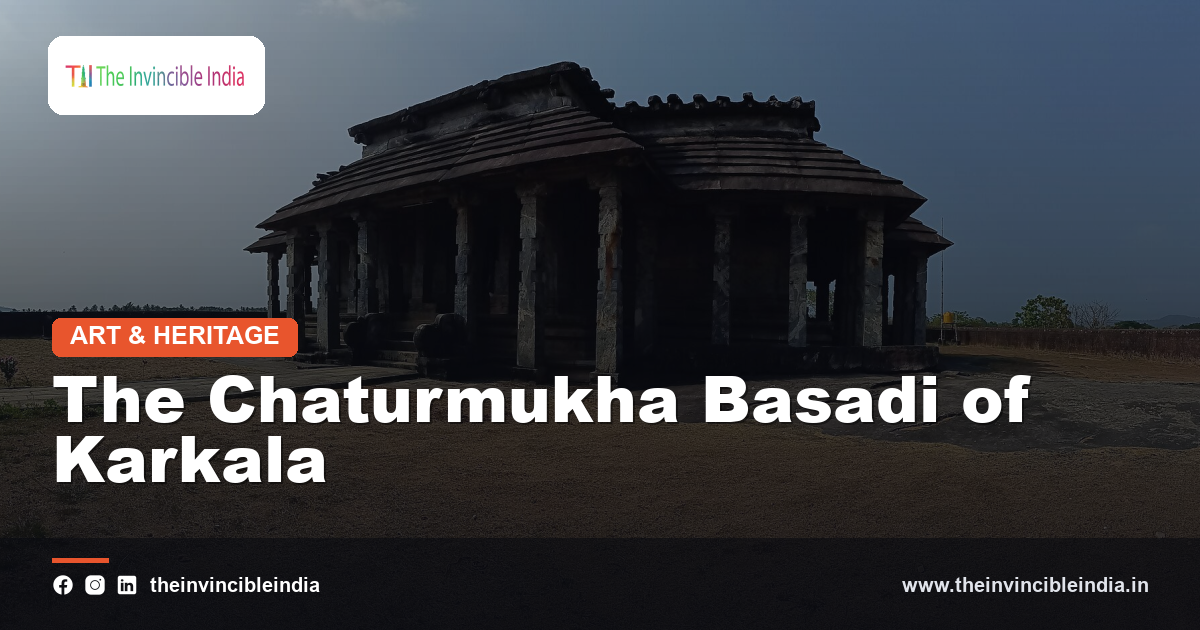
The Chaturmukha Basadi of Karkala, also written Chaturmukha basti or Chaumukh basadi, is a Jain temple, or basadi, in the town of Karkala in Udupi district, Karnataka, in southern India. A basadi is a Jain temple, and chaturmukha means four-faced, describing the temple’s distinctive plan in which identical doorways on four sides lead inward toward images of the Jain Tirthankaras, so that the shrine faces equally in all directions. The temple is generally dated to the fifteenth or sixteenth century, and tradition associates its building with the Bhairarasa Wodeyars, the local chiefs of Karkala, around 1586. It stands near the celebrated monolithic statue of Gommateshwara, or Bahubali, that is one of the great landmarks of Karkala. Part of the wider story told in the guide to Indian temple architecture, this article explains its location, history, four-faced plan, sculpture and living significance within the Jain heritage of coastal Karnataka.
Quick answer: The Chaturmukha Basadi is a four-faced Jain temple, or basadi, in the town of Karkala in Udupi district, Karnataka, India. In its chaturmukha, or four-faced, plan, identical doorways on four sides lead inward toward images of the Jain Tirthankaras, so the shrine faces equally in all directions. Generally dated to the fifteenth or sixteenth century and associated by tradition with the Bhairarasa Wodeyars around 1586, it stands near the famous monolithic Gommateshwara (Bahubali) statue of Karkala and remains a revered Jain place of worship.
Key Takeaways
- The Chaturmukha Basadi is a four-faced Jain temple, or basadi, in the town of Karkala, Udupi district, Karnataka.
- In its chaturmukha plan, identical doorways on four sides lead inward toward images of the Jain Tirthankaras.
- It is generally dated to the fifteenth or sixteenth century, traditionally to around 1586.
- Tradition associates its building with the Bhairarasa Wodeyars, the local chiefs of Karkala.
- It stands near the celebrated monolithic Gommateshwara, or Bahubali, statue of Karkala.
- It remains a revered Jain place of worship and a monument of coastal Karnataka’s Jain heritage.
The sections below explain where the temple stands, how it was built and what a visitor can still see today.
Quick Facts
| Detail | Information |
|---|---|
| Location | Karkala, Udupi district, Karnataka |
| Type | Jain temple (basadi), chaturmukha plan |
| Dedication | The Jain Tirthankaras |
| Period | Generally 15th-16th century; traditionally around 1586 |
| Builders | Associated by tradition with the Bhairarasa Wodeyars |
| Material | Dressed and carved granite |
| Key feature | Identical doorways on four sides (four-faced plan) |
| Nearby landmark | Monolithic Gommateshwara (Bahubali) statue |
| Nearest city | Udupi, coastal Karnataka |
What Is the Chaturmukha Basadi of Karkala?
The Chaturmukha Basadi of Karkala is a Jain temple, or basadi, celebrated for its distinctive four-faced plan, standing in the town of Karkala in Udupi district of coastal Karnataka. A basadi is a Jain place of worship, and chaturmukha, meaning four-faced, describes the temple’s design in which identical doorways open on all four sides and lead inward toward images of the Jain Tirthankaras, the revered teachers of the Jain faith. What distinguishes the temple is this symmetry, which allows the shrine to face equally in every direction, together with its rows of stone pillars and its dignified, austere beauty. Generally dated to the fifteenth or sixteenth century, it is associated by tradition with the Bhairarasa Wodeyars, the local chiefs of Karkala. The Chaturmukha Basadi is therefore best understood as both a living Jain shrine and a fine example of the Jain temple architecture of the region, admired for its harmonious four-faced form.
Where Is Karkala Located?
Karkala is located in Udupi district in the coastal region of Karnataka, in southern India, among the low hills and green country that lie between the Western Ghats and the Arabian Sea. The town is an old centre of Jain culture, with several basadis, the great Gommateshwara statue and other monuments that record a long history of Jain patronage in this part of the coast. Karkala lies within reach of the temple town of Udupi, famous for its Krishna shrine, and of the coastal city of Mangaluru. Roads connect the town with these larger centres, making it accessible to travellers exploring the heritage of coastal Karnataka. The surrounding landscape of hills, fields and forest reflects the character of the region. The location of Karkala therefore places the Chaturmukha Basadi in a historic Jain centre, among the monuments that make this corner of coastal Karnataka an important landscape for the study of Jain art and devotion.
What Is a Basadi in the Jain Tradition?
A basadi, also spelled basti, is a Jain temple, a place of worship in the Jain tradition, one of India’s ancient faiths founded on the teachings of the Tirthankaras. Jain temples house images of the Tirthankaras, the great spiritual teachers who are revered as having shown the path to liberation, and they are places of quiet devotion, meditation and ritual. The term basadi is widely used in Karnataka, where Jainism has a long and distinguished history, and the region preserves many such temples of great beauty. A basadi is typically marked by its serene atmosphere, its images of the Tirthankaras and its restrained, dignified architecture. Jainism teaches non-violence, truth and self-discipline, and its temples reflect these values in their calm and ordered character. Understanding the meaning of a basadi therefore helps explain the Chaturmukha Basadi of Karkala, which is a fine example of the Jain temples that enrich the heritage of coastal Karnataka.
Why Is the Temple Called Four-Faced?
The temple is called four-faced, or chaturmukha, because it is built on a symmetrical plan in which identical doorways open on all four sides and lead inward toward the images of the Tirthankaras, so that the shrine faces equally in every direction. This design means there is no single front or back; a worshipper may approach and enter from any of the four directions, and the sacred images are arranged so as to be seen from each entrance. The four-faced plan expresses an ideal of balance and completeness, fitting for a place of worship, and it is a notable form in Jain temple architecture. The symmetry gives the building a distinctive dignity and order. This arrangement sets the temple apart from shrines with a single entrance and orientation. The four-faced design of the Chaturmukha Basadi therefore defines its character, uniting architectural symmetry with devotional meaning in one of the striking Jain monuments of Karkala.
When Was the Chaturmukha Basadi Built?
The Chaturmukha Basadi is generally dated to the fifteenth or sixteenth century, with tradition associating its building with the year 1586 and with the Bhairarasa Wodeyars, the local chiefs who ruled Karkala. This period was one of active Jain patronage in the region, during which the chiefs raised temples and monuments, including the great Gommateshwara statue, as acts of devotion and marks of their support for the faith. The traditional date and attribution rest on local memory and historical study, and because such details can be debated, the temple is best described as a work of the later medieval period. Its style and plan are consistent with the Jain temple architecture of that age in coastal Karnataka. The building of the Chaturmukha Basadi therefore reflects the devotion and resources of the Jain community and its patrons in Karkala, during a flourishing period of Jain art and architecture in the coastal region of Karnataka.
Who Were the Bhairarasa Wodeyars?
The Bhairarasa Wodeyars were the local chiefs, or rulers, of Karkala, a line associated with the patronage of Jainism in this part of coastal Karnataka during the later medieval period. Such regional chiefs played an important role in the history of the coast, governing their territories and supporting religious institutions, and the Bhairarasa Wodeyars are remembered especially for their devotion to the Jain faith. Tradition credits them with the building of major monuments at Karkala, including the great monolithic statue of Gommateshwara and basadis such as the Chaturmukha Basadi. Their patronage helped make Karkala one of the notable centres of Jain culture in the region. As with many local dynasties, the full details of their history are known in part, and attributions rest on tradition and historical study. The Bhairarasa Wodeyars therefore hold an important place in the story of Karkala, as the patrons under whom its celebrated Jain monuments are traditionally said to have been raised.
How Is the Temple Laid Out?
The Chaturmukha Basadi is laid out on a symmetrical, four-faced plan, with identical doorways opening on each of the four sides and leading inward toward a central shrine that houses images of the Tirthankaras. Rows of stone pillars support the halls that surround the central space, giving the interior an ordered, spacious character typical of Jain temples. The building usually stands on a raised base and is approached by steps on its sides, in keeping with its all-directional design. The arrangement of the images allows them to be seen from each of the four entrances, reinforcing the ideal of balance that defines the temple. The restrained ornament and clean lines reflect the dignified aesthetic of Jain architecture. This layout, with its fourfold symmetry, is the temple’s defining feature. The plan of the Chaturmukha Basadi therefore unites architectural clarity with devotional purpose, creating a shrine that faces the world equally in every direction from the heart of Karkala.
Who Is Worshipped at the Temple?
The Chaturmukha Basadi is dedicated to the Jain Tirthankaras, the revered teachers of the Jain faith who are honoured as having shown the path to spiritual liberation. The images enshrined in the temple represent these Tirthankaras, and worship takes the form of quiet devotion, offerings and ritual carried out in the calm manner characteristic of Jain practice. Jainism honours twenty-four Tirthankaras in the present age, and basadis across Karnataka enshrine their images as focuses of reverence. The four-faced plan of the temple allows the sacred images to be approached and seen from every direction, reinforcing their central place in the shrine. The devotional life of the temple connects it to the wider Jain community of Karkala and the coastal region. The worship of the Tirthankaras at the Chaturmukha Basadi therefore defines its religious character, uniting the temple with the living tradition of Jain faith and practice that has flourished for centuries in coastal Karnataka.
What Do the Carvings and Pillars Show?
The carvings and pillars of the Chaturmukha Basadi reflect the restrained, dignified aesthetic of Jain temple architecture, in which clean lines and ordered form are valued as highly as elaborate ornament. The temple is marked by its rows of stone pillars, often finely shaped, which carry the halls that surround the central shrine and give the interior its spacious, serene character. Carved detail appears on the pillars, doorways and ceilings, in keeping with the traditions of the region, though the overall effect is one of calm order rather than crowded decoration. The images of the Tirthankaras within are the focus of the design, and the architecture is arranged to honour them. The granite from which the temple is built allowed durable, carefully worked surfaces. The carvings and pillars of the Chaturmukha Basadi therefore combine devotional purpose with architectural refinement, expressing the austere beauty that distinguishes the Jain monuments of Karkala and the wider coastal region of Karnataka.
What Materials and Techniques Were Used?
The Chaturmukha Basadi was built chiefly of granite, the hard, durable stone widely used for the monuments of coastal Karnataka, worked by skilled masons into dressed blocks and carved elements. Granite is more difficult to carve than the softer stones used elsewhere, so its use reflects both the resources of the patrons and the skill of the craftsmen. The stone was dressed and assembled in the traditional Indian manner, with pillars shaped and set upright to carry the halls, and the whole raised on a firm base. The four-faced plan demanded careful planning so that the four sides matched exactly and the central shrine stood in perfect symmetry. These techniques, common to the temples of the region, have allowed the basadi to survive for centuries in the humid coastal climate. The materials and techniques of the Chaturmukha Basadi therefore demonstrate the durability and skill of the stone building traditions of coastal Karnataka, suited to a monument meant to endure.
What Is the Link to the Gommateshwara Statue?
The Chaturmukha Basadi stands near the celebrated monolithic statue of Gommateshwara, also known as Bahubali, that is one of the great landmarks of Karkala and a major focus of Jain devotion. Gommateshwara, or Bahubali, is a revered figure in Jain tradition, honoured for renouncing worldly power to seek spiritual liberation, and colossal statues of him stand at several sites in Karnataka, the most famous at Shravanabelagola. The statue at Karkala, traditionally associated with the Bhairarasa Wodeyars, is among the notable monolithic images of the region and draws pilgrims and visitors. Together, the statue and the nearby basadis make Karkala an important centre of Jain heritage. The proximity of the Chaturmukha Basadi to this great statue links the two monuments within a single sacred landscape. The connection between the Chaturmukha Basadi and the Gommateshwara statue therefore enriches the Jain heritage of Karkala, uniting temple and colossal image in one devotional setting.
How Does It Compare With Other Jain Temples?
The Chaturmukha Basadi compares with other Jain temples of Karnataka as a distinguished example of the four-faced, or chaturmukha, plan, a form prized in Jain architecture for its symmetry and balance. The region of coastal and southern Karnataka preserves many basadis, from simple village shrines to richly pillared temples such as the great basadi at Moodbidri, and the chaturmukha form appears at several notable sites. Compared with temples that have a single entrance and orientation, the four-faced plan gives the Karkala basadi a special dignity and completeness. Its granite construction and restrained ornament link it to the building traditions of the coast. Studying it alongside other basadis reveals both the shared values of Jain architecture, such as serenity and order, and the variety of its forms. The Chaturmukha Basadi therefore holds an important place among the Jain temples of Karnataka, representing the four-faced ideal within the rich heritage of the coastal region.
How Is the Temple Protected and Preserved?
The Chaturmukha Basadi is preserved through heritage protection together with the continuing care of the Jain community, as with many historic temples in Karnataka. Archaeological authorities are responsible for documenting, conserving and safeguarding notable monuments, while the community and temple committees maintain worship and upkeep. Challenges in the humid coastal climate include weathering, moisture, the growth of vegetation and the wear caused by time and by visitors. Conservation work aims to stabilise the structure and protect its surfaces without altering the historic design, using methods that respect original materials. Because the precise arrangements and status of a monument can change, readers are advised to consult current information from official heritage bodies and the temple authorities. Respectful visitor behaviour, including observing the customs of a living Jain shrine, also helps protect it. The preservation of the Chaturmukha Basadi therefore depends on cooperation between officials, the Jain community and visitors who value its place in the heritage of coastal Karnataka.
How Can Visitors Experience the Basadi Respectfully?
Visitors can experience the Chaturmukha Basadi most respectfully by approaching it as a living Jain place of worship, observing the customs appropriate to a sacred shrine. Footwear is removed before entering, modest clothing is worn, and quiet, dignified behaviour is expected in keeping with the serene atmosphere of a Jain temple. The cooler months from about November to February are generally the most comfortable for travel in coastal Karnataka, which is warm and humid for much of the year. It is wise to ask about timings, as temples may open only at set hours, and to follow any guidance from the temple authorities regarding photography and conduct. Combining a visit with the nearby Gommateshwara statue and the other basadis of Karkala makes for a rich experience of the town’s Jain heritage. Experiencing the Chaturmukha Basadi with respect therefore allows the visitor to appreciate both its architecture and its living devotional meaning.
Why Does the Chaturmukha Basadi Matter?
The Chaturmukha Basadi matters as a fine example of Jain temple architecture and as a monument of the rich Jain heritage of coastal Karnataka. Its distinctive four-faced plan, in which identical doorways on all four sides lead toward the images of the Tirthankaras, expresses an ideal of balance and completeness that is both architecturally striking and devotionally meaningful. As a work associated with the Bhairarasa Wodeyars and standing near the great Gommateshwara statue, it records the devotion and patronage that made Karkala a notable centre of Jain culture. For scholars it offers insight into the chaturmukha form and the building traditions of the coast, while for pilgrims and visitors it remains a serene and dignified place of worship. The temple also reflects the enduring values of the Jain faith, such as non-violence and self-discipline. The Chaturmukha Basadi therefore matters as both a living shrine and a treasured part of the cultural heritage of Karnataka.
The Chaturmukha Basadi Today
The Chaturmukha Basadi of Karkala today remains both a living Jain shrine and a valued monument of the Jain heritage of coastal Karnataka. Its symmetrical four-faced plan, its rows of stone pillars and its images of the Tirthankaras, together with its traditional association with the Bhairarasa Wodeyars and its nearness to the great Gommateshwara statue, continue to draw pilgrims, art historians and travellers exploring the heritage of the region. The temple preserves, in its calm and ordered form, the dignified beauty and the enduring values of the Jain tradition. Continued conservation, respectful visits and scholarly study help ensure that it endures for future generations. For those exploring the Jain monuments of Karkala and the wider coast, it makes a rewarding and serene destination. The Chaturmukha Basadi thus stands as a lasting witness to the faith, patronage and artistry of the Jain community in the town of Karkala in southern Karnataka.
Sources & Further Reading
- Archaeological Survey of India (asi.nic.in).
- Department of Tourism, Government of Karnataka (karnatakatourism.org).
Frequently Asked Questions
Where is the Chaturmukha Basadi located?
The Chaturmukha Basadi is located in the town of Karkala in Udupi district of coastal Karnataka, in southern India. It stands near the famous monolithic Gommateshwara statue and is reached by road from Udupi and Mangaluru.
What does chaturmukha mean?
Chaturmukha means four-faced, describing the temple’s symmetrical plan in which identical doorways open on all four sides and lead inward toward the images of the Jain Tirthankaras. A worshipper may approach and enter from any of the four directions.
What is a basadi?
A basadi, also spelled basti, is a Jain temple, a place of worship in the Jain tradition that houses images of the Tirthankaras. The term is widely used in Karnataka, which preserves many such temples of great beauty.
When was the Chaturmukha Basadi built?
The temple is generally dated to the fifteenth or sixteenth century, with tradition associating its building with the year 1586 and with the Bhairarasa Wodeyars, the local chiefs of Karkala. It belongs to a flourishing period of Jain patronage in the region.
What is the link between the basadi and the Gommateshwara statue?
The Chaturmukha Basadi stands near the celebrated monolithic statue of Gommateshwara, or Bahubali, one of the great landmarks of Karkala. Together the statue and the basadis make Karkala an important centre of Jain heritage.
What is the best time to visit Karkala?
The best time to visit is the cooler season from about November to February. Coastal Karnataka is warm and humid for much of the year, so these months are more comfortable for travel.


