

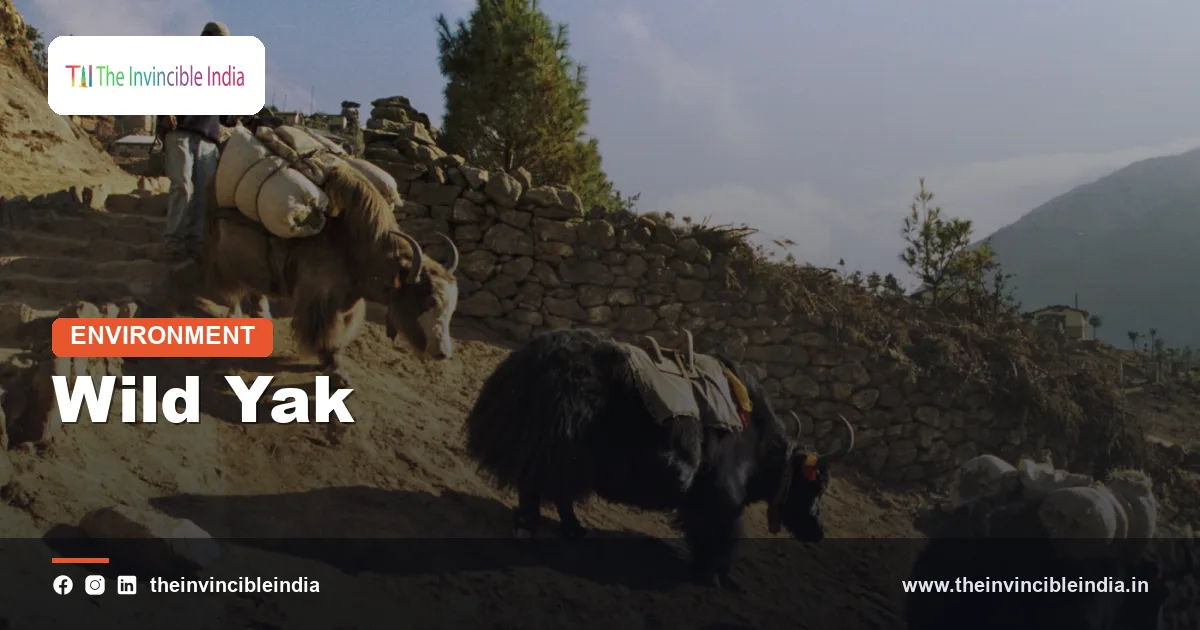
The wild yak (Bos mutus) is a massive, long-haired, high-altitude wild bovid and the wild ancestor of the domestic yak, surviving in India only in tiny numbers on the cold, windswept Changthang (Chang Tang) plateau of eastern Ladakh near the Tibetan border. Globally, the species lives mainly on the Tibetan Plateau and is classified as Vulnerable on the IUCN Red List, while in India it receives the highest level of legal protection.
Wild yak conservation in India matters because the animal is a flagship of one of the planet’s harshest ecosystems, and because the Indian population is small, remote and sensitive to hybridisation with domestic yaks, competition with livestock and disturbance. Protecting the wild yak means safeguarding the high-altitude cold desert that also supports kiang, Tibetan antelope, snow leopard and black-necked cranes.
| Attribute | Details |
|---|---|
| Common name | Wild yak (Tibetan: drong) |
| Scientific name | Bos mutus (formerly often treated as Bos grunniens mutus) |
| Family | Bovidae (cattle, bison, buffalo, antelopes and relatives) |
| Range in India | Eastern Ladakh, including the Changthang plateau near the Line of Actual Control; very small numbers |
| Global range | Tibetan Plateau and adjoining high-altitude regions, chiefly in China |
| Habitat | Alpine meadows, cold steppe and high-altitude desert, roughly 4,000 to 6,000 m |
| Size | Adult males up to about 1.6-2 m at the shoulder and weighing well over 500 kg, sometimes approaching a tonne |
| IUCN status | Vulnerable (global); India’s population is very small and tightly restricted |
| Legal protection in India | Highest protection under the Wildlife (Protection) Act, 1972 (Schedule I historically); consult current schedules |
Key Takeaways
- The wild yak (Bos mutus) is the wild ancestor of the domestic yak and one of the largest land mammals living at extreme altitude, mostly above 4,000 metres.
- In India, the wild yak survives only in very small numbers in eastern Ladakh, especially on the Changthang plateau along the Tibetan border.
- The wild yak is classified as Vulnerable on the IUCN Red List, with most of the world population on the Tibetan Plateau in China.
- Wild yaks are adapted to extreme cold by a thick undercoat, long skirt-like hair, large lungs and heart, and a body built to conserve heat.
- The main threats to the wild yak are hybridisation with domestic yaks, hunting, competition with livestock for pasture and growing disturbance in remote habitats.
- Wild yak conservation in India depends on strict legal protection, protected areas in Ladakh and careful monitoring of a remote border region.
What is the wild yak?
The wild yak is a large, shaggy, dark-coated wild bovid native to the high plateaus of Central Asia, and it is the species from which the domestic yak was derived thousands of years ago. Its scientific name is Bos mutus, and it belongs to the same family as cattle, bison and buffalo.
The wild yak differs markedly from its domestic descendant. Wild animals are much larger, darker and more heavily built, with a pronounced shoulder hump, long curved horns and a thick fringe of hair hanging from the flanks and belly nearly to the ground. Domestic yaks, by contrast, are smaller, come in a variety of colours including white and brown, and are tame.
The species has been known to the high-altitude pastoral peoples of the Himalaya and Tibet for millennia, and features in local folklore and Tibetan Buddhist culture. In scientific literature, the wild yak has sometimes been treated as a subspecies of the domestic yak, but most modern authorities recognise it as a distinct species, Bos mutus, while the domestic form is called Bos grunniens.
What does the wild yak look like and how big is it?
The wild yak is a heavily built, dark brown to black bovid with a high shoulder hump, a low-slung head, curved horns and a long, shaggy coat. Adult males are considerably larger than females, standing roughly 1.6 to 2 metres at the shoulder and weighing from several hundred kilograms to nearly a tonne in the largest individuals, though figures vary by source.
Both sexes carry horns, which in bulls may be well over half a metre to a metre long and sweep outward and upward. The coat consists of a dense, soft undercoat topped with coarse long outer hair, and the skirt of hair along the sides acts as insulation against snow and wind. Calves are born in early summer and are usually brown.
The tail is long and bushy, and the animal often holds it raised when alarmed. Wild yaks are generally shy of people and flee when approached, but bulls, especially wounded or in rut, can be dangerous.
How is the wild yak adapted to extreme cold and altitude?
The wild yak is adapted to extreme cold and thin air through a thick insulating coat, a large chest cavity housing big lungs and a large heart, and physiological traits that help it use oxygen efficiently at high altitude. These traits allow it to survive temperatures that can fall far below freezing and elevations where oxygen is scarce.
Key adaptations include:
- Insulation: a double coat with a dense underfur and long guard hairs that shield the body from wind and snow.
- Body shape: a compact, bulky form that reduces heat loss, and few sweat glands, which limits water and heat loss.
- Respiration: large lungs and a large heart relative to body size, supporting oxygen uptake in thin air.
- Diet and digestion: a rumen that digests tough, low-quality grasses and sedges efficiently.
- Behaviour: using snow as a water source and moving to lower, sheltered valleys in harsh winters.
Genetic studies on yaks have identified changes in genes related to oxygen use and energy metabolism, though the precise details are still the subject of research. A side effect of these adaptations is that wild yaks tolerate heat poorly and are restricted to cold regions.
Where does the wild yak live in India?
The wild yak lives in India only in eastern Ladakh, chiefly on the Changthang plateau, the Indian extension of the Tibetan Plateau, where it is found in remote, high-altitude cold desert and steppe near the border with Tibet. Historically, it may have occurred in some other Himalayan border regions such as parts of Sikkim and Arunachal Pradesh, but reliable records of resident populations there are scarce.
Indian wild yaks are generally associated with remote valleys near places like the Chang Chenmo valley and the high basins around Hanle and Pangong, as well as surrounding border areas, though exact movements are poorly documented. Because many of these areas lie close to the Line of Actual Control and are militarily sensitive, survey access is limited and systematic data are hard to gather.
Population figures for India are uncertain, and estimates in the literature range from a few dozen to a few hundred animals depending on the source and period. Such figures should be treated as approximate, and some animals may move between India and Tibet.
Wild yak habitat features
- Altitude generally between 4,000 and 6,000 metres.
- Alpine meadows, cold steppe and rocky high-altitude desert.
- Seasonal movements between summer pastures and sheltered winter areas.
- Availability of grasses, sedges and snowmelt water.
What does the wild yak eat and how does it live?
The wild yak is a herbivore that grazes mainly on grasses and sedges, supplemented by herbs and lichens, and it lives in herds that vary in size by season. Females and young typically form larger groups, while adult males are more solitary or form small bachelor herds outside the breeding season.
Mating occurs in late summer to autumn, when bulls compete for females, and calves are born the following spring or early summer after a gestation of roughly nine months. A single calf is normal. Yaks are slow breeders, which makes populations slow to recover once they decline.
Seasonal movements follow forage and snow conditions: animals use higher pastures in summer and lower, more sheltered valleys in winter. In very cold weather, they can paw through snow to reach food. Wolves and snow leopards may take calves, though adult wild yaks have few natural predators.
How is the wild yak related to the domestic yak?
The domestic yak (Bos grunniens) descends from the wild yak and was domesticated by high-altitude herders thousands of years ago on and around the Tibetan Plateau. Today, millions of domestic yaks provide milk, meat, wool, transport and fuel in the form of dung for communities in the Himalaya, Tibet, Central Asia and Mongolia.
In India, domestic yaks are kept in Ladakh, Himachal Pradesh, Uttarakhand, Sikkim and Arunachal Pradesh. The ICAR National Research Centre on Yak at Dirang in Arunachal Pradesh works on yak research and breeding. Yak milk products such as churpi, a hard cheese, are important in Himalayan food economies.
Yaks also hybridise with cattle to produce animals such as the dzo (male) and dzomo (female), which are used for farming at middle altitudes. The relationship between wild and domestic yaks is the root of one of the major conservation concerns: domestic animals can interbreed with wild ones.
Why is the wild yak threatened?
The wild yak is threatened by hunting, hybridisation with domestic yaks, competition with livestock for pasture, habitat disturbance and long-term climate change. Of these, interbreeding with domestic yaks is widely regarded as a particular risk for the genetic integrity of wild populations.
Historically, wild yaks were hunted for meat, hides and trophies, and were reduced in many areas of their range. Hunting has declined where enforcement is strong, but illegal killing still occurs in parts of the Tibetan Plateau. Hybridisation happens when wild bulls mate with domestic cows grazing in high pastures, or when domestic bulls stray into wild herds.
In India, additional pressures include seasonal grazing by nomadic herders and their livestock in Changthang, disturbance linked to military and civilian infrastructure in border areas, increasing tourism and road traffic, and potential disease transmission from livestock. Climate change may alter pasture quality and snow patterns, with effects that are still being studied.
Threats and their effects
| Threat | Effect on wild yaks |
|---|---|
| Hunting and poaching | Direct mortality of adults, especially large males |
| Hybridisation with domestic yaks | Dilutes wild genetics and may lower adaptation to harsh conditions |
| Competition with livestock | Reduces forage and pushes yaks to poorer areas |
| Disease from livestock | Risk of transmission of pathogens to wild herds |
| Disturbance and infrastructure | Fragments habitat and disrupts movement in border areas |
| Climate change | Alters pasture, snow cover and water availability |
How is the wild yak protected in India?
The wild yak is protected in India under the Wildlife (Protection) Act, 1972, which gives it the highest tier of protection traditionally associated with Schedule I, making hunting a serious offence. The exact schedule arrangement has been revised through amendments, so the current text of the Act should be checked for the present position.
Internationally, the wild yak is listed in Appendix I of the Convention on International Trade in Endangered Species of Wild Fauna and Flora (CITES), which generally prohibits commercial international trade in the species. The IUCN Red List categorises the wild yak as Vulnerable, reflecting a global population that is limited and under pressure.
Within Ladakh, protected areas such as the Changthang Cold Desert Wildlife Sanctuary, the Karakoram Wildlife Sanctuary and the Hanle area provide a framework for habitat protection. The Changthang sanctuary in particular covers large areas of high-altitude cold desert that shelter several rare species, including the Tibetan antelope, Tibetan wild ass (kiang), snow leopard and black-necked crane.
What other species share the wild yak’s habitat?
The wild yak shares its Changthang habitat with a distinctive group of high-altitude species adapted to cold desert and steppe. Protecting the wild yak therefore helps maintain the wider ecosystem.
- Kiang (Tibetan wild ass): a large wild equid found in herds on the plateau.
- Tibetan antelope (chiru): a rare antelope, historically hunted for its fine wool.
- Tibetan gazelle and Tibetan argali: other grazers of the high steppe.
- Snow leopard and Tibetan wolf: top predators of the region.
- Black-necked crane: a high-altitude wetland bird that breeds in Ladakh.
Pastoral communities such as the Changpa nomads, who herd pashmina goats, sheep and yaks, also live in the region. Balancing their livelihoods with wildlife conservation is a continuing challenge, and community-based approaches are increasingly discussed.
What is needed to conserve the wild yak in India?
Conserving the wild yak in India requires reliable population surveys, genetic monitoring, management of grazing and hybridisation risks, strong enforcement against poaching and cooperation with local communities. Because the Indian population is small, even minor losses can matter.
Priority measures commonly suggested by conservation biologists include:
- Regular surveys using vantage-point counts, camera traps and, where permitted, drones to estimate numbers and movements.
- Genetic sampling to detect hybridisation and assess diversity.
- Regulating livestock grazing near key wild yak areas and discouraging free-ranging domestic yak bulls.
- Veterinary health programmes for livestock to reduce disease risk.
- Involving herders through incentives, awareness and benefit-sharing.
- Coordinating with security agencies so that infrastructure and patrols support, rather than harm, wildlife.
- Regional cooperation with neighbouring countries, since animals may cross borders.
Bottom Line
The wild yak is an iconic survivor of the Tibetan Plateau, but in India it clings to a narrow foothold in eastern Ladakh. With its numbers small and its habitat remote and politically sensitive, conservation depends on strict protection, careful monitoring and sustainable coexistence with herders and their livestock.
Frequently Asked Questions
What is a wild yak?
A wild yak (Bos mutus) is a huge, shaggy, high-altitude bovid native to the Tibetan Plateau and adjoining regions, and it is the wild ancestor of the domestic yak. It is darker, larger and more heavily built than domestic yaks. It lives mostly above 4,000 metres.
Where are wild yaks found in India?
Wild yaks in India are found in eastern Ladakh, mainly on the Changthang plateau near the Tibetan border. The Indian population is very small and lives in remote, high-altitude areas. Exact numbers are uncertain because the region is difficult to survey.
Is the wild yak endangered?
The wild yak is classified as Vulnerable on the IUCN Red List, one step below Endangered. Most wild yaks live in China, and the Indian population is tiny and fragile. Threats include hunting, hybridisation with domestic yaks and competition with livestock.
How does the wild yak survive in extreme cold?
The wild yak survives extreme cold through a thick double coat, a bulky body that conserves heat and large lungs and heart suited to thin air. It also has a digestive system that can process tough high-altitude grasses. These traits let it live at altitudes of 4,000 to 6,000 metres.
What is the difference between wild and domestic yaks?
Wild yaks are larger, darker and heavier, with a more pronounced hump and long skirt of hair, while domestic yaks are smaller, tamer and come in different colours. Domestic yaks (Bos grunniens) were bred from wild yaks thousands of years ago and are kept for milk, meat, wool and transport. The two can interbreed, which creates a conservation concern for wild populations.
How is the wild yak protected in India?
The wild yak is protected under the Wildlife (Protection) Act, 1972, which prohibits hunting and gives it top-tier legal status, and it is covered by CITES Appendix I internationally. Protected areas in Ladakh, such as the Changthang Cold Desert Wildlife Sanctuary, safeguard parts of its habitat. Because schedules are amended from time to time, the latest official listing should be checked.
{“@context”:”https://schema.org”,”@graph”:[{“@type”:”FAQPage”,”mainEntity”:[{“@type”:”Question”,”name”:”What is a wild yak?”,”acceptedAnswer”:{“@type”:”Answer”,”text”:”A wild yak (Bos mutus) is a huge, shaggy, high-altitude bovid native to the Tibetan Plateau and adjoining regions, and it is the wild ancestor of the domestic yak. It is darker, larger and more heavily built than domestic yaks. It lives mostly above 4,000 metres.”}},{“@type”:”Question”,”name”:”Where are wild yaks found in India?”,”acceptedAnswer”:{“@type”:”Answer”,”text”:”Wild yaks in India are found in eastern Ladakh, mainly on the Changthang plateau near the Tibetan border. The Indian population is very small and lives in remote, high-altitude areas. Exact numbers are uncertain because the region is difficult to survey.”}},{“@type”:”Question”,”name”:”Is the wild yak endangered?”,”acceptedAnswer”:{“@type”:”Answer”,”text”:”The wild yak is classified as Vulnerable on the IUCN Red List, one step below Endangered. Most wild yaks live in China, and the Indian population is tiny and fragile. Threats include hunting, hybridisation with domestic yaks and competition with livestock.”}},{“@type”:”Question”,”name”:”How does the wild yak survive in extreme cold?”,”acceptedAnswer”:{“@type”:”Answer”,”text”:”The wild yak survives extreme cold through a thick double coat, a bulky body that conserves heat and large lungs and heart suited to thin air. It also has a digestive system that can process tough high-altitude grasses. These traits let it live at altitudes of 4,000 to 6,000 metres.”}},{“@type”:”Question”,”name”:”What is the difference between wild and domestic yaks?”,”acceptedAnswer”:{“@type”:”Answer”,”text”:”Wild yaks are larger, darker and heavier, with a more pronounced hump and long skirt of hair, while domestic yaks are smaller, tamer and come in different colours. Domestic yaks (Bos grunniens) were bred from wild yaks thousands of years ago and are kept for milk, meat, wool and transport. The two can interbreed, which creates a conservation concern for wild populations.”}},{“@type”:”Question”,”name”:”How is the wild yak protected in India?”,”acceptedAnswer”:{“@type”:”Answer”,”text”:”The wild yak is protected under the Wildlife (Protection) Act, 1972, which prohibits hunting and gives it top-tier legal status, and it is covered by CITES Appendix I internationally. Protected areas in Ladakh, such as the Changthang Cold Desert Wildlife Sanctuary, safeguard parts of its habitat. Because schedules are amended from time to time, the latest official listing should be checked.”}}]}]}


