

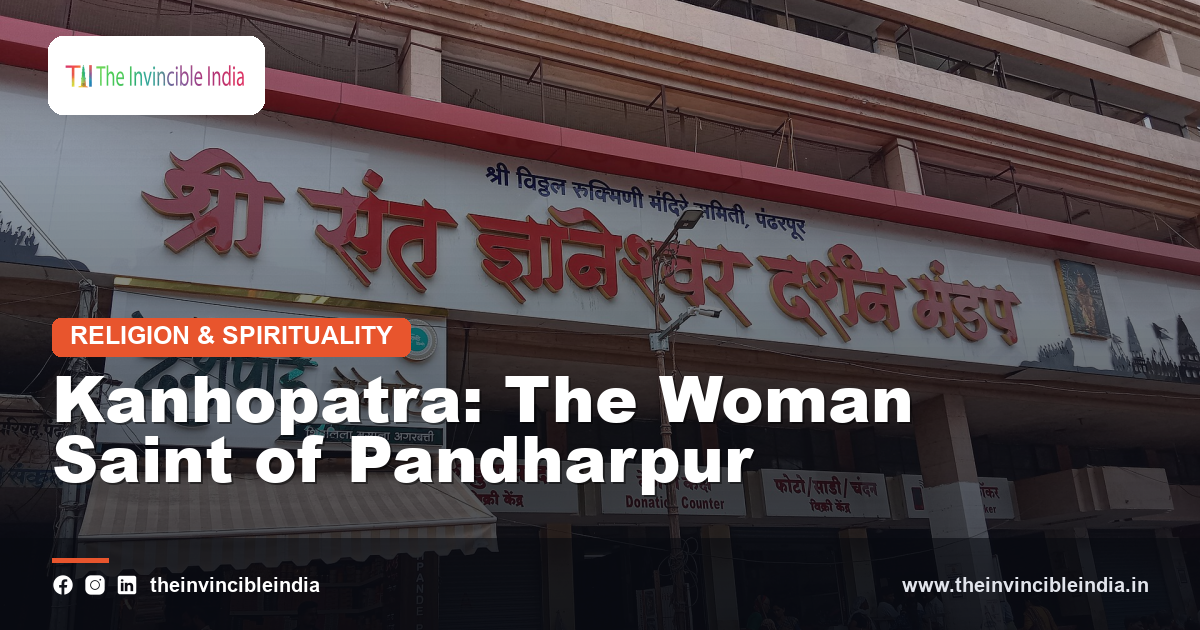
Kanhopatra was a woman saint of the Varkari tradition of Maharashtra and a devotee of Vitthal, the form of Vishnu enshrined at Pandharpur, generally placed by tradition around the fifteenth century. Devotional tradition holds that she was the daughter of a dancer, a woman of great beauty, who turned from the prospect of a life at court to surrender herself wholly to Vitthal, and that in the end she merged with the deity at Pandharpur. A few of her abhangas, the devotional songs of the tradition, survive and express her ardent love and longing for the Lord. Her story is cherished as devotional hagiography and should be received in that spirit rather than as documented history. Her life belongs to the wider world of the Bhakti movement and the devotion of the Varkari saints, and she is honoured as one of the beloved women among them.
Quick answer: Kanhopatra was a woman saint of the Varkari tradition of Maharashtra and a devotee of Vitthal of Pandharpur, generally placed by tradition around the fifteenth century. Devotional tradition holds that she was a dancer’s daughter who surrendered herself to Vitthal rather than a life at court, and that she merged with the deity. A few of her abhangas survive, and her story is cherished as devotional hagiography.
Key Takeaways
- Kanhopatra was a woman saint of the Varkari tradition and a devotee of Vitthal of Pandharpur.
- She is generally placed by tradition around the fifteenth century.
- Tradition holds that she was a dancer’s daughter who surrendered to Vitthal rather than a life at court.
- Tradition holds that in the end she merged with the deity at Pandharpur.
- A few of her abhangas, the devotional songs of the tradition, survive.
- Her story is cherished as devotional hagiography rather than documented history.
The sections below explain her life as told by devotional tradition, her name, the Varkari tradition, the worship of Vitthal, her early life and surrender, the tradition of her merging with the deity, her abhangas and her continuing place in devotion.
Quick Facts
| Detail | Information |
|---|---|
| Tradition | Varkari sampradaya, Maharashtra |
| Era | Around the fifteenth century, generally placed |
| Region | Maharashtra; associated with Pandharpur |
| Language of works | Marathi |
| Principal works | A few surviving abhangas |
| Deity | Vitthal (Vithoba), a form of Vishnu |
| Known for | A woman saint who surrendered wholly to Vitthal |
| Principal shrine | Associated with the Vitthal temple at Pandharpur |
Who Was Kanhopatra?
Kanhopatra was a woman saint of the Varkari tradition of Maharashtra and a devotee of Vitthal of Pandharpur, generally placed by tradition around the fifteenth century. She is honoured as one of the beloved women saints of the tradition, remembered for her ardent love for the Lord.
Devotional tradition pictures her as a woman of great beauty, the daughter of a dancer, who turned from the world to surrender herself wholly to Vitthal, and whose devotion found voice in abhangas. Her story is bound to Pandharpur, the holy town of the Varkari fellowship, where tradition holds that she merged with the deity. Because her life comes down through devotional tradition rather than documented record, it should be received as hagiography, in a spirit of reverence. Her standing as a woman saint of the Varkari tradition, remembered for her surrender to Vitthal and for her surviving songs, is firmly and lovingly held in the memory of Maharashtra.
What Does Her Name Signify?
The saint is known as Kanhopatra, a name by which she is remembered among the women saints of the Varkari tradition, and recognising it helps a reader place her among the devotees of Vitthal. The name is cherished in the devotion of Maharashtra as that of a beloved woman saint.
In the Varkari tradition the names of the saints are honoured with reverence, and Kanhopatra is remembered as the name of a woman who gave herself wholly to the Lord of Pandharpur. The devotion attached to her name reflects the love in which she is held by the faithful. Recognising her name and its place in the tradition helps a reader follow her story and appreciate her standing among the saints. Her name thus marks her as a revered woman saint of the Varkari fellowship, and recognising it helps a reader approach the devotional tradition that cherishes her memory.
What Is the Varkari Tradition?
The Varkari tradition is the devotional movement of Maharashtra centred on the worship of Vitthal of Pandharpur, marked by the singing of abhangas, the pilgrimage to the shrine and a devotion open to people of every walk of life. Kanhopatra is honoured among its saints.
The word Varkari refers to one who undertakes the vari, the regular pilgrimage to Pandharpur, and the tradition gathers a great company of saint-poets whose songs express a simple and heartfelt devotion to the Lord. It teaches that loving devotion to Vitthal is open to all, whatever their caste, calling or station, and it cherishes the chanting of the divine name and the singing of devotional song. Kanhopatra belongs to this fellowship, honoured as one of its beloved women saints. Understanding the Varkari tradition helps a reader see the devotional world in which her life and song found their meaning and the openness that welcomed a woman of her station into the company of the saints.
Who Is Vitthal, the Lord of Pandharpur?
Vitthal, also called Vithoba or Panduranga, is the form of the divine enshrined at Pandharpur and worshipped as a form of Vishnu, often understood as Krishna, who stands upon a brick with his hands upon his hips. He is the beloved Lord of the Varkari tradition and the focus of Kanhopatra’s devotion.
The image of Vitthal at Pandharpur is cherished as the heart of the tradition, drawing pilgrims from across Maharashtra who come singing the praises of the Lord. The saint-poets sang of Vitthal as a near and gracious God, a loving presence close to his devotees. Kanhopatra is remembered as one who surrendered herself wholly to Vitthal and poured out her love for him in abhangas. Understanding the place of Vitthal helps a reader appreciate the devotion that filled her life and the shrine at Pandharpur around which her story and the whole Varkari tradition gather.
What Is the Story of Her Early Life?
Devotional tradition holds that Kanhopatra was the daughter of a dancer and a woman of great beauty, raised in a world far from the company of saints, yet drawn by her heart to the love of Vitthal. This account of her early life is cherished as hagiography rather than documented history.
Tradition tells that she was born into the household of a dancer and grew up amid the world of music and beauty, yet that her soul turned toward the Lord of Pandharpur. The stories dwell on the contrast between her outward circumstances and the inward devotion that grew within her, a contrast that makes her surrender to Vitthal all the more cherished. Because this account comes down through devotional tradition, careful writers present it explicitly as hagiography, honouring its meaning for the faithful while not treating it as chronicle. The story of her early life sets the stage for the devotion that became the heart of her memory.
Why Did She Surrender to Vitthal?
Devotional tradition holds that Kanhopatra surrendered herself wholly to Vitthal rather than accept a life at court, choosing the love of the Lord above worldly station and glory. This surrender is the heart of her story and the reason she is cherished among the saints.
Tradition relates that, faced with the prospect of a life at court, Kanhopatra turned instead to Pandharpur and gave herself entirely to Vitthal, seeking refuge in the Lord rather than in worldly power. Her choice is cherished as an image of the soul that prefers devotion to all the honours of the world. The stories dwell on her longing for Vitthal and her trust that he alone was her true refuge. Because this account is devotional tradition, careful writers present it as hagiography, honouring its meaning for the faithful. Her surrender to Vitthal is remembered as a cherished example of wholehearted devotion that chose the Lord above the world.
What Is the Tradition of Her Merging With the Deity?
Devotional tradition holds that in the end Kanhopatra merged with Vitthal at Pandharpur, finding her final refuge in the Lord to whom she had given herself wholly. This cherished account is received as hagiography rather than documented history.
Tradition relates that Kanhopatra, seeking refuge in Vitthal, was taken up into the deity at Pandharpur, so that her surrender was crowned by union with the Lord she loved. The story is cherished as the culmination of her devotion, an image of the soul that is received at last into the divine. A place associated with her memory is honoured in connection with the Vitthal temple at Pandharpur. Because this account comes down through devotional tradition, careful writers present it explicitly as hagiography, honouring its meaning for the faithful while not treating it as chronicle. The tradition of her merging with the deity is the beloved climax of the story of Kanhopatra.
What Are Her Abhangas?
Abhangas are the devotional songs of the Varkari tradition, verses in Marathi that praise Vitthal and express the love and longing of the devotee, and a few of Kanhopatra’s abhangas survive. Through them her devotion was given voice and handed down to later generations.
The abhang is a form cherished across the Varkari tradition, sung on pilgrimage and in worship, carrying the heartfelt devotion of the saint-poets to the people. A small number of abhangas attributed to Kanhopatra survive, and they are treasured as the voice of her ardent love for the Lord of Pandharpur. Because these songs belong to the living tradition and are sung within it, careful accounts describe them in general terms rather than claiming detailed knowledge of every verse. The surviving abhangas of Kanhopatra are cherished as a precious trace of her devotion and as the voice of a woman saint among the singing saints of Maharashtra.
What Themes Fill Her Songs?
The surviving abhangas of Kanhopatra are filled with the themes of love and longing for Vitthal, of refuge sought in the Lord and of the soul that gives itself wholly to the divine. These themes are the heart of her devotional song and of her memory.
Her songs give voice to a heartfelt and ardent devotion, dwelling on her longing for Vitthal, her trust in him as her only refuge and her surrender of all to his love. They share in the spirit of the abhangas of the other saints of the tradition, yet they carry the particular voice of a woman who turned from the world to the Lord. Because the songs belong to the living tradition, careful accounts describe their themes in general terms rather than claiming detailed knowledge of every verse. For devotees the themes of her abhangas give voice to their own love for Vitthal, which is why her songs remain cherished in the devotion of Maharashtra.
Why Is She Honoured as a Woman Saint?
Kanhopatra is honoured as a woman saint of the Varkari tradition because her wholehearted surrender to Vitthal and her surviving songs won her a cherished place among the devotees of the Lord, in a fellowship that welcomed saints of every station. Her memory is treasured as that of a beloved woman among the saints.
The Varkari tradition cherishes a number of women saints whose devotion is honoured alongside that of the men, and Kanhopatra holds a special place among them. Her story, of a woman who turned from the world to give herself wholly to Vitthal, is cherished as an image of devotion that transcends station and circumstance. Her abhangas keep her voice alive in the tradition. For devotees the honour given to Kanhopatra as a woman saint reflects the openness of the Varkari fellowship, which welcomed the love of the Lord from all who offered it, and which cherishes her memory among its beloved saints.
Where Is Her Memory Kept at Pandharpur?
The memory of Kanhopatra is kept at Pandharpur, the holy town of the Varkari tradition, where a place associated with her is honoured in connection with the Vitthal temple, the shrine to which her devotion was given. Pandharpur is the chief home of her memory.
Pandharpur, the cherished centre of the worship of Vitthal, draws pilgrims from across Maharashtra, and the memory of Kanhopatra is woven into the devotion of the town where tradition holds that she merged with the Lord. A place linked to her memory is honoured there, keeping alive the story of the woman saint and her surrender to Vitthal. The town is thus bound in the devotional geography of Maharashtra to her memory. Understanding where her memory is kept at Pandharpur helps a reader place the honour given to Kanhopatra within the living devotion that gathers around the shrine of the Lord she loved.
When Did Kanhopatra Live?
Kanhopatra is generally placed by tradition around the fifteenth century, in the age of the Varkari saints of Maharashtra, and because her story comes down through devotional tradition it is wise to describe her era in general terms rather than fix exact dates. She is associated with Pandharpur and the worship of Vitthal.
Her life is placed in the Marathi country during a period cherished as a great age of saints, when the Varkari tradition and the worship of Vitthal flourished. Because the accounts of her life come through devotional tradition and hagiography, careful writers describe her general period and her associations with reverence while leaving finer details open, in keeping with the respectful caution the sources invite. Her era is remembered as a time of the flowering of devotion to the Lord of Pandharpur, when a woman of her story could find a cherished place among the saints.
How Is She Remembered Among the Varkari Saints?
Kanhopatra is remembered among the great fellowship of Varkari saints, the saint-poets of Pandharpur who sang the praises of Vitthal, and she holds an honoured place among them as a beloved woman saint. Her name is recalled with those of the other cherished saints of Maharashtra.
The Varkari tradition cherishes a great company of saints who arose from every walk of life, and Kanhopatra is counted among them, remembered for her surrender to Vitthal, her surviving abhangas and her story of devotion. Her place in this fellowship reflects the spirit of the tradition, which gathered saints of many kinds, women and men alike, into one devotion. For devotees the remembrance of Kanhopatra among the Varkari saints keeps alive the story of the woman who turned from the world to give herself wholly to the Lord of Pandharpur, and who is cherished among the beloved saints of the tradition.
Why Does Kanhopatra Still Matter Today?
Kanhopatra still matters today because her story of wholehearted surrender to Vitthal and her surviving abhangas remain cherished in the Varkari tradition, and because she is honoured as one of the beloved women saints of Maharashtra. Her memory continues to inspire the devotion of the faithful.
For devotees she is the woman who turned from the world to give herself wholly to the Lord of Pandharpur, a cherished example of devotion that transcends station and circumstance. Her abhangas keep her voice alive in the tradition. Her story comes down through devotional hagiography, and careful readers treat it as such, honouring its meaning for the faithful while recognising its character. Her enduring importance lies in her place among the women saints of the Varkari tradition and in the love for Vitthal that her story and her songs still awaken in the hearts of the faithful.
Kanhopatra Today
Kanhopatra today is remembered as a beloved woman saint of the Varkari tradition, a devotee who surrendered herself wholly to Vitthal of Pandharpur and whose surviving abhangas express her ardent love for the Lord. Her memory endures as a cherished presence among the saints of Maharashtra.
Through her story of surrender and her voice in song, she became an enduring image of wholehearted devotion that chose the Lord above the world. Her life comes down through devotional tradition, and its episodes, including the tradition of her merging with the deity, are received as hagiography, honoured for their meaning rather than treated as documented chronicle. Her legacy endures as a reminder that the love of the Lord is open to all who offer it, and that the devotion of a woman saint can find a cherished and lasting place in the heart of the Varkari tradition.
Sources & Further Reading
- Ministry of Culture, Government of India (indiaculture.gov.in).
- Sahitya Akademi general references on Marathi devotional literature.
Frequently Asked Questions
Who was Kanhopatra?
Kanhopatra was a woman saint of the Varkari tradition of Maharashtra and a devotee of Vitthal of Pandharpur, generally placed by tradition around the fifteenth century. Devotional tradition holds that she surrendered herself wholly to Vitthal, and a few of her abhangas survive, expressing her ardent love for the Lord.
What is the story of Kanhopatra?
Devotional tradition holds that Kanhopatra was a dancer’s daughter who, rather than accept a life at court, surrendered herself wholly to Vitthal of Pandharpur, and that in the end she merged with the deity. Her story is cherished as devotional hagiography rather than documented history.
What are the abhangas of Kanhopatra?
Abhangas are the devotional songs of the Varkari tradition, verses in Marathi that praise Vitthal and express the devotee’s love and longing. A few of Kanhopatra’s abhangas survive and are treasured as the voice of her ardent devotion to the Lord of Pandharpur.
Why is Kanhopatra honoured as a woman saint?
Kanhopatra is honoured as a woman saint of the Varkari tradition because her wholehearted surrender to Vitthal and her surviving songs won her a cherished place among the devotees of the Lord. Her memory reflects the openness of the Varkari fellowship, which welcomed the love of the Lord from all who offered it.
Where is Kanhopatra associated?
Kanhopatra is associated with Pandharpur, the holy town of the Varkari tradition and the home of the Vitthal temple, where tradition holds that she merged with the deity. A place linked to her memory is honoured there, keeping alive the story of the woman saint and her devotion.
When did Kanhopatra live?
Kanhopatra is generally placed by tradition around the fifteenth century, in the age of the Varkari saints of Maharashtra. Because her story comes down through devotional tradition, her era is best described in general terms rather than by exact dates.


