

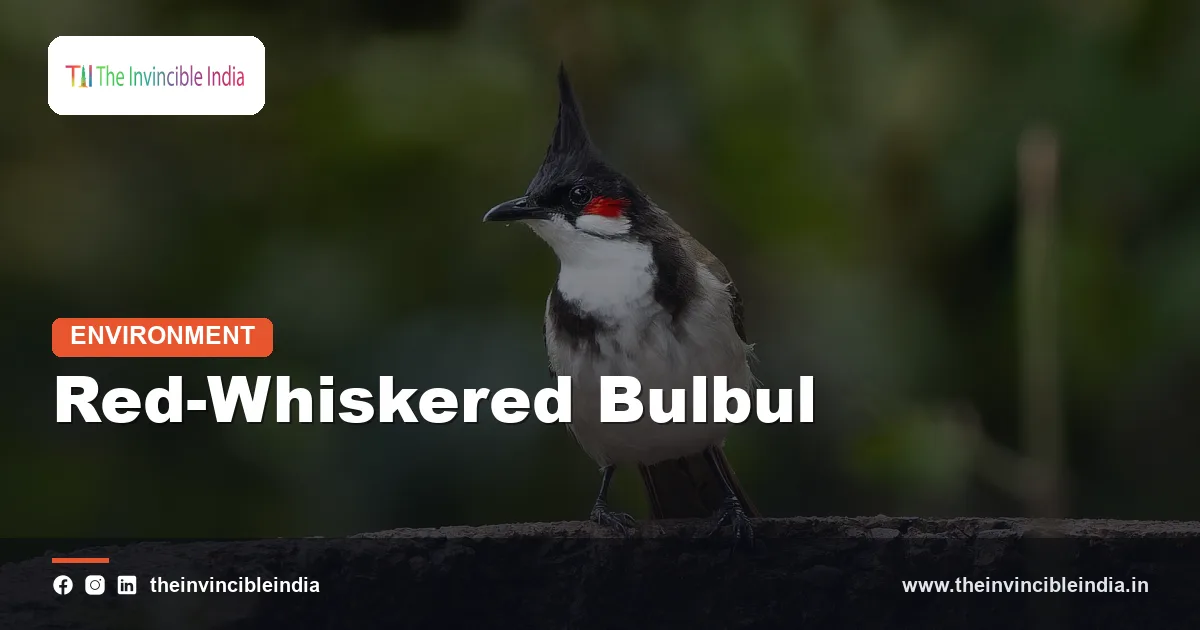
The red-whiskered bulbul (Pycnonotus jocosus) is a medium-small songbird of South and Southeast Asia, recognisable by its pointed black crest, the red patch behind each eye that gives the bird its “whisker”, and a crimson patch under the tail. It is one of the most popular and cheerful garden birds in India, loved for its lively calls, and it has also been carried far beyond Asia, where escaped cage birds have formed introduced populations in several warm regions.
This explainer covers how to identify the red-whiskered bulbul, where it lives in India, what it eats, how it calls, how it nests, and how it became an introduced bird abroad. It was last reviewed on 23 October 2026, and population statements are kept general because bird numbers change.
Red-Whiskered Bulbul Quick Facts
| Common name | Red-whiskered bulbul |
|---|---|
| Scientific name | Pycnonotus jocosus |
| Family | Pycnonotidae (bulbuls) |
| Size | About 20 cm long |
| Key features | Tall black crest, red cheek patch, white cheek, red vent, white-tipped tail |
| Diet | Fruit, nectar and insects |
| Native range | Indian subcontinent, Southeast Asia and southern China |
| Introduced range | Parts of Australia, Hawaii, Florida, Fiji, Mauritius and other regions |
| IUCN status | Least Concern |
Key Takeaways
- The red-whiskered bulbul is a crested songbird, about 20 cm long, with a red patch behind the eye and a crimson patch under the tail.
- The red-whiskered bulbul is native to the Indian subcontinent and Southeast Asia, and it is common in gardens, light woodland and village edges across much of India.
- The red-whiskered bulbul eats mainly small fruits and berries, and it also takes nectar, flower parts and insects.
- Males and females of the red-whiskered bulbul look alike, and both sing a cheerful, varied series of whistled phrases.
- The red-whiskered bulbul has been introduced, mostly through escaped cage birds, into parts of Australia, Hawaii, Florida and other warm regions.
- The IUCN classifies the red-whiskered bulbul as Least Concern, although in introduced regions it is monitored as a potentially invasive bird.
What is the red-whiskered bulbul?
The red-whiskered bulbul is a passerine bird in the bulbul family, Pycnonotidae, and it is native to southern Asia. Its scientific name, Pycnonotus jocosus, was given by Carl Linnaeus in the eighteenth century, and the Latin species name jocosus means “merry” or “jesting”, which suits its cheerful manner.
Bulbuls are a family of mostly fruit-eating, noisy and sociable songbirds found in Africa and Asia. The word “bulbul” in Indian languages is often used for several birds, and in Persian and Urdu poetry it usually refers to the nightingale, which is a different bird. In ornithology, bulbul refers to the Pycnonotidae family.
In India the red-whiskered bulbul is one of the best-known members of its family, along with the red-vented bulbul, the white-browed bulbul and the Himalayan bulbul.
How do you identify a red-whiskered bulbul?
A red-whiskered bulbul is identified by its tall black crest, a bright red spot behind the eye, a white cheek framed by a thin black line and a crimson patch under the tail. The back is brown, the underparts are whitish, and the tail has a white tip.
The main field marks are as follows.
- Crest: a narrow, pointed black crest that the bird raises and lowers while calling or when alarmed.
- Red whisker: a small red patch just behind and below the eye, which is easier to see when the bird turns its head.
- Cheek and breast: a white cheek bordered by a black moustache, and a darker patch on each side of the upper breast that can look like a partial collar.
- Red vent: a crimson patch under the tail, visible when the bird flies or perches with its tail down.
- Tail: brown with white tips on the outer feathers.
The red-whiskered bulbul is often confused with the red-vented bulbul, but the latter lacks the tall crest, the red whisker and the white cheek and has a white rump. The red-whiskered bulbul also has a more pointed, elegant crest.
Where does the red-whiskered bulbul live?
The red-whiskered bulbul lives in gardens, scrub, open woodland, plantations and forest edges across the Indian subcontinent and Southeast Asia. In India it is found across most of the peninsula, the Himalayan foothills, the north-east and the plains, and it is generally scarcer in the driest north-western regions.
Several subspecies are recognised, and they differ slightly in colour, with some races showing more brown on the cheek or a different tone on the underparts. The bird is common near human settlement, including city parks, hill-station gardens and village orchards, and is frequently heard before it is seen.
The red-whiskered bulbul avoids very dry desert areas and dense, unbroken forest interiors. It prefers places where fruiting shrubs, trees and bushes are available through much of the year.
What does the red-whiskered bulbul eat?
The red-whiskered bulbul eats mainly small fruits and berries, supplemented by nectar, flower petals, buds and insects. Fruit forms most of its diet, and the bird visits fig trees, lantana, banyan, neem, papaya, mulberry and many wild berries.
Insects become more important during the breeding season, when parents feed the chicks protein-rich prey such as caterpillars, beetles and grasshoppers. The bird sometimes catches flying insects in short sallies from a perch, and it will visit gardens to take soft fruits.
Because it swallows fruits and later drops the seeds elsewhere, the red-whiskered bulbul helps spread many plants. This role as a seed disperser is beneficial in native habitats, though it can also assist the spread of weeds, such as lantana, whose berries are readily eaten.
What does the red-whiskered bulbul sound like?
The red-whiskered bulbul has a cheerful, whistled and somewhat jumbled song, made up of short phrases that are often written in field guides as “pettigrew” or “kick-pettigrew”. The song is clear and repeated, and it is among the most recognisable bird sounds in Indian gardens and hill stations.
Both males and females call, and pairs often sing in a loose duet. Besides the main song, the bird gives sharp alarm notes, chatters and short contact calls when moving between trees. Singing is most active in the morning and in the breeding season.
The bird often sings from the top of a bush or tree with its crest raised, and its bright, musical voice is one reason it has long been admired as a garden bird.
How does the red-whiskered bulbul breed?
The red-whiskered bulbul breeds by building a small, cup-shaped nest in a shrub, a hedge or a low tree, where the female lays about two or three eggs. The nest is made of fine twigs, grass, roots and sometimes bits of plastic or paper in urban areas, and it is often placed within easy reach of a garden path.
The eggs are pinkish-white with reddish-brown speckles. The female incubates for roughly two weeks, and both parents feed the nestlings with insects and fruit pulp. The chicks leave the nest about two weeks after hatching, though parents continue to feed them for a time.
Breeding seasons vary across India but are often concentrated in the warmer months, with a second brood possible. Because the nests are low, they are vulnerable to crows, cats and rats, and nesting success depends on cover and quiet.
How did the red-whiskered bulbul become an introduced bird abroad?
The red-whiskered bulbul became an introduced bird abroad mainly through the cage-bird trade, in which birds were carried to new countries and some later escaped or were released. Established populations are known in parts of Australia, Hawaii, Florida, Fiji and Mauritius, among other places.
The details differ by region.
- Australia: introduced in the nineteenth century, it became established around Sydney, and authorities in some states treat it as an unwanted species and try to prevent further spread.
- Hawaii: escaped cage birds formed populations on islands such as Oahu, where the bulbul eats fruit and spreads seeds of non-native plants.
- Florida: small populations became established in the Miami area after escapes, and the bird is monitored by wildlife agencies.
- Other islands: warm island habitats with plentiful fruit have favoured the establishment of introduced bulbuls.
Conservation agencies are concerned that introduced bulbuls may compete with native birds, damage fruit crops and spread weed seeds. Impacts vary from one place to another and are still being studied.
Red-whiskered bulbul compared with other Indian bulbuls
The red-whiskered bulbul is easier to separate from other Indian bulbuls once the crest, cheek and vent colour are noted. The table below compares it with two common relatives.
| Feature | Red-whiskered bulbul | Red-vented bulbul | Himalayan bulbul |
|---|---|---|---|
| Scientific name | Pycnonotus jocosus | Pycnonotus cafer | Pycnonotus leucogenis |
| Crest | Tall and pointed | Short and rounded | Short, black |
| Face | Red spot behind eye, white cheek | Dark face, no red spot | White cheek patch |
| Vent colour | Crimson | Crimson, with white rump | Yellow |
| Typical habitat | Gardens and light forest | Cities, gardens and scrub | Himalayan foothills and hills |
Is the red-whiskered bulbul threatened or protected?
The red-whiskered bulbul is not threatened; the IUCN Red List treats it as Least Concern because it is widespread and common across a large native range. The bird adapts well to gardens and plantations, which helps it persist near people.
Within India, native wild birds are protected under the Wildlife (Protection) Act, 1972, which restricts capture and trade. Despite this, bulbuls have historically been trapped for the cage-bird market in parts of Asia, and illegal trapping remains a concern in some regions.
You can help by planting fruiting native shrubs, keeping gardens free of heavy pesticide use and avoiding the purchase of wild-caught birds. In regions where the bulbul is introduced, the guidance is the opposite: authorities there ask residents not to release cage birds.
How can you attract red-whiskered bulbuls to a garden?
You can attract red-whiskered bulbuls to a garden by planting fruiting shrubs and trees, offering water and keeping some dense cover for nesting. The bird is mainly a fruit-eater, so a garden that produces berries or soft fruit in many months of the year is the most reliable way to draw a pair.
- Plant native fruiting species such as figs, mulberry, jamun, ber and wild berry shrubs, which are favoured by many Indian bulbuls.
- Add flowering plants that offer nectar, since the bird also visits blossoms.
- Keep a dense hedge or thick shrub at about head height, which offers a protected nest site.
- Provide a shallow, clean water dish, refreshed regularly in hot weather.
- Limit pesticide use, because insects are essential food for growing chicks.
- Choose native plants over invasive ones such as lantana, whose berries are eaten by bulbuls but whose spread harms natural habitats.
Once a pair settles, the male often sings from the same perch each morning. Residents who see a nest should keep pets away and avoid pruning that hedge until the chicks have left.
Bottom Line
The red-whiskered bulbul is a sociable, crested and cheerful bird whose red cheek spot and bright song make it an easy favourite in Indian gardens. It is common in its native range and does well alongside people, but its history abroad shows how a popular cage bird can become an introduced species when it escapes.
Frequently Asked Questions
Why is it called the red-whiskered bulbul?
It is called the red-whiskered bulbul because of the small red patch behind each eye that looks like a whisker. The bird also has a white cheek, a tall black crest and a crimson patch under the tail. Together these marks make it one of the easiest bulbuls to identify.
What is the difference between a red-whiskered and a red-vented bulbul?
The red-whiskered bulbul has a tall pointed crest, a red spot behind the eye and a white cheek, while the red-vented bulbul has a short crest, a dark face and a white rump. Both have a crimson patch under the tail, which causes confusion. The red-whiskered bulbul is generally found in greener, wetter areas.
What does the red-whiskered bulbul eat?
The red-whiskered bulbul eats mainly small fruits and berries, along with nectar, flower parts and insects. Figs, lantana berries, papaya and mulberries are common foods. Insects are especially important when chicks are being fed.
Is the red-whiskered bulbul found outside India?
Yes, the red-whiskered bulbul is found outside India, both naturally and as an introduced bird. It is native across other parts of South and Southeast Asia, and it has been introduced to places such as parts of Australia, Hawaii and Florida. Most introduced populations began with escaped cage birds.
Is the red-whiskered bulbul an invasive species?
The red-whiskered bulbul is considered a potentially invasive species in some places where it has been introduced, though it is not invasive in its native India. In countries such as Australia, authorities monitor and in some places control it. Its impact depends on the local ecosystem and is still being studied.
Can I keep a red-whiskered bulbul as a pet in India?
No, you should not keep a wild red-whiskered bulbul as a pet in India, because native wild birds are protected under the Wildlife (Protection) Act, 1972. Capturing or trading wild birds is illegal, and caged birds often suffer stress. It is far better to enjoy them in a garden with fruiting plants.
{“@context”:”https://schema.org”,”@graph”:[{“@type”:”FAQPage”,”mainEntity”:[{“@type”:”Question”,”name”:”Why is it called the red-whiskered bulbul?”,”acceptedAnswer”:{“@type”:”Answer”,”text”:”It is called the red-whiskered bulbul because of the small red patch behind each eye that looks like a whisker. The bird also has a white cheek, a tall black crest and a crimson patch under the tail. Together these marks make it one of the easiest bulbuls to identify.”}},{“@type”:”Question”,”name”:”What is the difference between a red-whiskered and a red-vented bulbul?”,”acceptedAnswer”:{“@type”:”Answer”,”text”:”The red-whiskered bulbul has a tall pointed crest, a red spot behind the eye and a white cheek, while the red-vented bulbul has a short crest, a dark face and a white rump. Both have a crimson patch under the tail, which causes confusion. The red-whiskered bulbul is generally found in greener, wetter areas.”}},{“@type”:”Question”,”name”:”What does the red-whiskered bulbul eat?”,”acceptedAnswer”:{“@type”:”Answer”,”text”:”The red-whiskered bulbul eats mainly small fruits and berries, along with nectar, flower parts and insects. Figs, lantana berries, papaya and mulberries are common foods. Insects are especially important when chicks are being fed.”}},{“@type”:”Question”,”name”:”Is the red-whiskered bulbul found outside India?”,”acceptedAnswer”:{“@type”:”Answer”,”text”:”Yes, the red-whiskered bulbul is found outside India, both naturally and as an introduced bird. It is native across other parts of South and Southeast Asia, and it has been introduced to places such as parts of Australia, Hawaii and Florida. Most introduced populations began with escaped cage birds.”}},{“@type”:”Question”,”name”:”Is the red-whiskered bulbul an invasive species?”,”acceptedAnswer”:{“@type”:”Answer”,”text”:”The red-whiskered bulbul is considered a potentially invasive species in some places where it has been introduced, though it is not invasive in its native India. In countries such as Australia, authorities monitor and in some places control it. Its impact depends on the local ecosystem and is still being studied.”}},{“@type”:”Question”,”name”:”Can I keep a red-whiskered bulbul as a pet in India?”,”acceptedAnswer”:{“@type”:”Answer”,”text”:”No, you should not keep a wild red-whiskered bulbul as a pet in India, because native wild birds are protected under the Wildlife (Protection) Act, 1972. Capturing or trading wild birds is illegal, and caged birds often suffer stress. It is far better to enjoy them in a garden with fruiting plants.”}}]}]}


