

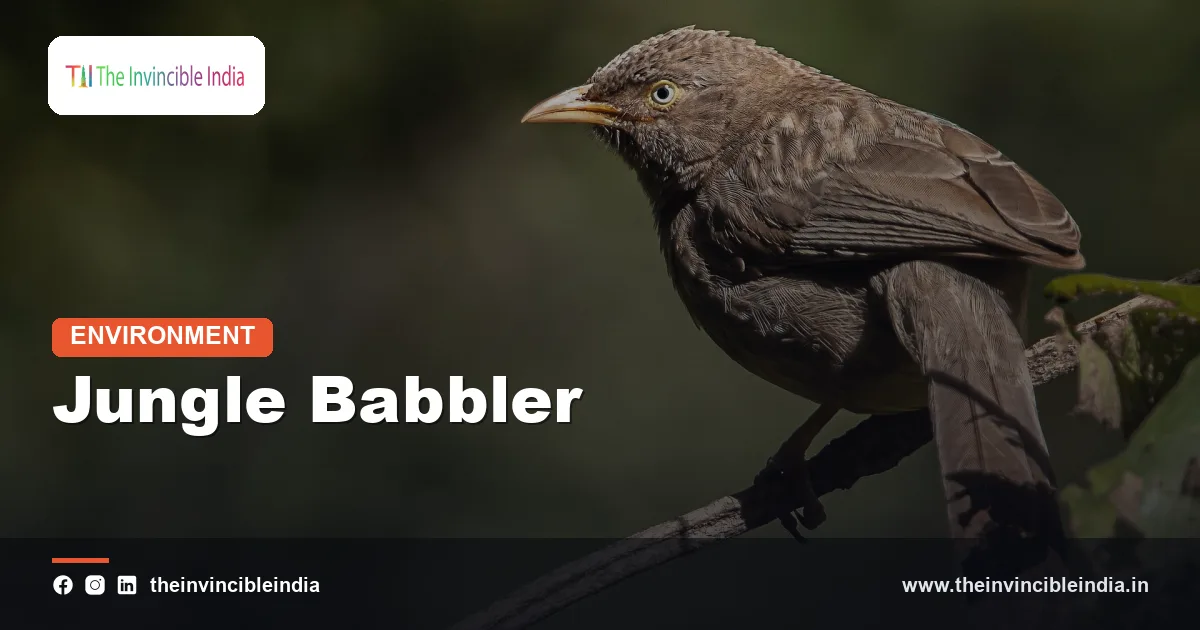
The jungle babbler (Argya striata) is a noisy, grey-brown, ground-foraging songbird of the Indian subcontinent that lives in tight-knit flocks, popularly called the “seven sisters” (saat bhai in Hindi). Almost anyone who has spent time in an Indian garden, village outskirt or city park has heard a group of jungle babblers squabbling in the undergrowth, and few birds in the country are as easy to recognise by sound alone.
The jungle babbler is a member of the babbler and laughingthrush family (Leiothrichidae) and is best known for its cooperative way of life, in which several birds share the work of defending a territory and raising chicks. This explainer covers its appearance, range, diet, social behaviour, breeding and the best ways to tell it apart from look-alike babblers, so that the facts below can be quoted on their own.
| Attribute | Details |
|---|---|
| Common name | Jungle babbler (also called Seven Sisters, saat bhai) |
| Scientific name | Argya striata (earlier placed in the genus Turdoides) |
| Family | Leiothrichidae (babblers and laughingthrushes) |
| Body length | About 25 cm, with a long, loosely graduated tail |
| Range | Most of the Indian subcontinent, including India, Nepal, Pakistan, Bangladesh and Sri Lanka |
| Habitat | Gardens, scrub, farmland edges, open woodland and towns |
| Social system | Flocks of roughly six to ten birds, with cooperative breeding and helpers at the nest |
| Conservation status | Least Concern on the IUCN Red List, a widespread and common bird |
Key Takeaways
- The jungle babbler is a common grey-brown songbird of the Indian subcontinent, scientifically named Argya striata, that lives in permanent social groups rather than alone or in pairs.
- The nickname “seven sisters” (saat bhai) refers to the bird’s habit of moving in small, chattering groups, and the number seven is a rough folk figure rather than a fixed group size.
- Jungle babblers practise cooperative breeding, meaning that several adults besides the nesting pair help to feed the chicks and guard the nest.
- The jungle babbler is an omnivore that eats insects, spiders, grains, berries, flower nectar and household scraps, which helps it thrive close to people.
- Jungle babblers are frequently chosen as foster hosts by cuckoos such as the pied cuckoo, which lay their eggs in babbler nests.
- The jungle babbler is listed as a species of Least Concern, and its adaptability to gardens and farmland has kept it widespread across India.
What is a jungle babbler?
A jungle babbler is a medium-sized, plain-looking passerine bird that spends most of its day on or near the ground in small, vocal flocks. Despite the word “jungle” in its English name, the jungle babbler is far more often seen in suburban gardens, village groves, hedgerows and farm edges than in deep forest.
The scientific name was long written as Turdoides striata, and many older field guides and websites still use that spelling. Modern genetic studies moved a group of babblers into the genus Argya, which is why current checklists list the species as Argya striata. Both names refer to the same bird, so a search under either name returns the same species.
The bird belongs to the order Passeriformes, the perching birds, and to the babbler family Leiothrichidae. Babblers as a group are known for being social, vocal and weak fliers, and the jungle babbler is probably the most familiar example in India.
What does a jungle babbler look like?
The jungle babbler looks like a dusty, earthy-brown bird with a slightly paler throat, a pale eye and a yellowish bill. Its overall colour ranges from grey-brown to a warmer brown, and the plumage is plain, with faint streaking visible only at close range.
Several features help with identification in the field:
- Size and shape: about 25 cm long, plump-bodied, with a long tail that looks rather ragged and loosely built.
- Bill and legs: a pale yellowish bill and yellowish legs that stand out against the dull plumage.
- Eye: a pale iris that gives the face a slightly wide-eyed, alert expression.
- Tail: a long, graduated tail with a paler, whitish look at the base and fine barring on the feathers.
- Flight: weak and low, with a few quick wingbeats followed by a short glide, usually from one bush to the next.
Males and females look alike, so the sexes cannot be separated reliably by plumage. Young birds resemble the adults but tend to look a little softer and duller in colour.
Why is the jungle babbler called the seven sisters?
The jungle babbler is called the seven sisters because it almost always moves in a small group that chatters, squabbles and calls together, giving the impression of a noisy family. In Hindi and several other Indian languages, the bird is known as saat bhai, literally “seven brothers”, and English speakers adopted the equivalent phrase “seven sisters”.
The number seven is a folk label, not a count. Real groups usually contain somewhere between six and ten birds, though a flock can be smaller or somewhat larger depending on the season and the territory. Observers who count the birds carefully often find that a group of “seven” has five, nine or eleven members.
The name has also stuck because babblers stay together all year, unlike many other garden birds that pair up only in the breeding season. A single jungle babbler on its own is an unusual sight, which is why the group nickname feels more natural than any individual name for the bird.
Where do jungle babblers live in India?
Jungle babblers live across most of mainland India, from the foothills of the Himalaya to the peninsular south, and they also occur in neighbouring Nepal, Pakistan, Bangladesh and Sri Lanka. The species is common in plains and low hills and becomes less frequent in very dry desert tracts and in dense, wet evergreen forest.
Typical habitats include:
- Town and city gardens with shrubs, hedges and fruiting trees.
- Village groves, farm boundaries and orchards.
- Scrub forest and open deciduous woodland.
- Roadside avenues, parks, campuses and the edges of temples and ruins.
The jungle babbler tolerates people well and nests close to houses, which is why it counts among the commonest birds of Delhi, Lucknow, Jaipur, Bhopal and many other north and central Indian cities. Very large or very dry open spaces with no shrub cover are usually avoided, because the birds depend on thickets for shelter and nest sites.
How do jungle babblers live and behave in a group?
Jungle babblers live in stable year-round groups that defend a shared territory, forage together and roost together. Within a group, the birds keep up a constant stream of low chattering, which helps members stay in contact while they move through dense cover.
Foraging as a team
A foraging group spreads out along the ground, hopping, flicking aside dead leaves with the bill and probing the soil for insects. Individuals take turns watching from a higher perch, and a sentinel gives a sharp alarm when a cat, snake, hawk or other danger appears. The rest of the group then freezes, flies for cover or gathers to mob the intruder.
Mobbing and defence
Babblers are well known for mobbing predators. A group will gather around a snake or a cat, calling loudly and bobbing about, until the threat leaves. Groups also defend their territory against neighbouring groups with displays and noisy exchanges, and such disputes can sound like a small street argument.
Bonding and roosting
Members of a group preen one another, a behaviour called allopreening, which helps maintain bonds. At night, the birds roost close together on a branch, often in a tight row, and they move to the same roosting spot day after day.
What do jungle babblers eat?
The jungle babbler is an omnivore that eats mainly insects and other small invertebrates, along with seeds, grains, fruits and flower nectar. Its diet changes with the season and with whatever is available in the garden or field.
Common items include:
- Insects such as ants, beetles, grasshoppers, caterpillars and termites.
- Spiders and other small invertebrates found in leaf litter.
- Seeds and cereal grains, including spilled grain around farms and houses.
- Soft fruits and berries from garden trees and shrubs.
- Nectar from flowers, taken when the birds visit flowering trees.
- Kitchen scraps, bread and rice left out by people.
Because the jungle babbler eats large numbers of insects, it is generally regarded as beneficial in gardens and farmland. Its mixed diet also explains why it copes well with the changes that come with urban growth.
How does cooperative breeding work in jungle babblers?
Cooperative breeding in jungle babblers means that birds other than the parents, often called helpers, assist in feeding the nestlings and defending the nest. This system is one of the main reasons the species attracts the interest of behavioural ecologists.
In a typical breeding attempt, the birds build a shallow cup nest from twigs, rootlets and grass, usually in dense shrub or a low tree. The female lays about three or four glossy, deep greenish-blue eggs, a colour that is distinctive among Indian garden birds. Incubation lasts roughly two weeks, and the young leave the nest roughly two weeks after hatching, although they are fed by group members for some time afterwards.
Group members that are not the nesting pair bring food, remove waste and warn of danger. Helpers are often relatives of the breeding birds, but the exact makeup of a group varies between studies and localities. Breeding in much of India takes place between spring and the monsoon months, and a group can raise more than one brood in a favourable year.
What does the jungle babbler’s call sound like?
The call of the jungle babbler is a harsh, repetitive, mewing and squealing chatter that rises when the group is excited. A foraging flock keeps up a softer, constant background conversation, while an alarm or a clash with a rival group produces loud, rapid, almost screeching notes.
Bird watchers often describe the sounds as a mix of “kyow”, “chee” and squeaky, rolling notes delivered by several birds at once. The chorus can be loud enough to wake a sleeping neighbourhood in the early morning. The noise has a practical purpose, since it keeps the group together in thick vegetation and announces ownership of a territory.
Because groups tend to call together, the sound of a jungle babbler flock is usually the first clue that the birds are nearby, long before they come into view.
How can you tell a jungle babbler from similar babblers?
The jungle babbler can be told from similar babblers by its plain grey-brown plumage, yellowish bill, pale eye and the lack of a bold head pattern. Three similar related species are also found in India, and comparing a few features usually settles the identification.
| Species | Scientific name | Key identifying features |
|---|---|---|
| Jungle babbler | Argya striata | Plain grey-brown body, yellowish bill, pale eye, groups of about six to ten birds |
| Large grey babbler | Argya malcolmi | Larger and greyer, with a longer tail that shows white outer feathers in flight |
| Common babbler | Argya caudata | Smaller and more streaked, with a very long tail, found in drier scrub and open country |
| Yellow-billed babbler | Argya affinis | Found in southern India and Sri Lanka, with differences in head colour and call from the jungle babbler |
Where ranges overlap, the safest approach is to note the size, tail length, bill colour and the habitat. A large flock in a dry scrubland is more likely to be common babblers, while a plain brown flock in a leafy garden is usually jungle babblers.
Do jungle babblers help or harm other birds?
Jungle babblers do both, because they are both attentive neighbours and frequent victims of nest parasites. Their loud alarm calls warn nearby birds, squirrels and other animals of predators, and many small species benefit from the early warning.
At the same time, jungle babbler nests are a favourite target for brood-parasitic cuckoos. The pied cuckoo, also known as the jacobin cuckoo, and the common hawk-cuckoo, often called the brainfever bird, are among the cuckoos that lay eggs in babbler nests in India. The cuckoo chick is raised by the babbler group at the expense of the host’s own young, although the full outcome varies by nest.
The pied cuckoo is also linked to the arrival of the monsoon in Indian folklore, and its appearance in many regions roughly matches the season when babblers are breeding. This overlap is one reason the two species are often discussed together by ornithologists and bird watchers.
Is the jungle babbler threatened, and how can it be attracted to a garden?
The jungle babbler is not threatened and is classed as Least Concern, because it is common, widespread and well adapted to human-modified land. Its numbers are generally believed to be stable, although local populations can fall where hedges, shrubs and old trees are cleared.
Gardeners who want babblers around can take a few simple steps:
- Keep a few dense shrubs and hedges, since babblers need cover for nesting and shelter.
- Leave some leaf litter on the ground, which supports the insects the birds hunt.
- Provide a shallow dish of clean water, refreshed daily, especially in summer.
- Plant fruiting and flowering species such as ber, mulberry, guava and hibiscus.
- Avoid pesticides, which remove the insect prey and can harm the birds directly.
Native wild birds in India are generally covered by the Wildlife (Protection) Act, 1972, so capturing or keeping wild babblers is not permitted. Watching them from a distance is both legal and rewarding.
Bottom Line
The jungle babbler is one of India’s most familiar garden birds, a plain grey-brown, noisy songbird whose strength lies in its social life. Living in stable groups, sharing nest duties and sounding alarms together, the “seven sisters” show how cooperation can help a small bird thrive close to people. It is easy to find, easy to learn and a good first species for anyone beginning to watch birds in India.
Frequently Asked Questions
What is the scientific name of the jungle babbler?
The scientific name of the jungle babbler is Argya striata. Older books and websites still use the earlier name Turdoides striata, but both names refer to the same species, which belongs to the family Leiothrichidae.
Why are jungle babblers called seven sisters?
Jungle babblers are called seven sisters because they move and call in small, noisy groups that resemble a chattering family. The number seven is a folk figure, and real groups usually have about six to ten birds.
What do jungle babblers eat?
Jungle babblers eat a mixed diet of insects, spiders, seeds, grains, fruits, flower nectar and household scraps. Insects form a large share of the food, which makes the birds useful in gardens and farmland.
How many eggs does a jungle babbler lay?
A jungle babbler usually lays about three or four glossy, deep greenish-blue eggs in a cup nest of twigs and grass. Incubation takes roughly two weeks, and other group members often help to feed the chicks.
Are jungle babblers aggressive?
Jungle babblers are not dangerous to people, but they are bold and noisy and will mob predators such as cats and snakes. Groups also defend their territory from neighbouring babbler groups with loud calls and displays.
Is the jungle babbler an endangered bird?
No, the jungle babbler is not endangered and is listed as Least Concern on the IUCN Red List. The species is common across the Indian subcontinent and adapts well to gardens, farmland and towns.
{“@context”:”https://schema.org”,”@graph”:[{“@type”:”FAQPage”,”mainEntity”:[{“@type”:”Question”,”name”:”What is the scientific name of the jungle babbler?”,”acceptedAnswer”:{“@type”:”Answer”,”text”:”The scientific name of the jungle babbler is Argya striata. Older books and websites still use the earlier name Turdoides striata, but both names refer to the same species, which belongs to the family Leiothrichidae.”}},{“@type”:”Question”,”name”:”Why are jungle babblers called seven sisters?”,”acceptedAnswer”:{“@type”:”Answer”,”text”:”Jungle babblers are called seven sisters because they move and call in small, noisy groups that resemble a chattering family. The number seven is a folk figure, and real groups usually have about six to ten birds.”}},{“@type”:”Question”,”name”:”What do jungle babblers eat?”,”acceptedAnswer”:{“@type”:”Answer”,”text”:”Jungle babblers eat a mixed diet of insects, spiders, seeds, grains, fruits, flower nectar and household scraps. Insects form a large share of the food, which makes the birds useful in gardens and farmland.”}},{“@type”:”Question”,”name”:”How many eggs does a jungle babbler lay?”,”acceptedAnswer”:{“@type”:”Answer”,”text”:”A jungle babbler usually lays about three or four glossy, deep greenish-blue eggs in a cup nest of twigs and grass. Incubation takes roughly two weeks, and other group members often help to feed the chicks.”}},{“@type”:”Question”,”name”:”Are jungle babblers aggressive?”,”acceptedAnswer”:{“@type”:”Answer”,”text”:”Jungle babblers are not dangerous to people, but they are bold and noisy and will mob predators such as cats and snakes. Groups also defend their territory from neighbouring babbler groups with loud calls and displays.”}},{“@type”:”Question”,”name”:”Is the jungle babbler an endangered bird?”,”acceptedAnswer”:{“@type”:”Answer”,”text”:”No, the jungle babbler is not endangered and is listed as Least Concern on the IUCN Red List. The species is common across the Indian subcontinent and adapts well to gardens, farmland and towns.”}}]}]}


