

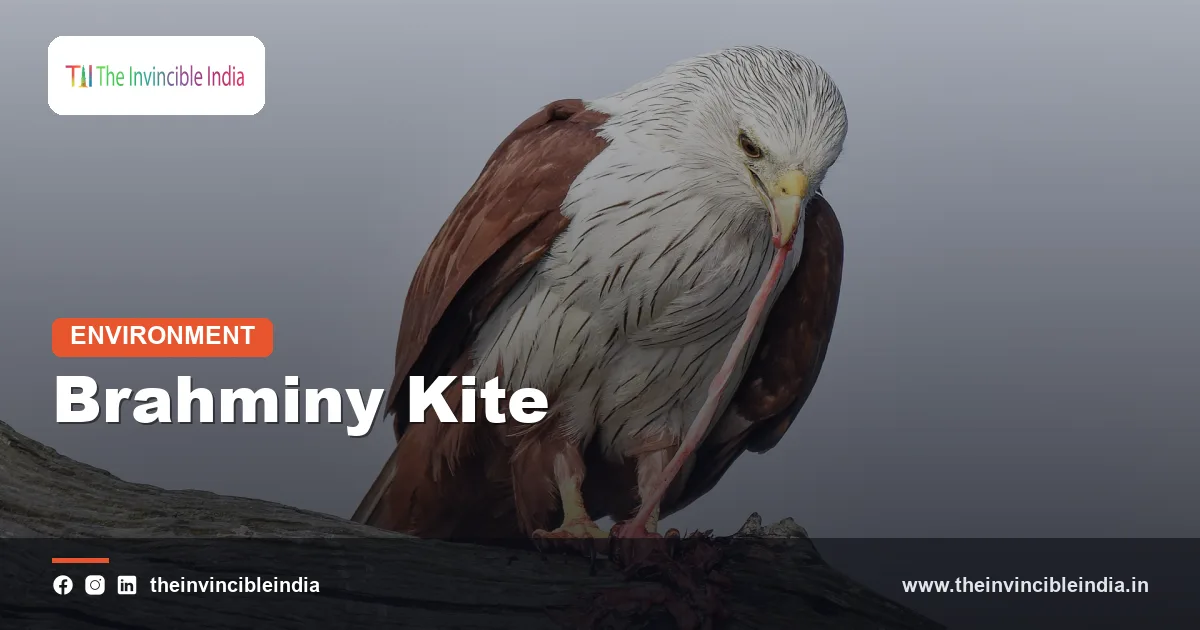
The brahminy kite (Haliastur indus) is a medium-sized bird of prey with a chestnut body, a white head and breast and black wingtips, found along the coasts, estuaries, backwaters, wetlands and harbours of India and much of southern and south-east Asia. It feeds on fish, crabs and carrion, and it is among the most recognisable raptors of the Indian shoreline.
The brahminy kite is also one of the few raptors with a strong place in Indian tradition, since in several regions it is identified with Garuda, the mount of Vishnu in Hindu belief. This explainer covers how to identify the brahminy kite, where it lives, what it eats, how it hunts and breeds, and why it holds religious significance. Last updated: 23 October 2026.
| Quick Facts | Brahminy kite |
|---|---|
| Scientific name | Haliastur indus |
| Family | Accipitridae (hawks, eagles and kites) |
| Approximate length | About 45 to 51 cm, with a wingspan of roughly 110 to 125 cm |
| Adult plumage | Chestnut body and wings, white head, neck and breast, black wingtips |
| Range | Indian subcontinent, South-East Asia and northern Australia |
| Habitat | Coasts, mangroves, estuaries, lakes, rivers, paddy fields and fishing harbours |
| Diet | Dead and live fish, crabs, frogs, insects, small birds and carrion |
| Nesting | Stick nest in a tall tree, usually near water, with one or two eggs |
| Conservation status | IUCN Least Concern; protected under the Wildlife (Protection) Act, 1972 |
Key Takeaways
- The brahminy kite (Haliastur indus) is a chestnut-bodied raptor with a white head and breast, and it is easy to recognise along Indian coasts and wetlands.
- The brahminy kite eats mainly fish, crabs and carrion, and it often scavenges around fishing harbours and landing sites.
- The adult brahminy kite has a rounded tail, whereas the black kite, which looks superficially similar, has a forked tail.
- Young brahminy kites are mottled brown and streaked, and they take about two to three years to reach the full chestnut and white adult plumage.
- The brahminy kite is associated with Garuda in parts of India, and its appearance during temple rituals is traditionally regarded as auspicious.
- The IUCN lists the brahminy kite as Least Concern, although loss of mangroves, wetlands and large nesting trees can affect local populations.
What is the brahminy kite?
The brahminy kite is a bird of prey in the family Accipitridae, the same family that includes hawks and eagles, and it is the only member of its genus, Haliastur, that regularly occurs in India. The genus name combines the Greek word for sea with the Latin word for a hawk, which fits the bird’s liking for coasts and water.
It is a resident species across most of its range, meaning that it does not undertake long migrations. In India it is found in coastal and low-lying inland areas from Gujarat and the western coast around to Tamil Nadu, the eastern coast, the Sundarbans and Assam. The species also lives in Sri Lanka, Bangladesh, Myanmar and Thailand, and extends through Indonesia and Malaysia to northern and eastern Australia.
The common name “brahminy” reflects the bird’s sacred associations in Indian tradition, and its Hindu significance is best understood through the identification of the bird with Garuda.
How can you identify a brahminy kite?
A brahminy kite can be identified by its rich chestnut body, snow-white head, neck and upper breast, black tips to the long wings and a short, rounded tail. No other common Indian raptor combines white and chestnut in this way, so adult birds are usually easy to separate even at a distance.
Adult features
- The head, neck and breast are white with fine dark streaks on the feathers, giving a clean, pale hood.
- The body, back, belly and wing coverts are a deep chestnut or rufous brown.
- The flight feathers at the ends of the wings are black, forming dark tips visible when the bird soars.
- The tail is rounded in shape rather than forked, with a pale tip.
- The bill is greyish and hooked, and the legs are yellowish.
Juvenile plumage
The young brahminy kite is mostly brown with pale streaking on the head and underparts, which makes it harder to identify. A young bird can be mistaken for a black kite or a young marsh harrier, but the rounded tail and pale patch under the outer wing feathers are clues. The chestnut and white of the adult appear gradually over about two to three years, passing through a blotchy intermediate stage.
Flight and voice
The brahminy kite soars on thermals and sea breezes with its wings held flat or slightly angled, and it glides low over water as it scans the surface. Its call is a thin, nasal, mewing cry that has been compared to the cry of a cat, often given near the nest or during aerial displays.
Where does the brahminy kite live in India?
The brahminy kite lives mostly along India’s coastline and in wetlands near rivers, lakes and paddy fields, and it is particularly common around harbours, estuaries and mangrove forests. The bird needs a combination of open water for foraging and tall trees for nesting and roosting.
Important Indian habitats include the Sundarbans mangroves in West Bengal, Bhitarkanika in Odisha, Chilika Lake, Pulicat Lake, the Kerala backwaters and the Gulf of Kachchh. The brahminy kite is also seen inland along large rivers and reservoirs, although it tends to remain relatively close to water.
Habitat in brief
- Coastal mangroves, creeks and tidal flats, where fish and crabs are easy to find.
- Fishing harbours and landing centres, where discarded fish offers easy meals.
- Freshwater lakes, ponds and rice paddies, particularly in low-lying regions.
- Village groves and large trees near water, which are used for roosting and nesting.
The bird is non-migratory in a strict sense, but local movements occur. Young birds disperse, and adults may shift between coastal and inland waters depending on water levels and food supply.
What does the brahminy kite eat?
The brahminy kite eats mainly fish, along with crabs, frogs, snakes, insects, small birds and carrion, and it is both a hunter and a scavenger. Its diet reflects an opportunistic approach, and the bird takes whatever food is easiest to obtain around water.
At fishing harbours it commonly picks up discarded fish and offal. Along tidal flats it takes crabs and stranded fish, and over rice fields it catches frogs and large insects. Unlike the osprey, which plunges feet-first into the water, the brahminy kite usually takes prey from the surface or the shore with its talons, and it rarely submerges. It will also steal food from other birds on occasion.
Hunting technique
The brahminy kite typically hunts by soaring or drifting at modest height, scanning the water, and then dropping with a slanting dive to pick up its prey. It also hunts from a perch on a tree, post or boat and watches for movement below. Fish are generally eaten on a perch, while carrion may be eaten at the site.
Role in the ecosystem
By eating dead fish and other waste, the brahminy kite helps clear organic debris from shores and harbours. It also acts as a predator of weak or injured fish, and its presence in mangroves is often taken as a rough indicator of a functioning coastal ecosystem. Birdwatchers in coastal districts often see it alongside other raptors such as the black kite and the white-bellied sea eagle.
How does the brahminy kite breed?
The brahminy kite breeds by building a loose platform nest of sticks high in a tall tree, usually close to water, where the female lays one or two eggs. The nest is lined with leaves, grass and other soft material and may be re-used and added to over several seasons.
Breeding times differ across India. In many regions, nesting takes place in the cooler or dry months, generally from late in the year into spring, though the timing in any area depends on local conditions. Both adults take part in building the nest and in feeding the young, although the female does most of the incubation. The eggs are whitish with brown or reddish blotches.
The chicks are fed on fish and other prey torn into small pieces. They remain in the nest for several weeks and then continue to be fed by their parents for some time after fledging. Because the clutch is small, a pair can raise only a few young in a season, which makes nest trees especially valuable.
Why is the brahminy kite associated with Garuda?
The brahminy kite is associated with Garuda because its white and chestnut plumage, its soaring flight and its presence at sacred waters led devotees in several regions to regard it as a form of the divine eagle that carries Vishnu. In some parts of South India the bird is known by a name linked to Garuda, and in Tamil it has been called Krishna parunthu.
Garuda, in Hindu tradition, is the king of birds and the vahana, or mount, of Vishnu. He appears in sculpture across temples and on the emblem of several institutions. Because real birds that match this imagery are rare, the brahminy kite has often been taken as the living counterpart. Its arrival, especially when circling above a temple during a ritual or festival, is considered a good omen in some communities.
Several well-known temple traditions are reported to involve circling kites at the time of offerings or ceremonies, and the bird is often mentioned in connection with Vaishnava pilgrimage sites in the south. These accounts are cultural and devotional in nature, and they are valued as heritage rather than as scientific claims. The same bird appears in other cultures: in Indonesia it is a well-known mascot of the capital, Jakarta.
How is the brahminy kite different from the black kite and other raptors?
The brahminy kite differs from the black kite mainly in colour and tail shape: the adult is chestnut and white with a rounded tail, whereas the black kite is dark brown with a forked tail. Both species can occur together at harbours and waterfronts, so the comparison is useful for observers.
| Feature | Brahminy kite | Black kite | Osprey |
|---|---|---|---|
| Scientific name | Haliastur indus | Milvus migrans | Pandion haliaetus |
| Adult colour | Chestnut with white head and breast | Dark brown with a paler head | Dark brown above, white below |
| Tail shape | Rounded | Forked, although it can look straighter when spread | Short and barred |
| Main food | Fish, crabs and carrion | Scraps, carrion and small prey | Live fish only |
| Hunting method | Surface pick-ups and scavenging | Scavenging and swooping | Plunge-dive feet-first |
| Usual habitat in India | Coasts, wetlands, harbours | Towns, rubbish dumps, rivers | Coasts, lakes, rivers, mostly as a winter visitor |
The brahminy kite is smaller than most sea eagles and larger than most harriers. Observers sometimes confuse juvenile brahminy kites with female marsh harriers, which hold their wings in a shallow V while gliding, but the kite usually flies with wings flat and a more buoyant, drifting action.
Is the brahminy kite threatened and what protects it?
The brahminy kite is not threatened globally: the International Union for Conservation of Nature (IUCN) assesses it as Least Concern because of its large range and stable overall numbers. In India it is covered by the Wildlife (Protection) Act, 1972, which prohibits hunting and capture of raptors.
Exact population totals are not firmly established, and local trends can differ. In some places the bird is common and visible, while in others it has declined or become scarce where coastal habitats have been altered.
Pressures on the species
- Clearing of mangroves and coastal trees for aquaculture, industry and construction.
- Pollution of estuaries and harbours, including plastics, oil and chemical contaminants that may harm food chains.
- Disturbance and loss of nest trees in coastal belts.
- Entanglement in fishing lines and nets in some localities.
Conservation actions that help
Protecting mangroves, wetlands and large coastal trees is the most effective step, since these areas supply both food and nest sites. Managing waste at fishing harbours, supporting community-based wetland conservation and recording sightings through citizen-science projects also help build a clearer picture of where the species is doing well.
Bottom Line
The brahminy kite is a distinctive chestnut-and-white raptor of India’s coasts and wetlands, valued both as a scavenger-predator of the shoreline and as a living symbol linked with Garuda. It is currently secure, but its long-term presence depends on protecting mangroves, wetlands and tall nesting trees.
Frequently Asked Questions
What is a brahminy kite?
The brahminy kite (Haliastur indus) is a medium-sized bird of prey with a chestnut body, white head and breast and black wingtips. It lives along coasts, estuaries, wetlands and harbours across India and South-East Asia. It feeds mainly on fish, crabs and carrion.
How do you tell a brahminy kite from a black kite?
An adult brahminy kite is chestnut with a white head and breast and a rounded tail, while a black kite is dark brown with a forked tail. The brahminy kite stays closer to water, whereas the black kite is also common in towns and around rubbish dumps. Juvenile brahminy kites are brown, so the tail shape and habitat are the best clues.
Why is the brahminy kite linked to Garuda?
The brahminy kite is linked to Garuda because its white and chestnut colouring and soaring flight match the divine eagle that carries Vishnu in Hindu tradition. In parts of South India the bird is known by names connected with Garuda. Its appearance over a temple is regarded as auspicious by some communities.
What does the brahminy kite eat?
The brahminy kite eats mainly fish, crabs and carrion, and it also takes frogs, insects and small birds. It hunts by soaring over water and picking prey from the surface, and it scavenges at fishing harbours. It does not usually dive into the water the way an osprey does.
Where can you see brahminy kites in India?
Brahminy kites can be seen along India’s coast and near large wetlands, including the Sundarbans, Bhitarkanika, Chilika Lake, Pulicat Lake and the Kerala backwaters. They are also common around fishing harbours. Some birds are found inland near big rivers and reservoirs.
Is the brahminy kite protected in India?
Yes, the brahminy kite is protected in India under the Wildlife (Protection) Act, 1972, which prohibits hunting and capture of wild raptors. The IUCN lists the species as Least Concern globally. Local populations can still fall where mangroves, wetlands and nesting trees are lost.
{“@context”:”https://schema.org”,”@graph”:[{“@type”:”FAQPage”,”mainEntity”:[{“@type”:”Question”,”name”:”What is a brahminy kite?”,”acceptedAnswer”:{“@type”:”Answer”,”text”:”The brahminy kite (Haliastur indus) is a medium-sized bird of prey with a chestnut body, white head and breast and black wingtips. It lives along coasts, estuaries, wetlands and harbours across India and South-East Asia. It feeds mainly on fish, crabs and carrion.”}},{“@type”:”Question”,”name”:”How do you tell a brahminy kite from a black kite?”,”acceptedAnswer”:{“@type”:”Answer”,”text”:”An adult brahminy kite is chestnut with a white head and breast and a rounded tail, while a black kite is dark brown with a forked tail. The brahminy kite stays closer to water, whereas the black kite is also common in towns and around rubbish dumps. Juvenile brahminy kites are brown, so the tail shape and habitat are the best clues.”}},{“@type”:”Question”,”name”:”Why is the brahminy kite linked to Garuda?”,”acceptedAnswer”:{“@type”:”Answer”,”text”:”The brahminy kite is linked to Garuda because its white and chestnut colouring and soaring flight match the divine eagle that carries Vishnu in Hindu tradition. In parts of South India the bird is known by names connected with Garuda. Its appearance over a temple is regarded as auspicious by some communities.”}},{“@type”:”Question”,”name”:”What does the brahminy kite eat?”,”acceptedAnswer”:{“@type”:”Answer”,”text”:”The brahminy kite eats mainly fish, crabs and carrion, and it also takes frogs, insects and small birds. It hunts by soaring over water and picking prey from the surface, and it scavenges at fishing harbours. It does not usually dive into the water the way an osprey does.”}},{“@type”:”Question”,”name”:”Where can you see brahminy kites in India?”,”acceptedAnswer”:{“@type”:”Answer”,”text”:”Brahminy kites can be seen along India’s coast and near large wetlands, including the Sundarbans, Bhitarkanika, Chilika Lake, Pulicat Lake and the Kerala backwaters. They are also common around fishing harbours. Some birds are found inland near big rivers and reservoirs.”}},{“@type”:”Question”,”name”:”Is the brahminy kite protected in India?”,”acceptedAnswer”:{“@type”:”Answer”,”text”:”Yes, the brahminy kite is protected in India under the Wildlife (Protection) Act, 1972, which prohibits hunting and capture of wild raptors. The IUCN lists the species as Least Concern globally. Local populations can still fall where mangroves, wetlands and nesting trees are lost.”}}]}]}


