

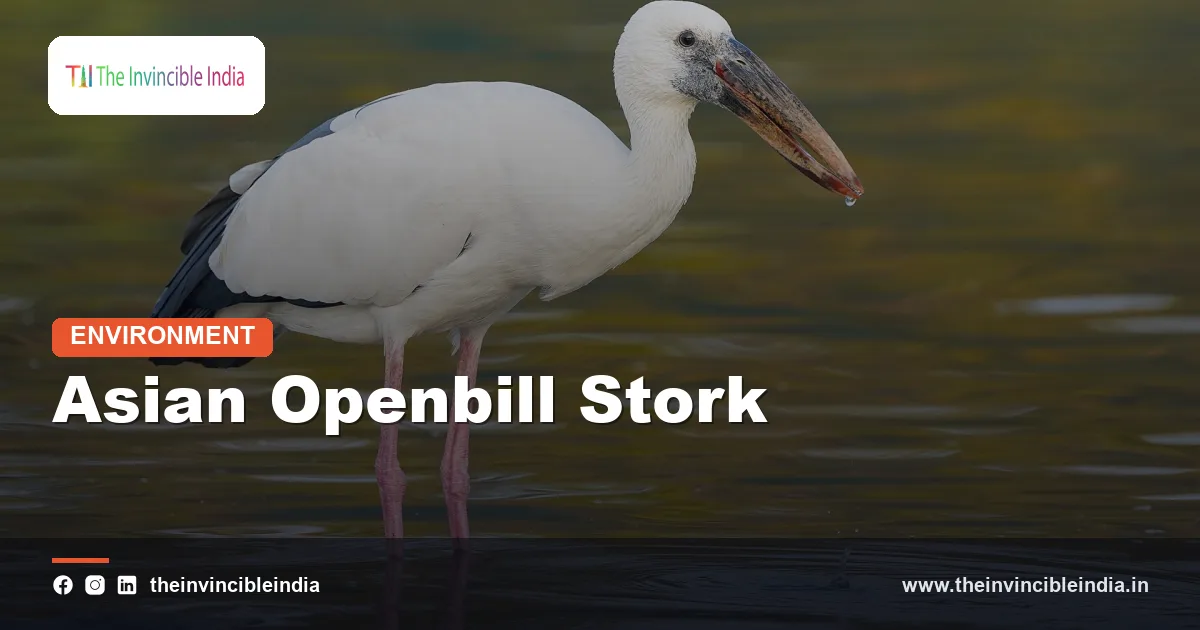
The Asian openbill (Anastomus oscitans), also called the Asian openbill stork, is a medium-sized greyish-white stork of South and Southeast Asia whose bill has a distinctive gap between the upper and lower mandibles, used to catch and extract freshwater snails and mussels. The Asian openbill is a familiar sight in Indian wetlands, paddy fields and village tanks, where it feeds on apple snails and nests in noisy colonies, often alongside herons, egrets and cormorants.
The Asian openbill is a social, largely resident stork that soars on thermals and breeds mainly around the monsoon. This explainer covers the bird’s identification, the working of its odd bill, diet, colonies, flight, movements, status in India and the best ways to watch it.
Quick Facts About the Asian Openbill
| Attribute | Detail |
|---|---|
| Common name | Asian openbill (Asian openbill stork) |
| Scientific name | Anastomus oscitans |
| Family | Ciconiidae (the storks) |
| Size | About 68 cm long, with a wingspan of roughly 1.5 metres |
| Breeding plumage | White body with glossy black wings and tail |
| Non-breeding plumage | Greyish-white body with dull black wings and tail |
| Bill | Pale horn-coloured, with a visible gap between the mandibles in adults |
| Main food | Freshwater snails, especially apple snails, plus mussels, crabs, frogs and insects |
| Conservation | Assessed as Least Concern by the IUCN |
Key Takeaways
- The Asian openbill (Anastomus oscitans) is a stork of the family Ciconiidae found across the Indian subcontinent and Southeast Asia.
- The Asian openbill has a gap between its upper and lower bill that forms in adults and is used to handle snails and mussels.
- The Asian openbill feeds mostly on freshwater snails, especially apple snails, and also takes mussels, crabs, frogs and large insects.
- The Asian openbill nests in colonies in trees, frequently sharing heronries with egrets, herons, spoonbills and cormorants.
- The Asian openbill is a strong soaring bird that uses rising warm air currents to travel long distances with little wing-flapping.
- The Asian openbill appears greyish-white in the non-breeding season and turns whiter with glossy black wings during breeding.
What Is the Asian Openbill Stork?
The Asian openbill stork is a large wading bird in the stork family, Ciconiidae, scientifically known as Anastomus oscitans. The genus name Anastomus means “with a mouth that is open”, and the species name “oscitans” means “yawning” in Latin, both referring to the bird’s gaping bill.
The Asian openbill is one of two living openbill species, the other being the African openbill (Anastomus lamelligerus). Both specialise in feeding on molluscs. The Asian species is found from the Indian subcontinent east to Thailand, Cambodia and Vietnam, and it is one of the commonest storks in many Indian wetlands.
In Hindi the bird is often called “ghonghil” or “ghongil”, though local names differ widely between regions and languages.
How Do You Identify an Asian Openbill?
An Asian openbill is identified by its stout, pale bill with a clear gap near the middle, its whitish or greyish body, and its black wings and tail. It is smaller than the painted stork and woolly-necked stork and more compact than a sarus crane, with pinkish-red legs, especially bright in the breeding season.
In the breeding season, the plumage turns white with a glossy black sheen on the wings and tail, and the legs turn a deeper pink or red. Outside breeding, the body looks dingy grey-white. Juveniles are browner and greyer, and their bills lack the gap, which develops as they mature.
What does the gap in the bill look like?
The gap is a narrow opening between the curved upper bill and the slightly arched lower bill, with the two meeting only at the tip. When the bill is closed, the gap is clearly visible from the side. The lower mandible has a slight bend, and the upper bill has a fine edge that forms a kind of tweezers when the two meet at the tip.
How Does the Asian Openbill’s Bill Work?
The Asian openbill’s bill works like a pair of pincers or nutcrackers, with its tip used to grip a snail and cut or crush the shell to get at the soft body. The gap is believed to help the bird hold large, round snail shells firmly, with the tips of the bill acting as a clamp.
The bird usually places the snail on the mud, holds it with the bill and extracts the body by cutting the muscle that attaches the animal to the shell, or by snipping the operculum (the shell’s door). The snail is then pulled out and swallowed, often without the shell being fully broken. It is a skilled and fast process and can process many snails in a short time.
The exact mechanism is still debated by ornithologists. Some researchers suggest the tip of the lower bill is used as a probe, and that the gap is a by-product of feeding wear. What is generally agreed is that the bill is strongly adapted to shelled prey, and that the gap grows more pronounced with age.
What Does the Asian Openbill Eat?
The Asian openbill eats mainly freshwater snails, particularly apple snails, along with mussels, crabs, frogs, fish, large insects and sometimes reptiles. Snails are by far the most important food and give the bird its ecological role.
It forages by wading slowly through shallow water, paddy fields and mud flats, probing with its bill and feeling for shelled prey. Where apple snails are abundant, the bird can be seen in large flocks feeding in rice fields. It may therefore help to control snail pests in some farmland, though the benefit varies and depends on local conditions.
| Food type | Role in the Asian openbill’s diet |
|---|---|
| Freshwater snails (including apple snails) | Staple food, taken in large numbers |
| Mussels and other molluscs | Regular food, opened with the bill tip |
| Crabs | Frequent supplementary prey |
| Frogs, small fish, large insects | Occasional prey, mainly when snails are scarce |
Where Does the Asian Openbill Live in India?
The Asian openbill lives in freshwater wetlands, marshes, lakes, ponds, village tanks, reservoirs and flooded paddy fields across most of India, and it is also common near rivers and irrigation canals. It prefers shallow water with muddy margins where snails are abundant.
The species is widespread in the plains and peninsula, with local gaps in the dry north-west and the high Himalaya. It generally avoids dense forest and arid zones. Because it follows water, it moves in response to rainfall and flooding, and it can appear in new areas soon after the monsoon fills fields and ponds.
Many Indian bird sanctuaries, including Keoladeo National Park in Rajasthan and heronries in Karnataka and Andhra Pradesh, are known for breeding colonies of openbills. The exact numbers and sites change from year to year, so local park guides are the best source of current information.
How Do Asian Openbills Breed in Colonies?
Asian openbills breed in colonies, building large platform nests of sticks high in trees, often over water or in villages, and typically in mixed heronries with other waterbirds. The colonies can be noisy, with constant bill-clattering, wing-flapping and stick-carrying.
The female usually lays two to five eggs, commonly around three to four, and both parents incubate and feed the chicks. The young are fed regurgitated food, mostly snails and other aquatic animals. Breeding is generally timed with the monsoon, when water and food are abundant, though the exact season varies across regions.
Colonies in village trees are often tolerated and even welcomed by local people, who see the arrival of the storks as a sign of good rains. This tradition has helped some colonies survive in surprisingly crowded places.
How Does the Asian Openbill Fly?
The Asian openbill flies with slow, deep wingbeats and frequently soars on warm air currents called thermals, circling upward and then gliding long distances without flapping. Its neck is extended in flight, and its legs trail behind, giving the bird a stretched, cross-like silhouette.
Soaring saves energy and lets the bird cover large areas to find fresh feeding sites. Flocks can be seen circling high above wetlands in the late morning when thermals form. In flight, the contrast between the whitish body and black flight feathers makes the bird distinct from egrets, which are all white, and from darker storks.
Does the Asian Openbill Migrate?
The Asian openbill is mainly resident, but it makes local and seasonal movements in response to rainfall, water levels and food supply. Some populations travel significant distances after breeding, and birds may appear at wetlands in the dry season when conditions are favourable.
Not all movements are well understood. In parts of Southeast Asia the species has expanded its range alongside apple snails, which were introduced as food and ended up spreading widely. In India, the bird’s movement is better described as nomadic or dispersive than as a fixed migration route.
How Does the Asian Openbill Compare With Other Indian Storks?
The Asian openbill is smaller and greyer than the painted stork and has a gap in its bill that no other Indian stork shows. India has several storks, and each has a different bill, size and habitat preference.
- Asian openbill: greyish-white, black wings, gap in bill, feeds mainly on snails
- Painted stork: pink-tinged tertials, black breast band, long yellow bill
- Black-necked stork (jabiru): large, glossy black-and-white with a very long black bill
- Woolly-necked stork: black with a white woolly neck and a stout black bill
- Lesser adjutant: bare head and neck, heavy bill, often found near wetlands and towns
Is the Asian Openbill Threatened?
No, the Asian openbill is assessed as Least Concern by the International Union for Conservation of Nature (IUCN), because it has a large range and is locally abundant. However, wetland drainage, pesticide use in paddy fields, tree felling at colony sites and hunting can harm local populations.
It is a legally protected native bird under the Wildlife (Protection) Act, 1972. Protecting heronry trees, keeping village ponds clean and limiting heavy pesticide use in farmland are the most practical ways to support the species. Because exact numbers vary, any population figure should be treated with caution.
How Can You Watch Asian Openbills Responsibly?
The best way to watch Asian openbills is to visit a wetland or heronry during the monsoon and post-monsoon months, observing from a distance with binoculars. Early morning and late afternoon offer good light and active feeding.
- Visit protected wetlands and heronries with local guides.
- Do not climb or shake nesting trees, as chicks and eggs fall easily.
- Keep a safe distance to avoid colony abandonment.
- Avoid using drones near colonies, which can frighten birds.
- Report sightings on citizen-science platforms to help track movements.
Bottom Line
The Asian openbill is a snail-eating stork whose gapped bill, colonial nesting and effortless soaring make it one of India’s most distinctive wetland birds. It remains widespread, but its future depends on healthy village ponds, paddy margins and the trees in which it breeds.
Frequently Asked Questions
Why is it called the Asian openbill?
The Asian openbill is named for the gap between its upper and lower mandibles, which stays open when the bill is closed. The gap is present in adults and is used to handle snails and mussels. The word “Asian” separates it from its African relative, the African openbill.
What does the Asian openbill eat?
The Asian openbill eats mainly freshwater snails, especially apple snails, and also mussels, crabs, frogs, fish and large insects. It wades in shallow water and mud to find prey. Snails make up the bulk of its diet.
How does the Asian openbill open snail shells?
The Asian openbill uses the tip of its bill to grip the snail and cut the muscle or operculum that holds the animal in its shell. The body is then pulled out and swallowed. The gap in the bill is thought to help hold round shells firmly.
Is the Asian openbill a migratory bird?
The Asian openbill is mostly resident in India, though it makes local movements in response to rainfall and water levels. It can appear in new areas after the monsoon fills wetlands. Its movements are better described as nomadic than as a fixed seasonal migration.
Where do Asian openbills nest?
Asian openbills nest in trees in colonies, often over water or in villages, building large platforms of sticks. They commonly share heronries with egrets, herons, spoonbills and cormorants. Breeding is mostly linked to the monsoon.
Is the Asian openbill stork endangered?
No, the Asian openbill is assessed as Least Concern by the IUCN because it is widespread and locally common. Local threats include wetland loss, pesticide use and felling of colony trees. It is protected in India under the Wildlife (Protection) Act, 1972.
{“@context”:”https://schema.org”,”@graph”:[{“@type”:”FAQPage”,”mainEntity”:[{“@type”:”Question”,”name”:”Why is it called the Asian openbill?”,”acceptedAnswer”:{“@type”:”Answer”,”text”:”The Asian openbill is named for the gap between its upper and lower mandibles, which stays open when the bill is closed. The gap is present in adults and is used to handle snails and mussels. The word “Asian” separates it from its African relative, the African openbill.”}},{“@type”:”Question”,”name”:”What does the Asian openbill eat?”,”acceptedAnswer”:{“@type”:”Answer”,”text”:”The Asian openbill eats mainly freshwater snails, especially apple snails, and also mussels, crabs, frogs, fish and large insects. It wades in shallow water and mud to find prey. Snails make up the bulk of its diet.”}},{“@type”:”Question”,”name”:”How does the Asian openbill open snail shells?”,”acceptedAnswer”:{“@type”:”Answer”,”text”:”The Asian openbill uses the tip of its bill to grip the snail and cut the muscle or operculum that holds the animal in its shell. The body is then pulled out and swallowed. The gap in the bill is thought to help hold round shells firmly.”}},{“@type”:”Question”,”name”:”Is the Asian openbill a migratory bird?”,”acceptedAnswer”:{“@type”:”Answer”,”text”:”The Asian openbill is mostly resident in India, though it makes local movements in response to rainfall and water levels. It can appear in new areas after the monsoon fills wetlands. Its movements are better described as nomadic than as a fixed seasonal migration.”}},{“@type”:”Question”,”name”:”Where do Asian openbills nest?”,”acceptedAnswer”:{“@type”:”Answer”,”text”:”Asian openbills nest in trees in colonies, often over water or in villages, building large platforms of sticks. They commonly share heronries with egrets, herons, spoonbills and cormorants. Breeding is mostly linked to the monsoon.”}},{“@type”:”Question”,”name”:”Is the Asian openbill stork endangered?”,”acceptedAnswer”:{“@type”:”Answer”,”text”:”No, the Asian openbill is assessed as Least Concern by the IUCN because it is widespread and locally common. Local threats include wetland loss, pesticide use and felling of colony trees. It is protected in India under the Wildlife (Protection) Act, 1972.”}}]}]}


