

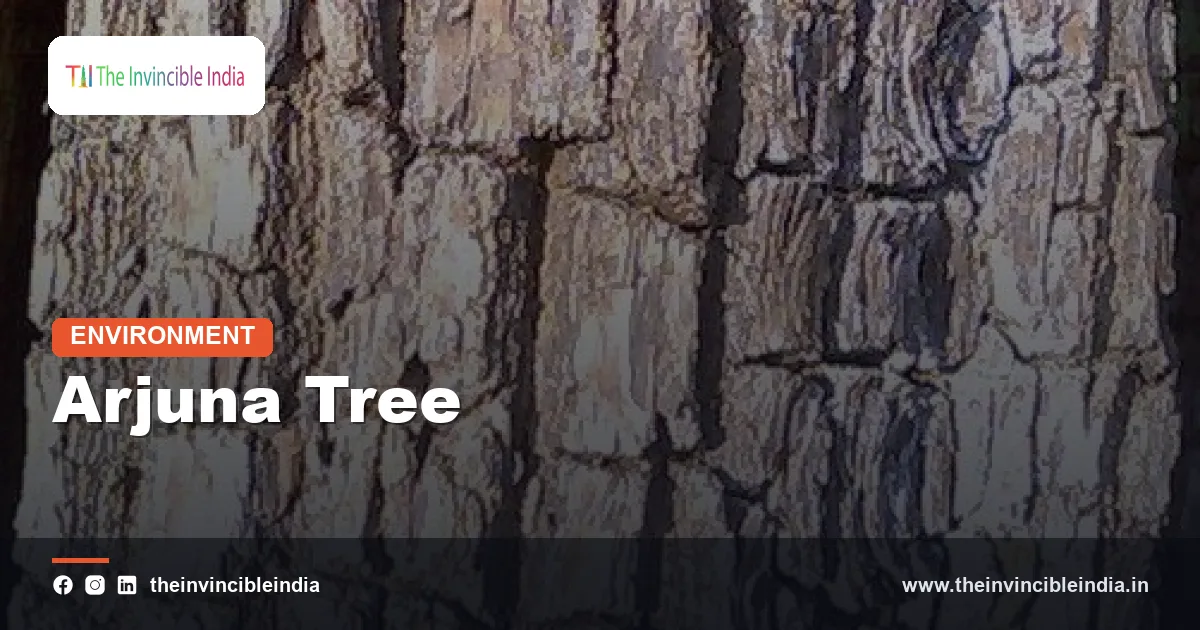
The arjuna tree (Terminalia arjuna) is a tall, buttressed riverbank tree of the Indian subcontinent, known for its smooth pale bark, which Ayurveda has used for centuries as a traditional heart tonic. Also called arjun, arjuna myrobalan or the white marudah, the arjuna tree belongs to the Combretaceae family and grows along rivers, streams and dry watercourses across much of India.
Beyond medicine, the arjuna tree is a host plant for the tasar silkworm, a source of tannin and durable timber, and a useful tree for stabilising riverbanks. This explainer covers its appearance, habitat, traditional use, ecology and conservation, and keeps health claims within what tradition and research can reasonably support. 23 October 2026 marks the latest review.
| Attribute | Details |
|---|---|
| Scientific name | Terminalia arjuna |
| Family | Combretaceae (the same family as the myrobalans harad and bahera) |
| Common names | Arjun, arjuna, kahua, white marudah, arjuna myrobalan |
| Native range | India, Nepal, Bangladesh, Sri Lanka and Pakistan |
| Habitat | Riverbanks, streams, ravines and moist low-lying ground, mostly below about 1,000 metres |
| Size and form | Tall deciduous to semi-evergreen tree, often 20 to 30 metres, with a buttressed trunk |
| Distinctive features | Smooth pale grey bark that peels in thin sheets; five-winged fruit |
| Principal uses | Ayurvedic bark preparations, tasar silkworm rearing, tannin, timber and riverbank protection |
Key Takeaways
- The arjuna tree is the common name for Terminalia arjuna, a large riverbank tree of the Combretaceae family found across India.
- Arjuna bark is a classical Ayurvedic remedy for the heart, traditionally taken as a decoction, as arjuna ksheerpaka (bark boiled in milk) or as the fermented tonic arjunarishta.
- Clinical evidence for arjuna bark in heart conditions is limited and mixed, and the bark is not a substitute for prescribed cardiac treatment.
- The leaves of the arjuna tree are a food plant for the tasar silkworm, Antheraea mylitta, which produces the wild silk known as tasar.
- The arjuna tree has a wide, buttressed base and deep roots that help hold soil on riverbanks and in seasonal watercourses.
- The arjuna tree is easily recognised by its smooth, whitish-grey bark and its distinctive fruit, which has five hard longitudinal wings.
What is the arjuna tree?
The arjuna tree is a large tree, Terminalia arjuna, that grows naturally beside rivers and streams in India, Nepal, Bangladesh, Sri Lanka and Pakistan. It is a close relative of the trees that yield the myrobalan fruits harad (Terminalia chebula) and bahera (Terminalia bellirica), which are among the three components of the Ayurvedic preparation triphala.
The tree is known across India by many local names, including arjun in Hindi and arjuna in Sanskrit, kahua in some northern dialects, and marutham or neer maruthu in Tamil. The Sanskrit word arjuna carries meanings of white, bright or clear, which fits the pale bark. The same word is the name of the Pandava prince in the Mahabharata, though the tree’s name reflects its colour rather than any single legend.
In forests it is usually found with other riverine species such as jamun, siris and mango, and in dry deciduous belts it clusters along perennial or seasonal channels. Many old arjuna trees also stand on temple grounds, village edges and the grounds of colonial-era buildings, because they were planted for shade and for their medicinal bark.
What does the arjuna tree look like?
The arjuna tree is easy to recognise by its tall straight trunk with a wide, flaring, buttressed base, its smooth pale bark and its drooping branches that give a rounded, spreading crown. Mature trees commonly reach 20 to 30 metres, and old trees can have very thick, fluted trunks.
Bark, leaves, flowers and fruit
- Bark: smooth, whitish to pale grey, thick and inner-reddish. It flakes off in large thin sheets, leaving shallow, curved scars, a feature that makes the tree stand out among riverside trees.
- Leaves: oblong, 10 to 20 centimetres long, arranged in loosely opposite pairs and smooth on top, with a lighter underside.
- Flowers: small, creamy white to yellowish, fragrant and borne in branched spikes, usually from about March to June.
- Fruit: a hard, woody drupe with five longitudinal wings, around 2.5 to 5 centimetres long, ripening in the cooler months and often remaining on the tree for a long time.
The buttresses are broad, plank-like ridges of trunk tissue that run out across the ground at the tree’s base. They give the arjuna a distinctive silhouette and help anchor the tree in the soft, shifting soils beside rivers.
The arjuna loses its leaves for a short time in the dry season in many regions, usually just before the new leaves appear, so it is best described as deciduous or semi-evergreen depending on the local climate.
Where does the arjuna tree grow in India?
The arjuna tree grows in the sub-Himalayan tract, the Gangetic plains and central India, as well as in parts of the Deccan and the southern peninsula, almost always near water. It is especially common in Uttar Pradesh, Bihar, Jharkhand, Madhya Pradesh, Chhattisgarh, Odisha, West Bengal, Maharashtra, Gujarat and Karnataka.
The tree favours deep alluvial soil that stays moist, although it can survive brief dry periods. Its roots penetrate far enough to tap groundwater, and it tolerates occasional flooding better than many other large trees. It does not do well in cold, high-altitude conditions, and it is rarely seen in the upper Himalaya.
Because it is so strongly tied to rivers, the arjuna tree is often used as a natural indicator of a water-bearing channel. Foresters and farmers know that arjuna avenues commonly mark old river courses, and plantations along canals and tanks in several states include the species.
What is the arjuna tree used for in Ayurveda?
In Ayurveda, the bark of the arjuna tree is used as a classical cardiac tonic, known in Sanskrit texts as hridya, meaning beneficial to the heart. It is one of the best-known herbal remedies in the Indian tradition and appears in many classical formulations.
The bark is most commonly taken in three forms. Practitioners prepare a decoction (kwatha) by boiling the bark in water, a milk preparation called arjuna ksheerpaka by boiling powdered bark in milk and water, and a fermented tonic known as arjunarishta. Bark powder is also available as capsules and tablets from many herbal manufacturers.
- Traditional use: as a general tonic for the heart and circulation.
- Other traditional uses: for wounds, fractures, ulcers and cough, and as an astringent in some home remedies.
- Active constituents studied: triterpenoids such as arjunic acid and arjunolic acid, tannins, flavonoids and glycosides.
What does the research say?
Laboratory studies and a number of small clinical trials have looked at arjuna bark in conditions such as angina and chronic heart failure, and some have reported modest improvements in symptoms or exercise tolerance. However, the studies are generally small and vary in dose and preparation, and larger rigorous trials are lacking. Researchers therefore describe the evidence as encouraging but not definitive.
Anyone with a heart condition should treat arjuna as a traditional supplement at most, never as a replacement for medical care. Arjuna products may interact with blood-pressure drugs, blood thinners or other heart medicines, and a doctor should always be consulted before use.
How is the arjuna tree connected to tasar silk?
The arjuna tree is one of the main food plants of the tasar silkworm, Antheraea mylitta, whose cocoons yield the coppery wild silk called tasar or kosa. The silkworm feeds on the leaves of arjuna and of asan (Terminalia tomentosa, also called saja), as well as on sal and a few other species.
Tasar silk is produced largely in Jharkhand, Chhattisgarh, Odisha, West Bengal, Maharashtra and Bihar, often by tribal and forest-dwelling communities who collect or rear cocoons on trees in forest plantations. India is among the largest producers of tasar silk globally, and the Central Silk Board supports research and development of the sector.
- Larvae are reared on host trees in the open, which makes the tree itself the farm.
- Cocoons are harvested, boiled and reeled into yarn that has a natural golden-brown tone.
- The silk is used for sarees, dress material, furnishing fabric and handloom products such as kosa silk from Chhattisgarh and Bhagalpuri tasar from Bihar.
This link means that conserving arjuna and asan groves directly supports forest-based livelihoods. A healthy stand of host trees can support repeated rearing seasons by rural households with minimal additional inputs.
What is the ecological role of the arjuna tree?
The arjuna tree plays an important ecological role by stabilising riverbanks, shading water bodies and feeding wildlife. Its large buttressed trunk and deep roots hold soil during floods, and its canopy shades the water edge, which helps keep stream temperatures down for fish and other aquatic life.
Flowers attract insects, including honey bees, and the tree’s flush of new leaves in spring feeds caterpillars and other herbivorous insects. Birds, bats and squirrels use the branches for roosting and nesting, and large old trees often have hollows that shelter owls, parakeets and small mammals.
The tree is also useful in riparian restoration. Foresters often plant arjuna on degraded river margins, canal banks and wetland edges in order to reduce erosion and restore a native canopy, although it needs reliable moisture in its early years to establish well.
What other products does the arjuna tree provide?
Beyond bark medicine, the arjuna tree yields tannin, timber, fodder and fuel. The bark contains a good amount of tannin and has been used locally in tanning leather and in dyeing, although synthetic and imported tannins now dominate the industrial market.
| Product | Source in the tree | Typical use |
|---|---|---|
| Medicinal bark | Stem bark, harvested in strips | Decoctions, ksheerpaka, arjunarishta, powders and capsules |
| Tannin | Bark | Traditional leather tanning and dyeing |
| Timber | Heartwood | Carts, agricultural implements, house posts, beams and general construction |
| Fuel | Branches and trimmings | Firewood and charcoal |
| Fodder | Leaves | Used as occasional cattle and goat fodder |
| Silkworm food | Leaves | Rearing of the tasar silkworm, Antheraea mylitta |
Arjuna timber is hard, heavy, durable and dark-brown, and it takes a good finish. It is not a top-grade furniture wood, but it is valued in rural areas for agricultural tools, cart wheels, and posts that must withstand weather and some contact with moisture. The timber can crack if it is seasoned too fast.
How is the arjuna tree grown and propagated?
The arjuna tree is grown mainly from seed, but nursery practitioners can also raise it from root suckers and cuttings. Fresh seed from the winged fruit germinates best when it is sown soon after collection and given steady moisture, since old seed has low viability and a hard coat that can slow germination.
Practical growing notes
- Soil: deep, moist alluvial soils near streams, tanks or canals are ideal.
- Water: young plants need regular irrigation in the first few dry seasons.
- Sun: the tree needs full sun and tends to grow tall quickly when well watered.
- Spacing: wide, as the crown and buttresses expand considerably.
- Growth: moderate; planted saplings can add around a metre or more of height per year under good conditions.
Avenue and campus planting of arjuna is common in several cities, partly because the tree is long-lived, partly because it looks handsome, and partly because it is easy to identify by its bark. It has also been planted on large scale in forestry and farm forestry programmes in Uttar Pradesh, Madhya Pradesh and Maharashtra.
Is the arjuna tree threatened by bark harvesting?
Bark harvesting is a real pressure on wild arjuna populations, because demand for the medicinal bark is high and unsustainable stripping can weaken or kill a tree. The bark is the commercial product, so trees are routinely stripped, and heavy or repeated removal of bark around the whole trunk can girdle the tree.
The National Medicinal Plants Board, under the Ministry of AYUSH, lists arjuna among the commercially important medicinal plants and promotes cultivation and good collection practices. Sustainable practice generally means taking bark in alternating vertical strips, leaving enough to allow regrowth, and rotating harvest between trees and years.
- Cultivation on farmland reduces pressure on wild stands.
- Good collection practices protect the cambium (the living layer under the bark).
- Community forest management helps regulate harvest and protect riverine groves.
Beyond harvesting, the arjuna tree is affected by loss of riverbank habitat to sand mining, encroachment, embankment construction and changes in river flow. Protecting riparian belts therefore benefits the arjuna along with many other species.
Bottom Line
The arjuna tree is a tall, buttressed riverbank species whose pale bark is one of the best-known remedies of Ayurveda, and whose leaves support India’s tasar silk tradition. Its health use rests on tradition and limited research, so it should be taken only with a doctor’s guidance, while the tree itself deserves protection for its ecological and livelihood value.
Frequently Asked Questions
What is the botanical name of the arjuna tree?
The botanical name of the arjuna tree is Terminalia arjuna. It belongs to the Combretaceae family, which also includes the myrobalan trees harad and bahera. The tree is native to the Indian subcontinent and grows mainly beside rivers and streams.
What is arjuna bark used for?
Arjuna bark is used in Ayurveda mainly as a traditional heart tonic, taken as a decoction, as arjuna ksheerpaka (bark boiled in milk) or as arjunarishta. It is also used traditionally for wounds and as an astringent. Scientific evidence is limited, and arjuna should not replace prescribed heart treatment.
How can you identify an arjuna tree?
An arjuna tree can be identified by its smooth, pale whitish-grey bark that peels in thin sheets, its broad buttressed trunk base and its five-winged woody fruit. It usually stands near a river, stream or other moist ground. The leaves are oblong and loosely paired, and the crown is spreading.
Which silkworm feeds on the arjuna tree?
The tasar silkworm, Antheraea mylitta, feeds on the leaves of the arjuna tree. It also feeds on asan (Terminalia tomentosa) and sal. Its cocoons yield tasar silk, a wild silk produced mainly in Jharkhand, Chhattisgarh, Odisha, West Bengal and neighbouring states.
Where does the arjuna tree grow?
The arjuna tree grows along rivers, streams and moist ravines across India, particularly in the Gangetic plains, central India, Odisha, West Bengal and parts of the Deccan. It is also found in Nepal, Bangladesh, Sri Lanka and Pakistan. It prefers deep, moist alluvial soil at low elevations.
Is it safe to take arjuna bark every day?
Arjuna bark is generally used in traditional doses without major reported problems, but it is not suitable for everyone and long-term safety data are limited. It may interact with blood-pressure medicines, blood thinners and other heart drugs. A person should consult a doctor before taking arjuna regularly, particularly if they have a heart condition, are pregnant or are on medication.
{“@context”:”https://schema.org”,”@graph”:[{“@type”:”FAQPage”,”mainEntity”:[{“@type”:”Question”,”name”:”What is the botanical name of the arjuna tree?”,”acceptedAnswer”:{“@type”:”Answer”,”text”:”The botanical name of the arjuna tree is Terminalia arjuna. It belongs to the Combretaceae family, which also includes the myrobalan trees harad and bahera. The tree is native to the Indian subcontinent and grows mainly beside rivers and streams.”}},{“@type”:”Question”,”name”:”What is arjuna bark used for?”,”acceptedAnswer”:{“@type”:”Answer”,”text”:”Arjuna bark is used in Ayurveda mainly as a traditional heart tonic, taken as a decoction, as arjuna ksheerpaka (bark boiled in milk) or as arjunarishta. It is also used traditionally for wounds and as an astringent. Scientific evidence is limited, and arjuna should not replace prescribed heart treatment.”}},{“@type”:”Question”,”name”:”How can you identify an arjuna tree?”,”acceptedAnswer”:{“@type”:”Answer”,”text”:”An arjuna tree can be identified by its smooth, pale whitish-grey bark that peels in thin sheets, its broad buttressed trunk base and its five-winged woody fruit. It usually stands near a river, stream or other moist ground. The leaves are oblong and loosely paired, and the crown is spreading.”}},{“@type”:”Question”,”name”:”Which silkworm feeds on the arjuna tree?”,”acceptedAnswer”:{“@type”:”Answer”,”text”:”The tasar silkworm, Antheraea mylitta, feeds on the leaves of the arjuna tree. It also feeds on asan (Terminalia tomentosa) and sal. Its cocoons yield tasar silk, a wild silk produced mainly in Jharkhand, Chhattisgarh, Odisha, West Bengal and neighbouring states.”}},{“@type”:”Question”,”name”:”Where does the arjuna tree grow?”,”acceptedAnswer”:{“@type”:”Answer”,”text”:”The arjuna tree grows along rivers, streams and moist ravines across India, particularly in the Gangetic plains, central India, Odisha, West Bengal and parts of the Deccan. It is also found in Nepal, Bangladesh, Sri Lanka and Pakistan. It prefers deep, moist alluvial soil at low elevations.”}},{“@type”:”Question”,”name”:”Is it safe to take arjuna bark every day?”,”acceptedAnswer”:{“@type”:”Answer”,”text”:”Arjuna bark is generally used in traditional doses without major reported problems, but it is not suitable for everyone and long-term safety data are limited. It may interact with blood-pressure medicines, blood thinners and other heart drugs. A person should consult a doctor before taking arjuna regularly, particularly if they have a heart condition, are pregnant or are on medication.”}}]}]}


