

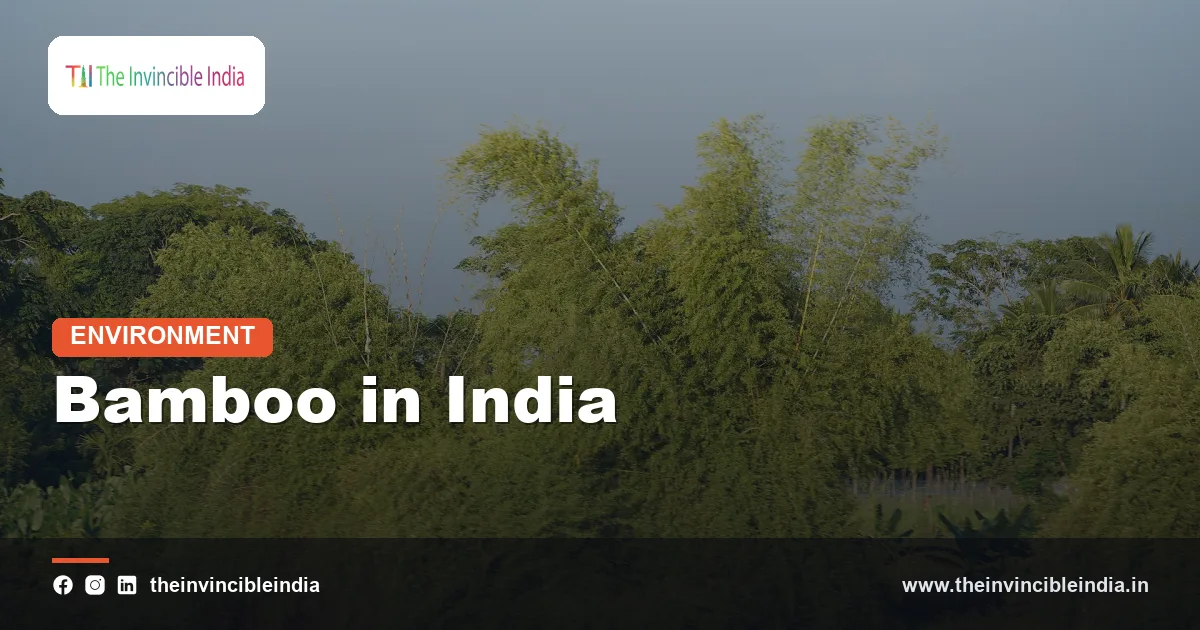
Bamboo is a group of giant, fast-growing woody grasses in the grass family (Poaceae, subfamily Bambusoideae), not a tree, and in India it supplies building material, scaffolding, handicrafts, paper pulp, food and livelihoods to millions of rural households. India is one of the world’s richest countries for bamboo diversity, with well over a hundred species, concentrated in the north-eastern states, the Western Ghats and the central Indian forest belt.
This explainer covers what bamboo is, how it grows, which species matter in India, how people use it, why whole bamboo forests flower and die together in long cycles that can trigger rat plagues, and how a 2017 change in forest law altered the legal status of bamboo grown outside forests. 23 October 2026 marks the latest review.
| Attribute | Details |
|---|---|
| Botanical status | Giant woody grass; subfamily Bambusoideae of the grass family Poaceae (not a tree) |
| Species in India | Well over 100 species in more than 20 genera, among the richest bamboo floras in the world |
| Main regions | North-east India (the richest), Western Ghats, Central India, Odisha, Himalayan foothills |
| Growth speed | Some species grow close to a metre in a single day during peak season |
| Stem structure | Hollow, jointed culm with solid nodes; no annual rings and no secondary thickening |
| Flowering | Many species flower together after decades, then die (gregarious flowering) |
| Key legal change | Indian Forest (Amendment) Act, 2017: bamboo grown outside forest areas no longer counted as a tree |
| Policy support | National Bamboo Mission (Ministry of Agriculture and Farmers’ Welfare) |
Key Takeaways
- Bamboo is a giant woody grass belonging to the family Poaceae, which makes it a close relative of wheat, rice and sugarcane rather than of timber trees.
- India is among the world’s richest countries for bamboo diversity, with well over a hundred species, and the north-eastern states hold the largest share.
- Some bamboo species grow nearly a metre a day at peak, and most reach full height within a single growing season.
- Many Indian bamboos flower together at intervals of several decades and then die, as seen in the mautam cycle of Mizoram, where Melocanna baccifera flowers about every 48 years.
- The Indian Forest (Amendment) Act, 2017 removed bamboo grown on non-forest land from the legal definition of a tree, so farmers no longer need a felling or transit permit for it.
- Bamboo is used for scaffolding, house construction, baskets, mats, furniture, incense sticks, paper pulp and edible shoots across India.
What is bamboo and why is it not a tree?
Bamboo is a perennial evergreen grass of the family Poaceae, and it is not a tree because it has no true wood, no vascular cambium and no annual growth rings. Botanists classify bamboos in the subfamily Bambusoideae, alongside the other grasses such as rice, wheat, maize and sugarcane.
Each bamboo stem, called a culm, is a hollow cylinder divided into segments by solid joints called nodes. The culm reaches its full diameter as it emerges from the ground, and it does not thicken afterwards the way a tree trunk does. Instead of adding rings, a bamboo culm hardens and strengthens over a few years as its tissues mature.
- Culm: the above-ground stem, hollow in most species and solid in a few such as Dendrocalamus strictus.
- Rhizome: the underground stem system from which new culms arise.
- Culm sheath: the protective leaf-like sheath that wraps each emerging shoot.
- Branches and leaves: develop after the culm reaches full height.
The two main growth forms are clumping (sympodial) bamboos, common in India, which form dense tufts that expand slowly outward, and running (monopodial) bamboos, which spread by long underground rhizomes. Most Indian species are clumping, and this makes them easier to manage and less invasive than many running bamboos found elsewhere.
How fast does bamboo grow?
Bamboo is among the fastest-growing plants on Earth, and some species can grow several centimetres to almost a metre in a single day during peak season. The new shoot emerges from the ground with its full diameter already set and then extends rapidly by elongation of its internodes, much like a telescope opening.
In most Indian species the new culms appear with the rains, and by the end of the monsoon season they have reached their full height, which in large species may be 20 to 30 metres. Over the following one to three years the culm hardens and its walls become strong enough for building use.
The speed of growth is the main reason bamboo is considered a renewable resource. A bamboo clump produces new culms every year, and mature culms can be harvested selectively without killing the plant. This is quite unlike the felling of a tree, which removes the whole plant and takes many years to replace.
Which bamboo species grow in India?
India has well over a hundred species of bamboo, of which a small number account for most of the commercial use. Species in the genera Bambusa, Dendrocalamus, Melocanna and Ochlandra dominate the Indian landscape.
| Species | Common name or note | Typical region and use |
|---|---|---|
| Dendrocalamus strictus | Male bamboo; solid or nearly solid culm | Dry deciduous forests across India; poles, scaffolding, pulp, agarbatti sticks |
| Bambusa bambos | Giant thorny bamboo | Peninsular India; construction, paper and living fences |
| Bambusa tulda | Bengal bamboo | Eastern and north-eastern India; construction, mats and baskets |
| Bambusa balcooa | Balku bamboo | Assam, West Bengal and Bihar; heavy construction and scaffolding |
| Melocanna baccifera | Muli bamboo | North-east India; weaving, building and the mautam flowering cycle |
| Dendrocalamus hamiltonii | Hamilton’s bamboo | Eastern Himalaya and north-east; edible shoots and construction |
| Ochlandra travancorica | Reed bamboo | Kerala and the Western Ghats; mats, baskets and paper pulp |
The north-eastern states, including Assam, Arunachal Pradesh, Mizoram, Manipur, Nagaland, Meghalaya and Tripura, have the greatest bamboo diversity and a large share of the country’s bamboo-bearing forest area. Madhya Pradesh, Maharashtra, Odisha, Chhattisgarh and Karnataka are also important.
How does bamboo support rural livelihoods in India?
Bamboo supports rural livelihoods in India by providing raw material for housing, tools, baskets, mats and handicrafts, as well as seasonal income from harvesting, weaving and trading. It is often called the poor man’s timber, because it is cheap, widely available and workable with simple tools.
In many villages, particularly in the north-east, Odisha, Chhattisgarh and Maharashtra, families harvest culms from forests and village groves, and artisan communities such as the Basors and Doms of eastern India have traditionally woven baskets, winnowing trays and mats. The work is often household-based, and women form a large share of the weaving workforce.
- Household goods: baskets, winnowing trays (sup), mats, brooms, fishing traps and fences.
- Agriculture: ladders, support poles for vines and crops, irrigation pipes and cattle sheds.
- Food: tender shoots are cooked fresh, fermented or pickled, particularly in the north-eastern states.
- Crafts: furniture, lamps, ornaments, toys and musical instruments such as the bansuri flute.
- Incense: round bamboo sticks form the core of agarbatti, supporting a large cottage industry.
The Ministry of Agriculture and Farmers’ Welfare runs the National Bamboo Mission, which was launched in 2006-07 and restructured in 2018-19, to promote bamboo cultivation, nurseries, processing and marketing. Its stated aims include raising farmer incomes by encouraging bamboo planting on private and non-forest land.
Why is bamboo used for scaffolding and construction?
Bamboo is used for scaffolding and construction because it is strong in tension, light to carry, cheap and quick to replace. Bamboo poles can bear heavy loads relative to their weight, which is why bamboo scaffolding is a common sight on construction sites and building repairs in Indian cities.
Scaffolding poles are usually lashed together with coir or nylon rope, and workers can adjust the structure quickly as the building rises. The flexibility of the poles gives some tolerance to wind and vibration. Safety depends on the quality of the culms, the lashing and the supervision, so many urban sites now combine bamboo with steel scaffolding.
Building with bamboo
- Traditional houses: split-bamboo walls, bamboo frames and thatched roofs are common in Assam, Tripura, Mizoram and rural Bengal.
- Stilt houses: raised bamboo platforms (chang ghar) suit flood-prone and hilly areas.
- Modern use: treated bamboo is used for laminated boards, flooring, panels, bridges and shelters.
- Seismic suitability: bamboo’s lightness and flexibility makes bamboo-framed houses relatively resilient in earthquake-prone regions.
Untreated bamboo is vulnerable to borers, fungi and moisture. Soaking in water, seasoning, smoke curing and chemical treatment with approved preservatives are all used to extend the life of building bamboo.
What role does bamboo play in the paper and pulp industry?
Bamboo is a long-established raw material for India’s paper and pulp industry, valued for its long, strong fibres. Indian paper mills have used bamboo as a pulp source for decades, particularly in eastern, central and southern India where forest bamboo is abundant.
Reed bamboo (Ochlandra) in Kerala and Dendrocalamus strictus in several states were traditionally supplied to mills under forest-department contracts. In recent decades, supply constraints have pushed many mills towards plantation wood and recycled fibre, but bamboo pulp remains important in some regions.
- Fibre quality: relatively long fibre, good for printing and writing paper when blended.
- Supply: harvested from forests and increasingly from farm plantations.
- Other industrial uses: charcoal, activated carbon, textile fibre (bamboo viscose), flooring and furniture boards.
Industrial demand is one reason policy attention turned to private bamboo cultivation. Farmers were reluctant to plant bamboo while legal restrictions applied, and the 2017 amendment was intended to address that.
What is the bamboo flowering cycle and why does it matter?
The bamboo flowering cycle is a long-interval event in which many bamboos of the same species flower at about the same time, produce seed and then die. This is called gregarious or mass flowering, and intervals range from several decades to over a century depending on the species.
In most species, the flowering clump is monocarpic, meaning it dies after setting seed. Large stands can therefore die back across hundreds or thousands of square kilometres, and the forest regenerates later from the seedlings. The cause of the synchrony is not fully understood, and scientists suggest an internal clock set at germination or seeding.
What is mautam?
Mautam is the Mizo name for the mass flowering and death of the bamboo Melocanna baccifera in Mizoram, which recurs at intervals of about 48 years. The cycle has been recorded in the 1860s, around 1911, in 1958-59 and again in 2006-08. A related, shorter cycle known as thingtam is associated with another bamboo species, with an interval of roughly 30 years.
- Flowering produces a huge crop of fleshy, fruit-like seeds that attract rodents.
- Rats breed explosively on the abundant food and then move to farmland when the bamboo seeds run out.
- Crops and stored grain are destroyed, causing famine conditions in affected villages.
The 1958-59 mautam famine had lasting political effects in Mizoram. The government response was widely criticised as inadequate, and the Mizo National Famine Front formed to give relief. That organisation later became the Mizo National Front, which led an insurgency from 1966, and a peace accord was signed in 1986. After the 2006-08 flowering, the state and central governments prepared in advance with rat control, grain storage and relief plans, and the impact was much more limited.
What changed with the 2017 law on bamboo?
The Indian Forest (Amendment) Act, 2017 removed bamboo grown outside forest areas from the definition of tree in the Indian Forest Act, 1927, so that such bamboo is treated as a grass and can be felled and transported without a permit. Before the amendment, bamboo was legally a tree under Section 2(7) of the 1927 Act, which meant that even farmers growing bamboo on their own land needed permission to fell it or move it.
The change was introduced first through an ordinance in November 2017 and was then passed by Parliament as an amendment to the Act. It applies to bamboo grown on non-forest land. Bamboo growing in notified forest areas continues to be regulated under the forest laws, and state governments have to make matching changes in their own rules and transit regulations.
- Before 2017: felling and transit permits applied to bamboo like timber trees, discouraging private cultivation.
- After 2017: bamboo grown on private or non-forest land is free to harvest and transport.
- In forests: bamboo remains subject to forest law and management plans.
The Forest Rights Act, 2006 separately recognises the rights of forest-dwelling communities over minor forest produce, which includes bamboo, and gives community gram sabhas a role in managing it. The 2017 amendment is aimed at the private cultivation side of the question and is meant to complement that law.
What are the environmental benefits of bamboo?
Bamboo offers several environmental benefits, because it grows quickly, covers the soil, binds slopes and stores carbon in its culms and roots. A dense clump holds soil against rainfall, so bamboo is planted on riverbanks, slopes and degraded land to reduce erosion.
- Soil protection: fibrous root and rhizome networks hold soil on slopes and embankments.
- Carbon: fast growth takes up carbon dioxide, and bamboo products can keep carbon stored for years.
- Regeneration: selective harvesting of mature culms leaves the clump intact.
- Wildlife: bamboo forests shelter species such as elephants, red pandas and many birds, and some of these feed on shoots and leaves.
Bamboo is not a cure-all. The gregarious die-off creates fire risk and temporary loss of habitat, overharvesting can damage clumps, and exotic running bamboos can behave invasively outside their range. Careful management and local knowledge are therefore important.
Bottom Line
Bamboo is a giant grass that behaves like a tree in the economy, supplying construction material, craft fibre, pulp and food to rural India. Its long flowering cycles and the associated rat plagues show why the plant needs careful management, and the 2017 change in law has made it easier for farmers to grow and sell bamboo from private land.
Frequently Asked Questions
Is bamboo a tree or a grass?
Bamboo is a grass, not a tree. It belongs to the grass family Poaceae, in the subfamily Bambusoideae, and has hollow jointed stems with no annual rings and no true wood. It is a relative of rice, wheat and sugarcane.
How fast does bamboo grow?
Bamboo is among the fastest-growing plants, and some species grow close to a metre in a single day at peak season. Most clumping Indian bamboos reach full height within one monsoon growing season. The culms then harden over the next one to three years.
What is mautam in Mizoram?
Mautam is the mass flowering and death of the bamboo Melocanna baccifera in Mizoram, which recurs about every 48 years. The abundant bamboo seed causes a rapid increase in rat numbers, and the rats then attack crops and grain stores. The cycle led to famine in 1958-59 and was managed more effectively in 2006-08.
Can bamboo be cut freely in India?
Bamboo grown on private or non-forest land can be felled and transported without a permit since the Indian Forest (Amendment) Act, 2017, which removed it from the definition of a tree. Bamboo in notified forest areas is still governed by forest law and management plans. State rules should also be checked, as state governments implement the change.
What is bamboo used for in India?
Bamboo in India is used for scaffolding, house construction, baskets, mats, furniture, agarbatti sticks, paper pulp and handicrafts. Tender shoots are also eaten, particularly in the north-eastern states. It is one of the most widely used non-timber forest products in rural livelihoods.
Which Indian state has the most bamboo?
The north-eastern states together have the largest share of India’s bamboo diversity and bamboo-bearing forest area, with Assam, Arunachal Pradesh, Mizoram and Manipur especially rich. Madhya Pradesh, Maharashtra, Odisha and Karnataka also have significant bamboo resources. The exact ranking by area changes with each forest survey.
{“@context”:”https://schema.org”,”@graph”:[{“@type”:”FAQPage”,”mainEntity”:[{“@type”:”Question”,”name”:”Is bamboo a tree or a grass?”,”acceptedAnswer”:{“@type”:”Answer”,”text”:”Bamboo is a grass, not a tree. It belongs to the grass family Poaceae, in the subfamily Bambusoideae, and has hollow jointed stems with no annual rings and no true wood. It is a relative of rice, wheat and sugarcane.”}},{“@type”:”Question”,”name”:”How fast does bamboo grow?”,”acceptedAnswer”:{“@type”:”Answer”,”text”:”Bamboo is among the fastest-growing plants, and some species grow close to a metre in a single day at peak season. Most clumping Indian bamboos reach full height within one monsoon growing season. The culms then harden over the next one to three years.”}},{“@type”:”Question”,”name”:”What is mautam in Mizoram?”,”acceptedAnswer”:{“@type”:”Answer”,”text”:”Mautam is the mass flowering and death of the bamboo Melocanna baccifera in Mizoram, which recurs about every 48 years. The abundant bamboo seed causes a rapid increase in rat numbers, and the rats then attack crops and grain stores. The cycle led to famine in 1958-59 and was managed more effectively in 2006-08.”}},{“@type”:”Question”,”name”:”Can bamboo be cut freely in India?”,”acceptedAnswer”:{“@type”:”Answer”,”text”:”Bamboo grown on private or non-forest land can be felled and transported without a permit since the Indian Forest (Amendment) Act, 2017, which removed it from the definition of a tree. Bamboo in notified forest areas is still governed by forest law and management plans. State rules should also be checked, as state governments implement the change.”}},{“@type”:”Question”,”name”:”What is bamboo used for in India?”,”acceptedAnswer”:{“@type”:”Answer”,”text”:”Bamboo in India is used for scaffolding, house construction, baskets, mats, furniture, agarbatti sticks, paper pulp and handicrafts. Tender shoots are also eaten, particularly in the north-eastern states. It is one of the most widely used non-timber forest products in rural livelihoods.”}},{“@type”:”Question”,”name”:”Which Indian state has the most bamboo?”,”acceptedAnswer”:{“@type”:”Answer”,”text”:”The north-eastern states together have the largest share of India’s bamboo diversity and bamboo-bearing forest area, with Assam, Arunachal Pradesh, Mizoram and Manipur especially rich. Madhya Pradesh, Maharashtra, Odisha and Karnataka also have significant bamboo resources. The exact ranking by area changes with each forest survey.”}}]}]}


