

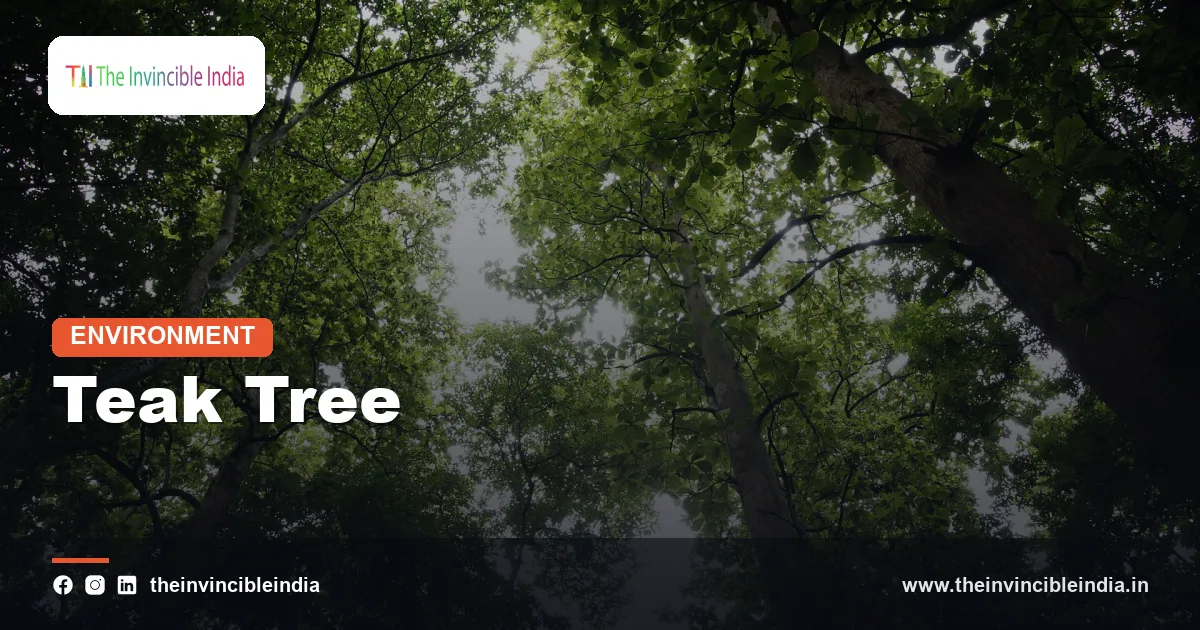
Teak (Tectona grandis) is a large deciduous tree of tropical Asia and the world’s most celebrated furniture and shipbuilding timber, known for its golden-brown, oily, durable wood and its very large leaves. India is one of teak’s native homes, with natural teak forests in the peninsula and central region and extensive teak plantations that supply much of the country’s premium timber.
Teak is prized because its wood resists rot, termites and moisture, stays dimensionally stable, and takes a rich finish, which is why it has been used for centuries in ships, temples, palaces and fine furniture. This explainer covers what teak is, where it grows in India, why the wood is so durable, the history of teak at places such as Nilambur, and how buyers can source it sustainably. Last updated: 23 October 2026.
Quick Facts: Teak at a Glance
| Common names | Teak, Sagwan (Hindi), Saguna (Odia), Thekku (Malayalam), Tekku (Tamil), Tega (Kannada), Sagun |
|---|---|
| Scientific name | Tectona grandis |
| Plant family | Lamiaceae (the mint family; older books place it in Verbenaceae) |
| Type | Tall deciduous hardwood tree, often 30 to 40 metres in height in good conditions |
| Native range | India, Myanmar, Thailand and Laos; widely planted in Africa, Latin America and elsewhere |
| Natural teak in India | Peninsular and central India, including the Western Ghats, Madhya Pradesh, Maharashtra, Karnataka, Kerala, Andhra Pradesh and Odisha |
| Leaves | Very large, broad, rough-textured leaves that are shed in the dry season |
| Wood properties | Golden-brown heartwood, natural oils and silica, high resistance to decay, termites and warping |
| Famous site | Conolly’s Plot in Nilambur, Kerala, regarded as the world’s oldest teak plantation |
Key Takeaways
- Teak (Tectona grandis) is a deciduous hardwood tree of the mint family that is native to India and parts of Southeast Asia.
- Teak wood is valued for its natural oils, which give it exceptional resistance to water, rot, termites and warping.
- Conolly’s Plot at Nilambur in Kerala, started in the 1840s, is widely regarded as the world’s oldest teak plantation.
- Teak leaves are among the largest of any tree commonly seen in India, and they turn the whole forest golden before they fall in the dry season.
- Most teak now used in India comes from managed plantations and farm plantings rather than from natural forest, which is protected from commercial felling.
- Buyers can choose sustainable teak by asking for legal documentation and, where available, certification such as that of the Forest Stewardship Council.
What is teak?
Teak is a large tropical hardwood tree, scientifically named Tectona grandis, that is native to India, Myanmar, Thailand and Laos and is famous for producing one of the world’s most durable and attractive timbers. The word teak itself is believed to come from the Malayalam word thekku.
Botanically, teak belongs to the Lamiaceae family, which also contains mint, basil and tulsi. The tree grows tall and straight with a clean trunk, sheds its leaves in the dry season and flowers in the rainy season in large, branched clusters of tiny whitish flowers. The fruit is a small, hard, round nut enclosed in an inflated, papery covering.
Teak is called the “king of timbers” in the trade, and the species has been introduced into plantations across Africa, Latin America, the Caribbean and other parts of Asia. India still ranks among the largest users of teak, importing sizeable quantities in addition to producing its own.
What does a teak tree look like?
A teak tree looks like a tall, straight deciduous tree with a fluted base, pale brown fibrous bark and unusually large, broad leaves that can be as long as a person’s forearm or more. In the dry season the tree stands bare, and in the monsoon it carries tall, airy plumes of small white flowers.
- Leaves: Oval to elliptical, opposite, often 30 to 50 centimetres or more in length on young or coppice shoots, with a rough upper surface and a hairy underside.
- Dye in the leaves: Young leaves release a reddish-pink stain when crushed, a feature sometimes used to identify the species.
- Bark: Light brown to grey, thin, fibrous and peeling in long strips.
- Flowers: Small, white and borne on large terminal panicles during the monsoon, attracting bees.
- Fruit: A hard, round nutlet wrapped in a bladder-like husk, which can remain dormant for a long time before germinating.
Mature teak forests in the dry season are open and sunlit, with fallen leaves covering the ground. This leaf litter makes teak forests prone to ground fires, and many teak trees have bark adapted to survive moderate burning.
Where does teak grow in India?
Teak grows naturally in the deciduous forests of peninsular and central India, including the Western Ghats, the Deccan plateau, Madhya Pradesh, Maharashtra, Gujarat, Karnataka, Kerala, Andhra Pradesh, Telangana, Chhattisgarh and Odisha. It is also widely planted on forest land and private farms throughout the country.
The tree needs a warm climate with a pronounced dry season, deep, well-drained fertile soil such as alluvial or loamy soil, and rainfall that is neither too light nor waterlogging. Teak performs poorly on shallow, compacted or waterlogged soils. Natural stands are common in the moist and dry deciduous forest belts, often mixed with sal, bamboo and other species.
Because of intense historical demand, most easily accessible natural stands were logged heavily in the nineteenth and twentieth centuries. Today, natural teak forests are largely protected, and plantations supply the bulk of the harvested wood.
Why is teak wood so durable?
Teak wood is so durable because its heartwood contains natural oils, rubber-like compounds and silica that repel water, insects and fungal decay. These properties let teak survive decades outdoors or at sea with little maintenance.
The heartwood starts golden-brown and darkens with age, while the sapwood is paler and less durable. Teak has a straight grain, a slightly oily feel, moderate weight and low shrinkage, so it stays stable when humidity changes. The silica content also dulls cutting tools, which is why teak is somewhat demanding to saw and plane.
| Property | What it means in practice |
|---|---|
| Natural oils | Repel water and slow rot, so teak suits boat decks, outdoor furniture and doors |
| Termite resistance | Heartwood is naturally unattractive to termites and wood-boring insects |
| Dimensional stability | Low shrinkage and swelling, so joints stay tight and surfaces stay flat |
| Straight grain | Easy to carve and to finish, giving an attractive, even appearance |
| Colour ageing | Golden-brown wood that weathers to a silvery grey outdoors if left unfinished |
What is teak used for?
Teak is used mainly for high-quality furniture, doors and windows, ship and boat decking, flooring, carved panels and temple or palace construction. It is the standard choice wherever strength, appearance and weather resistance are needed together.
- Furniture: Sofas, beds, dining tables, cabinets and carved pieces, especially in homes and heritage buildings.
- Doors and windows: Teak frames and shutters last for generations and are prized in traditional Indian houses.
- Shipbuilding: Teak was long the preferred timber for ships and boats because it resists seawater and shipworm.
- Outdoor use: Garden furniture, decks and boat fittings that must withstand sun and rain.
- Flooring and panelling: Stable, attractive and durable interior surfaces.
Teak leaves have minor local uses as a wrapping and plate material, and the crushed leaves have been used traditionally as a natural dye. Teak sawdust and offcuts are used for fuel and for making composite products.
How did teak shape India’s shipbuilding history?
Teak shaped India’s shipbuilding history by giving the Bombay Dockyard and other Indian yards a timber that was resistant to rot and shipworm, so that Indian-built teak ships became famous for lasting decades at sea. The Wadia family of Bombay, master shipbuilders, built many teak vessels for the British Royal Navy and for merchant trade in the late eighteenth and nineteenth centuries.
One celebrated example is HMS Trincomalee, a frigate built of Malabar teak at Bombay and launched in 1817, which has been preserved as a museum ship in Hartlepool, England. The durability of the ship, long after most wooden vessels had been lost, is often used to illustrate teak’s strength.
Demand for naval and merchant timber led colonial authorities to control teak forests and to experiment with systematic planting. This is one reason that teak became one of the first Indian trees managed with a scientific forestry plan.
What is Conolly’s Plot in Nilambur?
Conolly’s Plot is a historic teak plantation on the banks of the Chaliyar river at Nilambur in Malappuram district, Kerala, and it is widely regarded as the world’s oldest teak plantation. It was established in the 1840s on the initiative of H. V. Conolly, the then Collector of Malabar, after whom it is named.
The plantation was created to ensure a supply of teak for the Royal Navy and for public works, and it later became a pioneer in plantation forestry. A well-known part of the plot still has tall, old teak trees, and the area is a popular tourist and research site. Nearby, the Teak Museum, run by the Kerala Forest Research Institute, displays the history, biology and uses of teak and is often described as the first museum devoted to a single tree species.
Kerala is also known for a very old teak called Kannimara in the Parambikulam Tiger Reserve, reputed to be several centuries old and often cited as one of the largest teak trees in the country. Its precise age and size are estimates and vary between sources.
How is teak grown in India today?
Teak is grown in India today mainly in plantations managed by state forest departments and forest development corporations, and in private farm plantations on agricultural land. These plantations produce most of the teak timber harvested in the country, because natural teak forests are restricted from commercial felling.
Plantation teak is usually raised from seedlings, root-shoot cuttings (stumps) or tissue-cultured plants, planted at a regular spacing and thinned several times. Forest-department rotations can be 50 to 80 years for high-quality timber, while private growers often harvest earlier, in roughly 20 to 30 years, to meet market demand. Early-harvested wood tends to have a higher proportion of sapwood and may be less durable than slowly grown old-growth teak.
Farm forestry and agroforestry
Many farmers in states such as Karnataka, Andhra Pradesh, Telangana, Maharashtra, Gujarat and Tamil Nadu plant teak on field boundaries or as block plantations. Rules for felling and transporting privately grown trees differ from state to state, and growers usually need to follow local permit procedures. Anyone considering teak as an investment should be wary of over-optimistic return claims, since timber prices, growth rates and rules vary and the investment horizon is long.
Is Indian teak different from Burmese and plantation teak?
Indian, Burmese and plantation teak are all the same species, Tectona grandis, but they differ in growth conditions, age at harvest and wood quality, which affects colour, density and price. Wood from slow-growing, older trees from certain regions is generally considered denser and more durable.
| Type | Source | Typical characteristics |
|---|---|---|
| Natural or old-growth teak | Mature trees from natural forests, mostly now protected or restricted | Dense, dark golden-brown, highly durable, expensive and scarce |
| Burmese (Myanmar) teak | Natural forests and plantations in Myanmar | Long regarded as the benchmark for quality; subject to export rules and sourcing concerns |
| Indian plantation teak | State-managed and private plantations in India | Variable by age and region; good quality when harvested at a mature age |
| Reclaimed teak | Old beams, doors and furniture recovered from demolished buildings | Well-seasoned and stable, and an environmentally friendly option |
The price and quality of teak therefore depend on the origin, age and grading. Sellers sometimes label wood as “Burma teak” or “Nilambur teak” for status, so buyers benefit from checking invoices and, where possible, independent inspection.
How can you buy teak sustainably?
You can buy teak sustainably by choosing wood with legal, traceable documentation, preferring certified or reclaimed teak, and avoiding timber of unknown origin. Certification schemes such as the Forest Stewardship Council (FSC) verify that wood comes from responsibly managed forests or plantations.
- Ask for the supplier’s proof of legal origin, such as transit permits, plantation records or import documents.
- Choose FSC-certified or similarly certified teak where available.
- Consider reclaimed teak from old buildings, which avoids new felling.
- Be wary of unusually cheap “old teak”, which may be mislabelled or illegally sourced.
- Use teak in long-lasting products, so that the tree’s long growing time is matched by a long product life.
Legal protection also matters. India’s Supreme Court, in the 1996 case widely known as the Godavarman case, ordered strict regulation of tree felling in forests, which tightened control on timber extraction from natural forests. Combined with state forest laws, this has made legal documentation an important part of the teak trade.
Bottom Line
Teak (Tectona grandis) is India’s premium timber tree, valued for oily, durable, stable wood that has built ships, temples and homes for centuries. Today’s supply depends on plantations, farm forestry and reclaimed wood, and sustainable buying depends on legality, traceability and realistic expectations about quality and age.
Frequently Asked Questions
What is the scientific name of teak?
The scientific name of teak is Tectona grandis, and it belongs to the Lamiaceae family, the same family as mint and tulsi. Older books list it under Verbenaceae. The common word teak is thought to come from the Malayalam word thekku.
Why is teak so expensive?
Teak is expensive because it grows slowly, is naturally durable and attractive, and is in high demand while supply from natural forests is restricted. Older, slow-grown trees command higher prices for their dense, well-coloured heartwood. Legal restrictions, transport costs and processing difficulty also add to the price.
Where is teak found in India?
Teak is found naturally in the deciduous forests of peninsular and central India, including the Western Ghats, Madhya Pradesh, Maharashtra, Karnataka, Kerala and Odisha, and it is planted widely in other states. Nilambur in Kerala is its best-known historic plantation area. Most teak harvested now comes from plantations.
How long does a teak tree take to mature?
A teak tree usually takes about 20 to 30 years to reach harvestable size on private plantations and 50 to 80 years or more for high-quality timber in forest-department rotations. Growth depends on soil, rainfall and management. Older trees generally produce denser and more durable heartwood.
Is teak better than sal for furniture?
Teak is generally better for fine furniture and outdoor use because it is more stable, easier to work and naturally weather-resistant, while sal is stronger and cheaper and is often used for structural parts. The better choice depends on budget and purpose. Many buyers use sal for frames and teak for visible surfaces.
What is Conolly’s Plot?
Conolly’s Plot is a historic teak plantation at Nilambur in Kerala, started in the 1840s and widely regarded as the world’s oldest teak plantation. It is named after H. V. Conolly, the Collector of Malabar. The area is now a heritage and tourist site, with a nearby Teak Museum run by the Kerala Forest Research Institute.
{“@context”:”https://schema.org”,”@graph”:[{“@type”:”FAQPage”,”mainEntity”:[{“@type”:”Question”,”name”:”What is the scientific name of teak?”,”acceptedAnswer”:{“@type”:”Answer”,”text”:”The scientific name of teak is Tectona grandis, and it belongs to the Lamiaceae family, the same family as mint and tulsi. Older books list it under Verbenaceae. The common word teak is thought to come from the Malayalam word thekku.”}},{“@type”:”Question”,”name”:”Why is teak so expensive?”,”acceptedAnswer”:{“@type”:”Answer”,”text”:”Teak is expensive because it grows slowly, is naturally durable and attractive, and is in high demand while supply from natural forests is restricted. Older, slow-grown trees command higher prices for their dense, well-coloured heartwood. Legal restrictions, transport costs and processing difficulty also add to the price.”}},{“@type”:”Question”,”name”:”Where is teak found in India?”,”acceptedAnswer”:{“@type”:”Answer”,”text”:”Teak is found naturally in the deciduous forests of peninsular and central India, including the Western Ghats, Madhya Pradesh, Maharashtra, Karnataka, Kerala and Odisha, and it is planted widely in other states. Nilambur in Kerala is its best-known historic plantation area. Most teak harvested now comes from plantations.”}},{“@type”:”Question”,”name”:”How long does a teak tree take to mature?”,”acceptedAnswer”:{“@type”:”Answer”,”text”:”A teak tree usually takes about 20 to 30 years to reach harvestable size on private plantations and 50 to 80 years or more for high-quality timber in forest-department rotations. Growth depends on soil, rainfall and management. Older trees generally produce denser and more durable heartwood.”}},{“@type”:”Question”,”name”:”Is teak better than sal for furniture?”,”acceptedAnswer”:{“@type”:”Answer”,”text”:”Teak is generally better for fine furniture and outdoor use because it is more stable, easier to work and naturally weather-resistant, while sal is stronger and cheaper and is often used for structural parts. The better choice depends on budget and purpose. Many buyers use sal for frames and teak for visible surfaces.”}},{“@type”:”Question”,”name”:”What is Conolly’s Plot?”,”acceptedAnswer”:{“@type”:”Answer”,”text”:”Conolly’s Plot is a historic teak plantation at Nilambur in Kerala, started in the 1840s and widely regarded as the world’s oldest teak plantation. It is named after H. V. Conolly, the Collector of Malabar. The area is now a heritage and tourist site, with a nearby Teak Museum run by the Kerala Forest Research Institute.”}}]}]}


