

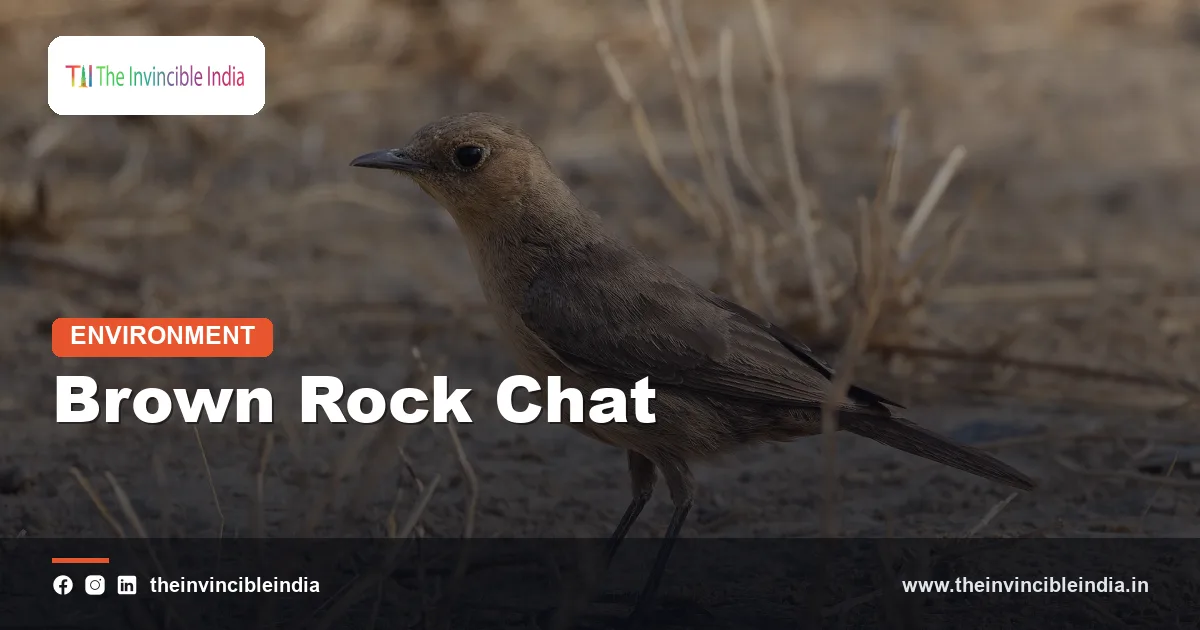
The brown rock chat (Oenanthe fusca) is a small, uniformly dark-brown songbird of the family Muscicapidae that lives on rocky outcrops, old forts and ruined buildings across the drier plains of the Indian subcontinent. It is a resident, tame and easily overlooked species, usually seen perched upright on a wall, ledge or boulder and flicking its wings open and shut.
Although the brown rock chat has no bright colours, it is one of the most characteristic birds of Indian heritage sites, quarries and rocky hills. This explainer covers how to identify the brown rock chat, where it lives in India, what it eats, how it sings and nests, and how it differs from similar brown birds.
| Fact | Detail |
|---|---|
| Common name | Brown rock chat (older English name: Indian chat) |
| Scientific name | Oenanthe fusca (formerly placed in the genus Cercomela) |
| Family | Muscicapidae (Old World flycatchers and chats) |
| Size | About 17 to 18 cm long; sexes look alike |
| Range in India | Resident across the dry plains and low hills of northern, western and central India and much of the Deccan plateau |
| Habitat | Rocky outcrops, ravines, quarries, stone walls, old forts, temples and ruined buildings |
| Diet | Mainly insects such as ants, beetles, termites and grasshoppers, picked from the ground |
| Breeding season | Roughly March to August, with a nest in a wall or rock crevice |
| Conservation status | Least Concern on the IUCN Red List |
Key Takeaways
- The brown rock chat (Oenanthe fusca) is a plain dark-brown chat of the family Muscicapidae, found on rocks and old buildings across the drier parts of India.
- Male and female brown rock chats look alike, with uniform brown plumage, a slender black bill and no white patches on the wings or tail.
- The brown rock chat is recognised by its upright stance and its habit of repeatedly flicking its wings half open while perched.
- The brown rock chat feeds mostly on ground insects, including ants, beetles, termites and grasshoppers, which it catches in short runs and quick pounces.
- The brown rock chat nests in holes and crevices in walls, rock faces and buildings, laying about three pale blue, reddish-speckled eggs.
- The brown rock chat is assessed as Least Concern, and it benefits from the stone walls, forts and quarries that supply it with nest sites.
What is the brown rock chat?
The brown rock chat is a small insect-eating songbird that belongs to the chat group of the Old World flycatcher family, Muscicapidae. Its scientific name is Oenanthe fusca, and it was long classified in a separate genus, Cercomela, before genetic studies placed it with the wheatears in Oenanthe.
The older English name “Indian chat” survives in many field guides, and it points to the bird’s range, which is centred on the Indian subcontinent. The word “chat” refers to the harsh, chattering calls of the group, while “fusca” is Latin for dusky or dark brown, a fair description of the plumage.
The brown rock chat is a non-migratory species. Individuals tend to stay in the same patch of rocky ground for years, defending a small territory around a favourite wall or boulder pile.
What does the brown rock chat look like?
The brown rock chat is a compact, upright bird with plain earth-brown plumage that is slightly paler on the underparts and darker on the wings and tail. Adults measure about 17 to 18 cm, which makes the brown rock chat a little larger than a house sparrow and a little slimmer.
Several features help with identification in the field.
- The plumage is uniform brown, with no streaks, bars or bright patches, and male and female are essentially identical.
- The bill is thin and black, and the legs are dark, which gives the bird a neat, slender look.
- The tail is dark brown, relatively long and often held slightly cocked, without the white base seen on many wheatears.
- Young birds are similar but show faint buff spotting on the back and wing feathers until their first moult.
The lack of obvious markings is itself a clue. Many look-alike birds have a chestnut vent, an orange tail or white wing panels, and the brown rock chat has none of these.
Where does the brown rock chat live in India?
The brown rock chat lives across the dry plains and low hills of northern, western and central India, and it reaches into the foothills of the Himalaya. It is also found in Pakistan and Nepal, and it is common in the rocky country of the Deccan plateau.
The species is far less common in the very humid regions. It is scarce in the wet forests of the Western Ghats, the Kerala lowlands and the far north-east, where continuous tree cover and heavy rain replace the open rocky ground it prefers.
Within its range, the brown rock chat is mostly a bird of low elevations, from sea-level plains to modest hills. It is a regular sight in places such as the stone ruins of Hampi, the forts of Rajasthan and Madhya Pradesh, and the granite hills and quarries of the peninsula, though local densities vary with the availability of rock and buildings.
Why is the brown rock chat found around old forts and buildings?
The brown rock chat is found around old forts and buildings because stone walls, ledges and crevices copy the cliffs and boulder slopes that are its natural habitat. A masonry fort offers the same hiding holes, lookout perches and sun-warmed surfaces that a rocky ravine provides.
This tolerance for human structures makes the brown rock chat a commensal species, one that lives alongside people without depending on farming or gardens. It readily uses railway cuttings, bridge piers, step-wells, temple compounds and the walls of abandoned houses.
Three habitat features matter most to the brown rock chat.
- Open ground or short scrub at the base of the rocks, where insects can be seen and caught easily.
- Crevices, holes and ledges that are deep enough to hold a nest out of the rain and away from predators.
- Elevated perches such as wall tops, roof edges and boulders that provide a clear view and a platform for singing.
What does the brown rock chat eat?
The brown rock chat eats mainly small insects and other invertebrates that it finds on or near the ground. Ants, beetles, termites, grasshoppers, caterpillars and small spiders make up most of the diet, and the bird occasionally takes flying insects in a short sally from its perch.
The hunting technique is simple and effective. The brown rock chat watches from a wall or stone, drops to the ground when it spots prey, runs a few quick steps, seizes the insect and returns to a perch. It may also hop along a wall or probe crevices for hidden insects.
In the hot months, when insects are active around sun-baked rock, the bird spends much of its time foraging in the early morning and late afternoon. Like most chats, it gets nearly all the water it needs from its food, although it will drink from puddles, tanks and leaking pipes when they are available.
How does the brown rock chat behave?
The brown rock chat behaves as a confiding, territorial bird that perches upright and constantly flicks its wings. The wing-flick is a quick partial opening of both wings, followed by a snap shut, and it is often combined with a slow bob or a gentle lifting of the tail.
Biologists believe such displays help in signalling to neighbours and mates and may startle small insects into moving. Whatever the reason, the flicking is the single best behavioural clue to the identity of the species.
The brown rock chat is usually seen alone or in pairs. It tolerates close approach by people, especially around temples, fort entrances and village houses, and it will often sit on a gate or roof edge a few metres away. Territories are defended with sharp calls and short chases, and a pair generally holds the same site year after year.
What does the brown rock chat sound like?
The brown rock chat has a short, sweet, warbling song and a set of sharp chipping calls. The song is a series of clear, musical phrases, slightly thrush-like in quality, and it is delivered from a prominent perch such as a rooftop, wall corner or boulder.
Males sing most often at dawn and in the breeding season, and the song carries well across open rocky ground. The alarm and contact calls are brief, dry “chik” or “tek” notes repeated in quick succession, which give the group its name “chat”.
The song is often the first sign that a brown rock chat is nearby. Because the bird is so plain, many observers learn to recognise it by ear before they pick it out by sight among the stones.
How does the brown rock chat breed?
The brown rock chat breeds in a crevice, hole or ledge in a wall, rock face or building, usually from about March to August. The nest is a loose pad of grass, rootlets and fibres, often lined with feathers, wool, hair or scraps of cloth, and it is tucked well out of sight.
A typical clutch has about three eggs, though two to four is normal. The eggs are pale bluish or greenish with fine reddish-brown speckles, and incubation lasts roughly two weeks. Both parents feed the chicks with insects, and the young leave the nest after about two weeks more.
Pairs may raise more than one brood in a season if conditions are good. Common nest sites include gaps between stones in old walls, holes under roof tiles, cavities in culverts, and cracks in quarry faces. This reliance on built structures explains why the species is steady around human settlements in dry regions.
How is the brown rock chat told apart from similar birds?
The brown rock chat is told apart from similar birds mainly by its uniform brown plumage, its slim black bill and its constant wing-flicking. Several other brown birds share its rocky haunts, and the table below sets out the key differences.
| Bird | Key difference from the brown rock chat |
|---|---|
| Indian robin (female) | Has a chestnut patch under the tail and holds its tail straight up |
| Black redstart (female or winter bird) | Shows a rusty-orange tail that quivers, especially in the cold-weather months |
| Pied bushchat (female) | Pale rump and a more rounded, plumper build, often on bushes and fences |
| House sparrow (female) | Thicker, conical bill and streaked back; hops rather than runs |
The upright stance and the wing-flick are the quickest checks. If a plain brown bird sits on a wall, flicks its wings half open and shows no orange or chestnut anywhere, it is very likely a brown rock chat.
Is the brown rock chat threatened?
The brown rock chat is not threatened. The IUCN Red List classifies it as Least Concern because it has a wide range, a large population and a tolerance of human-altered habitats.
Its main risks are local rather than national. The restoration or demolition of old buildings can remove nest crevices, and quarry closure or the conversion of rocky wasteland to plantations and housing reduces foraging ground. Pesticide use around farmland edges may reduce insect prey in some places.
Simple steps help the species in towns and heritage sites. Leaving small gaps in old masonry, avoiding sealing every crevice during repairs, and keeping patches of open, unsprayed ground near walls all support the brown rock chat and many other cavity-nesting birds.
Bottom Line
The brown rock chat (Oenanthe fusca) is a plain but appealing resident of India’s rocks, forts and ruins, known for its upright pose, wing-flicking and sweet short song. It is secure and widespread, and it shows how a wild bird can live comfortably alongside old human structures.
Frequently Asked Questions
What is a brown rock chat?
A brown rock chat is a small, uniformly brown songbird of the family Muscicapidae, scientifically named Oenanthe fusca. It lives on rocky outcrops, old forts and ruined buildings in the drier parts of India and neighbouring countries, and it is known for flicking its wings while perched.
Where can I see a brown rock chat in India?
The brown rock chat can be seen at rocky hills, quarries, old forts, temples and ruins across northern, western and central India and the Deccan. Heritage sites such as Hampi and many Rajasthan and Madhya Pradesh forts are reliable places to look, usually at wall tops or boulders in the early morning.
What does the brown rock chat eat?
The brown rock chat eats mostly small insects. Ants, beetles, termites, grasshoppers and caterpillars are its main foods, and it catches them by dropping from a perch to the ground, running a few steps and seizing the prey.
Does the brown rock chat migrate?
The brown rock chat does not migrate over long distances. It is a resident bird that stays in or near its home territory through the year, though some individuals may make short local movements in response to heat, food or weather.
How do you tell a brown rock chat from an Indian robin?
A brown rock chat has uniform brown plumage and no chestnut under the tail, while the Indian robin has a chestnut patch beneath the tail. The robin also holds its tail cocked high, whereas the brown rock chat keeps a more upright body and flicks its wings.
Is the brown rock chat endangered?
The brown rock chat is not endangered. It is rated Least Concern by the IUCN because it is widespread, common in suitable habitat and able to nest in walls and buildings.
{“@context”:”https://schema.org”,”@graph”:[{“@type”:”FAQPage”,”mainEntity”:[{“@type”:”Question”,”name”:”What is a brown rock chat?”,”acceptedAnswer”:{“@type”:”Answer”,”text”:”A brown rock chat is a small, uniformly brown songbird of the family Muscicapidae, scientifically named Oenanthe fusca. It lives on rocky outcrops, old forts and ruined buildings in the drier parts of India and neighbouring countries, and it is known for flicking its wings while perched.”}},{“@type”:”Question”,”name”:”Where can I see a brown rock chat in India?”,”acceptedAnswer”:{“@type”:”Answer”,”text”:”The brown rock chat can be seen at rocky hills, quarries, old forts, temples and ruins across northern, western and central India and the Deccan. Heritage sites such as Hampi and many Rajasthan and Madhya Pradesh forts are reliable places to look, usually at wall tops or boulders in the early morning.”}},{“@type”:”Question”,”name”:”What does the brown rock chat eat?”,”acceptedAnswer”:{“@type”:”Answer”,”text”:”The brown rock chat eats mostly small insects. Ants, beetles, termites, grasshoppers and caterpillars are its main foods, and it catches them by dropping from a perch to the ground, running a few steps and seizing the prey.”}},{“@type”:”Question”,”name”:”Does the brown rock chat migrate?”,”acceptedAnswer”:{“@type”:”Answer”,”text”:”The brown rock chat does not migrate over long distances. It is a resident bird that stays in or near its home territory through the year, though some individuals may make short local movements in response to heat, food or weather.”}},{“@type”:”Question”,”name”:”How do you tell a brown rock chat from an Indian robin?”,”acceptedAnswer”:{“@type”:”Answer”,”text”:”A brown rock chat has uniform brown plumage and no chestnut under the tail, while the Indian robin has a chestnut patch beneath the tail. The robin also holds its tail cocked high, whereas the brown rock chat keeps a more upright body and flicks its wings.”}},{“@type”:”Question”,”name”:”Is the brown rock chat endangered?”,”acceptedAnswer”:{“@type”:”Answer”,”text”:”The brown rock chat is not endangered. It is rated Least Concern by the IUCN because it is widespread, common in suitable habitat and able to nest in walls and buildings.”}}]}]}


