

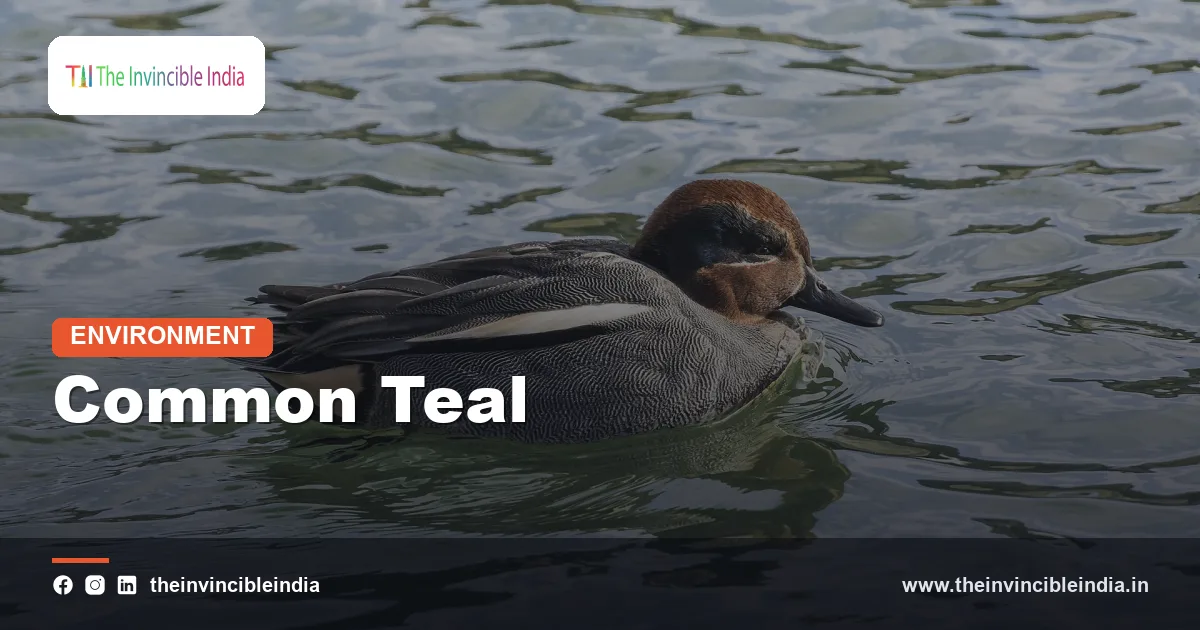
The common teal (Anas crecca) is a small, fast-flying dabbling duck that breeds across northern Eurasia and winters in huge numbers on wetlands throughout India. It is one of the smallest ducks in the country, and the drake is easily recognised by his chestnut head with a broad green eye patch, a cream stripe along the body and a yellow-buff patch beneath the tail.
Flocks of common teal twist and turn together in flight, then drop suddenly onto shallow water, which makes them one of the most lively sights at any Indian wetland in winter. This guide explains how to identify the common teal, where and when it appears in India, what it eats and how to tell it from similar small ducks.
| Common name | Common teal (also called Eurasian teal) |
|---|---|
| Scientific name | Anas crecca |
| Family | Anatidae (ducks, geese and swans) |
| Size | About 34 to 38 cm in length; wingspan roughly 53 to 59 cm |
| Range in India | Common to abundant winter visitor to shallow lakes, jheels, ponds, marshes and flooded fields across most of the country |
| Diet | Seeds, aquatic plants, insects, small snails and crustaceans, taken mainly from shallow water and mud |
| Breeding and migration | Breeds in northern Europe and Asia; Indian birds arrive from about September and leave by March or April |
| Conservation status | Least Concern globally (IUCN); protected under India’s Wild Life (Protection) Act, 1972 |
Key Takeaways
- The common teal is among the smallest ducks in India, about the size of a pigeon, with a compact body and a short neck.
- The drake common teal has a chestnut head with a green eye patch edged in buff, a horizontal white stripe on the shoulder and a yellowish patch under the tail.
- Common teal arrive in India from about September and leave by March or April, with the largest numbers between November and February.
- The common teal feeds by dabbling in very shallow water and mud, eating seeds, small invertebrates and plant material.
- Both sexes of the common teal show a bright green speculum in flight, which flashes when flocks turn.
- The common teal is classed as Least Concern by the IUCN, but its Indian winter wetlands are threatened by drainage, pollution and illegal hunting.
What is the common teal?
The common teal is a small dabbling duck of the family Anatidae that breeds in the northern forests, marshes and moors of Europe and Asia and migrates south in winter. It is a true migrant in India, where it is among the commonest winter ducks, and in many places it outnumbers larger duck species.
The word “teal” is also used for several other small ducks, and this can cause confusion. The common teal (Anas crecca), sometimes called the Eurasian teal, breeds in Eurasia. The green-winged teal of North America was long treated as the same species, but many modern checklists treat it as a separate species. In India, the bird seen is almost always the Eurasian form, although rare vagrants of the American form have been claimed.
Within India, the common teal shares wetlands with the garganey, a small duck that is also a winter visitor and sometimes passes through in large numbers during migration. The two small ducks are often seen together, and learning to separate them is a typical step for new birdwatchers.
How do you identify a common teal?
A common teal is identified by its small size, compact shape and, in the male, a rich chestnut head with a dark green band running back from the eye. Even at a distance, the drake looks greyish with a cream-edged patch on the rear.
The drake
The adult male common teal in winter has a chestnut head, a glossy green patch that starts at the eye and sweeps back toward the nape, and a thin buff outline around the green. The body is finely marked grey, with a horizontal white line along the shoulder, a spotted buff breast and a creamy-yellow triangle beside the black tail. The bill is small and dark.
The female and eclipse male
The female is a mottled brown duck with a pale streak under the tail and a dark line through the eye. She resembles a small female mallard. The male in eclipse plumage after breeding looks like the female but keeps a more uniform, greyer look. By late autumn, the males moult into full colour.
In flight
In flight, the common teal shows a pale wing bar and a bright green speculum bordered by buff and black. Flocks twist and wheel in tight formation, like starlings, and they take off almost vertically from the water. The quick, direct flight of a flock is one of the best clues to the species.
Voice
The drake gives a clear, high-pitched, whistling “krik-krik” or “preep-preep” that carries over water, and the female produces a sharp, short quack. A large winter flock can produce a continuous chorus of whistling.
How is the common teal different from the garganey?
The common teal differs from the garganey in having a chestnut head with a green eye patch and a white shoulder stripe, whereas the male garganey has a brown head with a broad white stripe curving over the eye. Females of the two are harder to separate, and observers rely on facial pattern and the wing colour in flight.
| Feature | Common teal | Garganey |
|---|---|---|
| Male head | Chestnut with green eye patch | Brown with long white stripe above the eye |
| Male body | Grey with white shoulder line | Brownish breast, finely barred flanks |
| Forewing in flight | Greyish-brown | Pale blue-grey in the male |
| Speculum | Bright green | Dull greyish-green |
| Female face | Plain, with a dark eye stripe | Strong pale stripe above and below the eye |
| Main season in India | Autumn to early spring | Autumn passage and winter, with spring passage |
Where is the common teal found in India?
The common teal is found in winter across almost the whole of India, wherever shallow, vegetated water is available, and it is especially common in the north, centre and east. It uses natural lakes, ponds, village tanks, marshes, paddy fields, reservoir edges and slow-flowing rivers.
Because the common teal is small and light, it prefers very shallow water, where it can feed by wading or dabbling without needing to swim in deep areas. Flocks often settle in reedy or weedy corners of a lake, in small pools on the edges of rivers, and in mudflats where seeds and insects are plentiful.
- Northern plains: Sultanpur, Okhla, Harike, Keoladeo and the many jheels of the Gangetic plain.
- Western India: Nal Sarovar, Thol Lake and wetlands of Kutch.
- Eastern India: Chilika Lake, Deepor Beel and other floodplain wetlands.
- Southern India: Kolleru Lake, irrigation tanks across the Deccan and coastal lagoons.
- Himalayan foothills and valleys: Hokersar, Wular Lake and Pong Dam Lake.
Small ponds and rice fields are as important as famous sanctuaries. Common teal often use even tiny wetlands, and this flexibility is one reason the species remains abundant.
When does the common teal visit India?
The common teal visits India from about September until March or April, and the peak months are December and January. The first birds usually appear in September, soon after the monsoon retreats, and groups continue to arrive through October.
Most northern breeding areas freeze from October or November, which forces the ducks to move south. The common teal travels along the Central Asian Flyway, crossing the high mountain ranges of the north. In spring, as the ice melts, the birds begin returning north in late February and March, and by April most have left India.
Some common teal remain in Pakistan, Nepal and Bangladesh, while many go on to winter in India and as far south as Sri Lanka. A few birds can be seen out of season, but these are usually injured or sick individuals that were unable to migrate.
What does the common teal eat?
The common teal eats seeds, small aquatic plants, insects, insect larvae, snails and tiny crustaceans, which it picks from the water surface or sieves from mud. In winter its diet is mostly seeds of grasses, sedges and other wetland plants, while in the breeding season animal food becomes much more important.
Unlike larger ducks, the common teal rarely upends in deep water. It feeds mostly by:
- Dabbling: nibbling and sieving at the surface.
- Mud-probing: feeding along muddy edges in a style that resembles a small wader.
- Walking in shallows: picking food from stems and leaves.
- Feeding in paddy: taking spilt grain and weed seeds after harvest.
The small bill of the common teal contains fine plates that sieve out seeds and invertebrates. Common teal tend to feed more actively at dusk and during the night, when disturbance is lower.
How does the common teal behave?
The common teal is a shy, sociable duck that lives in flocks, hides in vegetation by day and often feeds at dawn and dusk. It is quick to take flight, and a single alarm call can send the whole flock into the air.
During the day many teal rest in sheltered corners of lakes, tucked into reeds or on muddy banks. Flocks tend to be tight and cohesive, and they often settle among other small ducks. In the air, the aerobatic displays are impressive, and the group can change direction together with astonishing precision.
Courtship begins in winter, and pairs form before the return migration. Displays include head-shaking, whistling and short, rushing swims. The drake often follows the female to her breeding area, and the pair arrives on the northern breeding grounds soon after the thaw.
How does the common teal breed?
The common teal breeds in the north of Europe and Asia in wooded marshes, moorland pools and bog-edged lakes, and it does not nest in India in significant numbers. The nest is a well-hidden hollow on the ground, usually concealed in thick grass, heather or under bushes and lined with down.
The female lays about eight to eleven creamy eggs, incubates them for roughly three weeks and leads the ducklings to water soon after hatching. The young feed on insects and tiny invertebrates, and they can fly in around four weeks. Common teal are among the quickest of the ducks to reach independence.
Because the species depends on small, shallow northern pools, it is sensitive to changes in climate, drought and the drainage of wetlands in the breeding range.
Is the common teal threatened?
The common teal is not globally threatened and is rated Least Concern by the IUCN, since it is one of the most abundant ducks in the world. In India, however, the loss of shallow wetlands and illegal hunting remain concerns.
- Wetland loss: reclamation, drainage and conversion of ponds and marshes for farming or construction.
- Pollution: effluents and fertiliser runoff reduce the plant and insect food the ducks need.
- Hunting and netting: small ducks are often targeted by illegal trappers during the winter.
- Disease: wild waterbirds can carry or be affected by avian influenza.
- Climate change: shifts in rainfall and temperature affect breeding success and migration timing.
The common teal is protected under the Wild Life (Protection) Act, 1972, and many key wintering sites are formally protected as national parks, sanctuaries or Ramsar wetlands. The Asian Waterbird Census, which takes place each January, includes the species in its counts.
Why is the common teal important?
The common teal is important because it links wetlands on two continents, shows the health of shallow freshwater habitats and is a valuable food source and seed disperser in the wetland ecosystem. Its presence signals that a pond or marsh still supports a working food web.
The common teal also helps disperse seeds: it carries plant seeds between wetlands on its feet and feathers and in its gut. It also serves as prey for eagles, harriers and falcons that winter in India. For people, flocks of teal are a major attraction for birdwatching and wetland tourism, and the birds draw attention to the need for wetland protection.
Bottom Line
The common teal is a small, quick and abundant winter duck that reaches India each autumn from northern breeding grounds. It does not need much space, but it does need shallow, clean and undisturbed water, and keeping village ponds and marshes alive is the most practical way of keeping flocks of teal in Indian skies.
Frequently Asked Questions
What is a common teal?
A common teal is a small, fast-flying dabbling duck (Anas crecca) that breeds in northern Europe and Asia and winters across India. The drake has a chestnut head with a green eye patch and a cream stripe on the shoulder. It is one of the smallest ducks in the country.
When do common teal come to India?
Common teal come to India from about September and stay until March or April. Numbers are highest in December and January. They leave for the northern breeding grounds as the ice there begins to melt.
What is the difference between a common teal and a garganey?
The male common teal has a chestnut head with a green eye patch, while the male garganey has a brown head with a broad white stripe over the eye. The common teal also has a bright green speculum, whereas the garganey’s is duller. Females are similar and are separated by facial pattern.
What does the common teal eat?
The common teal eats seeds, small aquatic plants, insects, snails and tiny crustaceans. It feeds by dabbling at the surface, probing mud and picking spilt grain in paddy fields. Animal food is more important in the breeding season.
Where can I see common teal in India?
Common teal can be seen at shallow wetlands across India, including Sultanpur, Keoladeo, Harike, Nal Sarovar, Chilika Lake and Kolleru Lake. They also use village ponds, tanks and flooded fields. The best time is between November and February, early in the morning.
Does the common teal breed in India?
No, the common teal does not breed regularly in India. It nests on the ground in northern Europe and Asia and arrives in India only for the winter. Indian sightings between October and March are migrants.
{“@context”:”https://schema.org”,”@graph”:[{“@type”:”FAQPage”,”mainEntity”:[{“@type”:”Question”,”name”:”What is a common teal?”,”acceptedAnswer”:{“@type”:”Answer”,”text”:”A common teal is a small, fast-flying dabbling duck (Anas crecca) that breeds in northern Europe and Asia and winters across India. The drake has a chestnut head with a green eye patch and a cream stripe on the shoulder. It is one of the smallest ducks in the country.”}},{“@type”:”Question”,”name”:”When do common teal come to India?”,”acceptedAnswer”:{“@type”:”Answer”,”text”:”Common teal come to India from about September and stay until March or April. Numbers are highest in December and January. They leave for the northern breeding grounds as the ice there begins to melt.”}},{“@type”:”Question”,”name”:”What is the difference between a common teal and a garganey?”,”acceptedAnswer”:{“@type”:”Answer”,”text”:”The male common teal has a chestnut head with a green eye patch, while the male garganey has a brown head with a broad white stripe over the eye. The common teal also has a bright green speculum, whereas the garganey’s is duller. Females are similar and are separated by facial pattern.”}},{“@type”:”Question”,”name”:”What does the common teal eat?”,”acceptedAnswer”:{“@type”:”Answer”,”text”:”The common teal eats seeds, small aquatic plants, insects, snails and tiny crustaceans. It feeds by dabbling at the surface, probing mud and picking spilt grain in paddy fields. Animal food is more important in the breeding season.”}},{“@type”:”Question”,”name”:”Where can I see common teal in India?”,”acceptedAnswer”:{“@type”:”Answer”,”text”:”Common teal can be seen at shallow wetlands across India, including Sultanpur, Keoladeo, Harike, Nal Sarovar, Chilika Lake and Kolleru Lake. They also use village ponds, tanks and flooded fields. The best time is between November and February, early in the morning.”}},{“@type”:”Question”,”name”:”Does the common teal breed in India?”,”acceptedAnswer”:{“@type”:”Answer”,”text”:”No, the common teal does not breed regularly in India. It nests on the ground in northern Europe and Asia and arrives in India only for the winter. Indian sightings between October and March are migrants.”}}]}]}


