

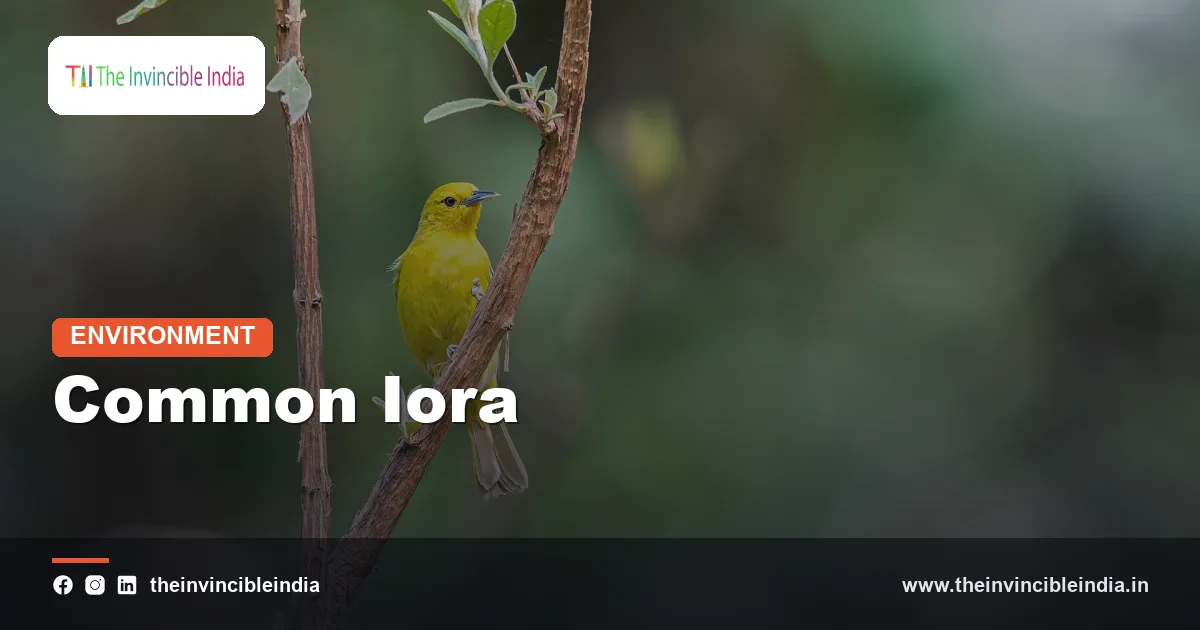
The common iora (Aegithina tiphia) is a small, bright yellow-and-green songbird of Indian gardens, groves and light forest, known for its clear whistled song and the fluffy aerial display of the male. It is one of the most widespread of the ioras, a small family of leaf-dwelling birds found only in tropical Asia, and it is a familiar sight in many Indian towns and villages that still have a good number of trees.
The common iora feeds mainly on small insects and spiders picked from foliage, and it often forages in the canopy with other small birds. Because it is tiny, active and usually high in the leaves, many people hear its whistling call long before they see the bird itself.
| Attribute | Detail |
|---|---|
| Common name | Common iora |
| Scientific name | Aegithina tiphia |
| Family | Aegithinidae (the ioras) |
| Size | About 14 cm long |
| India range and habitat | Across most of India outside the driest deserts and highest mountains; gardens, groves, scrub, mangroves, plantations and open forest |
| Diet | Small insects, caterpillars and spiders; occasionally a little fruit or nectar |
| Breeding | Small cup nest of fine fibres bound with cobweb on a fork; usually two to four eggs, mostly around the monsoon |
| Conservation status | Least Concern on the IUCN Red List |
Key Takeaways
- The common iora (Aegithina tiphia) is a tiny songbird about 14 cm long, with yellow underparts, green or black upperparts and two white wing bars.
- The male common iora performs a courtship display in which it leaps into the air and spirals down with its white rump feathers fluffed out like a small ball.
- Common ioras feed mostly on insects, caterpillars and spiders gleaned from leaves, usually high in trees.
- The common iora has a wide range across India, in gardens, mango groves, scrub, mangroves and open forest, and it tolerates well-treed human settlements.
- The nest of the common iora is a tiny neat cup bound with spider silk and lichen-like fibres, built on a thin fork of a tree.
- The common iora is assessed as Least Concern globally, although it needs trees and shrubs to survive.
What is the common iora?
The common iora is a small passerine bird belonging to the family Aegithinidae, which contains only a handful of species found in the tropical parts of South and Southeast Asia. Its scientific name is Aegithina tiphia, and it is the species that most Indian birdwatchers simply call the iora.
Ioras are related to the leafbirds and share their love of foliage. They are usually described as active, rather fidgety birds that hop and flit through leaves, hanging at odd angles as they search for food. The common iora is the one found over the widest area, from the plains of India to Sri Lanka, Nepal, Bangladesh and across Southeast Asia to Indonesia.
Several regional forms, called subspecies, are recognised. They differ mainly in how much black the male shows on the back and wings in breeding plumage. In southern India and some other regions, males can look strongly black above, while in many northern populations the male is more green with only a darker, blackish tinge on the back.
How do you identify a common iora?
A common iora can be identified by its small size, yellow underparts, two white bars across the wing, and a thin, pointed, slightly curved bill. The male in breeding season has a glossy black back and tail contrasting with a vivid yellow face and underside, while the female and non-breeding male look olive-green above.
Male and female plumage
The male in breeding plumage is the showiest. The upper parts are black, sometimes glossy, with a bright yellow head and underbody, and the white wing bars stand out sharply. In the non-breeding season, the male moults to a more subdued look, with olive-green on the back and a yellower body, rather like the female.
The female is greenish above, with a plain yellowish-green underside and the same two white wing bars. Young birds resemble the female. This seasonal and sexual variation sometimes confuses beginners, who may think they are looking at different species.
Similar birds
- The golden-fronted leafbird is larger and has a heavier bill, and its green plumage has no white wing bars.
- Warblers are drab and streaked, lacking the clean yellow underparts of the iora.
- Marshall’s iora and the great iora are related species with more limited ranges in the northern and northeastern hills, and they differ in size and in the pattern of their plumage.
Where does the common iora live?
The common iora lives across most of the Indian subcontinent in wooded and semi-open habitats such as gardens, mango orchards, roadside avenues, scrub, mangroves and light forest. It avoids the driest deserts, the highest mountain zones and treeless open plains.
The bird is a good example of a species that has adapted to human neighbourhoods. In many Indian cities, ioras can be found in parks, campuses and large gardens with a good variety of trees. Places with neem, mango, tamarind, banyan, peepal and flowering shrubs give the bird both food and nesting sites. In coastal India the common iora also occurs in mangroves and casuarina plantations.
The species is generally resident, but some local movements occur, depending on food and seasons. It is typically found at low to middle elevations and does not need unbroken forest, though it does need continuous or connected tree cover.
What does the common iora eat?
The common iora eats mostly small insects, caterpillars, aphids, beetles and spiders that it picks from leaves and twigs. It is a gleaner, meaning it searches the surface of foliage for prey rather than catching insects in the air for most of its meals.
The bird forages by hopping and fluttering among leaves, sometimes hanging upside down to reach the underside of a leaf. Its thin, pointed bill is well suited for picking tiny prey from crevices and leaf surfaces. Occasionally it visits flowering trees to take nectar or the insects attracted to the blossoms, and it may eat a small amount of fruit.
Role in gardens and farms
Because ioras eat caterpillars and other insects that feed on foliage, they help control pests on trees. In orchards and urban gardens, small insect-eating birds provide a natural form of pest control. Maintaining trees and shrubs with a mix of native species helps keep such birds present without any need for chemicals.
How does the male common iora court a female?
The male common iora courts a female by leaping from a perch into the air and spiralling down on fluffed-out feathers, with his white rump puffed into a ball. This acrobatic display is one of the most charming behaviours among Indian garden birds, and many observers describe it as a small aerial dance.
During the display, the male raises and spreads the long, fluffy feathers of the lower back, which are white and silky. He jumps up from a branch with a whirr of wings, and as he descends he twists and spins, sometimes returning to the same perch. The display is accompanied by a series of calls and often takes place early in the breeding season, when the male is in his boldest colours.
Alongside the display, the male sings from a prominent perch. The song is a long, drawn-out, rising and falling whistle, often written as a clear “wheee-ooo”, followed by shorter notes. The bird has a varied repertoire, including a series of chirpy notes and a sweet, flute-like phrase.
How and when does the common iora breed?
The common iora breeds mainly during and around the monsoon in most of India, building a small cup nest in the fork of a tree and laying about two to four eggs. The exact season varies with region, and in some southern areas breeding may extend into other months.
The nest is a neat cup, about the size of a small teacup, woven from fine grass, bark fibres and similar material, and bound together with cobweb. The outside is often decorated with lichen-like pieces or bits of bark so the nest blends into the branch and looks like a small knob. It is placed on a thin horizontal fork in a tree or bush, at a modest height above the ground.
Both parents are involved in nesting and feeding the chicks, and the eggs are pale with streaks or blotches. After hatching, the young are fed small insects and leave the nest in a couple of weeks or so. The pair may raise more than one brood in a favourable season. The following table summarises the breeding cycle.
| Stage | What happens |
|---|---|
| Courtship | Male sings and performs the leaping, fluffed-rump display |
| Nest building | Pair builds a small cup of fine fibres and cobweb on a fork |
| Eggs | Usually two to four pale, marked eggs |
| Incubation and feeding | Parents share care and feed the chicks insects |
| Fledging | Young leave the nest after about two weeks and are fed for a short time afterwards |
What is the call of the common iora?
The call of the common iora is a clear, drawn-out whistle, often rendered as “wheee-tu” or a long rising note followed by a falling one. It is one of the most recognisable bird sounds in many Indian gardens, especially in the hot weather and monsoon months.
The song is a long, pure whistle that rises, pauses and falls, and it may be repeated many times. The bird also gives short, chirping, scolding notes when alarmed. Because the iora usually sits among leaves, the sound often gives it away before the bird is seen.
Birdwatchers often learn the iora’s whistle as one of the first bird calls to identify by ear. Hearing the long whistle in a leafy neighbourhood can confirm that a small group of ioras is nearby, often in the same tree as bulbuls, tailorbirds and other garden birds.
Is the common iora threatened?
The common iora is not threatened globally and is assessed as Least Concern on the IUCN Red List because of its large range and adaptable habits. Even so, the species depends on trees, so it declines locally where gardens and groves are cleared for construction.
Like other wild Indian birds, the common iora is protected by the Wildlife (Protection) Act, 1972. The main threats are the loss of urban tree cover, pruning that removes foliage during the breeding season, and the heavy use of pesticides that reduce insect food. In some places, birds are also caught for the cage-bird trade, although this is illegal.
How can you help common ioras?
- Plant and protect native trees such as neem, mango, jamun and fig in gardens and housing societies.
- Avoid heavy pruning of trees during the monsoon, when many birds are nesting.
- Reduce pesticide use, so that caterpillars and other insects remain available as food.
- Keep a water source in the garden during summer for birds that visit regularly.
Bottom Line
The common iora is a small, leaf-dwelling songbird whose clear whistle and fluffy courtship leaps make it one of the most appealing birds of Indian gardens. It is secure as a species, but it survives in towns and villages only where trees and insect food remain, so preserving green cover helps keep it around.
Frequently Asked Questions
What does a common iora look like?
A common iora is a small bird about 14 cm long with yellow underparts and two white bars on each wing. Breeding males have glossy black backs, while females and non-breeding males are olive-green above.
Where is the common iora found in India?
The common iora is found across most of India in gardens, groves, scrub, mangroves, plantations and light forest. It avoids the driest deserts and the highest mountains, and it is common wherever there are enough trees.
What does the common iora eat?
The common iora eats small insects, caterpillars and spiders, which it picks from leaves and twigs. It occasionally takes nectar or a little fruit but depends mainly on insects found in tree foliage.
Why does the male common iora leap into the air?
The male common iora leaps into the air as part of a courtship display aimed at attracting a female. He fluffs out his white rump feathers into a ball and spirals down to the perch while calling.
What is the song of the common iora like?
The song of the common iora is a long, clear, drawn-out whistle that rises and falls, often followed by shorter notes. It is a common sound in Indian gardens and often reveals the bird hidden among leaves.
Is the common iora a protected bird?
The common iora is a protected bird under the Wildlife (Protection) Act, 1972, which covers wild Indian birds. It is also classified as Least Concern on the IUCN Red List, as it has a wide range and adapts well to gardens.
{“@context”:”https://schema.org”,”@graph”:[{“@type”:”FAQPage”,”mainEntity”:[{“@type”:”Question”,”name”:”What does a common iora look like?”,”acceptedAnswer”:{“@type”:”Answer”,”text”:”A common iora is a small bird about 14 cm long with yellow underparts and two white bars on each wing. Breeding males have glossy black backs, while females and non-breeding males are olive-green above.”}},{“@type”:”Question”,”name”:”Where is the common iora found in India?”,”acceptedAnswer”:{“@type”:”Answer”,”text”:”The common iora is found across most of India in gardens, groves, scrub, mangroves, plantations and light forest. It avoids the driest deserts and the highest mountains, and it is common wherever there are enough trees.”}},{“@type”:”Question”,”name”:”What does the common iora eat?”,”acceptedAnswer”:{“@type”:”Answer”,”text”:”The common iora eats small insects, caterpillars and spiders, which it picks from leaves and twigs. It occasionally takes nectar or a little fruit but depends mainly on insects found in tree foliage.”}},{“@type”:”Question”,”name”:”Why does the male common iora leap into the air?”,”acceptedAnswer”:{“@type”:”Answer”,”text”:”The male common iora leaps into the air as part of a courtship display aimed at attracting a female. He fluffs out his white rump feathers into a ball and spirals down to the perch while calling.”}},{“@type”:”Question”,”name”:”What is the song of the common iora like?”,”acceptedAnswer”:{“@type”:”Answer”,”text”:”The song of the common iora is a long, clear, drawn-out whistle that rises and falls, often followed by shorter notes. It is a common sound in Indian gardens and often reveals the bird hidden among leaves.”}},{“@type”:”Question”,”name”:”Is the common iora a protected bird?”,”acceptedAnswer”:{“@type”:”Answer”,”text”:”The common iora is a protected bird under the Wildlife (Protection) Act, 1972, which covers wild Indian birds. It is also classified as Least Concern on the IUCN Red List, as it has a wide range and adapts well to gardens.”}}]}]}


