

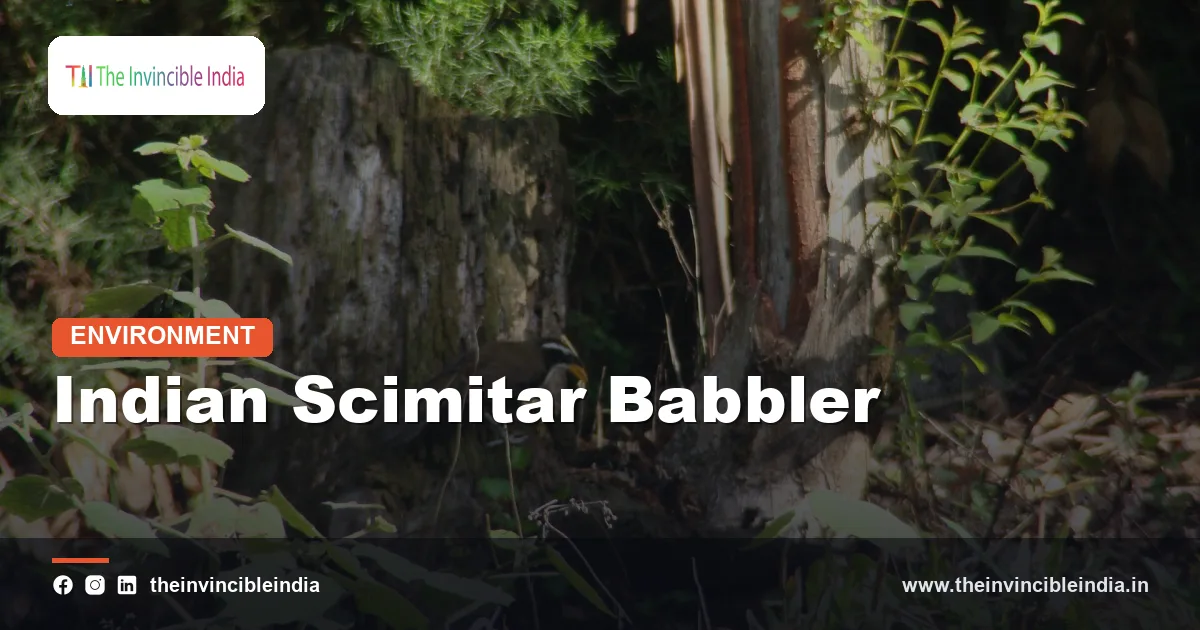
The Indian scimitar babbler (Pomatorhinus horsfieldii) is a forest babbler with a long, curved yellow bill, a bold white eyebrow stripe and a white throat, known for the paired duet calls with which it keeps in touch in the undergrowth of Indian hill forests and scrub. It is a bird of the Western Ghats, the hills of peninsular India and neighbouring ranges, and it is far more often heard than seen.
The sickle-shaped bill gives the bird its name, since a scimitar is a curved sword. This explainer covers how to identify the Indian scimitar babbler, where it lives in India, what it eats, how its famous duets work, how it breeds and how it differs from other scimitar babblers. Information was last reviewed on 23 October 2026.
| Attribute | Details |
|---|---|
| Common name | Indian scimitar babbler |
| Scientific name | Pomatorhinus horsfieldii |
| Family | Timaliidae (Old World babblers) |
| Size | About 22 cm long, with a long, down-curved yellow bill |
| Range and habitat in India | Hill forests, bamboo, scrub and thickets of peninsular India, including the Western Ghats and other hill ranges |
| Diet | Insects, spiders and other small invertebrates, with some fruit, seeds and nectar |
| Breeding | Domed nest of grass, leaves and fibre, usually low in a bank or thicket, with a small clutch of white eggs |
| Conservation status | Least Concern on the IUCN Red List |
Key Takeaways
- The Indian scimitar babbler (Pomatorhinus horsfieldii) is a roughly 22 cm babbler with a long, curved yellow bill, a white eyebrow and a white throat and breast.
- The Indian scimitar babbler lives in hill forests, thickets, bamboo and scrub of peninsular India, where it moves low in the undergrowth in pairs or small groups.
- The Indian scimitar babbler is famous for its duet, in which a male and a female call back and forth in tightly timed sequence.
- The Indian scimitar babbler uses its long, curved bill to probe bark, moss, crevices and leaf litter for insects and spiders.
- The Indian scimitar babbler builds a domed nest with a side entrance, a design that shelters its eggs and chicks.
- The Indian scimitar babbler is classified as Least Concern, though loss and fragmentation of forest and thicket habitat can affect local numbers.
What Is the Indian Scimitar Babbler?
The Indian scimitar babbler is a medium-sized, forest-dwelling babbler in the family Timaliidae, notable for its long, curved yellow bill and its habit of calling in duet. It belongs to the genus Pomatorhinus, a group of scimitar babblers found across South and Southeast Asia, and it is the common scimitar babbler of the peninsular Indian hills.
The species name horsfieldii commemorates Thomas Horsfield, a nineteenth-century naturalist who studied the wildlife of Asia. The bird was described in the early nineteenth century and has been the subject of changing classification. Birds that were once grouped together as a single widespread species have, in the light of newer research, been separated into several, and the Indian scimitar babbler is now treated as a species of the Indian peninsula, with a related form in Sri Lanka regarded separately.
The Indian scimitar babbler is a resident bird. A pair or small party keeps to the same patch of forest or thicket for years, defending it with calling rather than with fights.
What Does the Indian Scimitar Babbler Look Like?
The Indian scimitar babbler is a brown-backed, white-fronted babbler with a long, down-curved yellow bill, a white eyebrow stripe and a dark band through the eye. It measures about 22 cm, with a relatively long tail that is often held low or cocked slightly as the bird hops.
Key identification features are:
- Curved bill: the long, sickle-shaped bill is yellow and is the clearest field mark.
- Eye stripe: a long white supercilium (eyebrow) runs above a dark line through the eye, giving a striking face pattern.
- White throat and breast: the front of the bird is a clean white, contrasting with the darker body.
- Olive-brown upperparts: the back, wings and tail are a plain olive-brown that helps the bird blend into undergrowth.
- Warm flanks: the sides and belly carry a brownish or rufous wash.
- Strong legs: well suited to hopping and clambering over branches and logs.
Males and females look much alike, and young birds are similar but duller. The bill is the feature that sets scimitar babblers apart from other babblers, and combined with the white eyebrow and throat it makes the Indian scimitar babbler easy to recognise when a good view is obtained.
Where Is the Indian Scimitar Babbler Found in India?
The Indian scimitar babbler is found in the hill forests, scrub and thickets of peninsular India, including the Western Ghats and several other hill ranges of the peninsula. It is a bird of foothills and middle elevations, using both moist and drier wooded habitat as long as the undergrowth is thick.
Typical habitats of the Indian scimitar babbler include:
- Undergrowth of moist and dry deciduous forest in hilly country.
- Bamboo clumps and dense thickets on slopes.
- Scrub forest and tangled vegetation near streams.
- Edges of plantations such as coffee, cardamom and teak where undergrowth remains.
- Rocky, bushy hillsides with a covering of shrubs.
The bird relies on cover. It forages in the lower layers of forest, on the ground and in shrubs, and it rarely ventures into open or heavily grazed land. Because it is secretive, a person walking through suitable habitat may hear several birds without seeing any. Boundaries between its range and those of related scimitar babblers in other regions follow the latest species classification, so a current field guide is useful when travelling between regions.
What Does the Indian Scimitar Babbler Eat?
The Indian scimitar babbler eats mainly insects, spiders and other small invertebrates, which it finds by probing into bark, moss, leaf litter, rotting logs and crevices with its long, curved bill. Beetles, ants, termites, caterpillars, crickets and snails are among the foods taken.
The diet also includes some plant matter. The Indian scimitar babbler occasionally eats small fruits and seeds and may visit flowers for nectar, which helps it through seasons when insects are less abundant.
Foraging techniques of the bird include:
- Bark probing: the curved bill is inserted into cracks and under moss on trunks and branches.
- Leaf-litter searching: the bird hops on the forest floor, tossing aside leaves to expose hidden prey.
- Log inspection: fallen wood and stumps are checked for insects.
- Low gleaning: prey is picked from foliage and twigs near the ground.
The shape of the bill is an adaptation to this feeding style, since the curve allows the bird to reach into narrow spaces and crevices that a straight bill could not. By eating many forest insects, the Indian scimitar babbler plays a small part in controlling insect populations.
How Do Indian Scimitar Babblers Behave?
The Indian scimitar babbler is a shy, skulking bird that usually lives in pairs or small groups and keeps within thick undergrowth, hopping and creeping through tangles. It seldom flies far and spends most of the time on or near the ground.
Typical behaviours are:
- Skulking: the bird moves through cover with little exposure and slips away at the first sign of disturbance.
- Short flights: when it does fly, the flight is low, weak and brief, from one bush to the next.
- Group movement: small parties of a few birds travel together and keep in contact by calling.
- Pair bonds: a male and female often forage close together and call in duet.
- Territorial calling: calling announces ownership of a territory to neighbours.
Because it is wary, the Indian scimitar babbler can be hard to watch. Observers who remain still and quiet, and who wait near a patch of undergrowth where calls have been heard, are most likely to see the birds emerge for a moment into view.
How Does the Indian Scimitar Babbler’s Duet Work?
The Indian scimitar babbler duets by having a male give a short, hollow, whistled note or phrase and a female answer almost instantly with a rapid, higher-pitched reply, so that the two sounds seem to come from a single bird. The pair may repeat the sequence many times, filling the forest with a ringing call.
Duetting is common among babblers and several other bird groups, and scientists have proposed several functions. In the Indian scimitar babbler the main ones are likely to be:
- Keeping contact: the pair stays together in thick vegetation where they cannot see each other.
- Defending territory: the combined call announces that the area is occupied by a bonded pair.
- Strengthening the pair bond: the precise timing requires cooperation and practice between partners.
The timing is so exact that a listener may think one bird is calling. The two-part nature becomes clear only when the voices of the two birds are heard separately or when observers see both singing. The song is one of the typical sounds of hill forests in the early morning and late afternoon.
How Does the Indian Scimitar Babbler Breed?
The Indian scimitar babbler builds a domed nest of grass, leaves and plant fibre, with a side entrance, placed low in a bank, bush, bamboo clump or tangle of undergrowth. The roof of the dome protects the eggs and chicks from rain, sun and predators.
Main details of breeding are:
- Season: breeding varies by region but often takes place around the pre-monsoon and monsoon months, when food is plentiful.
- Nest: a rounded, roofed structure well hidden at or near ground level.
- Eggs: a small clutch of white eggs, usually about three to four.
- Parental care: both parents, sometimes with help from other group members, feed the nestlings.
- After fledging: young birds stay near the adults and learn to forage and call.
The concealed nest is difficult to find, and visitors should avoid searching for it, since disturbance may cause the adults to abandon eggs or young. Exact nest details can vary between regions and populations.
How Is the Indian Scimitar Babbler Different from Other Scimitar Babblers?
The Indian scimitar babbler differs from other scimitar babblers in its yellow bill, white eyebrow and throat, and its range in peninsular India, whereas related species live in the Himalayan foothills, northeast India or Sri Lanka. Several scimitar babblers in India resemble each other, so a comparison helps.
| Species | Region in India | Main identification clues |
|---|---|---|
| Indian scimitar babbler | Peninsular India, including Western Ghats and hills | Yellow curved bill, white eyebrow, white throat and breast, olive-brown back |
| Rusty-cheeked scimitar babbler | Himalayan foothills and northeast | Rusty cheeks and flanks, white throat, curved bill |
| White-browed scimitar babbler | Himalayan region and northeast | Bold white eyebrow, dark crown, stout curved bill |
| Slender-billed scimitar babbler | Northeast hills | Very thin, long curved bill |
The Indian scimitar babbler can be separated from the other scimitar babblers mainly by location, since each lives in its own region. Within peninsular India, there are few birds with a similar combination of a long curved yellow bill and white front.
Is the Indian Scimitar Babbler Threatened?
The Indian scimitar babbler is not globally threatened and is classified as Least Concern by the International Union for Conservation of Nature (IUCN). It has a reasonably large range and uses a variety of wooded habitats with thick undergrowth.
Pressures that can still affect local populations are:
- Clearance of forest and thicket for farming, mining, roads and construction.
- Fragmentation of wooded habitat into small isolated patches.
- Removal of undergrowth in managed plantations.
- Repeated burning or heavy grazing that thins the understorey.
Protecting hill forests and allowing a dense understorey to grow back helps the Indian scimitar babbler and many other forest birds. Protected areas such as national parks and wildlife sanctuaries in the Western Ghats provide important refuges.
How Can You Watch the Indian Scimitar Babbler?
The best way to see the Indian scimitar babbler is to visit hill forest early in the morning, listen for the duet and then wait quietly near the sound. The birds are shy, so patience matters more than any special equipment.
Useful tips include:
- Learn the call first, since listening is the easiest way to locate the birds.
- Approach slowly and stop often, avoiding sudden movement.
- Scan the ground, logs and low branches rather than the treetops.
- Use binoculars to see the curved yellow bill and the white eyebrow.
- Do not use recorded calls repeatedly, as this stresses the birds and can disrupt breeding.
Even when the birds stay hidden, the duet itself is a memorable sound, and hearing it is often the main reward of a walk in peninsular hill forest.
Why Does the Indian Scimitar Babbler Matter?
The Indian scimitar babbler matters because it is an insect-eater of the forest understorey, an indicator of dense undergrowth and a fascinating example of duet singing in birds. As a widespread forest species, it also helps to link people with the quieter life of hill forests.
By hunting insects in bark and leaf litter, the Indian scimitar babbler contributes to the balance of forest invertebrates. Its need for thick cover makes it a useful sign of habitat quality, and its coordinated calling offers scientists a way to study communication and cooperation between mated birds.
Bottom Line
The Indian scimitar babbler is a curved-billed, white-fronted forest babbler of peninsular India that forages low for insects and announces itself with precisely timed duets. It is not threatened, but it needs the dense understorey of hill forests and thickets to survive.
Frequently Asked Questions
What is the scientific name of the Indian scimitar babbler?
The scientific name of the Indian scimitar babbler is Pomatorhinus horsfieldii. It belongs to the family Timaliidae, the Old World babblers. The species name honours the naturalist Thomas Horsfield.
Why is it called a scimitar babbler?
The Indian scimitar babbler is called a scimitar babbler because its long, down-curved bill resembles a scimitar, a curved sword. The bill helps the bird probe bark, moss and crevices for insects and spiders.
Where is the Indian scimitar babbler found?
The Indian scimitar babbler is found in hill forests, bamboo, scrub and thickets of peninsular India, including the Western Ghats. It prefers places with dense undergrowth and is a resident that does not migrate.
What does the Indian scimitar babbler eat?
The Indian scimitar babbler eats mainly insects, spiders and other small invertebrates found in bark, moss and leaf litter. It also eats small amounts of fruit, seeds and nectar.
How does the Indian scimitar babbler call?
The Indian scimitar babbler calls in a duet, with the male giving a low, whistled note and the female answering at once with a quicker, higher reply. The pair repeats the sequence to keep contact and defend their territory.
Is the Indian scimitar babbler endangered?
No, the Indian scimitar babbler is not endangered and is classified as Least Concern by the IUCN. Local populations may decline if forest and thicket habitat is cleared or fragmented.
{“@context”:”https://schema.org”,”@graph”:[{“@type”:”FAQPage”,”mainEntity”:[{“@type”:”Question”,”name”:”What is the scientific name of the Indian scimitar babbler?”,”acceptedAnswer”:{“@type”:”Answer”,”text”:”The scientific name of the Indian scimitar babbler is Pomatorhinus horsfieldii. It belongs to the family Timaliidae, the Old World babblers. The species name honours the naturalist Thomas Horsfield.”}},{“@type”:”Question”,”name”:”Why is it called a scimitar babbler?”,”acceptedAnswer”:{“@type”:”Answer”,”text”:”The Indian scimitar babbler is called a scimitar babbler because its long, down-curved bill resembles a scimitar, a curved sword. The bill helps the bird probe bark, moss and crevices for insects and spiders.”}},{“@type”:”Question”,”name”:”Where is the Indian scimitar babbler found?”,”acceptedAnswer”:{“@type”:”Answer”,”text”:”The Indian scimitar babbler is found in hill forests, bamboo, scrub and thickets of peninsular India, including the Western Ghats. It prefers places with dense undergrowth and is a resident that does not migrate.”}},{“@type”:”Question”,”name”:”What does the Indian scimitar babbler eat?”,”acceptedAnswer”:{“@type”:”Answer”,”text”:”The Indian scimitar babbler eats mainly insects, spiders and other small invertebrates found in bark, moss and leaf litter. It also eats small amounts of fruit, seeds and nectar.”}},{“@type”:”Question”,”name”:”How does the Indian scimitar babbler call?”,”acceptedAnswer”:{“@type”:”Answer”,”text”:”The Indian scimitar babbler calls in a duet, with the male giving a low, whistled note and the female answering at once with a quicker, higher reply. The pair repeats the sequence to keep contact and defend their territory.”}},{“@type”:”Question”,”name”:”Is the Indian scimitar babbler endangered?”,”acceptedAnswer”:{“@type”:”Answer”,”text”:”No, the Indian scimitar babbler is not endangered and is classified as Least Concern by the IUCN. Local populations may decline if forest and thicket habitat is cleared or fragmented.”}}]}]}


