

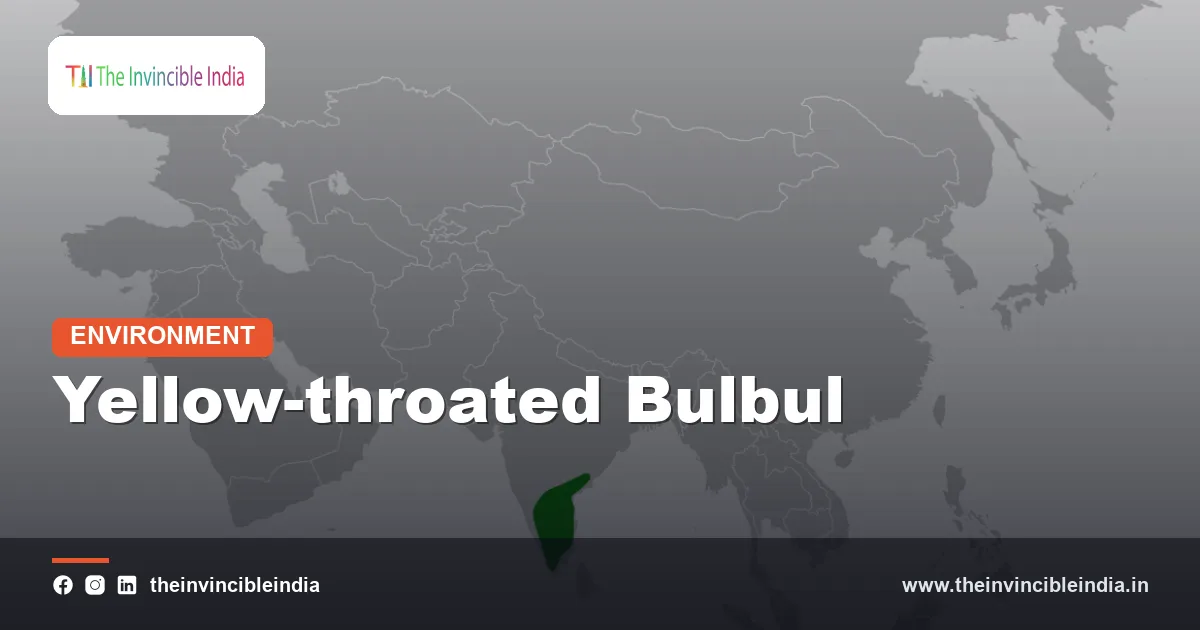
The yellow-throated bulbul (Pycnonotus xantholaemus) is a bright yellow and olive bulbul that is endemic to the rocky scrub hills of peninsular India, meaning it occurs nowhere else in the world, and it is classed as a Near Threatened species. It is the only bulbul in India restricted to a small, specialised habitat of boulder-strewn hills and dry scrub, which makes it a prized sighting for birdwatchers in the south.
The yellow-throated bulbul is a localised and relatively uncommon bird, and its future depends largely on the survival of the rocky hills where it lives. This explainer covers what the yellow-throated bulbul looks like, where it is found in India, what it eats, how it breeds and why conservationists watch the species closely.
| Attribute | Detail |
|---|---|
| Common name | Yellow-throated bulbul |
| Scientific name | Pycnonotus xantholaemus |
| Family | Pycnonotidae (bulbuls) |
| Size | About 20 cm long |
| Range and habitat in India | Endemic to peninsular India; rocky scrub hills with boulders and thorny bushes, mostly in the dry interior and the Eastern Ghats region |
| Diet | Fruit, berries, nectar and insects |
| Breeding | Cup nest in a thorny bush or crevice-side shrub; usually two or three spotted eggs |
| Conservation status | Near Threatened on the IUCN Red List; localised and sensitive to habitat loss |
Key Takeaways
- The yellow-throated bulbul is a roughly 20 cm olive-and-yellow bulbul with a bright yellow head and throat and a yellow patch under the tail.
- The yellow-throated bulbul is endemic to peninsular India, which means the whole world population lives within the Indian peninsula.
- The yellow-throated bulbul depends on rocky scrub hills with boulders and thorny bushes, a habitat that is patchy and often disturbed.
- The yellow-throated bulbul eats fruit, berries, nectar and insects, and it spends much of its time in and around thorny shrubs.
- The yellow-throated bulbul is classed as Near Threatened because its habitat is localised and is being lost to quarrying, clearing and land conversion.
- The yellow-throated bulbul is a useful indicator of the condition of dry rocky scrub, which is often undervalued in land-use planning.
What does the yellow-throated bulbul look like?
The yellow-throated bulbul is a medium-sized, olive-brown and yellow bird about 20 cm long, with a bright yellow throat and face, a darker olive-brown back and wings, and a yellow patch under the tail. It is one of the most colourful bulbuls in India, and the yellow on the head and throat gives it a vivid appearance compared with most of its relatives.
The upperparts are olive, the wings and tail are brownish, and the underparts are yellowish with a duller wash on the belly. The bill is short and dark, the legs are sturdy, and there is no prominent crest. Males and females look much alike. Young birds are duller, with less intense yellow on the face and throat, and take some months to acquire adult colour.
Features that help in identification
- Bright yellow throat and face.
- Olive-brown upperparts without a crest.
- Yellow patch under the tail.
- A habit of staying around boulders and thorny bushes.
What does endemic mean for the yellow-throated bulbul?
Endemic means that the yellow-throated bulbul occurs naturally only in one region, which in this case is peninsular India, and nowhere else in the world. This gives India a special responsibility for the species, because if its habitat is lost here, the bird has no other country to fall back on.
Endemic species are often more vulnerable than widespread ones, because their whole population lives within a limited area that can be affected by a single type of threat. For the yellow-throated bulbul, the restricted range and the narrow habitat requirement are the two main reasons for its Near Threatened status. Conservation of the species is therefore closely linked to the protection of rocky scrub hills across the peninsula.
Where is the yellow-throated bulbul found in India?
The yellow-throated bulbul is found in the rocky scrub hills of peninsular India, mainly in dry interior regions and in parts of the Eastern Ghats and the Deccan plateau, in states such as Andhra Pradesh, Telangana, Karnataka and Tamil Nadu. Within this wide region, it is patchily distributed and occurs only where suitable hills are present.
The yellow-throated bulbul prefers hills with large boulders, rocky outcrops and thorny scrub, and it is rarely seen in moist forest or heavily farmed plains. It is a resident species, which means it stays in the same general area throughout the year. Because suitable habitat is scattered, populations can be small and isolated from each other, and a patch of hills lost to quarrying may remove a local population entirely.
Typical habitats
- Boulder-strewn hills with sparse thorny bushes.
- Dry scrub jungle on rocky slopes.
- Rocky outcrops with scattered trees and shrubs.
- Edges of dry deciduous forest where rocks and scrub meet.
What does the yellow-throated bulbul eat?
The yellow-throated bulbul eats a mixed diet of fruit, berries, nectar and insects, taking food from the thorny shrubs and small trees that grow among the rocks. It feeds on small fruits of scrub plants, and it adds insects such as beetles, caterpillars and ants to its diet, particularly during the breeding season.
The bird forages by hopping through the branches of bushes, picking fruit and insects from leaves and twigs, and occasionally flying out to snatch a flying insect. Nectar from flowering shrubs provides additional energy at certain times of year. By eating fruit and spreading the seeds in its droppings, the yellow-throated bulbul helps scrub plants to grow on rocky slopes where seeds do not travel easily by other means.
| Food type | Examples | Ecological role |
|---|---|---|
| Fruit and berries | Small fruits of thorny scrub plants | Seed dispersal on rocky slopes |
| Nectar | Flowers of scrub shrubs | Occasional pollination |
| Insects | Beetles, caterpillars, ants | Natural control of insects |
How does the yellow-throated bulbul sing and behave?
The yellow-throated bulbul gives a series of lively, whistled and chattering notes, and it behaves as a social, active bird that lives in pairs or small groups among rocks and bushes. Its calls are cheerful and carry across the open rocky ground, which helps observers to locate the bird before they see it.
The yellow-throated bulbul often perches on top of a boulder or a bush, where its yellow face stands out against the background of rock and scrub. It flies short distances between bushes and is generally alert, flying off into cover if disturbed. Small groups may feed together in a fruiting shrub, and the birds keep in touch by calling to each other as they move across the hillside.
- The bird is usually found in pairs or small parties.
- It uses boulders and bushes as perches and lookouts.
- It stays within a limited patch of hill and rarely moves far.
- It is most active and vocal in the early morning and late afternoon.
How does the yellow-throated bulbul breed?
The yellow-throated bulbul breeds by building a neat cup-shaped nest of twigs, grass and fine fibres in a thorny bush or a shrub growing among rocks, and the female usually lays two or three eggs with reddish or purplish spots. The nest is often placed in a protected spot within thorny vegetation, which helps to keep it away from predators.
Both parents are involved in raising the young, which are fed on insects and soft fruit. The breeding season varies across the range and is usually linked to the period when food is plentiful, often following the rains. Because the species depends on a small number of suitable nest sites, disturbance of the scrub or removal of thorny bushes during the breeding season can cause nests to fail.
Stages of the breeding cycle
- Pairs claim a patch of rocky scrub and call from perches.
- The nest is built in a thorny bush or shrub among rocks.
- Two or three eggs are incubated by the parents.
- Chicks are fed on insects and fruit until they leave the nest.
How is the yellow-throated bulbul different from other bulbuls?
The yellow-throated bulbul is different from other bulbuls in India because of its bright yellow head and throat, its lack of a crest and its restriction to rocky scrub hills. Most other bulbuls have dark heads, crests or paler, plainer faces.
| Bulbul | Key difference from the yellow-throated bulbul |
|---|---|
| White-browed bulbul | Olive-brown with a white eyebrow, shy, lives in thickets rather than on rocky hills |
| Red-vented bulbul | Dark head, scaly body and red patch under the tail, common near towns |
| Red-whiskered bulbul | Pointed black crest with a red whisker and white cheek |
| Himalayan bulbul | Black crest and white cheeks, found in the western Himalaya |
Among these species, the yellow-throated bulbul is the easiest to recognise by its colour alone. Its yellow face and rocky home together make it a distinctive bird.
Why is the yellow-throated bulbul Near Threatened?
The yellow-throated bulbul is Near Threatened because it has a restricted range and a narrow habitat, and that habitat is being lost to quarrying, land clearing and conversion. Species that occur in only one region and in one kind of habitat are naturally at greater risk than birds with wide ranges and flexible habits.
The rocky scrub hills where the yellow-throated bulbul lives are often seen as unproductive land. They may be quarried for stone, cleared for plantations, converted for housing or used for infrastructure. Overgrazing and repeated burning of scrub can also degrade the vegetation. Since the bird has few alternative habitats, these changes can reduce its population. Conservationists therefore treat the species as one that needs attention before it becomes more seriously threatened.
Main pressures on the species
- Quarrying and mining of rocky hills.
- Clearing of scrub for farms, plantations and construction.
- Overgrazing and repeated burning of dry scrub.
- Fragmentation of habitat into small, isolated patches.
Why does the yellow-throated bulbul matter for the environment?
The yellow-throated bulbul matters because it disperses seeds, eats insects and serves as an indicator of the health of rocky scrub hills. In dry, rocky country where soil is thin and plants grow slowly, a seed-dispersing bird makes a real difference to how vegetation spreads over the hillside.
The species also draws attention to a type of habitat that is easily overlooked. Rocky hills with scrub are home to many other animals, including reptiles, small mammals and other birds, and they help in holding soil and capturing rain. Protecting the habitat of the yellow-throated bulbul therefore protects a wider community of wildlife, not just a single bird.
How can you watch the yellow-throated bulbul responsibly?
The best way to watch the yellow-throated bulbul is to visit known rocky scrub hills early in the morning, scan the tops of boulders and bushes for a flash of yellow, and listen for its cheerful calls. Responsible viewing matters more than usual because the species is localised and sensitive to disturbance.
- Visit in the cool hours of the early morning or late afternoon.
- Scan boulders and the tops of thorny bushes with binoculars.
- Look for the bright yellow face and throat as the key identification marks.
- Keep a good distance from nests and avoid disturbing thorny cover during the breeding season.
- Stay on existing paths and avoid damaging the scrub vegetation.
- Report sightings to local birdwatching groups so that distribution records improve.
How can the yellow-throated bulbul be protected?
The yellow-throated bulbul can be protected mainly by conserving the rocky scrub hills where it lives, because the bird has very few alternatives if its home is cleared. Protection of the habitat, rather than of individual birds, is the most effective approach for a localised endemic species of this kind.
Several practical measures help. Scrub-covered rocky hills can be recognised as valuable natural habitat in land-use planning instead of being labelled as unused land. Quarrying and construction can be kept away from hills known to hold the species, and grazing and fires can be managed so that thorny shrubs are able to regrow. Community groups, schools and local birdwatchers can also contribute by recording sightings, which helps scientists to understand where the species still survives.
- Recognise rocky scrub hills as important wildlife habitat in planning decisions.
- Keep new quarries and building projects away from known bulbul hills.
- Control burning and heavy grazing on scrub slopes.
- Support local surveys and citizen-science bird records.
Bottom Line
The yellow-throated bulbul is a bright, endemic bird of rocky scrub hills in peninsular India, and its Near Threatened status reflects the pressure on its narrow habitat. Safeguarding boulder-strewn hills and thorny scrub is the most direct way to keep this species and many of its neighbours secure.
Frequently Asked Questions
What is a yellow-throated bulbul?
The yellow-throated bulbul is a bright olive-and-yellow bulbul with a yellow head and throat that is endemic to peninsular India. It lives on rocky scrub hills with boulders and thorny bushes. It is classed as Near Threatened.
Where is the yellow-throated bulbul found?
The yellow-throated bulbul is found only in peninsular India, on rocky scrub hills in the dry interior and parts of the Eastern Ghats region. States where it occurs include Andhra Pradesh, Telangana, Karnataka and Tamil Nadu. It is patchily distributed and depends on suitable hills.
Is the yellow-throated bulbul endemic to India?
The yellow-throated bulbul is endemic to India, which means it occurs naturally nowhere else in the world. All of its population lives in the peninsular part of the country. This makes India solely responsible for its conservation.
What does the yellow-throated bulbul eat?
The yellow-throated bulbul eats fruit, berries, nectar and insects. It feeds in thorny shrubs and small trees among the rocks. It spreads seeds of scrub plants through its droppings.
Why is the yellow-throated bulbul Near Threatened?
The yellow-throated bulbul is Near Threatened because it has a small range and a narrow habitat that is being lost. Quarrying, land clearing and conversion of rocky scrub hills reduce the places where it can live. Its populations are also fragmented.
How can you identify a yellow-throated bulbul?
The yellow-throated bulbul is identified by its bright yellow face and throat, olive-brown upperparts and a yellow patch under the tail. It has no crest and is usually seen on boulders or thorny bushes in rocky scrub. Its habitat and colour together set it apart from other bulbuls.
{“@context”:”https://schema.org”,”@graph”:[{“@type”:”FAQPage”,”mainEntity”:[{“@type”:”Question”,”name”:”What is a yellow-throated bulbul?”,”acceptedAnswer”:{“@type”:”Answer”,”text”:”The yellow-throated bulbul is a bright olive-and-yellow bulbul with a yellow head and throat that is endemic to peninsular India. It lives on rocky scrub hills with boulders and thorny bushes. It is classed as Near Threatened.”}},{“@type”:”Question”,”name”:”Where is the yellow-throated bulbul found?”,”acceptedAnswer”:{“@type”:”Answer”,”text”:”The yellow-throated bulbul is found only in peninsular India, on rocky scrub hills in the dry interior and parts of the Eastern Ghats region. States where it occurs include Andhra Pradesh, Telangana, Karnataka and Tamil Nadu. It is patchily distributed and depends on suitable hills.”}},{“@type”:”Question”,”name”:”Is the yellow-throated bulbul endemic to India?”,”acceptedAnswer”:{“@type”:”Answer”,”text”:”The yellow-throated bulbul is endemic to India, which means it occurs naturally nowhere else in the world. All of its population lives in the peninsular part of the country. This makes India solely responsible for its conservation.”}},{“@type”:”Question”,”name”:”What does the yellow-throated bulbul eat?”,”acceptedAnswer”:{“@type”:”Answer”,”text”:”The yellow-throated bulbul eats fruit, berries, nectar and insects. It feeds in thorny shrubs and small trees among the rocks. It spreads seeds of scrub plants through its droppings.”}},{“@type”:”Question”,”name”:”Why is the yellow-throated bulbul Near Threatened?”,”acceptedAnswer”:{“@type”:”Answer”,”text”:”The yellow-throated bulbul is Near Threatened because it has a small range and a narrow habitat that is being lost. Quarrying, land clearing and conversion of rocky scrub hills reduce the places where it can live. Its populations are also fragmented.”}},{“@type”:”Question”,”name”:”How can you identify a yellow-throated bulbul?”,”acceptedAnswer”:{“@type”:”Answer”,”text”:”The yellow-throated bulbul is identified by its bright yellow face and throat, olive-brown upperparts and a yellow patch under the tail. It has no crest and is usually seen on boulders or thorny bushes in rocky scrub. Its habitat and colour together set it apart from other bulbuls.”}}]}]}


