

The plant called sarpagandha (Rauvolfia serpentina) is a small, evergreen, medicinal shrub of India and South and Southeast Asia, whose root is the natural source of reserpine, one of the first modern drugs used against high blood pressure. Sarpagandha has been used in Indian traditional medicine for centuries, and its overharvesting from forests in the twentieth century made it one of the best-known threatened medicinal plants of the country.
This article explains what sarpagandha is, how it looks, where it grows, what it contains, how it entered modern medicine and why it needs protection. Sarpagandha contains potent alkaloids and a prescription drug, so it must never be self-administered, and all traditional uses described here are historical and not medical advice.
Quick Facts
| Botanical name | Rauvolfia serpentina (L.) Benth. ex Kurz |
|---|---|
| Family | Apocynaceae (the dogbane family) |
| Common names | Sarpagandha, Indian snakeroot, Chandrika, Sarpagandhi |
| Part used | Dried root and root bark |
| Where grown in India | Sub-Himalayan tract, Uttar Pradesh, Uttarakhand, Bihar, West Bengal, Assam, Odisha and parts of the Western Ghats and peninsular India; wild and cultivated |
| Active compounds | Indole alkaloids including reserpine, ajmaline, ajmalicine, serpentine, yohimbine-type alkaloids and rescinnamine |
| Traditional uses | Folk and Ayurvedic use for snakebite, fever, restlessness, sleeplessness, mental disturbance and raised blood pressure |
| Cultivation and status | Shade-tolerant shrub grown from seed or root cuttings; wild populations are threatened and the species is listed as Endangered by the IUCN and in CITES Appendix II |
Key Takeaways
- Sarpagandha is the Indian name for Rauvolfia serpentina, a shrub of the family Apocynaceae whose root contains indole alkaloids.
- The drug reserpine, isolated from sarpagandha roots in the early 1950s, was among the first effective medicines for high blood pressure.
- The root of sarpagandha contains reserpine, ajmaline, ajmalicine and other alkaloids, so it is a powerful substance and not a casual herbal remedy.
- Wild sarpagandha has declined sharply because of overcollection of its roots, and the species is listed as Endangered by the IUCN.
- Reserpine is a prescription drug and sarpagandha must never be self-administered, because incorrect use can cause serious harm.
- Sarpagandha can be cultivated from seeds or root cuttings in shaded, moist, humus-rich soil, which reduces pressure on wild populations.
What is sarpagandha?
Sarpagandha is a perennial, evergreen shrub of the family Apocynaceae, best known as the plant from which the alkaloid reserpine was first isolated. The plant is native to India and its neighbouring countries and has been recorded in forests and open woodland from the foothills of the Himalayas to peninsular India.
The Sanskrit name combines sarpa, meaning snake, with gandha, meaning smell or scent, and it is commonly understood as pointing to the long association of the plant with snakes. Traditional accounts say the root was used in folk medicine for snakebite and scorpion sting, and the twisted, snake-like shape of the root is sometimes said to have contributed to the name. In English the plant is called Indian snakeroot.
The scientific genus Rauvolfia honours Leonhard Rauwolf, a German physician and botanist of the sixteenth century who travelled in the Middle East. The species name serpentina refers to the snake connection. The plant is sometimes confused with other Rauvolfia species, such as Rauvolfia tetraphylla, which also contain alkaloids.
What does the sarpagandha plant look like?
The sarpagandha plant is a small, erect shrub usually growing to between thirty and ninety centimetres, with smooth stems that exude a milky latex when cut. This milky juice is a common feature of the dogbane family.
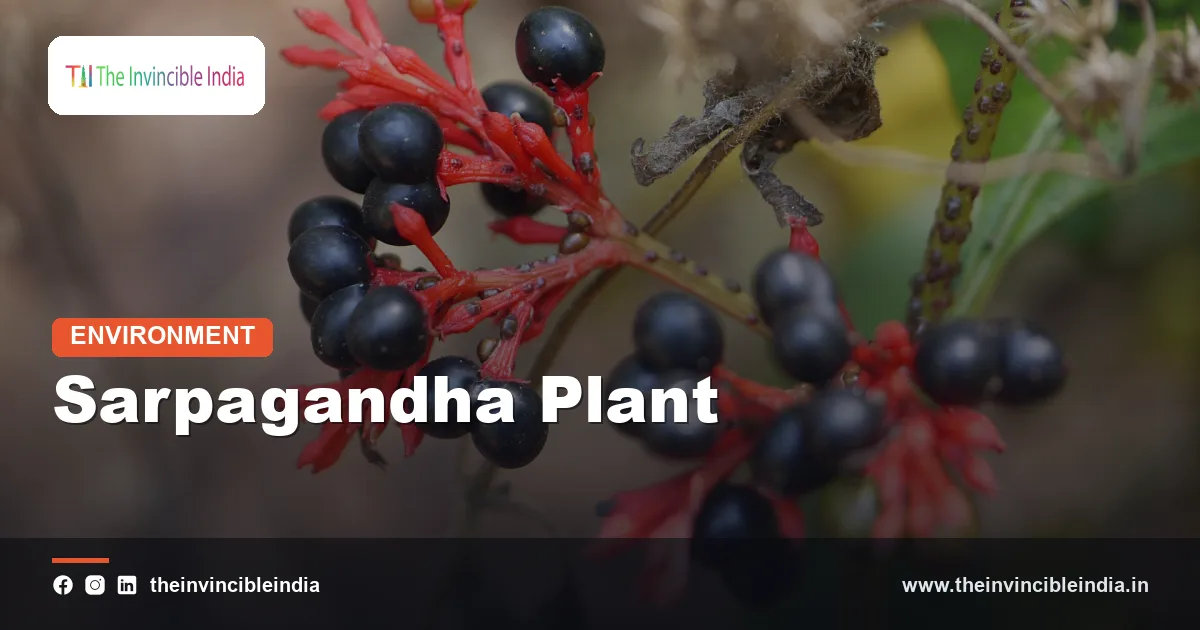
The leaves are lance-shaped to oblong, glossy and dark green above, and are arranged in whorls of three, sometimes four, around the stem. The flowers are small, tubular and borne in clusters at the tips of branches. They are white to pale pink and are carried on conspicuous red or reddish stalks, which makes the flowering plant easy to recognise.
The fruits are small, fleshy, round drupes that occur in pairs. They turn from green to purplish black when ripe. The root system is the economically important part: the main root is long, tortuous and only a little branched, with a pale yellowish interior and a bitter taste. Mature roots are typically harvested after two to three years of growth.
Where does sarpagandha grow in India?
Sarpagandha grows in shady, moist, humid forest floors and thickets across India, especially in the sub-Himalayan region, the plains of northern and eastern India and parts of the Western Ghats. It prefers tropical and subtropical climates with good rainfall and humus-rich soil.
Natural populations have been reported from the foothills of the Himalayas in Uttarakhand and Uttar Pradesh, the Terai region, Bihar, West Bengal, Assam, Odisha, and the Western Ghats of Kerala and Karnataka. Outside India the species occurs in Nepal, Bangladesh, Sri Lanka, Myanmar and other parts of Southeast Asia.
Forest departments, research bodies and the National Medicinal Plants Board, established in 2000, have all promoted conservation and cultivation of the plant. Because many wild populations have vanished from their former range, sarpagandha is today more often found in cultivation or in protected locations than in the open forest.
What compounds does sarpagandha contain?
Sarpagandha contains more than fifty indole alkaloids, with reserpine, ajmaline, ajmalicine, serpentine and rescinnamine among the best known. These alkaloids are concentrated mainly in the root bark, and the total alkaloid content has historically been about one to two per cent of the dried root.
The main alkaloids have different actions on the body. Reserpine lowers blood pressure and affects the nervous system by depleting certain chemical messengers in nerve endings. Ajmaline has been used as a medicine for abnormal heart rhythm. Ajmalicine, also known as raubasine, has been used in some countries for circulatory disorders. Because the plant produces a mixture of strongly active substances, its effects are far more complex than those of an ordinary herb.
| Alkaloid | Notable feature |
|---|---|
| Reserpine | Historic antihypertensive and antipsychotic drug; prescription only |
| Ajmaline | Used in medicine for certain heart rhythm disorders |
| Ajmalicine | Used in some countries for circulatory conditions |
| Serpentine | One of the main alkaloids, found in the root |
| Rescinnamine | A related alkaloid with blood pressure lowering action |
How did sarpagandha enter modern medicine?
Sarpagandha entered modern medicine in the mid-twentieth century, when Indian physicians reported its effect on blood pressure and chemists isolated reserpine from the root in 1952. The story is one of the classic examples of a traditional plant leading to a modern drug.
Indian doctors had used the root for hypertension and mental restlessness, and in 1949 the Mumbai physician Rustom Jal Vakil published a clinical account of its use in raised blood pressure in a British medical journal. Researchers at the Swiss company Ciba then isolated reserpine in 1952, and the compound was soon used in hospitals across the world to treat hypertension and, for a time, severe mental illness.
The medical role of reserpine has since declined. Newer antihypertensive medicines with fewer side effects, such as ACE inhibitors, beta-blockers and calcium-channel blockers, have largely replaced it as first-line therapy. Reserpine is still available in some places, but only on prescription and with medical supervision.
How has sarpagandha been used traditionally?
Sarpagandha has been used traditionally in India as a root remedy for snakebite, fever, insomnia, anxiety, mental disturbance and high blood pressure, usually in folk medicine and in Ayurvedic formulations prepared by trained practitioners. Texts and local traditions describe it as a calming plant.
Some Ayurvedic and folk uses recorded in the literature are:
- A root decoction or powder for restlessness and sleeplessness.
- Use in remedies for blood pressure and for mental excitement.
- A folk remedy for snake and scorpion bites, which has no reliable scientific support.
- Use for fever, dysentery and in some cases to ease childbirth in village practice.
These practices are historical and should not be repeated at home. The strength of sarpagandha alkaloids varies from root to root, and an incorrect amount can cause serious side effects.
Can sarpagandha be taken without a doctor?
No, sarpagandha must not be self-administered, because it contains reserpine, which is a prescription drug, and other powerful alkaloids that can cause serious side effects. Only a qualified doctor or a registered Ayurvedic physician should decide whether any preparation containing it is appropriate.
Reported adverse effects of reserpine and sarpagandha root include low blood pressure, slow heartbeat, stuffy nose, drowsiness, stomach upset and, importantly, depression, which can sometimes be severe. The drug can interact with antidepressants, heart medicines and anaesthetics. People with a history of depression, ulcers, kidney disease or gallstones, pregnant and breastfeeding women, and children are especially at risk.
Anyone currently taking blood pressure medicines should not replace them with a herbal product. Please consult a qualified doctor before using any product that contains sarpagandha or Rauvolfia.
How is sarpagandha cultivated?
Sarpagandha is cultivated from seeds or root cuttings in moist, well-drained, humus-rich soil under partial shade, and it takes two to three years to produce a root of harvestable size. Farming provides an alternative to collecting plants from the wild.
Seeds have poor and uneven germination, so nursery raising is common, and seedlings are transplanted at the start of the monsoon. Root cuttings and stem cuttings are also used because they establish more reliably. The crop needs regular watering in dry spells, weed control and a warm, humid climate.
Harvesting is done by carefully digging up the whole plant so that the long root is not broken, after which the roots are washed, cut and dried in shade. Because the plant takes years to mature and the roots are removed completely, sustainable supply depends on planting new crops continuously.
Why is sarpagandha endangered?
Sarpagandha is endangered mainly because its roots were collected from the wild on a very large scale to meet demand for reserpine, and the plant takes years to regrow. Loss of forest habitat added to the pressure.
The International Union for Conservation of Nature (IUCN) lists Rauvolfia serpentina as Endangered, and the species is included in Appendix II of the Convention on International Trade in Endangered Species (CITES), which regulates international trade. India also placed restrictions on the export of wild-collected roots in the later twentieth century, and the plant is a priority species for conservation programmes run through the National Medicinal Plants Board and state forest departments.
Conservation measures include protecting natural habitats, growing the plant in botanical gardens and medicinal plant conservation areas, supporting farmer cultivation and using tissue culture to produce planting material. These steps aim to keep the species available for research and traditional medicine without further harm to wild populations.
What other Rauvolfia species grow in India?
Besides Rauvolfia serpentina, India has several other Rauvolfia species, of which Rauvolfia tetraphylla, Rauvolfia vomitoria and Rauvolfia canescens are the best known, and some of these also contain reserpine-type alkaloids. Rauvolfia tetraphylla, a shrub of the American tropics now naturalised in parts of India, and Rauvolfia vomitoria, an African tree, have been used as commercial alternative sources of the alkaloids.
These related species matter for two reasons. First, they are sometimes mixed or substituted in the market for the true sarpagandha root, which can lead to products of uneven strength. Second, they offer a means of meeting some of the demand for alkaloids without taking more roots from the endangered Indian snakeroot. Correct botanical identification is therefore essential, and it is carried out by trained botanists, forest staff and pharmacognosy laboratories.
What is the cultural and scientific legacy of sarpagandha?
The legacy of sarpagandha is that it linked India’s village medical traditions with the pharmaceutical laboratories of the twentieth century, and it remains a standard teaching example in pharmacognosy, the study of medicines from natural sources. Students of botany and pharmacy in India still learn the plant as a case study of how folk knowledge can guide drug discovery.
The plant also shows the risk of treating nature as an endless supply. Once reserpine became a global medicine, collectors dug up roots across the forests of northern and eastern India, and wild stocks fell steeply within a few decades. The experience helped to shape later policies on medicinal plant conservation, sustainable harvest and cultivation in India. Today, researchers continue to study the alkaloid-producing pathways of Rauvolfia, because related compounds remain of interest in chemistry and medicine.
Bottom Line
Sarpagandha, or Rauvolfia serpentina, is an Indian shrub whose root gave medicine the drug reserpine and then became endangered through overharvesting. It is a potent, medically significant plant that should be used only under a qualified doctor’s supervision and never self-administered.
Frequently Asked Questions
What is sarpagandha?
Sarpagandha is the Indian name for Rauvolfia serpentina, a small evergreen shrub of the family Apocynaceae. Its root contains indole alkaloids, including reserpine. It is also called Indian snakeroot in English.
What is sarpagandha used for?
Sarpagandha has traditionally been used in Indian folk medicine and Ayurveda for high blood pressure, restlessness, insomnia, fever and snakebite. Its alkaloid reserpine was used in modern medicine as a blood pressure drug. These uses are historical, and the plant must not be self-administered.
Is sarpagandha safe to take at home?
No, sarpagandha is not safe to take at home without medical supervision, because it contains reserpine, a prescription drug, and other strong alkaloids. Side effects can include low blood pressure, slow heart rate and depression. A qualified doctor should always be consulted first.
Where does sarpagandha grow in India?
Sarpagandha grows in shady, humid forest and thicket habitats in the sub-Himalayan region, the northern and eastern plains and parts of the Western Ghats. States such as Uttarakhand, Uttar Pradesh, Bihar, West Bengal, Assam, Odisha, Kerala and Karnataka have records of the plant. Wild populations are now much reduced.
Why is sarpagandha endangered?
Sarpagandha is endangered because its roots were harvested in huge quantities from the wild for the drug trade, and the plant grows slowly. Habitat loss has added to the decline. The IUCN lists it as Endangered, and it is in CITES Appendix II.
Who discovered reserpine from sarpagandha?
Reserpine was isolated from sarpagandha roots in 1952 by chemists at the Swiss company Ciba. Indian physician Rustom Jal Vakil had earlier, in 1949, published a clinical account of the root’s effect on high blood pressure. The discovery is a well-known example of traditional knowledge leading to a modern drug.
{“@context”:”https://schema.org”,”@graph”:[{“@type”:”FAQPage”,”mainEntity”:[{“@type”:”Question”,”name”:”What is sarpagandha?”,”acceptedAnswer”:{“@type”:”Answer”,”text”:”Sarpagandha is the Indian name for Rauvolfia serpentina, a small evergreen shrub of the family Apocynaceae. Its root contains indole alkaloids, including reserpine. It is also called Indian snakeroot in English.”}},{“@type”:”Question”,”name”:”What is sarpagandha used for?”,”acceptedAnswer”:{“@type”:”Answer”,”text”:”Sarpagandha has traditionally been used in Indian folk medicine and Ayurveda for high blood pressure, restlessness, insomnia, fever and snakebite. Its alkaloid reserpine was used in modern medicine as a blood pressure drug. These uses are historical, and the plant must not be self-administered.”}},{“@type”:”Question”,”name”:”Is sarpagandha safe to take at home?”,”acceptedAnswer”:{“@type”:”Answer”,”text”:”No, sarpagandha is not safe to take at home without medical supervision, because it contains reserpine, a prescription drug, and other strong alkaloids. Side effects can include low blood pressure, slow heart rate and depression. A qualified doctor should always be consulted first.”}},{“@type”:”Question”,”name”:”Where does sarpagandha grow in India?”,”acceptedAnswer”:{“@type”:”Answer”,”text”:”Sarpagandha grows in shady, humid forest and thicket habitats in the sub-Himalayan region, the northern and eastern plains and parts of the Western Ghats. States such as Uttarakhand, Uttar Pradesh, Bihar, West Bengal, Assam, Odisha, Kerala and Karnataka have records of the plant. Wild populations are now much reduced.”}},{“@type”:”Question”,”name”:”Why is sarpagandha endangered?”,”acceptedAnswer”:{“@type”:”Answer”,”text”:”Sarpagandha is endangered because its roots were harvested in huge quantities from the wild for the drug trade, and the plant grows slowly. Habitat loss has added to the decline. The IUCN lists it as Endangered, and it is in CITES Appendix II.”}},{“@type”:”Question”,”name”:”Who discovered reserpine from sarpagandha?”,”acceptedAnswer”:{“@type”:”Answer”,”text”:”Reserpine was isolated from sarpagandha roots in 1952 by chemists at the Swiss company Ciba. Indian physician Rustom Jal Vakil had earlier, in 1949, published a clinical account of the root’s effect on high blood pressure. The discovery is a well-known example of traditional knowledge leading to a modern drug.”}}]}]}


