

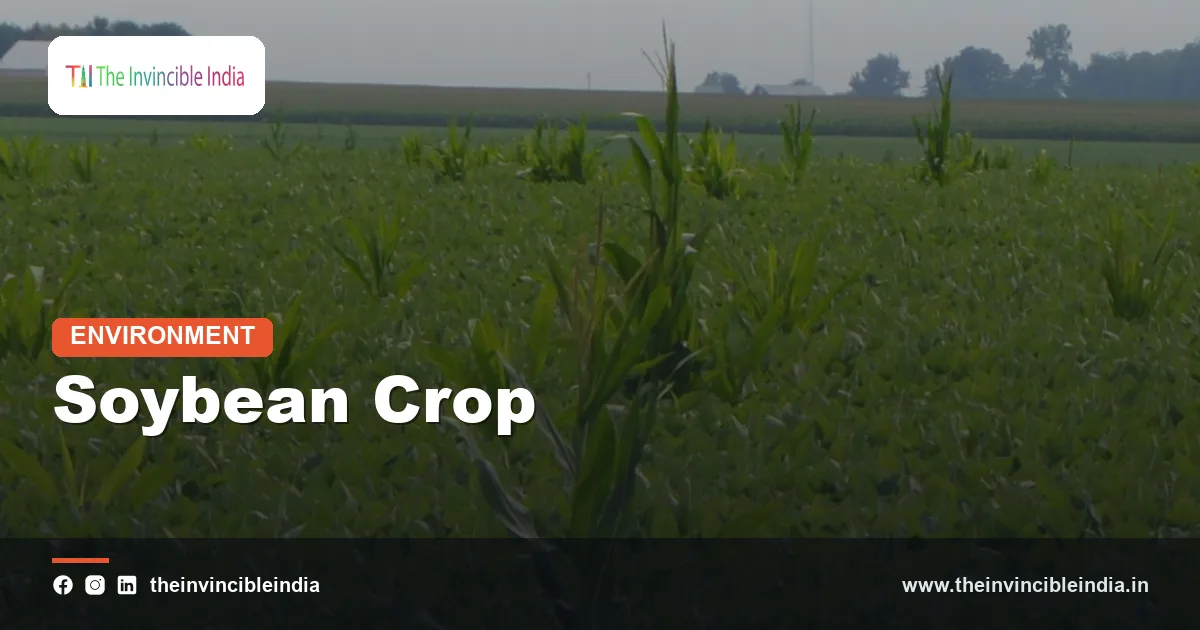
The soybean (Glycine max) is a legume crop grown for its protein-rich and oil-rich seeds, and in India it has become the country’s leading oilseed of the kharif season, raised mainly in Madhya Pradesh and Maharashtra. The plant is an upright, bushy annual that ripens in roughly three to four months, and its seeds contain about 40 per cent protein and around 20 per cent oil by weight.
Unlike most traditional Indian pulses, the soybean is not a dal in the usual sense: it is crushed mainly for edible oil, and the protein-rich meal left behind feeds poultry and livestock and also goes into soy chunks, flour and soy milk. This explainer describes the plant, its history in India, how it is grown and processed, and why it matters to farmers, industry and diets.
| Attribute | Detail |
|---|---|
| Common names | Soybean, soya bean, soya (Hindi: soyabean or bhat in the Himalayan hills) |
| Scientific name | Glycine max (L.) Merr. |
| Plant family | Fabaceae (the legume or pea family) |
| Origin | East Asia, domesticated in China thousands of years ago |
| Where grown in India | Madhya Pradesh (the largest producer), Maharashtra, Rajasthan, Karnataka, Telangana and Gujarat |
| Growing season | Kharif (monsoon) crop, sown in June or July and harvested in September to October |
| Part used | Seeds, crushed for oil and meal; seeds also used for soy milk, tofu, soy chunks and flour |
| Main products and uses | Edible oil, soymeal for animal feed, soy flour, soy chunks (nutri-nuggets), soy milk, tofu, lecithin |
| Importance | Leading kharif oilseed of India and a major source of vegetable protein for feed and food |
Key Takeaways
- The soybean (Glycine max) is a legume native to East Asia that has been grown in India on a large scale mainly since the 1970s.
- Soybean seeds contain about 40 per cent protein and roughly 20 per cent oil, which is why the crop is both an oilseed and a protein crop.
- Madhya Pradesh is India’s largest soybean-producing state, and the crop is centred on the Malwa region around Indore.
- Soybean in India is a kharif crop sown with the monsoon in June or July and harvested around September and October.
- Most of the soybean grown in India is crushed for oil and soymeal, and the soymeal is used chiefly as feed for poultry and other livestock.
- Soybean roots host Bradyrhizobium bacteria that fix atmospheric nitrogen, which makes the crop a useful rotation partner for wheat and other cereals.
What Is a Soybean?
A soybean is the seed of Glycine max, a leguminous plant that produces hairy pods containing two to four round or oval seeds, which are usually yellow but may also be green, brown or black. The seeds are rich in protein and edible oil, and they are processed into dozens of food, feed and industrial products.
The crop belongs to the Fabaceae family along with peas, chickpeas and lentils, but it is classed by agricultural agencies as an oilseed rather than a pulse. In trade, soybean is counted among the major oilseeds of the world, together with groundnut, rapeseed-mustard and sunflower.
Where did the soybean come from?
The soybean was domesticated in East Asia, mainly in China, where it has been cultivated for thousands of years as a source of protein and as the raw material for tofu, soy sauce and fermented pastes. From East Asia the crop spread across the world, and the United States, Brazil and Argentina are now the largest producers.
In India, black and yellow soybean types known locally as bhat or bhatt have long been grown in the hill regions of present-day Uttarakhand and in parts of the north-east, where they are cooked into traditional dishes. Large-scale commercial cultivation on the central Indian plateau began in the 1960s and 1970s, when research institutions and extension programmes introduced improved varieties.
What Does the Soybean Plant Look Like?
The soybean plant is an erect, branching annual herb, usually 50 to 100 centimetres tall, with hairy stems, three-part leaves and small white, pink or purple flowers that develop into fuzzy pods. Farmers recognise the crop in the field by its dense green canopy that turns yellow and drops its leaves as the pods ripen.
- Roots: a deep taproot with many nodules that hold nitrogen-fixing Bradyrhizobium bacteria.
- Leaves: trifoliate, with three broad leaflets, shed naturally as the crop matures.
- Flowers: small, self-pollinating flowers borne in clusters at the leaf joints.
- Pods: short, hairy and slightly curved, 3 to 7 centimetres long, turning tan or brown when mature.
- Seeds: round to oval, typically pale yellow, with a visible scar called the hilum.
Soybean is photoperiod-sensitive, which means flowering is triggered by shorter days. Varieties are therefore matched to a region’s latitude and sowing date, and this is why varieties bred for central India do not always perform well elsewhere.
Where Is Soybean Grown in India?
Soybean is grown mainly in central and peninsular India, with Madhya Pradesh and Maharashtra producing the bulk of the national crop, followed by Rajasthan, Karnataka, Telangana and Gujarat. Madhya Pradesh is often called the soya state of India, and the area around Indore is the commercial and research hub of the industry.
| State | Role in Soybean Production |
|---|---|
| Madhya Pradesh | Largest producing state; Malwa plateau and Indore region form the core |
| Maharashtra | Second major producer, especially Marathwada and Vidarbha |
| Rajasthan | Growing area in the southeastern districts such as Kota and Jhalawar regions |
| Karnataka | Cultivated in the northern districts of the state |
| Telangana | Notable area in the northern districts |
| Gujarat | Smaller but regular cultivation in several districts |
Soybean is grown almost entirely under rainfed conditions on black cotton soils. The ICAR-Indian Institute of Soybean Research at Indore, a national research institute of the Indian Council of Agricultural Research, develops varieties and production technology for the crop.
What Conditions Does Soybean Need to Grow?
Soybean grows best in warm, humid conditions with temperatures of roughly 20 to 30 degrees Celsius, well-distributed monsoon rainfall and a well-drained, fertile soil. The crop is sensitive to both drought during flowering and pod filling and to waterlogging at any stage.
| Requirement | Typical Range or Preference |
|---|---|
| Temperature | About 20 to 30 degrees Celsius during growth |
| Rainfall | Roughly 600 to 1000 millimetres, well distributed through the season |
| Soil | Well-drained medium to deep black soil or loam, near-neutral pH |
| Sowing time | Mid-June to early July, after the monsoon sets in |
| Seed rate | Often around 60 to 80 kilograms per hectare, depending on seed size |
| Crop duration | About 90 to 110 days for most varieties |
Soybean seed loses its ability to germinate quickly in storage, so farmers must use fresh, high-quality seed, and many state seed agencies supply certified seed each season.
How Is Soybean Cultivated?
Soybean is cultivated by sowing inoculated seed in rows soon after the monsoon begins and then controlling weeds and drainage for about three months. Good drainage is the single most important practice, because excess water in the field can kill seedlings and reduce yield.
Land preparation and sowing
The field is ploughed and harrowed to a fine tilth, and many farmers now use broad bed and furrow or ridge-and-furrow layouts that drain extra rain and hold moisture in dry spells. Seed is sown by seed drill in rows about 30 to 45 centimetres apart and at a shallow depth of 2 to 3 centimetres.
Seed treatment and nutrition
Seed is treated with a fungicide and then inoculated with Bradyrhizobium japonicum culture, because soils where soybean has not been grown may lack the right bacteria. A basal dose of phosphorus, potassium and sulphur is commonly applied, while nitrogen is largely supplied by the root nodules.
Weed control and harvest
Weeds are controlled by hand weeding, inter-row hoeing or recommended herbicides during the first four to six weeks. The crop is harvested when leaves have fallen and pods have turned brown, and farmers must avoid delays because ripe pods can shatter and spill seed.
Why Is Soybean Good for the Soil?
Soybean is good for the soil because its root nodules host Bradyrhizobium bacteria that fix nitrogen from the air, and the crop residue returns nitrogen and organic matter to the field. A soybean crop can therefore reduce the fertiliser requirement of the following wheat or chickpea crop.
In central India the soybean-wheat and soybean-chickpea rotations have become common systems. These sequences make use of monsoon rain for soybean and residual soil moisture or irrigation for the winter crop, and they spread risk across two crops in a year.
Soybean also has a deep taproot that improves soil structure and a dense canopy that protects the soil from monsoon erosion. Over-reliance on a single crop, however, can lead to disease build-up, which is why crop rotation is recommended.
What Diseases and Pests Affect Soybean?
The main threats to soybean in India include yellow mosaic virus, rust, stem fly, girdle beetle and defoliating caterpillars, which can reduce yield in years of heavy infestation. Farmers rely on resistant varieties, timely sowing and need-based spraying to keep losses in check.
- Yellow mosaic disease: a viral infection spread by whiteflies that causes yellow mottling on leaves.
- Soybean rust: a fungal disease that causes small brown spots under the leaves and early leaf fall.
- Stem fly and girdle beetle: insects whose larvae tunnel inside stems and weaken or kill young plants.
- Semilooper, tobacco caterpillar and other leaf-eaters: caterpillars that strip foliage.
- Charcoal rot and root rot: soil-borne fungal diseases that become worse under moisture stress.
Integrated pest management, which blends resistant varieties, crop rotation, clean seed and careful use of pesticides, is the approach recommended by agricultural universities. Genetically modified soybean has not been approved for commercial cultivation in India, so Indian soybean farming relies on conventionally bred varieties.
How Is Soybean Processed?
Soybean is processed by cleaning, cracking and flaking the seeds and then extracting the oil with a solvent, which leaves behind a protein-rich cake or meal. India has a sizeable network of solvent extraction plants, many clustered in Madhya Pradesh, and the industry is represented by the Soybean Processors Association of India (SOPA), based in Indore.
| Product | What It Is | Main Use |
|---|---|---|
| Soybean oil | Edible oil pressed or solvent-extracted from the seed | Cooking oil, refined oil blends, vanaspati |
| Soymeal (de-oiled cake) | Protein-rich residue after oil extraction | Poultry, cattle and aquaculture feed; export |
| Soy chunks (nutri-nuggets) | Textured vegetable protein from defatted flour | Curries, pulao, cutlets |
| Soy flour | Finely ground, heat-treated seed | Protein enrichment of bread, biscuits and baby food |
| Soy milk and tofu | Water extract of the seed and its curd | Dairy-free drinks and paneer-like preparations |
| Lecithin | Fatty compound recovered during refining | Emulsifier in foods and cosmetics |
Is Soybean Nutritious?
Soybean is nutritious because it provides complete protein, healthy unsaturated fats, fibre, iron, calcium and B vitamins in a plant-based food. Unlike most pulses, soybean protein contains all the essential amino acids in useful proportions, which is why it is widely used in vegetarian diets and in fortified foods.
Raw soybean contains natural compounds, such as trypsin inhibitors, that interfere with digestion, so the seed must be properly cooked, roasted or processed before eating. Soy products are safe and widely eaten in moderation by most people, but individuals with a soy allergy or a thyroid condition should take advice from a medical professional.
In India, soy chunks have become a popular, low-cost protein source in vegetarian cooking, and soy flour is sometimes blended with wheat flour to raise the protein content of staple foods.
Why Does the Soybean Matter to the Indian Economy?
The soybean matters to the Indian economy because it is the country’s largest kharif oilseed, a main source of domestic edible oil, and the basis of the soymeal industry that supports poultry and aquaculture. India produces only part of the edible oil it consumes and imports a substantial share, so a strong domestic oilseed sector is of strategic importance.
Soybean offers farmers in central India a cash crop that fits the monsoon season and can be followed by a winter crop. The government announces a Minimum Support Price (MSP) for soybean each year, and the National Mission on Edible Oils and related schemes aim to raise domestic oilseed output.
Indore has long been the trading centre for soybean and its products, and the crop supports crushing mills, transporters, feed makers and exporters. Production varies with the monsoon, and prices respond to both domestic rainfall and global oilseed markets.
Bottom Line
The soybean is the most important oilseed of India’s monsoon season and a bridge between farm and feed industry. Its dual role as an oil source and a protein source, together with its ability to fix nitrogen, makes it a central crop of the country’s agricultural economy.
Frequently Asked Questions
Is soybean a pulse or an oilseed?
Soybean is a legume that is classified as an oilseed in India and in world trade. It is grown mainly for its oil and protein-rich meal rather than for dal, although it belongs to the same Fabaceae family as pulses.
Which state produces the most soybean in India?
Madhya Pradesh is the largest soybean-producing state in India, followed by Maharashtra and Rajasthan. The area around Indore is the main commercial and research centre of the industry.
When is soybean sown and harvested in India?
Soybean is sown in June or July with the arrival of the monsoon and is harvested around September and October. The crop duration is roughly 90 to 110 days, depending on the variety.
What is soybean used for in India?
Most soybean in India is crushed for edible oil and soymeal, with the meal used mainly as animal feed. Smaller quantities become soy chunks, soy flour, soy milk, tofu and lecithin.
How much protein does soybean contain?
Soybean seeds contain about 40 per cent protein by weight, which is higher than most pulses. The protein contains all the essential amino acids, so it is considered nutritionally complete.
Is genetically modified soybean grown in India?
No, genetically modified soybean has not been approved for commercial cultivation in India, so Indian farmers grow conventionally bred varieties. Imported edible oils derived from genetically modified soybean are regulated separately under Indian food safety rules.
{“@context”:”https://schema.org”,”@graph”:[{“@type”:”FAQPage”,”mainEntity”:[{“@type”:”Question”,”name”:”Is soybean a pulse or an oilseed?”,”acceptedAnswer”:{“@type”:”Answer”,”text”:”Soybean is a legume that is classified as an oilseed in India and in world trade. It is grown mainly for its oil and protein-rich meal rather than for dal, although it belongs to the same Fabaceae family as pulses.”}},{“@type”:”Question”,”name”:”Which state produces the most soybean in India?”,”acceptedAnswer”:{“@type”:”Answer”,”text”:”Madhya Pradesh is the largest soybean-producing state in India, followed by Maharashtra and Rajasthan. The area around Indore is the main commercial and research centre of the industry.”}},{“@type”:”Question”,”name”:”When is soybean sown and harvested in India?”,”acceptedAnswer”:{“@type”:”Answer”,”text”:”Soybean is sown in June or July with the arrival of the monsoon and is harvested around September and October. The crop duration is roughly 90 to 110 days, depending on the variety.”}},{“@type”:”Question”,”name”:”What is soybean used for in India?”,”acceptedAnswer”:{“@type”:”Answer”,”text”:”Most soybean in India is crushed for edible oil and soymeal, with the meal used mainly as animal feed. Smaller quantities become soy chunks, soy flour, soy milk, tofu and lecithin.”}},{“@type”:”Question”,”name”:”How much protein does soybean contain?”,”acceptedAnswer”:{“@type”:”Answer”,”text”:”Soybean seeds contain about 40 per cent protein by weight, which is higher than most pulses. The protein contains all the essential amino acids, so it is considered nutritionally complete.”}},{“@type”:”Question”,”name”:”Is genetically modified soybean grown in India?”,”acceptedAnswer”:{“@type”:”Answer”,”text”:”No, genetically modified soybean has not been approved for commercial cultivation in India, so Indian farmers grow conventionally bred varieties. Imported edible oils derived from genetically modified soybean are regulated separately under Indian food safety rules.”}}]}]}


