

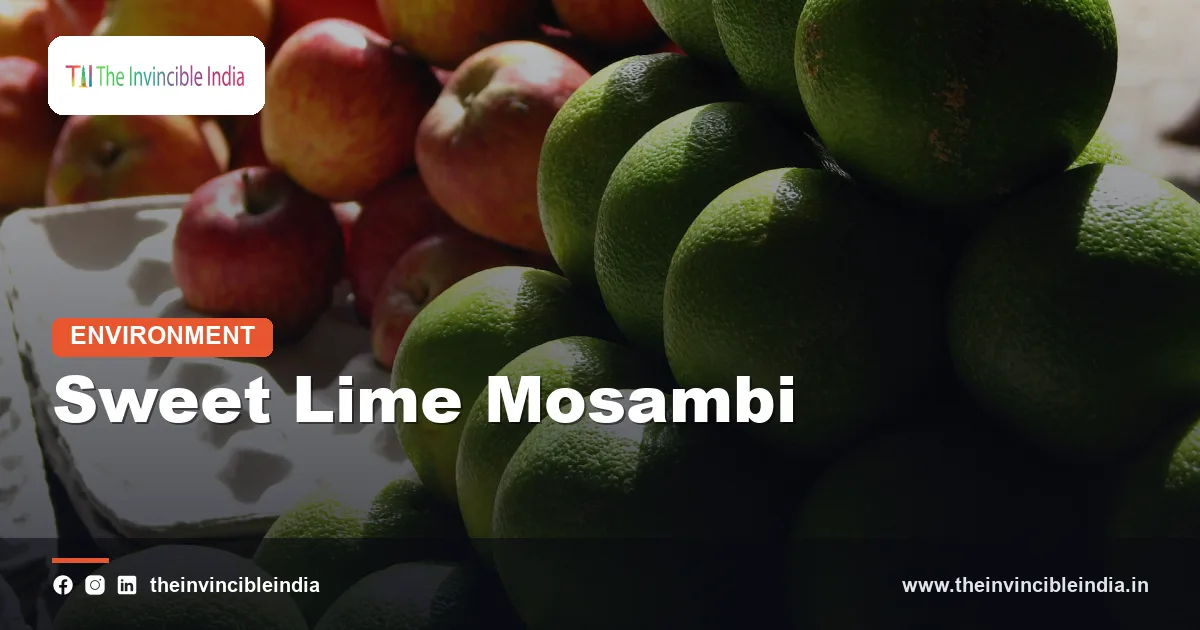
The sweet lime, known in India as mosambi (also spelt mosambi or musambi), is a mild, juicy, low-acid citrus fruit with a green to pale-yellow rind and sweet, pale-gold pulp that is most often pressed into fresh juice. Mosambi is one of the commonest fruits in Indian orchards, juice stalls and hospital fruit baskets, and it is grown across the drier and semi-arid belts of the peninsula and the north-west.
This explainer describes what the sweet lime is, how the tree grows, where it is cultivated, why its juice tastes so different from a sour lime or a bitter orange, what it contains and how growers care for the crop. It is written as an everyday guide to a fruit most Indians have drunk but few have looked at closely.
| Quick Fact | Detail |
|---|---|
| Common names | Sweet lime, mosambi (musambi), sathgudi (a closely related Andhra type), sweet orange (loosely) |
| Scientific name | Usually listed as Citrus limetta; some botanists place Indian mosambi with the sweet oranges, Citrus sinensis, so classification varies |
| Family | Rutaceae (the citrus or rue family) |
| Where grown in India | Maharashtra, Andhra Pradesh, Telangana, Karnataka, Gujarat, Rajasthan, Punjab and Haryana, among other states |
| Season | Fruit ripens mainly from about September to December, with a second smaller crop in many regions depending on the flowering season (bahar) chosen |
| Part used | Juicy pulp and juice; peel is a minor by-product |
| Nutrition | Mostly water and natural sugars, with vitamin C, some potassium and dietary fibre in the pulp |
| Main uses | Fresh juice, table fruit, juice for the sick and convalescent, and flavouring |
Key Takeaways
- The sweet lime, or mosambi, is a low-acid citrus fruit of the family Rutaceae that is eaten mainly as fresh juice in India.
- Mosambi is not the same as the small, sour lime (nimbu) used in cooking, and it is also different from the loose-skinned mandarin or santra.
- Mosambi trees are evergreen, grow to roughly three to six metres and are usually propagated by budding onto a hardy rootstock rather than from seed.
- Maharashtra and Andhra Pradesh are among the best-known mosambi-growing regions in India, along with parts of Telangana, Karnataka, Gujarat and Punjab.
- Mosambi juice is a good source of vitamin C, but the juice tastes best when pressed fresh because it can turn bitter on standing.
- Growers manage the crop through flowering-season control, irrigation, pruning and protection from citrus canker, leaf miner, psylla and greening disease.
What Is the Sweet Lime (Mosambi)?
The sweet lime, or mosambi, is a citrus fruit with a mild, sweet taste and very little acid, grown on an evergreen tree and eaten mostly as juice. Its rind stays greenish or turns pale yellow when ripe, and the segments inside hold abundant, pale-yellow to light-orange juice.
Despite the word “lime”, the fruit is nothing like the sharply sour green lime used in dal, pickle and nimbu pani. The “sweet” in its name marks the contrast. Where the common lime is valued for acidity, the mosambi is valued for gentleness, which is why it is often the first fruit offered to someone who is unwell or fasting, and why it is the default juice in many Indian towns.
The fruit is roughly round to slightly oval, usually weighing a couple of hundred grams, with a fairly thin, somewhat leathery skin that is easy to peel with a knife but harder to peel by hand than a mandarin. Seeds are present in many local types, though seedless or low-seed selections are also grown.
Is Mosambi the Same as Sweet Orange?
Mosambi is closely related to the sweet orange but is not always the same fruit, and botanists do not agree on a single classification. Many references treat it as Citrus limetta, the sweet lime, while others consider the Indian mosambi to be a sweet orange cultivar of Citrus sinensis.
In everyday Indian use the distinction is practical rather than botanical. Mosambi usually has a greener rind when ripe, a paler juice and a milder, less aromatic flavour than a typical orange. A related type called sathgudi, widely grown in Andhra Pradesh, is also commonly sold as mosambi or sweet orange. For shoppers, the useful rule is that mosambi means a green-to-yellow, thin-skinned, mild juice fruit sold by weight or by the dozen.
The citrus family is famously prone to natural hybridisation, which is the main reason names overlap. Oranges, pomelos, mandarins and limes have crossed freely over centuries, producing many in-between forms that are named by local markets long before botanists classify them.
How Does the Mosambi Tree Grow?
The mosambi tree is a small, spreading, evergreen citrus tree that usually reaches about three to six metres, with glossy dark-green leaves and short thorns on young branches. It grows best in warm, sunny conditions with well-drained soil and moderate water.
The leaves are oval with a slightly winged leaf stalk, a typical feature of citrus, and they release a citrus fragrance when crushed. White, fragrant flowers appear in clusters, usually after a spell of dry weather or water stress followed by irrigation or rain. The flowers are pollinated largely by insects, and only a small share of flowers set fruit. The rest drop, which is normal.
Rootstock and propagation
Commercial mosambi orchards rarely grow trees from seed. Seed-grown trees vary in quality and take longer to bear, so nurseries propagate by budding, which means grafting a bud of the desired variety onto the root system of a hardy rootstock. Rough lemon (Jatti Khatti) and Rangpur lime are among the rootstocks used in India for their vigour and tolerance of difficult soils.
Years to fruit
A budded tree begins bearing fruit in about three to four years and reaches full production by around eight to ten years. Well-managed orchards can remain productive for decades, though yields decline and disease pressure rises as trees age.
Where Is the Sweet Lime Grown in India?
The sweet lime is grown mainly in the drier central and southern parts of India, with Maharashtra and Andhra Pradesh long being regarded as leading growing regions, together with parts of Telangana, Karnataka, Gujarat, Rajasthan, Punjab and Haryana. Exact rankings of states change year to year, so published figures should be read with the reporting year in mind.
In Maharashtra, mosambi is concentrated in the Marathwada and Vidarbha districts, where semi-arid conditions and drip irrigation have made citrus a major horticultural crop. In Andhra Pradesh and Telangana, sathgudi-type sweet orange or mosambi orchards are common on red and sandy loam soils. In Punjab and Haryana, mosambi is a smaller but established crop alongside kinnow, a mandarin hybrid, in irrigated plains.
The fruit is a staple of the national fruit market. Trucks carry it from growing belts to cities across the country, and juice vendors in places as far apart as Delhi, Kolkata and Chennai rely on supply from several states through the year.
When Is Mosambi in Season?
Mosambi is in season mainly from about September to December in most growing regions, though local flowering patterns mean fruit is available in other months as well. The main harvest follows the monsoon, with the largest volumes reaching markets in the cooler months.
The key to the calendar is the flowering season, called bahar in Indian horticulture. A mosambi tree can be induced to flower at different times of year by withholding water for a period and then irrigating. Growers commonly speak of three flowering seasons:
- Ambe bahar, flowering roughly in January and February, with fruit harvested in the following winter or late monsoon months.
- Mrig bahar, flowering roughly in June and July with the monsoon, producing fruit later in the year.
- Hasta bahar, flowering roughly in September and October, producing fruit in the following spring and summer.
Growers usually choose one bahar based on water availability, market prices and the pest and disease burden. Because summer juice demand is high, fruit that can be picked in warm months often fetches better prices, even though the water cost of getting it is higher.
What Does Mosambi Juice Taste Like and Why Is It Sweet?
Mosambi juice tastes mild, sweet and lightly floral because the fruit contains natural sugars in good quantity and very little citric acid, so the sharpness typical of citrus is largely absent. The juice is pale and slightly cloudy and is usually served over ice, often with a pinch of black salt.
Sweetness in a citrus fruit depends on the ratio of sugars to acids, sometimes called the brix-to-acid ratio. Mosambi has a high ratio compared with lemons, sour limes and many oranges, which makes it taste sweet even if its sugar content is not unusually high. Slightly under-ripe fruit still tastes sweet, which is part of why it is picked and marketed while the rind is still greenish.
One quirk is that mosambi juice, like some other citrus juices, can develop a bitter note if it is left standing, because compounds in the fruit change after the cells are crushed. Vendors therefore press the fruit to order and serve it quickly, and most home cooks do the same.
What Nutrients Does Mosambi Provide?
Mosambi provides water, natural sugars, vitamin C, small amounts of potassium and folate, and dietary fibre in the pulp. A medium fruit supplies a meaningful share of an adult’s daily vitamin C needs, but exact values vary with variety, ripeness and growing conditions.
The nutrient profile can be summarised in a few lines:
- Vitamin C: the best-known nutrient in mosambi, needed for normal tissue repair and for iron absorption from plant foods.
- Natural sugars: mainly sucrose, glucose and fructose, which give the fruit its energy and sweetness.
- Fibre: present in the pulp and membranes, much of which is lost when the fruit is strained into juice.
- Minerals: small amounts of potassium, calcium and magnesium.
- Plant compounds: flavonoids such as hesperidin, which are common to citrus fruits.
Eating the whole fruit rather than drinking only the juice keeps the fibre and slows sugar absorption. People who manage diabetes are generally advised to treat fruit juice as a sugary drink and to consult a doctor or dietitian about portion size, because that advice rests on how the body handles sugars rather than on anything unique to mosambi.
How Is Mosambi Used in Indian Life?
Mosambi is used mainly as fresh juice, followed by table fruit, fruit-basket gifts and flavouring, and it holds a particular place as a recovery drink in homes and hospitals. Its mild flavour makes it acceptable to children, older people and those on restricted diets.
Common uses include:
- Roadside and home juice: pressed by hand or machine, often served with ice and a pinch of salt or black salt (kala namak).
- Get-well gifts: a bag of mosambi is a traditional gift for patients, both for its mild taste and its reputation for being gentle on the stomach.
- Fasting and light meals: the juice is often taken during fasts and as a light morning drink.
- Fruit salads and chaat: segments are added to fruit plates, sometimes seasoned with chaat masala.
- Processing: some juice is concentrated, canned or bottled, though much of the fruit is sold fresh.
The peel is richer in aromatic oil than the pulp. It is sometimes dried, grated for flavouring or used in household cleaning, but it is a small by-product compared with the juice.
What Is the Difference Between Mosambi, Orange, Lemon and Lime?
Mosambi differs from orange, lemon and lime mainly in taste, rind colour and use: it is the mildest of these citrus fruits, with a green-to-yellow rind, while lemons and limes are sour and oranges are sweeter but more acidic and aromatic. The following table sets out the contrast in plain terms.
| Fruit | Typical rind | Taste | Common use |
|---|---|---|---|
| Mosambi (sweet lime) | Green to pale yellow, thin | Mild, sweet, low acid | Fresh juice |
| Orange (such as Nagpur santra) | Loose, orange-yellow | Sweet-sour, aromatic | Eaten in segments, juice |
| Lemon | Yellow, firm | Strongly sour | Drinks, cooking, pickle |
| Lime (nimbu) | Small, green | Sharply sour, bitter edge | Nimbu pani, cooking, garnish |
| Pomelo | Very thick, pale green-yellow | Sweet to tart, faint bitterness | Eaten fresh, peel candied |
The mosambi therefore sits near the sweet end of the family. It is far more acceptable raw than a lime, but it lacks the vivid acidity that many people look for in a squeezed drink.
How Is Mosambi Cultivated?
Mosambi is cultivated in orchards on well-drained, medium-textured soils, planted as budded saplings at spacings of about four to six metres and managed through regular irrigation, fertiliser, pruning and pest control. Heavy waterlogged soils and strongly saline soils are poorly suited to citrus.
Planting and care
Saplings are planted at the start of the rainy season or in early spring in pits filled with soil and organic manure. Young trees are trained to a single stem with a balanced head of branches. Drip irrigation has been widely adopted in dry districts because it saves water and keeps the soil moisture steady, which is particularly useful for fruit set.
Common pests and diseases
Citrus is vulnerable to several problems, and growers need to scout orchards regularly. The better-known ones include:
- Citrus canker: a bacterial disease causing raised, corky lesions on leaves and fruit.
- Citrus leaf miner: a small moth whose larvae tunnel inside young leaves, leaving silvery trails.
- Citrus psylla: a sap-sucking insect that also spreads greening disease.
- Citrus greening (huanglongbing): a serious bacterial disease that causes yellow mottling and poor, lopsided fruit.
- Gummosis and root rot: fungal problems linked with waterlogging and injury to the lower trunk.
Good orchard hygiene, disease-free budwood from certified nurseries, balanced nutrition and timely sprays are the main defences. Because citrus greening has no easy cure, planting healthy material in the first place matters more than later treatment.
Harvest and handling
Fruit is picked by hand or with clippers when the rind has begun to change from dark to light green and the juice has reached the expected sweetness. Growers cut rather than pull the fruit to avoid tearing the rind, then grade, clean and pack it in crates or boxes for transport.
How Can You Choose and Store Good Mosambi?
A good mosambi feels heavy for its size, has firm, smooth skin and smells faintly of citrus at the stem end. Weight indicates juice content, and heavy fruit usually yields the most.
A few practical points:
- Avoid fruit with soft spots, mould near the stem or deeply wrinkled, dry skin.
- A little green on the rind is normal and does not mean the fruit is raw.
- Mosambi keeps for a week or two at room temperature and noticeably longer when refrigerated.
- Roll the fruit under the palm before cutting, which helps loosen the juice vesicles.
- Wash the rind before juicing, since the knife passes through the surface.
Why Does the Sweet Lime Matter?
The sweet lime matters because it is a widely grown, affordable fruit crop that supports many horticulture farmers and gives urban India a familiar, low-cost source of vitamin C and fluid. It is also a good example of how a single fruit can link a drought-prone orchard in the interior to a street corner in a distant city.
For farmers, mosambi offers a perennial crop that can be grown in drier areas with controlled irrigation, though it demands steady water, skilled pruning and vigilance against disease. For consumers, it is one of the few fruits that is available fresh, cheaply and in a ready-to-drink form almost everywhere.
Bottom Line
The sweet lime, or mosambi, is India’s gentlest everyday citrus, valued for mild juice, low acidity and wide availability. It grows on evergreen budded trees in the dry central, southern and north-western parts of the country and is best drunk freshly pressed.
Frequently Asked Questions
What is a sweet lime or mosambi?
A sweet lime, or mosambi, is a mild, low-acid citrus fruit with a green to pale-yellow rind and sweet, juicy pulp. It is grown across India and is mostly consumed as fresh juice. It is different from the small sour lime used in cooking.
Is mosambi the same as orange?
Mosambi is closely related to the sweet orange but is usually a different, milder fruit. It has a greener, thinner rind and paler, less aromatic juice, although botanists differ on whether Indian mosambi is a sweet lime (Citrus limetta) or a sweet orange (Citrus sinensis) type.
Which states in India grow mosambi?
Maharashtra and Andhra Pradesh are among the best-known mosambi-growing states. Telangana, Karnataka, Gujarat, Rajasthan, Punjab and Haryana also grow it. Rankings change from year to year, so exact production figures depend on the reporting period.
When is mosambi in season?
Mosambi is in season mainly from about September to December. Because growers can control the flowering season, called bahar, fruit may also be harvested in other months in some regions.
Why does mosambi juice sometimes taste bitter?
Mosambi juice can turn bitter when it is left standing after pressing. Compounds released from the crushed fruit change over time and produce a bitter edge, so the juice tastes best when it is pressed and drunk fresh.
Is mosambi good for health?
Mosambi is a good source of vitamin C and also supplies water, natural sugars, potassium and some fibre. The whole fruit is more filling than the juice, and people managing blood sugar should treat the juice as a sugary drink and take medical advice on quantity.
{“@context”:”https://schema.org”,”@graph”:[{“@type”:”FAQPage”,”mainEntity”:[{“@type”:”Question”,”name”:”What is a sweet lime or mosambi?”,”acceptedAnswer”:{“@type”:”Answer”,”text”:”A sweet lime, or mosambi, is a mild, low-acid citrus fruit with a green to pale-yellow rind and sweet, juicy pulp. It is grown across India and is mostly consumed as fresh juice. It is different from the small sour lime used in cooking.”}},{“@type”:”Question”,”name”:”Is mosambi the same as orange?”,”acceptedAnswer”:{“@type”:”Answer”,”text”:”Mosambi is closely related to the sweet orange but is usually a different, milder fruit. It has a greener, thinner rind and paler, less aromatic juice, although botanists differ on whether Indian mosambi is a sweet lime (Citrus limetta) or a sweet orange (Citrus sinensis) type.”}},{“@type”:”Question”,”name”:”Which states in India grow mosambi?”,”acceptedAnswer”:{“@type”:”Answer”,”text”:”Maharashtra and Andhra Pradesh are among the best-known mosambi-growing states. Telangana, Karnataka, Gujarat, Rajasthan, Punjab and Haryana also grow it. Rankings change from year to year, so exact production figures depend on the reporting period.”}},{“@type”:”Question”,”name”:”When is mosambi in season?”,”acceptedAnswer”:{“@type”:”Answer”,”text”:”Mosambi is in season mainly from about September to December. Because growers can control the flowering season, called bahar, fruit may also be harvested in other months in some regions.”}},{“@type”:”Question”,”name”:”Why does mosambi juice sometimes taste bitter?”,”acceptedAnswer”:{“@type”:”Answer”,”text”:”Mosambi juice can turn bitter when it is left standing after pressing. Compounds released from the crushed fruit change over time and produce a bitter edge, so the juice tastes best when it is pressed and drunk fresh.”}},{“@type”:”Question”,”name”:”Is mosambi good for health?”,”acceptedAnswer”:{“@type”:”Answer”,”text”:”Mosambi is a good source of vitamin C and also supplies water, natural sugars, potassium and some fibre. The whole fruit is more filling than the juice, and people managing blood sugar should treat the juice as a sugary drink and take medical advice on quantity.”}}]}]}


