

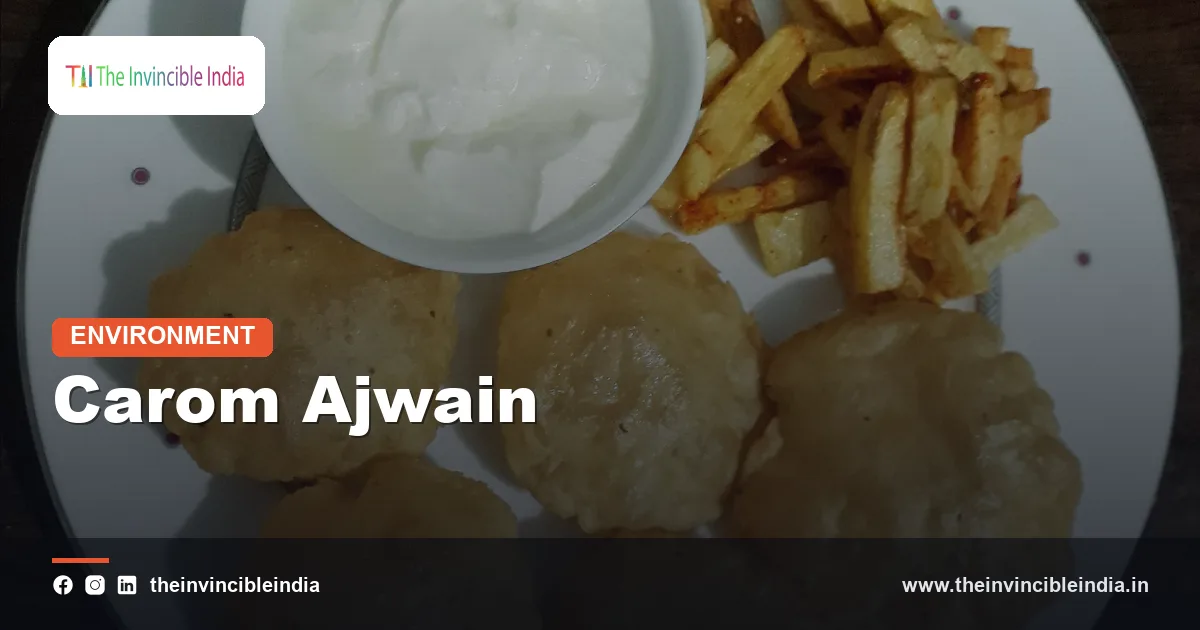
The seed-spice ajwain, also called carom or bishop’s weed, is the small, ridged, thyme-scented fruit of the annual herb Trachyspermum ammi, a member of the carrot family that is grown as a winter crop in the dry plains of western India. Rajasthan and Gujarat are the leading producing states, and the spice is used whole in breads, fritters, snacks and home digestive remedies across the country.
Although it is sold as a seed, ajwain is actually a tiny dried fruit that gets its sharp, pungent flavour from an aromatic compound called thymol. This explainer covers the plant, where and how it is grown, how it differs from related spices, and how it is used in Indian kitchens.
Quick Facts
| Common names | Ajwain, carom seeds, bishop’s weed, ajowan (Sanskrit: yavani) |
|---|---|
| Scientific name | Trachyspermum ammi |
| Family | Apiaceae (the carrot or celery family) |
| Where grown in India | Mainly Rajasthan and Gujarat; also Madhya Pradesh, Uttar Pradesh, Andhra Pradesh, Telangana and parts of Karnataka |
| Growing season | Winter (rabi) crop: sown around October to November, harvested around February to April |
| Plant type | Erect annual herb, roughly 60 to 90 centimetres tall |
| Part used | The dried fruit (commonly called the seed) |
| Uses | Flavouring for parathas, pakoras and snacks; digestive aid; essential-oil and thymol extraction |
Key Takeaways
- Ajwain (Trachyspermum ammi) is an annual herb of the carrot family whose tiny ridged fruits are sold as carom seeds.
- The sharp flavour of ajwain comes mainly from thymol, the same aromatic compound that gives thyme its characteristic smell.
- Rajasthan and Gujarat are the principal ajwain-growing states, and the crop is sown in the cool season and harvested in spring.
- Ajwain is a hardy, low-water crop that suits light, well-drained soils and semi-arid climates, but it is sensitive to frost at flowering.
- Ajwain is fried or roasted in hot oil before use, which mellows its bitterness and releases its aroma.
- Ajwain is a different plant from the leafy herb sometimes called ajwain patta, which is Coleus amboinicus (Indian borage).
What is ajwain?
Ajwain is a seed-spice produced by the plant Trachyspermum ammi, whose small, egg-shaped, greyish-brown fruits are used whole in Indian cooking. Each fruit is only about two millimetres long, with fine ridges on its surface, and splits into two halves when fully dry, although the halves usually stay together.
Botanically, the plant belongs to Apiaceae, the family of cumin, coriander, fennel, celery, dill and carrot. In all these plants the “seed” sold in shops is really a dry fruit called a schizocarp, and ajwain follows the same pattern. The English name “carom” is believed to be a borrowing from the Indian name, and the plant is also called ajowan and bishop’s weed in older English texts.
The aroma of ajwain is strong, warm and slightly bitter, closely resembling thyme but sharper. Tasted raw, the fruits are hot and pungent enough to numb the tongue briefly, which is why cooks use them in small quantities and nearly always cook or roast them first.
What does the ajwain plant look like?
The ajwain plant is a slender, branching annual herb that grows about 60 to 90 centimetres tall and has finely divided, feathery leaves. The stems are thin and grooved, the leaves are cut into narrow thread-like segments, and the whole plant has a delicate, fern-like appearance in the field.
The flowers are tiny and white, grouped in the compound umbels that are typical of the carrot family. An umbel looks like an upturned umbrella, with many short stalks radiating from one point and each ending in a small flower cluster. Bees and other insects visit these flowers, and after pollination each flower develops into a single pair of tiny fruits.
As the crop matures, the leaves turn yellowish and the umbels turn grey-brown. This colour change tells farmers that the fruits are ready to be harvested. The fruits are held loosely on the dried heads and can drop if the crop is left standing too long.
Where is ajwain grown in India?
Ajwain is grown in India mainly in Rajasthan and Gujarat, which together account for the largest share of the national crop. Smaller areas are planted in Madhya Pradesh, Uttar Pradesh, Andhra Pradesh, Telangana and Karnataka, and the crop is also grown in Iran, Afghanistan and Egypt, which are often suggested as the region of its origin.
These regions share a similar set of conditions: dry weather, light to medium soil and cool winter nights. In Rajasthan the crop fits into the winter season on irrigated or moisture-retaining land, often after a monsoon crop has been taken off. In Gujarat it is grown in the drier districts of the state, and it is sometimes rotated with cotton, groundnut or cereals.
Ajwain is a minor spice compared with chilli, turmeric or cumin in terms of total area, but it is a dependable cash crop for small and medium farmers because it needs relatively little water and can be sold throughout the year after storage.
How is ajwain grown?
Ajwain is grown as a winter (rabi) crop by sowing very small seeds in well-prepared, well-drained soil in October or November and harvesting the dried umbels in spring. The crop is usually raised with limited irrigation and comparatively few inputs.
Climate and soil
The plant prefers a cool, dry climate with moderate temperatures during growth. Light loam or sandy loam soils with good drainage suit it best, whereas waterlogged, heavy clay is harmful because the seedlings are fine-rooted and easily rot. Frost during flowering and fruit-setting can badly damage the crop, so sowing time is chosen to avoid the coldest weeks at the critical stages.
Sowing and care
- The seed bed is levelled and pulverised, because the seeds are so small that they must be sown shallow.
- Seeds are mixed with sand for even broadcasting or sown in rows, and are lightly covered with soil.
- Light irrigation after sowing helps germination, and later watering is limited to a few critical stages such as branching and flowering.
- Weeding and thinning are done early, because the young seedlings grow slowly and weeds can outcompete them.
Pests and diseases include aphids on tender shoots and fungal problems such as powdery mildew and wilt in humid or cloudy spells. Crop rotation and clean seed help reduce these risks.
How is ajwain harvested and processed?
Ajwain is harvested by cutting the whole plants when most umbels have turned greyish-brown and then drying them for a few days before threshing out the fruits. The harvest takes place in spring, usually between February and April depending on the region and sowing date.
Harvesting is done in the cool part of the day to reduce shattering losses. The cut plants are laid out in the sun or under cover to dry, and the fruits are then threshed by beating or by machine. The grain is winnowed to remove stalks and dust, graded for size and colour, and stored in dry bags.
Quality is judged by the uniformity of the fruits, their light greyish colour and the strength of the aroma. Properly stored ajwain keeps its flavour for a long time because the essential oil is held inside the fruit, but it should be kept away from moisture and strong smells.
Why does ajwain smell like thyme?
Ajwain smells like thyme because its essential oil contains a high proportion of thymol, the phenol that is also the main aromatic compound in thyme. The essential oil makes up a modest share of the dried fruit by weight, and thymol often forms the largest part of that oil, with smaller amounts of related compounds such as p-cymene and gamma-terpinene.
The strong thymol content explains both the sharp taste and the traditional importance of ajwain. Thymol is used industrially as an ingredient in antiseptic and oral-care products, flavourings and some pharmaceutical preparations, and ajwain is a significant natural source. Ajwain oil is therefore distilled commercially in addition to the whole seed being sold for the kitchen.
The same compound is why ajwain seeds have a numbing, warming effect in the mouth and why they are always used sparingly.
How is ajwain used in Indian cooking?
Ajwain is used in Indian cooking as a tempering spice and as a flavouring kneaded into doughs and batters, mostly for fried or starchy foods. A pinch is typically fried in hot ghee or oil for a few seconds so that its pungency softens and its aroma spreads through the dish.
- Breads: Ajwain parathas, puris, theplas, missi rotis and bhature often contain a spoonful of the seeds in the dough.
- Fritters and snacks: Pakoras, bhajiyas, namkeen mixtures, sev, mathri and nimki use ajwain for flavour.
- Vegetables and lentils: It is used in tempering for some dals, potato dishes and gourd curries.
- Pickles: A few seeds are added to some achar masalas.
- Drinks and home remedies: Ajwain water and ajwain with salt are taken after heavy meals in many households.
Cooks value ajwain particularly with foods made from gram flour, lentils or deep-fried batter, which are heavy on the stomach. The tradition of pairing it with these dishes is long-established, even though it rests on cultural experience rather than clinical proof.
What are the traditional uses of ajwain beyond the kitchen?
Traditional uses of ajwain beyond the kitchen are mainly as a home remedy for indigestion, wind and cold symptoms, and as a mild insect-repellent in stored grain and clothes. These are practices passed down in families and in Ayurveda, in which the fruit is called yavani and is considered warming.
- Roasted ajwain with salt is taken to ease heaviness after meals.
- Seeds are warmed in a cloth bundle and used as a compress for aches.
- Steam with a few seeds in hot water is breathed in during colds.
- Seeds are mixed with stored grain or placed among clothes to discourage insects.
These customs are widespread, but they are not substitutes for medical care. Anyone with persistent digestive trouble, a chronic illness or pregnancy should consult a doctor before using ajwain in large or medicinal amounts.
How is ajwain different from cumin and ajwain patta?
Ajwain differs from cumin in being a different plant with a thyme-like, hotter flavour, and it differs from ajwain patta in being a seed-spice rather than a leafy herb. The three are often confused because of similar names or appearance.
| Item | Plant | Family | Flavour and use |
|---|---|---|---|
| Ajwain (carom) | Trachyspermum ammi | Apiaceae | Sharp, thyme-like, tempered in breads and snacks |
| Cumin (jeera) | Cuminum cyminum | Apiaceae | Warm, earthy, used in tempering and spice blends |
| Ajwain patta (Indian borage) | Coleus amboinicus | Lamiaceae | Thick aromatic leaf, used in fritters and home remedies |
| Celery seed | Apium graveolens | Apiaceae | Bitter and celery-like, used in pickles and seasonings |
The leafy plant called ajwain patta is a succulent herb of the mint family. Its leaf smells similar because it also contains thymol-type compounds, but it is an entirely separate species and is not the source of carom seeds.
How should ajwain be stored and judged for quality?
Ajwain should be stored whole in a clean, dry, airtight container away from heat, light and damp, and it keeps its flavour well for a year or more when handled this way. Because the aromatic oil sits inside the tiny fruit, whole ajwain holds its strength far longer than ground powder, which is why the spice is almost always sold whole.
Good ajwain has a uniform greyish-brown colour, a clean sharp smell when rubbed between the fingers and very little dust, stalk or soil. Pale, dull or musty seed is usually old or has absorbed moisture. Buyers who need only a little can crush a pinch in the palm just before use, which releases the aroma much more strongly than adding the seed straight into the pan.
In the trade, ajwain is graded by seed size, cleanliness and oil content, and processors that distil the oil prefer lots with a high oil yield.
Why does ajwain matter to farmers and the spice trade?
Ajwain matters to farmers because it is a low-input, drought-tolerant crop that gives a cash return in dry regions where few other crops grow well. Small landholders in Rajasthan and Gujarat can fit it into winter rotations and sell it through spice markets and mandis.
India supplies most of the ajwain used in its own kitchens and exports some to other countries, particularly those with large South Asian populations, as well as to industries that extract thymol. Production and prices vary with rainfall, cold spells and the area sown, so the market can move sharply from year to year.
The Spices Board of India and state agricultural universities support the crop through improved varieties, advice on clean seed and guidance on harvest and post-harvest handling. The cultivation of ajwain also supports rural processing and trading activity around spice mandis.
Bottom Line
Ajwain is the thymol-rich fruit of Trachyspermum ammi, a hardy winter herb of the carrot family grown mainly in Rajasthan and Gujarat. Its sharp flavour makes it a staple in fried breads and snacks, and its low water demand makes it a practical dryland cash crop.
Frequently Asked Questions
What is ajwain in English?
Ajwain is called carom seeds in English, and is also known as ajowan or bishop’s weed. It is the dried fruit of the plant Trachyspermum ammi. The spice has a sharp, thyme-like flavour.
Is ajwain the same as cumin?
No, ajwain is not the same as cumin. Both belong to the carrot family, but ajwain comes from Trachyspermum ammi and cumin from Cuminum cyminum. Ajwain is smaller, sharper and thyme-like, while cumin is warm and earthy.
Which Indian states grow the most ajwain?
Rajasthan and Gujarat grow the most ajwain in India. Smaller areas are cultivated in Madhya Pradesh, Uttar Pradesh, Andhra Pradesh, Telangana and Karnataka. The crop suits dry, light-soil regions with a cool winter.
When is ajwain sown and harvested?
Ajwain is sown as a winter crop around October to November and harvested around February to April. The exact dates depend on the region and local weather. Farmers cut the plants when the umbels turn greyish-brown, then dry and thresh them.
Why is ajwain added to parathas and fried snacks?
Ajwain is added to parathas and fried snacks because its strong, thyme-like flavour balances rich or starchy food. Cooks also use it for its long-standing reputation as a digestive aid. The seeds are usually fried or roasted briefly to soften their bitterness.
Is ajwain patta the same as ajwain seeds?
No, ajwain patta is not the same as ajwain seeds. Ajwain patta is the leaf of Coleus amboinicus, or Indian borage, a succulent mint-family herb. Ajwain seeds are the dried fruits of Trachyspermum ammi from the carrot family.
{“@context”:”https://schema.org”,”@graph”:[{“@type”:”FAQPage”,”mainEntity”:[{“@type”:”Question”,”name”:”What is ajwain in English?”,”acceptedAnswer”:{“@type”:”Answer”,”text”:”Ajwain is called carom seeds in English, and is also known as ajowan or bishop’s weed. It is the dried fruit of the plant Trachyspermum ammi. The spice has a sharp, thyme-like flavour.”}},{“@type”:”Question”,”name”:”Is ajwain the same as cumin?”,”acceptedAnswer”:{“@type”:”Answer”,”text”:”No, ajwain is not the same as cumin. Both belong to the carrot family, but ajwain comes from Trachyspermum ammi and cumin from Cuminum cyminum. Ajwain is smaller, sharper and thyme-like, while cumin is warm and earthy.”}},{“@type”:”Question”,”name”:”Which Indian states grow the most ajwain?”,”acceptedAnswer”:{“@type”:”Answer”,”text”:”Rajasthan and Gujarat grow the most ajwain in India. Smaller areas are cultivated in Madhya Pradesh, Uttar Pradesh, Andhra Pradesh, Telangana and Karnataka. The crop suits dry, light-soil regions with a cool winter.”}},{“@type”:”Question”,”name”:”When is ajwain sown and harvested?”,”acceptedAnswer”:{“@type”:”Answer”,”text”:”Ajwain is sown as a winter crop around October to November and harvested around February to April. The exact dates depend on the region and local weather. Farmers cut the plants when the umbels turn greyish-brown, then dry and thresh them.”}},{“@type”:”Question”,”name”:”Why is ajwain added to parathas and fried snacks?”,”acceptedAnswer”:{“@type”:”Answer”,”text”:”Ajwain is added to parathas and fried snacks because its strong, thyme-like flavour balances rich or starchy food. Cooks also use it for its long-standing reputation as a digestive aid. The seeds are usually fried or roasted briefly to soften their bitterness.”}},{“@type”:”Question”,”name”:”Is ajwain patta the same as ajwain seeds?”,”acceptedAnswer”:{“@type”:”Answer”,”text”:”No, ajwain patta is not the same as ajwain seeds. Ajwain patta is the leaf of Coleus amboinicus, or Indian borage, a succulent mint-family herb. Ajwain seeds are the dried fruits of Trachyspermum ammi from the carrot family.”}}]}]}


