

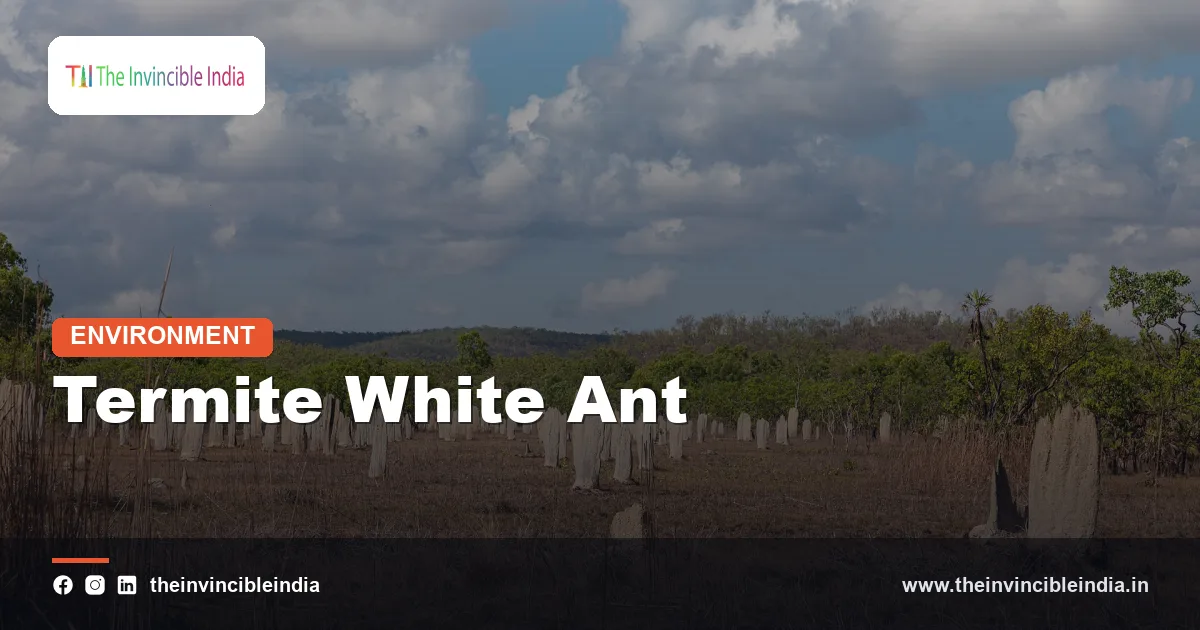
A termite is a small, soft-bodied social insect that lives in organised colonies and feeds on cellulose from wood, plant litter and soil humus, and in India it is widely known as the white ant even though it is not an ant. Termites build earthen mounds, tunnels and hidden galleries, and a single colony may contain thousands to millions of individuals divided into workers, soldiers and reproductives.
The termite is both a pest and a keystone species: it damages timber, books and buildings, yet it also recycles dead plant matter, enriches the soil and supports many other animals. This article explains what a termite is, how a colony is organised, how mounds work, which kinds occur in India, how termites differ from ants, why they swarm after the first rains, and how homes are protected from them.
Quick Facts
| Common name | Termite (white ant; deemak in Hindi) |
|---|---|
| Scientific classification | Class Insecta; order Blattodea (formerly the separate order Isoptera), epifamily Termitoidae; the largest family is Termitidae |
| Size | Workers and soldiers are a few millimetres long; winged reproductives are about 1 to 2 cm with wings; queens of some species grow to several centimetres |
| Habitat in India | Soil, mounds, dead wood, standing trees, grassland, forests, farmland and buildings, from the plains to the hills |
| Diet | Cellulose in dead wood, grass, leaf litter, dung and humus; some species cultivate fungus gardens on chewed plant matter |
| Life cycle | Incomplete metamorphosis: egg, nymph, then worker, soldier or winged reproductive; the royal pair may live for many years |
| Ecological role | Decomposer and soil engineer that recycles plant material, aerates soil and creates shelter for other animals |
| Notable features | Caste system, mound building, gut microbes that digest cellulose, soft pale bodies, straight beaded antennae and an aversion to light and open air |
Key Takeaways
- A termite is a social insect of the order Blattodea, and its closest living relatives are cockroaches, not ants.
- A termite colony is divided into castes: workers that feed and build, soldiers that defend, and reproductives, including a king and queen, that breed.
- Termites digest cellulose with the help of microbes in their gut or, in the fungus-growing group, with a fungus of the genus Termitomyces.
- Winged termites emerge in large numbers during the first monsoon showers in India, shed their wings after a short flight and try to found new colonies in pairs.
- Termite mounds are built from soil, saliva and dung, and their internal tunnels regulate temperature, humidity and airflow.
- Protection against termites in Indian buildings relies on soil treatment before construction, physical barriers, dry well-seasoned timber and regular inspection.
What is a termite?
A termite is a pale, soft-bodied insect that lives in a colony and eats cellulose, the tough substance that makes up the walls of plant cells. Termites belong to the order Blattodea, the group that also contains cockroaches, and they are now classified as a lineage of social cockroaches.
The body of a worker or soldier is divided into head, thorax and abdomen, with a broad join between the thorax and abdomen and no narrow waist. The antennae are straight and beaded, and the workers are usually blind or nearly blind. Termites avoid light and dry air, so they travel inside tunnels or under covered tubes made of soil.
The world has roughly three thousand described species of termite, mostly in the tropics, and India has a few hundred. Only a small fraction cause damage to buildings or crops. Most species work quietly on dead wood, grass and leaf litter, and they are among the most important recyclers of plant material in tropical soils.
Why is a termite called a white ant?
A termite is called a white ant because the pale workers look like small ants and live in colonies, but the name is misleading, as termites and ants belong to completely different insect orders. Termites are related to cockroaches, while ants are related to bees and wasps.
The two groups evolved their social way of life independently, which is an example of convergent evolution. Both have workers, soldiers and queens, both build elaborate nests, and both can form very large colonies, but the details of their bodies and life cycles differ sharply. Using the term termite is therefore more accurate than white ant.
How is a termite colony organised?
A termite colony is organised into castes, each with a fixed job, and the colony functions as a single unit under the control of the royal pair. The main castes are the workers, the soldiers and the reproductives, together with the young nymphs.
- Workers: pale, wingless, mostly blind individuals that forage for food, build and repair the nest, tend the eggs and feed the other castes. They are the most numerous members of the colony and the ones that actually damage wood.
- Soldiers: individuals with enlarged, hardened heads and strong jaws, or, in the nasute group, a snout that squirts a sticky defensive fluid. They defend against ants and other attackers.
- Reproductives: the king and queen, who found the colony, and the winged males and females, called alates, that leave to establish new colonies.
- Nymphs: young individuals that may develop into workers, soldiers or reproductives, depending on the needs of the colony.
Unlike ants, in which workers are all female, termite workers and soldiers can be both male and female. The king stays with the queen for life and mates with her repeatedly. This is another difference between termites and the ants, in which males die soon after mating.
The queen
The queen of a mature colony of the larger mound-building species has a hugely swollen abdomen and can lay thousands of eggs a day. She is kept in a sealed royal chamber deep within the nest, tended by workers who feed her, clean her and carry away the eggs. A queen may live for many years, and some are thought to live for a decade or more.
How do termites digest wood?
Termites digest wood with the help of microbes, because the termite itself cannot fully break down cellulose. The lower termites carry single-celled protists in their hindgut, and the higher termites rely mostly on bacteria, while the fungus-growing species use an outside fungus as well.
The workers chew wood and other plant matter, pass it through the gut and, in some species, swallow it again or feed it to nestmates. The microbes ferment the cellulose and release nutrients that the termite can absorb. Young termites acquire their gut microbes from nestmates through a process of mutual feeding called trophallaxis, so the colony as a whole passes its digestive partners from one generation to the next.
Fungus-growing termites
Termites of the subfamily Macrotermitinae, which include the common Indian genera Odontotermes and Macrotermes, grow a fungus of the genus Termitomyces in special chambers called fungus combs. The workers bring in plant matter, chew it, and place it in the comb, where the fungus breaks it down. The termites then eat the fungus and the partly digested material. Some of these fungi produce mushrooms above ground after rain, and the so-called termite mushrooms are collected and eaten in several parts of India.
What are the main types of termite found in India?
The main types of termite found in India are subterranean termites, mound-building termites, drywood termites and grass-harvesting termites. They differ in where they nest and what they eat, and each type has its own typical pattern of damage.
| Type | Typical Indian genera | Nest and habit |
|---|---|---|
| Subterranean termites | Odontotermes, Microtermes, Coptotermes, Heterotermes | Nest in soil, travel through mud tubes, attack wood, crops and buildings from the ground |
| Mound-building termites | Macrotermes, Odontotermes | Build large earthen mounds, often with fungus gardens; common on farmland and in scrub |
| Drywood termites | Neotermes, Cryptotermes | Live inside sound dry wood and furniture, without contact with soil; leave small pellets |
| Harvester termites | Trinervitermes | Forage in the open for dry grass and carry it back to the nest |
| Arboreal and wood-nesting termites | Microcerotermes, Nasutitermes and others | Build nests on tree trunks and branches, joined to the soil by covered runways |
The species that most often damage buildings and crops in India are the subterranean termites of the genera Odontotermes, Microtermes and Coptotermes. The drywood termites are less common but difficult to detect, as they work inside the wood.
How do termites build mounds?
Termites build mounds by mixing soil with saliva and dung, laying it in small pellets and shaping it into hard towers and ridges that surround a network of tunnels and chambers. The material dries to a cement-like hardness, and a mound can stand for years.
The mounds of some tropical species rise to several metres, and old mounds are among the largest structures built by any insect relative to its body size. In the larger mounds, the royal chamber and fungus combs lie near the base, while the outer walls contain a system of passages that supply fresh air.
How a mound works
A mound acts as a ventilation and climate-control device. Warm air rises through the central channels, cooler air enters through the porous outer walls, and the exchange of gases keeps the interior temperature and humidity steady. Workers open or close vents and adjust the structure to suit the weather.
In Indian culture, the termite mound is known as a valmika or anthill. Traditional accounts say that the sage Valmiki, the traditional author of the Ramayana, was given that name because an anthill grew around him during his long meditation. Termite mounds are also commonly associated with snakes, as cobras and other species often shelter in abandoned mounds.
Why do winged termites appear after the first rains?
Winged termites appear after the first rains because the damp soil and warm, humid air provide good conditions for new colonies, and the rain triggers the colony to release its reproductives in a mass flight. The sudden clouds of insects around lamps in the evening are a familiar sign of the monsoon in much of India.
The winged males and females, called alates, leave the nest in large numbers at the same time, which lowers the risk for any individual and helps them find mates from other colonies. After a short flight they land, shed their wings and pair up. The female lifts the tip of her abdomen to release a scent that attracts a male, and the pair walk in tandem to look for a place to dig.
The pair then seal themselves into a small chamber in the soil or wood and begin a new colony. Most of the flyers are eaten by birds, lizards, frogs, bats, spiders, ants and even people in some regions, where they are collected and cooked as food. Only a few pairs survive to found colonies.
How is a termite different from an ant?
A termite differs from an ant in its body shape, antennae, wings and ancestry: the termite has a broad waist, straight beaded antennae and wings of equal length, while the ant has a narrow waist, elbowed antennae and forewings that are longer than the hindwings. Their body colours and habits also differ.
| Feature | Termite | Ant |
|---|---|---|
| Waist | Broad, with no narrow waist | Narrow, pinched waist |
| Antennae | Straight and beaded | Elbowed |
| Wings (reproductives) | Four wings of equal length | Forewings longer than hindwings |
| Body colour | Pale, soft and often translucent (workers) | Usually dark, brown or red and harder |
| Closest relatives | Cockroaches (Blattodea) | Bees and wasps (Hymenoptera) |
| Diet | Mainly cellulose | Mixed: insects, nectar, seeds and honeydew |
| Light and air | Avoids both; works inside tunnels | Active in the open |
A related point of confusion is the carpenter ant, which nests in wood but does not eat it, and which can be told apart from the termite by its narrow waist, elbowed antennae and dark body.
How do termites damage buildings and crops?
Termites damage buildings and crops by eating the cellulose in wood, paper, cloth and plant roots from the inside, often leaving only a thin outer shell, so the damage is hidden until it is advanced. Subterranean species enter buildings from the soil through foundation cracks and gaps around pipes, building mud tubes across surfaces that they cannot tunnel through.
The signs of an infestation include mud tubes on walls and foundations, hollow-sounding timber, blistered or crumbling paint, tiny holes in furniture, discarded wings near windows after a swarm and small piles of pellets near drywood termite galleries. In fields, termites attack the roots and stems of sugarcane, groundnut, wheat, maize, fruit trees and young tree plantations, particularly in dry soil.
Books, wooden doors, window frames, cupboards, old documents and electrical fittings are also at risk, since the insects tunnel to reach any cellulose source. They are far more destructive in humid, warm regions, where colonies are large and active all year.
How can homes be protected against termites?
Homes can be protected against termites by treating the soil before construction, using physical barriers, keeping timber dry and well seasoned, repairing leaks and inspecting regularly. Prevention is far easier and cheaper than curing a heavy infestation.
- Pre-construction treatment: a chemical barrier is applied to the foundation soil before the floor is laid. The Bureau of Indian Standards (BIS) has issued a code of practice for anti-termite measures in buildings (IS 6313).
- Post-construction treatment: holes are drilled and treated at the base of walls and around the plinth to create a barrier in the soil.
- Physical measures: fine stainless-steel mesh, concrete floors and well-fitted damp-proof courses make it harder for termites to reach timber.
- Good timber practice: use seasoned, treated or naturally resistant timber, and keep wood away from damp soil.
- Moisture control: repair leaking pipes, ensure drainage away from the walls and avoid storing firewood or cardboard against the house.
- Inspection: check regularly for mud tubes and hollow wood, particularly after the monsoon.
Anti-termite treatments use pesticides and should be done by trained professionals who follow the recommended products and safety measures. Homeowners should keep children and pets away from treated areas during the work.
Why are termites important to the environment?
Termites are important to the environment because they break down dead wood and plant litter, return nutrients to the soil, improve soil structure and provide food and shelter for many other animals. In tropical grasslands and forests, they are among the most significant decomposers.
Their tunnels improve the infiltration of water and the aeration of the soil, and their mounds concentrate nutrients such as nitrogen and phosphorus, creating patches where plants grow more richly. Termite mounds are used as dens or shelters by snakes, mongooses, lizards, birds and other small animals, and old mounds may be colonised by trees and shrubs.
Termites are also a food source for ants, spiders, birds, bats, lizards, frogs, pangolins, sloth bears and many other animals. The sloth bear of India, for example, uses its long claws to dig into mounds and suck up the insects. Termites also release methane as a by-product of digestion, a small natural contribution to atmospheric gases.
Bottom Line
The termite is a social insect related to cockroaches, not ants, and it lives in castes within hidden nests and mounds across India. It is a serious pest of wood and crops, but also an indispensable recycler of dead plant matter, and the best response to it is prevention through soil treatment, dry timber and regular inspection.
Frequently Asked Questions
What is a termite?
A termite is a small, pale, social insect that lives in colonies and feeds on cellulose from wood, grass and plant litter. It belongs to the order Blattodea and is related to cockroaches. In India it is commonly called the white ant, even though it is not an ant.
Is a termite the same as a white ant?
A termite is what is commonly called a white ant, but it is not a true ant. Ants belong to the order Hymenoptera with bees and wasps, while termites are social relatives of cockroaches. The name arose because the pale workers resemble ants in size and colonial life.
Why do winged termites come out after the first rain?
Winged termites come out after the first rain because the damp soil and humid air favour the start of new colonies. The colony releases its winged males and females together in a mass flight so that they can find mates from other colonies. After landing they shed their wings, pair up and try to found a new nest.
What do termites eat?
Termites eat cellulose, which is found in dead wood, grass, dry leaves, paper, cloth, dung and humus. They digest it with the help of microbes in their gut, and some species also grow a fungus on chewed plant matter. The workers feed the soldiers, the young and the royal pair.
How can I tell termites from ants?
Termites can be told from ants by their broad waist, straight beaded antennae and pale body, while ants have a narrow waist, elbowed antennae and usually darker colour. Winged termites also have four wings of equal length, but ants have longer forewings than hindwings. Termites avoid light, whereas most ants walk openly in daylight.
How can termites be prevented in a house?
Termites can be prevented in a house by treating the soil before construction, using physical barriers, keeping timber dry and repairing leaks. The Bureau of Indian Standards has a code of practice for anti-termite measures in buildings. Regular inspection for mud tubes and hollow wood allows early action.
{“@context”:”https://schema.org”,”@graph”:[{“@type”:”FAQPage”,”mainEntity”:[{“@type”:”Question”,”name”:”What is a termite?”,”acceptedAnswer”:{“@type”:”Answer”,”text”:”A termite is a small, pale, social insect that lives in colonies and feeds on cellulose from wood, grass and plant litter. It belongs to the order Blattodea and is related to cockroaches. In India it is commonly called the white ant, even though it is not an ant.”}},{“@type”:”Question”,”name”:”Is a termite the same as a white ant?”,”acceptedAnswer”:{“@type”:”Answer”,”text”:”A termite is what is commonly called a white ant, but it is not a true ant. Ants belong to the order Hymenoptera with bees and wasps, while termites are social relatives of cockroaches. The name arose because the pale workers resemble ants in size and colonial life.”}},{“@type”:”Question”,”name”:”Why do winged termites come out after the first rain?”,”acceptedAnswer”:{“@type”:”Answer”,”text”:”Winged termites come out after the first rain because the damp soil and humid air favour the start of new colonies. The colony releases its winged males and females together in a mass flight so that they can find mates from other colonies. After landing they shed their wings, pair up and try to found a new nest.”}},{“@type”:”Question”,”name”:”What do termites eat?”,”acceptedAnswer”:{“@type”:”Answer”,”text”:”Termites eat cellulose, which is found in dead wood, grass, dry leaves, paper, cloth, dung and humus. They digest it with the help of microbes in their gut, and some species also grow a fungus on chewed plant matter. The workers feed the soldiers, the young and the royal pair.”}},{“@type”:”Question”,”name”:”How can I tell termites from ants?”,”acceptedAnswer”:{“@type”:”Answer”,”text”:”Termites can be told from ants by their broad waist, straight beaded antennae and pale body, while ants have a narrow waist, elbowed antennae and usually darker colour. Winged termites also have four wings of equal length, but ants have longer forewings than hindwings. Termites avoid light, whereas most ants walk openly in daylight.”}},{“@type”:”Question”,”name”:”How can termites be prevented in a house?”,”acceptedAnswer”:{“@type”:”Answer”,”text”:”Termites can be prevented in a house by treating the soil before construction, using physical barriers, keeping timber dry and repairing leaks. The Bureau of Indian Standards has a code of practice for anti-termite measures in buildings. Regular inspection for mud tubes and hollow wood allows early action.”}}]}]}


