

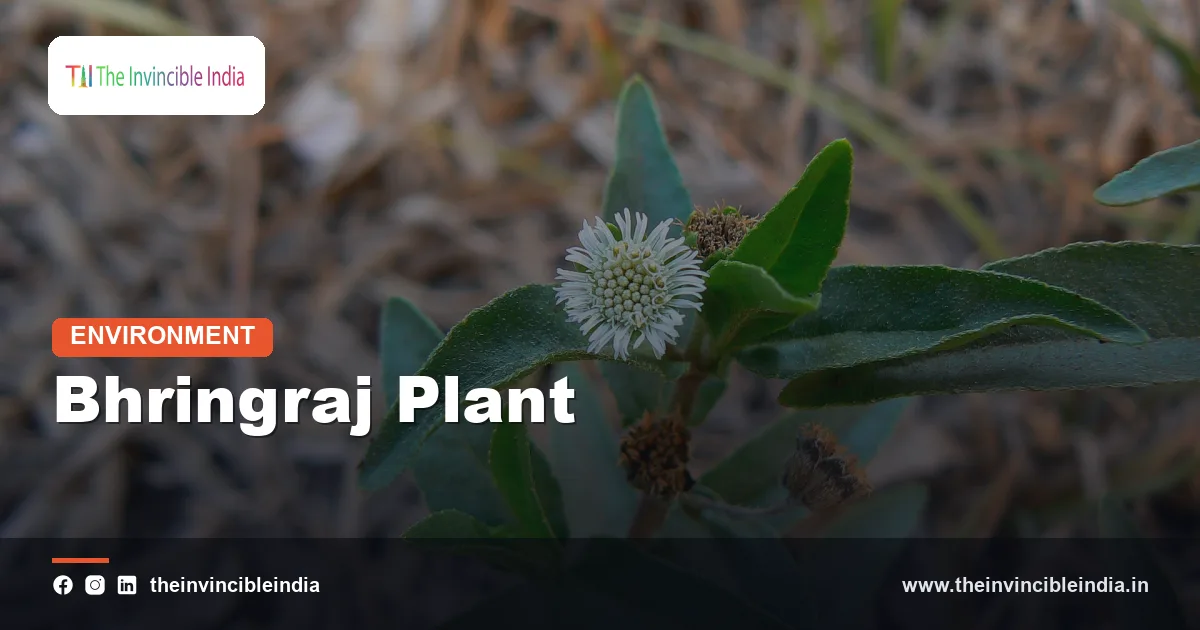
Bhringraj is a small, sprawling herb of wet ground (Eclipta prostrata) that is widely known in Ayurveda as the “king of hair” and is traditionally used in oils for the scalp and in tonics for the liver. It is a common roadside and paddy-field plant across India, recognisable by its rough, narrow leaves and small white daisy-like flower heads, and most people meet it first as a bottle of dark herbal hair oil.
This explainer describes the bhringraj plant, where it grows, what its names mean, how bhringraj oil is traditionally prepared, what the plant contains and how to think about its claims. The uses described here are traditional and are not proven medical claims.
| Attribute | Details |
|---|---|
| Common names | Bhringraj, bhangra, false daisy, trailing eclipta, kesharaja |
| Botanical name | Eclipta prostrata (L.) L., also written Eclipta alba |
| Family | Asteraceae (the daisy or sunflower family) |
| Plant type | Annual, sometimes short-lived perennial, branching herb that sprawls or grows upright |
| Part used | Whole plant, mainly the fresh leaves and juice |
| Where found in India | Wet fields, paddy margins, canal banks, roadside ditches and damp waste ground across the plains and lower hills |
| Key plant compounds | Coumestans such as wedelolactone and demethylwedelolactone, flavonoids, thiophenes and triterpenoid saponins |
| Traditional Ayurvedic role | Kesya (hair-supporting), rasayana (rejuvenating) and a liver tonic herb |
| Notable fact | The crushed leaves leave a dark, almost black stain on the skin |
Key Takeaways
- Bhringraj (Eclipta prostrata) is a small herb of the daisy family that grows in wet places across India and is called the “king of hair” in Ayurvedic tradition.
- The bhringraj plant has narrow, rough, hairy leaves and tiny white flower heads that look like miniature daisies, and its fruits are small and dark.
- Bhringraj oil is traditionally prepared by cooking the juice of the fresh plant with sesame or coconut oil, often along with other herbs.
- The best-known compound in bhringraj is wedelolactone, a coumestan that is the usual chemical marker used to check the quality of extracts.
- Yellow bhringraj, a different plant sometimes sold under the same name, is usually Sphagneticola calendulacea, which is a separate species from the white-flowered Eclipta prostrata.
- Bhringraj uses in hair care and liver health are traditional and not proven by strong clinical evidence, so anyone with a medical condition should consult a qualified professional first.
What is bhringraj?
Bhringraj is the Ayurvedic and Hindi name for Eclipta prostrata, a herb of the Asteraceae family that grows as a common weed of damp ground and is valued in Indian traditional medicine. The family is the same one that includes the sunflower, marigold, daisy and zinnia, and the tiny flower heads of bhringraj show the typical daisy structure on a very small scale.
The plant is also known in English as false daisy and trailing eclipta. Its botanical name has changed over time, so older books and many commercial labels give the species as Eclipta alba. The two names refer to the same plant in most Indian herbal literature, and Eclipta prostrata is now the accepted name.
In Sanskrit the plant is called bhringaraja. The word bhringa refers to a large black bee or a dark bird, and raja means king, which is usually read as “king of the bees” or, in the context of hair care, “king of hair”. Both readings reflect long-standing associations: bees visit the small flowers, and the plant’s dark juice is linked with dark, healthy hair.
What does the bhringraj plant look like?
The bhringraj plant is a low, branching herb, usually 10 to 50 centimetres tall, with stems that lie along the ground at the base and rise at the tips. The stems are slender, often reddish or purplish, and covered in short, stiff, whitish hairs that make the whole plant feel rough to the touch.
The leaves are narrow and lance-shaped, borne in opposite pairs along the stem, with a pointed tip and very slightly toothed edges. Both surfaces are rough because of the fine hairs. The leaves have little stalk, and they are quite dark green in damp, fertile ground.
The flowers are small round heads, about a centimetre across, with white petal-like ray florets around a centre of tiny whitish disc florets. They sit singly or in pairs on short stalks at the leaf joints. After flowering, the heads produce small, dark, ridged, wedge-shaped fruits (technically achenes) that are easily carried by water and mud.
A plant that stains dark
One of the most distinctive features of bhringraj is that its crushed leaves and juice turn black on exposure to air. Rubbing a fresh leaf between the fingers leaves a dark green to black stain, which is part of the reason the plant became linked with hair-darkening traditions. The colour change is a natural oxidation of the plant’s compounds and does not by itself prove any effect on hair.
Where does bhringraj grow in India?
Bhringraj grows throughout India wherever the soil is moist, including paddy fields, canal and river banks, village ponds, drains and damp waste ground. It is most abundant in the monsoon, when it appears in large numbers in fields and along roads, and it thrives in warm, humid conditions.
The plant is also widespread in the tropical and subtropical regions of Asia, Africa, Australia and the Americas, and it is regarded as a weed in many countries. Its seeds germinate quickly in wet soil, and the plant grows readily in rice-growing regions, where it is a common weed of the crop. Because it is so widespread, most bhringraj sold in India is gathered from the wild or from field margins rather than grown on large organised farms, although small-scale cultivation exists.
A practical point follows from this habitat. Plants growing next to drains, roads or polluted water can absorb contaminants, so clean and known collection sites matter for any herb meant for use on the body.
What is the difference between white and yellow bhringraj?
White bhringraj is Eclipta prostrata, the plant with small white flower heads, while yellow bhringraj is usually a different plant, Sphagneticola calendulacea (also known as Wedelia chinensis or Wedelia calendulacea), which has bright yellow flowers. Both are daisy-family herbs of damp ground, and Ayurvedic texts and traders sometimes group them under the name bhringraj.
| Feature | White bhringraj | Yellow bhringraj |
|---|---|---|
| Botanical name | Eclipta prostrata | Sphagneticola calendulacea (Wedelia calendulacea) |
| Flower colour | Small, white | Larger, bright yellow |
| Flower size | About 1 cm across | About 2 cm across |
| Leaves | Narrow, rough, hairy, lance-shaped | Thicker, coarser, broader, opposite |
| Common use | Hair oils, liver tonics, rasayana | Used as a substitute, also in liver and hair preparations |
Because the two plants are not identical in their chemistry, a bottle labelled only “bhringraj” may contain either. A reliable label gives the botanical name, and that is the surest way to know which plant is being used.
How is bhringraj oil traditionally made?
Bhringraj oil is traditionally made by simmering the fresh juice or paste of the bhringraj plant in a base oil, usually sesame oil or coconut oil, until the water has evaporated and only the herb-infused oil remains. This slow-cooking method, called taila paka in Ayurveda, is the classical way of preparing medicated oils.
In classical preparations the oil is often combined with other herbs and a milk or water medium, and the mix is cooked on low heat while being stirred. The finished oil is filtered and stored. Commercial versions vary widely, and many use a simple extract of the herb in a base oil rather than the full classical process.
Traditional ways of using the oil
- Massaged into the scalp and left for a short time before a hair wash
- Applied to the hair lengths to condition them
- Used in shiro abhyanga, the Ayurvedic head massage
- Combined with amla, hibiscus, brahmi or neem in homemade mixes
Sesame and coconut oils are themselves popular hair oils, so some of the effect people notice may come from the oil and the massage and not from the herb alone. Anyone who is allergic to a base oil, or has a scalp condition, should do a patch test and check with a professional first.
What are the active compounds in bhringraj?
The characteristic compounds of bhringraj are coumestans, chiefly wedelolactone and demethylwedelolactone, along with flavonoids, thiophene derivatives, triterpenoid saponins and a range of minor constituents. Wedelolactone is the best-studied and is often used as a chemical marker for judging the identity and quality of bhringraj extracts.
Laboratory studies, mostly on cells and animals, have examined the plant’s extracts for effects on the liver, inflammation, oxidative stress and hair growth. A few small studies in animals have reported hair-growth-promoting effects for Eclipta extracts, but good-quality trials in humans are limited. Researchers therefore describe the evidence as early and inconclusive.
For a reader, the important distinction is between a plant that has interesting compounds and a plant that has been proven to treat a condition. Bhringraj sits firmly in the first category.
What does Ayurveda say about bhringraj?
Ayurveda describes bhringraj as a rasayana, or rejuvenating herb, with a special connection to hair, the liver and the eyes. It is considered bitter and pungent in taste, warming in potency and balancing for the kapha and vata doshas, and it is widely listed among the herbs that support hair (kesya).
The classical Ayurvedic literature and later regional texts describe the plant for uses including hair loss and early greying, skin problems, liver and spleen complaints, and as a general tonic. Fresh leaf juice, dried leaf powder and medicated oils are the main forms.
These are traditional statements within the Ayurvedic framework. They explain why the plant became central to hair care and herbal tonics in India, but they are not the same as laboratory or clinical proof, and a modern reader should treat them as cultural and historical knowledge.
| Traditional use | Form | Evidence status |
|---|---|---|
| Hair fall and greying | Medicated oil, juice, paste | Traditional; limited modern evidence |
| Liver support | Fresh juice, powder, decoction | Traditional; studied mainly in animals |
| Skin conditions | Leaf paste, oil | Traditional |
| General rejuvenation | Powder, tonic formulations | Traditional |
| Eye and head comfort | Head massage, oil | Traditional |
Is bhringraj safe to use?
Bhringraj applied to the scalp in oil form is generally well tolerated, but internal use of extracts or powders should be approached with care and discussed with a qualified professional. The herb is traditional and is not a proven medicine, and individual reactions vary.
- Patch test any new oil or paste on a small patch of skin, since allergic reactions to plants of the daisy family can occur.
- Keep oil away from the eyes, as the plant’s juice and oil can irritate them.
- Avoid internal medicinal use during pregnancy and breastfeeding unless a qualified practitioner advises otherwise.
- People with liver disease, or those who take regular medicines, should check before taking bhringraj in any concentrated form.
- Choose products that give the botanical name and are made by reputable manufacturers, as herbal products can vary in quality.
- Do not use a herb as a substitute for medical care when hair loss is sudden or patchy, as it can be a sign of an underlying condition that needs a doctor.
This article is general information and is not medical advice. A consult-a-professional approach is the responsible one, especially for children, older adults and people with existing conditions.
Why does the bhringraj plant matter?
The bhringraj plant matters because it connects a roadside weed with one of the most recognisable herbal traditions in India, hair care with natural oils. A plant that farmers pull out of paddy fields is, in another setting, the central ingredient of a well-known product category.
It also shows the value of weedy plants in traditional medicine. Many of the herbs of Ayurveda are not rare forest plants but common species of fields, hedges and wet ground, which means that local people have long had hands-on knowledge of them. Keeping that knowledge alive depends on protecting the ordinary habitats where such plants grow.
Finally, bhringraj is a useful case study in reading herbal labels. The same name can cover more than one species, a single plant can have many regional names, and the traditional claims are far ahead of the laboratory evidence. A careful reader keeps these three points in mind.
How can bhringraj be grown at home?
Bhringraj can be grown at home from seed or cuttings in a pot or garden bed with moist, fertile soil and plenty of light. The plant is a fast grower and handles warm, wet weather well, and it often self-seeds once established.
- Sow seeds on the surface of damp soil at the start of the monsoon, or press stem cuttings into moist soil.
- Use a wide pot or a bed with good drainage, and keep the soil damp but not waterlogged.
- Give it full sun to light shade for steady, compact growth.
- Pinch the tips to encourage branching and a bushier plant.
- Harvest the leaves and young shoots before or during flowering, and use them fresh.
A home-grown plant is a good way to ensure the leaves are clean and the species is correct, and it is a handy way to learn to recognise the plant in the wild.
Bottom Line
Bhringraj is a rough-leaved, white-flowered herb of wet ground that Ayurveda calls the king of hair and that Indian households know best as a dark herbal oil. Its uses are traditional rather than proven, so it is best treated as a cultural and herbal ingredient and not as a medical treatment, with professional advice sought for any health concern.
Frequently Asked Questions
What is bhringraj used for?
Bhringraj is traditionally used in India for hair care, in the form of medicated oils, and as a rejuvenating and liver-supporting herb in Ayurveda. The fresh juice, leaf powder and infused oil are the main forms. These uses are traditional and are not proven medical treatments.
What is the botanical name of bhringraj?
The botanical name of bhringraj is Eclipta prostrata, which is also written Eclipta alba in older books and on many product labels. The plant belongs to the Asteraceae (daisy) family. Yellow bhringraj, a different plant, is usually Sphagneticola calendulacea.
Why is bhringraj called the king of hair?
Bhringraj is called the king of hair because its Sanskrit name, bhringaraja, combines bhringa (a black bee or dark bird) with raja (king), and Ayurveda strongly associates the plant with hair health. Its oil has been used for centuries in head massage. The title reflects tradition rather than proven results.
Where does bhringraj grow in India?
Bhringraj grows throughout India in wet and damp places, including paddy fields, canal banks, ponds and roadside ditches. It is most abundant in the monsoon and prefers warm, humid conditions. It is a common weed in rice-growing regions.
Is bhringraj oil safe for daily use?
Bhringraj oil is generally well tolerated on the scalp, but a patch test is advisable before regular use. The oil can irritate the eyes, and people with sensitive skin or allergies to daisy-family plants should be careful. Anyone with a scalp condition or sudden hair loss should consult a doctor.
Can bhringraj be grown at home?
Yes, bhringraj grows easily at home from seed or cuttings in moist, fertile soil with plenty of light. It grows fast in the monsoon and often self-seeds. Growing it at home helps ensure the plant is clean and correctly identified.
{“@context”:”https://schema.org”,”@graph”:[{“@type”:”FAQPage”,”mainEntity”:[{“@type”:”Question”,”name”:”What is bhringraj used for?”,”acceptedAnswer”:{“@type”:”Answer”,”text”:”Bhringraj is traditionally used in India for hair care, in the form of medicated oils, and as a rejuvenating and liver-supporting herb in Ayurveda. The fresh juice, leaf powder and infused oil are the main forms. These uses are traditional and are not proven medical treatments.”}},{“@type”:”Question”,”name”:”What is the botanical name of bhringraj?”,”acceptedAnswer”:{“@type”:”Answer”,”text”:”The botanical name of bhringraj is Eclipta prostrata, which is also written Eclipta alba in older books and on many product labels. The plant belongs to the Asteraceae (daisy) family. Yellow bhringraj, a different plant, is usually Sphagneticola calendulacea.”}},{“@type”:”Question”,”name”:”Why is bhringraj called the king of hair?”,”acceptedAnswer”:{“@type”:”Answer”,”text”:”Bhringraj is called the king of hair because its Sanskrit name, bhringaraja, combines bhringa (a black bee or dark bird) with raja (king), and Ayurveda strongly associates the plant with hair health. Its oil has been used for centuries in head massage. The title reflects tradition rather than proven results.”}},{“@type”:”Question”,”name”:”Where does bhringraj grow in India?”,”acceptedAnswer”:{“@type”:”Answer”,”text”:”Bhringraj grows throughout India in wet and damp places, including paddy fields, canal banks, ponds and roadside ditches. It is most abundant in the monsoon and prefers warm, humid conditions. It is a common weed in rice-growing regions.”}},{“@type”:”Question”,”name”:”Is bhringraj oil safe for daily use?”,”acceptedAnswer”:{“@type”:”Answer”,”text”:”Bhringraj oil is generally well tolerated on the scalp, but a patch test is advisable before regular use. The oil can irritate the eyes, and people with sensitive skin or allergies to daisy-family plants should be careful. Anyone with a scalp condition or sudden hair loss should consult a doctor.”}},{“@type”:”Question”,”name”:”Can bhringraj be grown at home?”,”acceptedAnswer”:{“@type”:”Answer”,”text”:”Yes, bhringraj grows easily at home from seed or cuttings in moist, fertile soil with plenty of light. It grows fast in the monsoon and often self-seeds. Growing it at home helps ensure the plant is clean and correctly identified.”}}]}]}


