

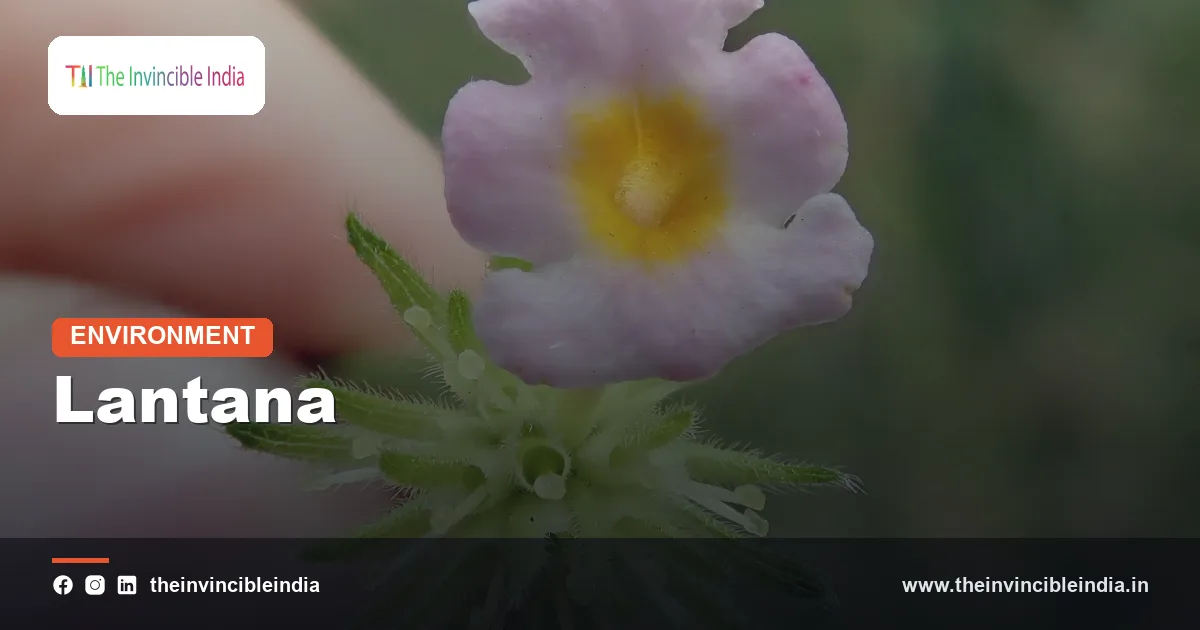
The lantana (Lantana camara) is a thorny-stemmed, multi-coloured flowering shrub native to tropical America that has become one of the most widespread invasive weeds in India, forming dense thickets across forests, grasslands, wastelands and roadsides. Lantana was brought to the subcontinent in the early nineteenth century as an ornamental garden plant, and it has since escaped cultivation and colonised millions of hectares of land.
The lantana is a plant of two reputations. Gardeners and butterflies value its long-lasting, colourful flower clusters, while foresters, wildlife managers, farmers and herders regard it as a serious ecological and economic problem. This explainer covers what lantana is, how it reached India, why it spreads so successfully, what harm and benefit it brings, and how it is managed.
Quick Facts About Lantana
| Attribute | Details |
|---|---|
| Common name | Lantana, wild sage, red sage, shrub verbena; known locally as raimuniya (Hindi belt) and unni chedi (Tamil) |
| Scientific name | Lantana camara L. |
| Family | Verbenaceae (the verbena family) |
| Origin | Tropical and subtropical Central and South America and the Caribbean |
| Arrival in India | Early nineteenth century, introduced as an ornamental and hedge plant |
| Where found in India | Almost every state, from plains and scrub to forests and Himalayan foothills up to roughly 2,000 metres |
| Flowering | Nearly year-round in warm, moist regions; heaviest after the monsoon |
| Growth form | Perennial woody shrub, usually 1 to 4 metres tall, sometimes scrambling higher over other plants |
| Impact and uses | Invasive weed that displaces native plants and poisons livestock; also a nectar plant, a source of craft material and an ornamental |
Key Takeaways
- Lantana (Lantana camara) is a flowering shrub of the verbena family that is native to tropical America and not to India.
- Lantana was introduced to India in the early nineteenth century as an ornamental plant and has since spread to almost every state.
- Lantana is on the Global Invasive Species Database list of 100 of the world’s worst invasive alien species.
- The leaves and unripe berries of lantana contain lantadenes, which can poison cattle, sheep and goats and cause liver damage and photosensitisation.
- Lantana spreads through bird-dispersed seeds and by resprouting from the roots after cutting or fire, which makes it hard to eradicate.
- Effective lantana management combines uprooting, repeated follow-up, planting of native species and community use of cut stems for crafts.
What is lantana?
Lantana is a perennial, woody shrub in the genus Lantana of the family Verbenaceae, and the species Lantana camara is the one that dominates Indian landscapes. A mature plant has square, bristly or prickly stems, opposite, rough-textured oval leaves with toothed edges, and a strong, pungent smell when the foliage is crushed.
The flowers of lantana are small, tubular and densely packed into flat-topped, rounded clusters. A single cluster often shows several colours at once, because the flowers change colour as they age. Typical combinations are yellow turning to orange and then red, or pink turning to deep magenta, and the colour change is thought to help visiting insects find the freshest, nectar-rich flowers.
After pollination, the flowers produce small, fleshy, round fruits called drupes. These are green when young and turn glossy blue-black when ripe. Each fruit holds one or two hard seeds, and a single large plant can produce thousands of fruits in a year.
Related lantana species
Several other lantanas are grown in India. Lantana montevidensis, the trailing or weeping lantana, has lilac or white flowers and a spreading habit that suits hanging baskets and ground cover. Many hybrid cultivars sold in nurseries come from Lantana camara and its relatives, and some modern cultivars are bred to set little or no seed so that they do not escape. The wild, aggressive form that infests forests is the seed-bearing, scrambling type of Lantana camara.
Where did lantana come from, and how did it reach India?
Lantana came to India from the Americas, where the genus is native from Mexico through Central America and the Caribbean to northern South America. Plant collectors and colonial-era botanical gardens carried it to Europe in the seventeenth century, and from Europe it was sent to many warm-climate colonies as a decorative shrub.
In India, lantana is generally recorded as arriving in the early nineteenth century through botanical and ornamental plantings. It was valued for its hardiness, its colour and its tolerance of poor soil, and it was used in gardens, as a hedge and in the compounds of bungalows and official buildings. The plant soon escaped from gardens, helped by birds that ate the berries and dropped the seeds far from the parent plant.
The same pattern repeated across the tropics. Lantana became established in Australia, South Africa, parts of East Africa, Southeast Asia, the Pacific islands and Hawaii, and it is now recognised as invasive on every continent except Antarctica. This worldwide record is one reason why the Global Invasive Species Database lists it among 100 of the world’s worst invasive alien species.
Why has lantana spread so widely in India?
Lantana has spread so widely in India because it combines several traits that favour invasive plants: prolific seed production, efficient bird dispersal, rapid regrowth, tolerance of fire and drought, and very few natural enemies in its new range. These traits work together, and each makes the others more effective.
Seeds carried by birds and mammals
Birds such as bulbuls, mynas and other fruit-eating species eat the ripe berries and pass the seeds in their droppings, often at perches, forest edges and along fences and wires. Some mammals, including monkeys and civets, also disperse the seeds. This gives lantana a patchy, long-distance spread that can seed a new thicket kilometres away from the nearest parent shrub.
Resprouting and fire tolerance
Lantana resprouts vigorously from the root crown after being cut, grazed, trampled or burned. Fire often thins the leaf litter and opens the ground to light, so burning can actually favour lantana over slower-growing native seedlings. In dry deciduous forests, where ground fires are common, this resprouting ability gives lantana a decisive advantage.
Disturbed ground and weak competition
Lantana thrives on disturbed land. Overgrazing, felling, forest fires, road building, abandoned farmland and the edges of plantations all create gaps in which lantana seedlings establish quickly. Once a thicket closes, the dense canopy shades out grasses and tree seedlings beneath it.
Chemical competition
Studies of lantana show that its leaves, roots and litter release chemicals that can slow the germination and growth of some other plants. This effect, called allelopathy, may add to the shading effect, although its importance in the field varies with soil and species and is still debated by researchers.
Few natural enemies
In its American home range, lantana is attacked by many specialist insects, fungi and other organisms that keep it in check. In India, most of these enemies are absent, so the plant grows with little natural control.
How much of India is affected by lantana?
Lantana is present in nearly every Indian state and in a wide range of habitats, from dry scrub and deciduous forests of central and southern India to moist forests of the Western Ghats, the Himalayan foothills and parts of the northeast. Surveys and forest assessments have reported that it occupies very large areas, and published estimates run to many millions of hectares, although exact figures differ with the method and the year of the survey.
Lantana is especially noticeable in protected areas, hill slopes, abandoned fields and along roads and railway lines. It is commonly found from sea level to about 2,000 metres in the Himalayas, and it grows best where annual rainfall is moderate to high. Very dry deserts, very cold alpine zones and dense, closed-canopy evergreen forests are less affected, because lantana needs light to establish.
Regions and habitats most affected
- Dry and moist deciduous forests: Peninsular and central India, where open canopies and frequent fires suit lantana.
- Western Ghats and Nilgiri slopes: Forest edges, plantations and degraded patches.
- Shivalik and Himalayan foothills: Sal forests and river banks in the lower hills.
- Grasslands and savannas: Where overgrazing opens the sward.
- Urban and rural wasteland: Roadsides, railway tracks, abandoned plots and ravines.
What harm does lantana do?
Lantana harms India’s ecosystems by displacing native plants, reducing the food available to grazing wildlife and livestock, altering fire behaviour and, in some places, restricting the movement of animals. These effects are well documented in forest and grassland research, although the scale varies by site.
Loss of native plants and fodder
Dense lantana thickets suppress the native herbs, grasses and tree seedlings beneath them. This lowers plant diversity and can slow natural forest regeneration. Because most Indian herbivores avoid eating lantana, the fodder available to deer, antelope, gaur and elephants in invaded areas can decline.
Effects on wildlife habitat
In some protected areas, thick lantana can make it harder for large herbivores to feed and move, which may in turn affect the prey available to carnivores such as tigers and leopards. At the same time, small birds and some small mammals use lantana for cover and nesting, so the overall effect on wildlife is mixed and depends on the species and the habitat.
Livestock poisoning and farm impact
Cattle, sheep and goats that eat lantana, particularly when other fodder is scarce, can fall ill. Lantana also invades pastures, orchards, tea and coffee estates and plantation edges, where it raises weeding costs and competes with crops.
Fire and forest management
Dry lantana stems and leaves can add to the fuel load in a forest, and dense stands can carry fire into places that would otherwise burn less intensely. Forest staff also spend money and labour clearing lantana from fire lines, roads and plantations every year.
Human health
Contact with lantana foliage can cause skin irritation in some people, and children have been poisoned by eating the berries. The plant is not a food or medicine that should be used without proper guidance.
Is lantana poisonous?
Lantana is poisonous to livestock and humans if eaten, because its leaves and unripe green berries contain pentacyclic triterpenoid compounds called lantadenes. Lantadene A and its relatives damage the liver and bile flow, and affected animals can develop jaundice and photosensitisation, in which unpigmented skin becomes sore and peels after sun exposure.
Poisoning is most often reported in cattle, buffalo, sheep and goats, especially young or newly introduced animals that have not learned to avoid the plant. Signs include loss of appetite, dullness, constipation, yellowing of the eyes and skin, and swelling or scabbing on sun-exposed areas. Veterinary treatment should be sought promptly.
Ripe blue-black berries are generally considered less toxic than green ones, and birds eat them with no visible harm. This difference between birds and mammals is one reason why the plant spreads so effectively. Even so, no part of lantana should be considered safe for people to eat.
Does lantana have any benefits or uses?
Lantana does have genuine uses, including nectar for butterflies and other pollinators, material for furniture and baskets, cover for small birds, fuel, and use as a hedge and ornamental. These benefits are real but they do not offset the damage caused by uncontrolled spread in natural habitats.
| Use | How lantana is used | Caution |
|---|---|---|
| Nectar source | The flower clusters attract many butterflies, bees and moths, including swallowtails | Supports pollinators but may draw them away from native plants |
| Craft and furniture | Cut stems are cleaned, steamed and bent to make chairs, tables, baskets and decorative items | Provides income in some communities; needs continued harvesting to matter ecologically |
| Fuel and fencing | Dry stems are used as firewood and as living or dead fences | Cutting alone does not kill the plant |
| Bird and small animal cover | Dense thickets shelter nesting birds and small mammals | Benefit is local and does not replace native habitat |
| Soil cover on bare slopes | Roots can hold loose soil on degraded ground | Better done with native shrubs and grasses |
| Research uses | Extracts are studied as possible natural insecticides and for other compounds | Toxicity limits direct use |
Community craft projects around lantana have been tried in several forest regions of India, where local people harvest the stems and make furniture and other goods. These projects link income to clearing, which gives people a reason to keep cutting the plant back. Their usefulness depends on steady markets, training and follow-up planting of native species on the cleared land.
How is lantana managed in India?
Lantana management in India relies on a mix of physical removal, restoration planting, biological control research and community use, because no single method eliminates lantana permanently. Cutting at ground level alone is rarely enough, since the plant resprouts from the root crown.
| Method | How it works | Strengths | Limits |
|---|---|---|---|
| Uprooting by hand or tools | Plants are pulled or dug out with the root crown, ideally in the rainy season when soil is soft | Most reliable for small and medium plants; avoids chemicals | Labour-intensive; seedlings return unless the site is monitored |
| Cut-root-stock method | Stems are cut and the root stock is removed or cut below the crown | Used in forest management for dense stands | Needs repeated follow-up visits |
| Fire | Burning removes the above-ground growth | Cheap and fast for clearing dry biomass | Often triggers vigorous resprouting and seed germination |
| Herbicide | Cut stumps or foliage are treated with chemicals | Effective on tough stands | Cost and environmental concerns; rarely suitable in protected areas |
| Biological control | Specialist insects from the plant’s home range attack leaves, flowers or seeds | Self-spreading and low running cost | Results in India and elsewhere have been partial and uneven |
| Restoration planting | Native trees, shrubs and grasses are planted after clearing | Shades out lantana seedlings and rebuilds habitat | Needs several years of weeding and protection |
Restoration is the key step
Ecologists emphasise that removing lantana without replacing it often fails, because the cleared ground is quickly recolonised. Where managers clear lantana and then plant or protect native trees, grasses and shrubs, the growing canopy and ground cover gradually suppress lantana seedlings. Controlled grazing, fire protection and several years of monitoring improve the outcome.
Role of forest departments and communities
State forest departments, research institutions and conservation groups have run lantana removal and restoration programmes in several Indian states. Many of these projects involve local people as workers and as craft producers, which builds support for long-term control. Programmes tend to work best when they focus on priority sites, such as grasslands, wildlife corridors and water-source areas, instead of trying to clear every hectare at once.
What are the lessons from lantana for invasive species policy?
The main lesson from lantana is that decorative plants can become costly ecological problems when introduced without assessing their invasion risk. Early detection and prevention are far cheaper than control after a species has covered millions of hectares.
The story also shows why gardeners and nurseries matter. Choosing native or sterile plants, avoiding the release of garden waste into forests and not planting known invasive species near wild habitats all reduce the chance of the next lantana. India’s biodiversity framework recognises invasive alien species as a threat to native ecosystems and has encouraged states to assess and manage them, although implementation differs between regions.
What can gardeners plant instead of lantana?
Gardeners who want colourful, pollinator-friendly shrubs can choose native or non-invasive alternatives such as hibiscus, ixora, justicia, native clerodendrum species and local wildflowers suited to the area. The best choice depends on climate, soil and the region of India, and a local nursery or botanical garden can advise on native options.
- Ixora and hibiscus: Long-flowering shrubs that attract butterflies and sunbirds in many parts of India.
- Native clerodendrum and justicia species: Provide nectar and are less likely to overrun natural habitat.
- Sterile lantana cultivars: If lantana is wanted, choose cultivars sold as seedless and never allow plants to grow near forests or wetlands.
- Local grasses and herbs: Support native insects and require little watering once established.
Bottom Line
Lantana is an attractive, hardy American shrub that became one of India’s most difficult invasive weeds after being introduced as an ornamental in the early nineteenth century. It cannot be removed by cutting alone, but a combination of uprooting, restoration of native vegetation, community craft use and careful garden choices can reduce its spread and restore habitats over time.
Frequently Asked Questions
Is lantana native to India?
No, lantana is not native to India. The common weedy species, Lantana camara, comes from tropical Central and South America and the Caribbean, and it reached India in the early nineteenth century as an ornamental plant. It then escaped cultivation and spread across the country.
Why is lantana considered an invasive weed?
Lantana is considered an invasive weed because it spreads rapidly, forms dense thickets and displaces native plants. Birds spread its seeds, it resprouts after cutting or fire, and few natural enemies control it in India. For these reasons it appears on the Global Invasive Species Database list of 100 of the world’s worst invasive alien species.
Is lantana poisonous to cattle and humans?
Yes, lantana is poisonous to cattle, sheep, goats and humans if eaten. Its leaves and unripe green berries contain lantadenes, which damage the liver and cause jaundice and photosensitisation in animals. Anyone suspecting lantana poisoning in livestock or in a child should seek veterinary or medical help immediately.
How can lantana be removed permanently?
Lantana is best removed by uprooting the whole plant, including the root crown, and then replacing it with native vegetation. Cutting stems alone usually fails because the shrub resprouts, and fire can make regrowth stronger. Follow-up weeding over several years is needed to deal with new seedlings from the soil seed bank.
Does lantana have any useful purpose?
Yes, lantana has some uses, although they do not cancel out its ecological harm. The flowers provide nectar for butterflies and bees, the stems are used to make furniture, baskets and fuel, and the shrub gives cover to small birds. Community craft schemes in some forest regions use harvested lantana to earn income while clearing the plant.
Can lantana be grown safely in a garden?
Lantana can be grown in a garden with care, but it is safer to choose sterile or non-seeding cultivars and to avoid planting it near forests, wetlands or farmland. Gardeners should remove fruits before they ripen and never dump cuttings in natural areas. Native flowering shrubs are a lower-risk alternative where the aim is to attract butterflies.
{“@context”:”https://schema.org”,”@graph”:[{“@type”:”FAQPage”,”mainEntity”:[{“@type”:”Question”,”name”:”Is lantana native to India?”,”acceptedAnswer”:{“@type”:”Answer”,”text”:”No, lantana is not native to India. The common weedy species, Lantana camara, comes from tropical Central and South America and the Caribbean, and it reached India in the early nineteenth century as an ornamental plant. It then escaped cultivation and spread across the country.”}},{“@type”:”Question”,”name”:”Why is lantana considered an invasive weed?”,”acceptedAnswer”:{“@type”:”Answer”,”text”:”Lantana is considered an invasive weed because it spreads rapidly, forms dense thickets and displaces native plants. Birds spread its seeds, it resprouts after cutting or fire, and few natural enemies control it in India. For these reasons it appears on the Global Invasive Species Database list of 100 of the world’s worst invasive alien species.”}},{“@type”:”Question”,”name”:”Is lantana poisonous to cattle and humans?”,”acceptedAnswer”:{“@type”:”Answer”,”text”:”Yes, lantana is poisonous to cattle, sheep, goats and humans if eaten. Its leaves and unripe green berries contain lantadenes, which damage the liver and cause jaundice and photosensitisation in animals. Anyone suspecting lantana poisoning in livestock or in a child should seek veterinary or medical help immediately.”}},{“@type”:”Question”,”name”:”How can lantana be removed permanently?”,”acceptedAnswer”:{“@type”:”Answer”,”text”:”Lantana is best removed by uprooting the whole plant, including the root crown, and then replacing it with native vegetation. Cutting stems alone usually fails because the shrub resprouts, and fire can make regrowth stronger. Follow-up weeding over several years is needed to deal with new seedlings from the soil seed bank.”}},{“@type”:”Question”,”name”:”Does lantana have any useful purpose?”,”acceptedAnswer”:{“@type”:”Answer”,”text”:”Yes, lantana has some uses, although they do not cancel out its ecological harm. The flowers provide nectar for butterflies and bees, the stems are used to make furniture, baskets and fuel, and the shrub gives cover to small birds. Community craft schemes in some forest regions use harvested lantana to earn income while clearing the plant.”}},{“@type”:”Question”,”name”:”Can lantana be grown safely in a garden?”,”acceptedAnswer”:{“@type”:”Answer”,”text”:”Lantana can be grown in a garden with care, but it is safer to choose sterile or non-seeding cultivars and to avoid planting it near forests, wetlands or farmland. Gardeners should remove fruits before they ripen and never dump cuttings in natural areas. Native flowering shrubs are a lower-risk alternative where the aim is to attract butterflies.”}}]}]}


