

The grass jewel (Freyeria trochylus) is a tiny brownish lycaenid butterfly, among the smallest butterflies in the world, that lives on open ground, lawns, roadsides and dry scrub across India. It is named for the bright orange-ringed, metallic-flecked spots near the tail end of the hindwing underside, which glint like small gems when the butterfly is seen from the right angle. With a wingspan of only about 1.5 cm, it is often mistaken for a moth or a speck of dust.
This article explains what the grass jewel is, why it is counted among the smallest butterflies, how to recognise it, where it lives in India, what its caterpillars eat and how it differs from other tiny blues. It is written for beginner butterfly watchers, students and gardeners who want clear, stable information.
| Common name | Grass jewel |
|---|---|
| Scientific name | Freyeria trochylus |
| Family and subfamily | Lycaenidae (gossamer-winged butterflies), subfamily Polyommatinae (the blues) |
| Wingspan | Roughly 1.2 to 2 cm, among the smallest butterflies in the world |
| Larval host plants | Low-growing herbs, with flowers, buds and developing seeds eaten; records vary by region |
| Range and habitat in India | Widespread across much of the country in lawns, wasteland, roadsides, dry scrub and open grassy ground, from the plains into the foothills |
| Flight season and broods | Flies for much of the year in warm regions, with several broods and numbers rising after the rains |
| Notable features | Tailless, grey-brown underside with white-edged bars and orange-ringed metallic spots, a low weak flight close to the ground |
Key Takeaways
- The grass jewel, scientific name Freyeria trochylus, is a lycaenid butterfly with a wingspan of only about 1.5 cm, making it one of the smallest butterflies in the world.
- The grass jewel gets its name from the orange-ringed, metallic-flecked spots on the hindwing underside, which resemble tiny jewels.
- The grass jewel is found across much of India in lawns, roadsides, wasteland and dry grassy ground, and it is common in places that look empty of butterflies.
- Grass jewel caterpillars feed on the flowers, buds and developing seeds of low-growing herbs rather than on grass, despite the butterfly’s name.
- The grass jewel flies very low and slowly, often settling on bare ground with its wings closed, and it is easiest to see by walking slowly over open patches.
- The grass jewel is not threatened in India and is a useful species for learning to notice small butterflies.
What is the grass jewel butterfly?
The grass jewel butterfly is a tiny member of the gossamer-winged butterfly family, Lycaenidae, belonging to the group of blues in the subfamily Polyommatinae. Its scientific name is Freyeria trochylus, and it is found across a wide belt of the Old World from Africa and the Mediterranean region through the Middle East and South Asia into parts of South-East Asia.
Although the family is known as the blues, the grass jewel is not blue to the casual eye. Its upperside is dark brown, sometimes with a faint bluish or violet sheen in good light, while its underside is a quiet grey-brown. The pattern that gives the species its common name is on the hindwing underside, where small black spots capped with orange and metallic scales sit near the tail end.
The grass jewel is a typical butterfly of open, disturbed ground. It does well in cities and villages because lawns, vacant plots, railway embankments and paths all supply the low herbs and bare patches it likes.
Why is the grass jewel one of the smallest butterflies in the world?
The grass jewel is counted among the smallest butterflies in the world because its wingspan is only about 1.5 cm, which is similar to a fingernail. A few other lycaenids, such as the tiny grass blue (Zizula hylax), are of comparable size, and different authors rank them slightly differently.
Small size is a feature of many lycaenids. The family contains many of the world’s smallest butterflies, and it is the second-largest butterfly family by number of species. Tiny butterflies gain several advantages: they need little food, can hide in grass and ground litter, and are easy to overlook for predators that hunt by sight.
The trade-off is that tiny butterflies are poor at long flights against wind. They stay close to the ground, where grass and herbs break the airflow, and they usually remain in small home ranges. This is why the grass jewel is often found in the same patch of waste ground day after day.
How can you identify a grass jewel?
A grass jewel can be identified by its tiny size, tailless wings, grey-brown underside with white-edged dark bars, and the orange-ringed metallic spots near the hindwing tail corner. These features together separate it from most other small butterflies on lawns and wasteland.
Upperside
The upperside is dark brown, often with a faint purplish or bluish sheen in males that is visible only when the wings are open in sunlight. The grass jewel opens its wings less often than many blues, so the upperside is hard to study.
Underside
The underside is pale grey-brown, crossed by series of dark spots and bars edged with white. On the hindwing, close to the tail end, there are small black spots ringed with orange and flecked with shiny scales. These are the “jewels” of the common name.
Shape and flight
The wings are rounded and have no tail. The flight is short, low and rather weak, usually only a few centimetres above the ground, and the butterfly drops again quickly onto a leaf, a flower or bare soil.
Where does the grass jewel live in India?
The grass jewel lives across much of India, in open, grassy and disturbed ground ranging from city lawns to dry scrub and roadsides. It is more often found in lowland and foothill areas than in dense forest, and it tends to avoid deep shade.
- Lawns, parks and playing fields with short grass and scattered herbs.
- Roadsides, railway embankments and canal banks with weedy vegetation.
- Vacant plots, wasteland and farm margins.
- Dry scrub and open grassy hillsides.
- Edges of paths in gardens, temple grounds and campuses.
Because it can live in disturbed habitats, the grass jewel does not depend on pristine forest. It tends to be recorded in places with plenty of low flowering weeds, which many gardeners remove. Leaving a corner of a garden unmown is often enough to attract it.
What does the grass jewel caterpillar eat?
The grass jewel caterpillar eats the flowers, buds and developing seeds of low-growing herbs rather than grass, despite the butterfly’s common name. The exact plants differ between regions, and observers have recorded the species on several weedy herbs of open ground.
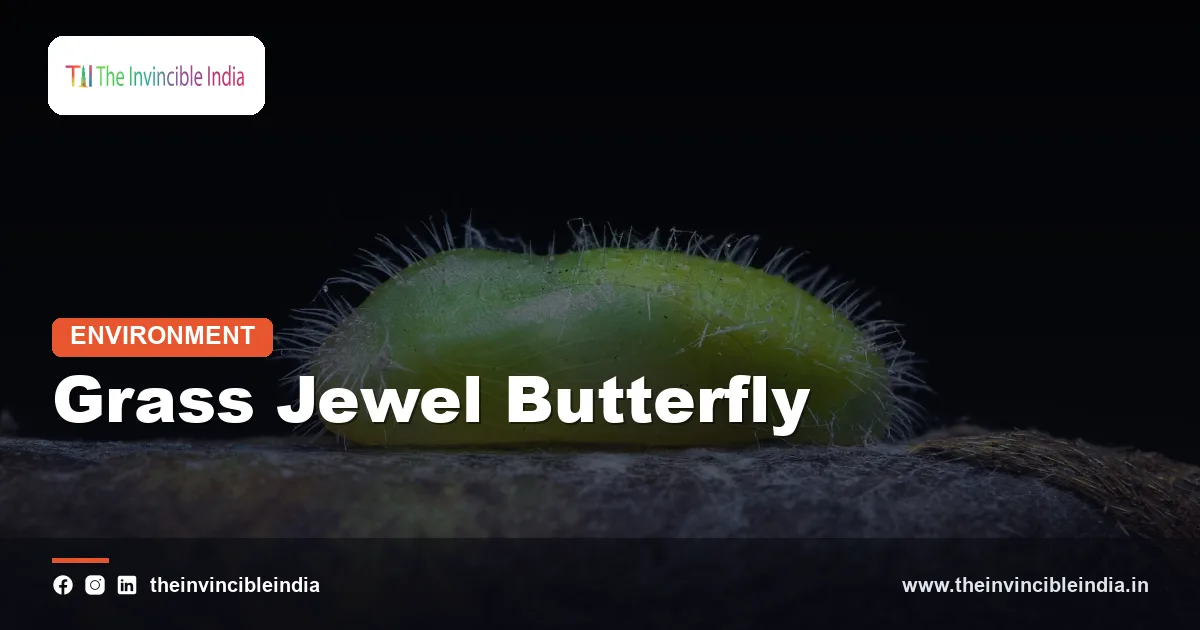
The female lays tiny eggs singly on flower buds or other tender parts of the host plant. The small, slug-shaped caterpillars feed on the reproductive parts of the plant, and their green or pinkish colour helps them blend into buds and flower heads. They are seldom noticed, and they cause no meaningful harm to crops or gardens.
Like many lycaenid caterpillars, they may be visited by ants. The strength of this relationship varies among species, and the grass jewel is less well studied than larger or more showy butterflies.
How does the grass jewel life cycle work?
The grass jewel passes through the standard four butterfly stages of egg, caterpillar, pupa and adult, and in warm regions the whole cycle can be completed in a few weeks. Several broods overlap through the year, so adults can be seen in many months.
| Stage | What happens |
|---|---|
| Egg | A tiny egg is laid on a flower bud or tender shoot of a low herb |
| Caterpillar | A small, woodlouse-shaped caterpillar eats buds, flowers and young seeds |
| Pupa | A very small pupa forms on the plant or in the litter close to it |
| Adult | The butterfly emerges, feeds on nectar from small flowers, mates and lays eggs |
Numbers tend to be highest soon after the monsoon, when weeds flower in large numbers. In drier months, the butterflies persist in damp or irrigated patches where host plants stay green.
How does the grass jewel behave?
The grass jewel behaves like a typical tiny lycaenid: it flies low, settles often, feeds at small flowers and basks on bare ground. The butterfly usually rests with its wings closed and held upright, and it may turn slowly to face the sun.
Adults feed on the nectar of small flowers close to the ground. Because of its short proboscis and small size, the grass jewel is most often found on tiny, shallow flowers, including those of common weeds.
When disturbed, the butterfly flies a short distance and lands again, often just a few steps away. Watchers who stand still for a minute will often see the butterfly come back to the same bare patch. The rubbing of the hindwings, which moves the glinting spots and false tail-end pattern, is typical of lycaenids and may draw a predator’s strike away from the head.
How is the grass jewel different from other tiny blues?
The grass jewel differs from other tiny blues mainly in its tailless wings, dark brown upperside and the orange-ringed metallic spots on its underside. Other very small butterflies share the same lawns and wasteland, so a quick comparison helps.
| Butterfly | Key difference from the grass jewel |
|---|---|
| Tiny grass blue (Zizula hylax) | Similar in size, but its underside has a row of small dark spots rather than the orange-ringed metallic ones |
| Dark grass blue (Zizeeria karsandra) | Slightly larger, with a bluer upperside in males and a spotted underside |
| Lime blue (Chilades lajus) | Larger, paler underside and a short hindwing tail |
| Pea blue (Lampides boeticus) | Much larger, with wavy lines on the underside and a thin tail |
| Eastern grass jewel (Freyeria putli) | A close relative, with a similar jewel-spotted pattern; needs careful comparison |
For a reliable identification, a photograph of the hindwing underside, taken close up with the wings closed, is usually best. The jewel-like spots are the quickest clue, though they may be hard to see unless the light is good.
How can you find and photograph a grass jewel?
You can find a grass jewel by walking slowly across open ground in warm sunshine and watching for a tiny brown butterfly rising from the grass. The best places are lawns, weedy patches, roadsides and dry scrub, especially after the rains when small flowers are in bloom.
- Look in the morning and late afternoon, when the butterflies bask and feed.
- Move slowly and avoid casting a shadow on the butterfly, which can make it fly.
- Watch the ground rather than the air, as it spends most of its time very low.
- Use a close-focus lens or a phone with macro mode to capture the hindwing spots.
- Note the date, place and flowers on which it feeds, which are useful records for citizen-science projects.
Patience matters more than equipment. The butterfly usually returns to the same spot, so waiting a minute after a disturbance often rewards the observer with a close view.
Why does the grass jewel matter?
The grass jewel matters because it shows that even tiny, unglamorous butterflies play a part in food webs and are good indicators of how much weedy, open habitat remains. It feeds on small flowers, is itself prey for spiders, lizards and birds, and its caterpillars use common herbs.
It is also useful for education. Because it lives in lawns and wasteland, school groups can see it without leaving the campus. Recording such common species over many years can show how land use, mowing and pesticide use change the insect life of a place.
Tiny butterflies like the grass jewel also remind observers that butterfly diversity is not limited to large, colourful species such as swallowtails. Many small lycaenids and skippers live unnoticed in the same gardens, and learning to see them improves a person’s overall awareness of local wildlife. A beginner who can recognise the grass jewel has usually developed the patience needed to identify other small insects as well.
Weather affects the species noticeably. On cool, cloudy or windy mornings the grass jewel stays hidden low in vegetation, and on very hot afternoons it retreats to shade. The most reliable viewing conditions are warm, bright and still, when the butterfly moves between flowers and bare ground and spends longer basking in the open.
Bottom Line
The grass jewel is a tiny, easily missed butterfly that rewards careful looking. It lives on lawns and rough ground across India, and its metallic-ringed spots explain its name. Leaving a patch of weedy ground in the garden is often all it takes to see one.
Frequently Asked Questions
What is the scientific name of the grass jewel butterfly?
The scientific name of the grass jewel butterfly is Freyeria trochylus. It belongs to the family Lycaenidae and the subfamily Polyommatinae. It is found across the Old World, including much of India.
How big is a grass jewel butterfly?
A grass jewel butterfly has a wingspan of only about 1.5 cm, which makes it one of the smallest butterflies in the world. It is similar in size to a fingernail. Its tiny size is why it is often mistaken for a moth or a speck of dust.
Why is it called the grass jewel?
It is called the grass jewel because of the orange-ringed black spots with metallic scales near the tail end of the hindwing underside, which glint like gems. The word “grass” refers to the open, grassy ground where the butterfly is usually seen. The caterpillars, however, feed on the flowers and seeds of low herbs.
Where can I see a grass jewel in India?
You can see a grass jewel on lawns, roadsides, wasteland, farm margins and dry scrub across much of India. It is most often seen close to the ground in warm sunshine. Walking slowly over open, weedy patches after the rains gives the best chance of spotting one.
What do grass jewel caterpillars eat?
Grass jewel caterpillars eat the flowers, buds and developing seeds of low-growing herbs. They do not feed mainly on grass, despite the butterfly’s name. The exact plants vary by region, and the caterpillars are small and rarely noticed.
Is the grass jewel butterfly rare?
No, the grass jewel is not rare in India and is not considered threatened. It is simply small and easy to overlook. It lives in common habitats such as lawns, roadsides and dry scrub, so it can often be found in towns and villages.
{“@context”:”https://schema.org”,”@graph”:[{“@type”:”FAQPage”,”mainEntity”:[{“@type”:”Question”,”name”:”What is the scientific name of the grass jewel butterfly?”,”acceptedAnswer”:{“@type”:”Answer”,”text”:”The scientific name of the grass jewel butterfly is Freyeria trochylus. It belongs to the family Lycaenidae and the subfamily Polyommatinae. It is found across the Old World, including much of India.”}},{“@type”:”Question”,”name”:”How big is a grass jewel butterfly?”,”acceptedAnswer”:{“@type”:”Answer”,”text”:”A grass jewel butterfly has a wingspan of only about 1.5 cm, which makes it one of the smallest butterflies in the world. It is similar in size to a fingernail. Its tiny size is why it is often mistaken for a moth or a speck of dust.”}},{“@type”:”Question”,”name”:”Why is it called the grass jewel?”,”acceptedAnswer”:{“@type”:”Answer”,”text”:”It is called the grass jewel because of the orange-ringed black spots with metallic scales near the tail end of the hindwing underside, which glint like gems. The word “grass” refers to the open, grassy ground where the butterfly is usually seen. The caterpillars, however, feed on the flowers and seeds of low herbs.”}},{“@type”:”Question”,”name”:”Where can I see a grass jewel in India?”,”acceptedAnswer”:{“@type”:”Answer”,”text”:”You can see a grass jewel on lawns, roadsides, wasteland, farm margins and dry scrub across much of India. It is most often seen close to the ground in warm sunshine. Walking slowly over open, weedy patches after the rains gives the best chance of spotting one.”}},{“@type”:”Question”,”name”:”What do grass jewel caterpillars eat?”,”acceptedAnswer”:{“@type”:”Answer”,”text”:”Grass jewel caterpillars eat the flowers, buds and developing seeds of low-growing herbs. They do not feed mainly on grass, despite the butterfly’s name. The exact plants vary by region, and the caterpillars are small and rarely noticed.”}},{“@type”:”Question”,”name”:”Is the grass jewel butterfly rare?”,”acceptedAnswer”:{“@type”:”Answer”,”text”:”No, the grass jewel is not rare in India and is not considered threatened. It is simply small and easy to overlook. It lives in common habitats such as lawns, roadsides and dry scrub, so it can often be found in towns and villages.”}}]}]}


