

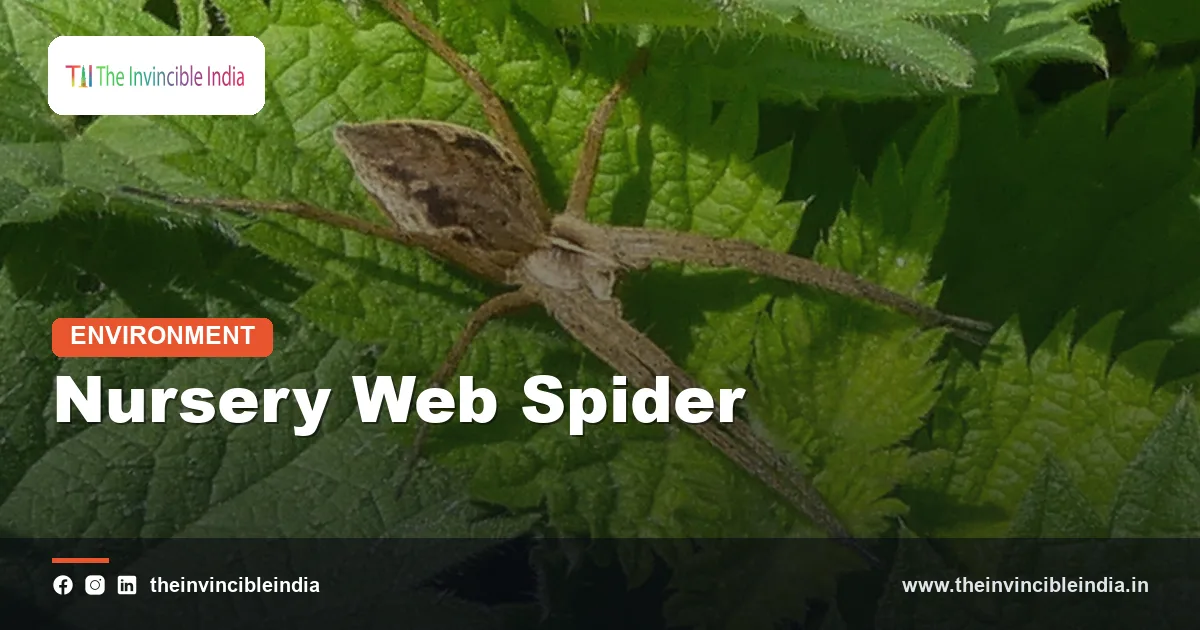
A nursery web spider is a long-legged hunting spider of the family Pisauridae in which the female carries her egg sac in her jaws and then builds a silk “nursery” tent among leaves to guard the sac and the newly hatched spiderlings. The nursery web spider does not trap prey in a web; it hunts on foliage, grass and the edges of water, and it uses silk mainly for the nursery, for egg sacs and for safety lines.
Spiders of this family occur in gardens, scrub, grassland, wetlands and forests across India, where they are quiet, useful predators of insects. This article explains what a nursery web spider is, how to recognise one, how the mother protects her young, how the life cycle works, and how it differs from similar spiders such as the wolf spider.
Quick Facts
| Attribute | Details |
|---|---|
| Common name | Nursery web spider |
| Scientific group | Family Pisauridae; order Araneae; class Arachnida |
| Size | Roughly 1 to 3 cm in body length, with long legs that extend the overall span much further |
| Habitat in India | Gardens, grass, shrubs, forest undergrowth, paddy fields, ponds and stream banks |
| Diet | Insects and other small invertebrates; larger species also take tadpoles and small fish near water |
| Hunting style | Active hunter or ambusher that does not use a web to catch prey |
| Life cycle | Egg sac carried by the mother, nursery tent, spiderlings, repeated moults, adult |
| Role | Natural predator that keeps garden and crop insect numbers in check |
Key Takeaways
- A nursery web spider is a member of the family Pisauridae and is named for the silk nursery tent that the female builds for her eggs and spiderlings.
- The female nursery web spider carries her round egg sac in her jaws (chelicerae) and pedipalps rather than attaching it to her spinnerets.
- The nursery web spider hunts by sight and vibration on plants and at the water’s edge, and it does not catch prey in a capture web.
- Males of some nursery web spider species offer the female a silk-wrapped prey item as a nuptial gift before mating.
- Nursery web spiders are not dangerous to people, and their bite, if it happens at all, is usually mild.
- Nursery web spiders reduce insect pests in gardens and fields, and this role is a good reason to leave them undisturbed.
What is a nursery web spider?
A nursery web spider is a spider of the family Pisauridae, a group of long-legged, free-ranging hunters found on every continent except Antarctica. The family contains several hundred species placed in dozens of genera, and it is closely related to the wolf spiders and lynx spiders.
The name comes from the mother’s behaviour. Shortly before the eggs hatch, she spins a tent-like mesh of silk in vegetation, places the egg sac inside and stays on guard nearby. This tent is the “nursery web”. It is not a prey-catching trap, and it is quite different from the orb webs of garden spiders or the funnel webs of grass spiders.
In India, genera such as Dolomedes, Perenethis, Hygropoda, Thalassius, Nilus and Euprosthenops belong to this family. The Indian pisaurid fauna has been described mainly in taxonomic papers, and the exact list of species continues to be updated.
How can you identify a nursery web spider?
A nursery web spider can be identified by its slender body, long spiny legs, mottled brown or grey colouring and its habit of resting with the front legs stretched forward on a leaf or twig. When a female carries her egg sac, the pale ball held beneath her jaws is a clear sign.
Typical identification features include the following.
- Body shape: A fairly elongated abdomen that tapers behind, and a carapace often marked with a lighter central stripe.
- Legs: Long, thin and spiny, with the first two or three pairs held forward and slightly apart while resting.
- Eyes: Eight eyes arranged in two fairly even rows, unlike the three-row pattern of wolf spiders.
- Colour: Camouflaged in brown, grey, tan or olive, sometimes with pale or white side stripes.
- Behaviour: Runs quickly when disturbed, and many species can walk on the surface of water.
Colour and pattern vary from one species to another, so careful identification needs a close look at the eyes and the genitalia of the adult, usually under magnification. For garden purposes, recognising the family by its posture and the carried egg sac is sufficient.
Where does a nursery web spider live in India?
A nursery web spider lives on low vegetation, grass, shrubs and tree trunks, and many species stay close to ponds, streams, marshes and paddy fields. The family is widespread across India, from the Western Ghats and the north-eastern states to the Himalayan foothills and the plains.
The habitat depends on the species. Some forest species rest on large leaves in damp undergrowth, while others live in tall grass and agricultural land. Members of the genera Dolomedes and Thalassius are semi-aquatic, standing on a plant or rock at the water’s edge and sensing ripples from prey. In the monsoon, when moisture and insect populations rise, these spiders are more often seen.
A nursery web spider does not need a fixed home. During the day it may hide in curled leaves, under bark or inside dense foliage, and it moves to a new spot as it follows prey. For this reason, a garden with a variety of plants and some leaf litter tends to support more of them.
How does a nursery web spider hunt without a web?
A nursery web spider hunts by waiting or stalking on plants and ground, detecting prey with its eyes and the vibration sensors on its legs, and then pouncing and biting. It does not rely on a web to snare insects.
The prey list includes flies, moths, beetles, grasshoppers, leafhoppers, small bugs and other spiders. Larger water-edge species can capture tadpoles, small fish and aquatic insects. After the bite, venom immobilises the prey, and digestive fluids liquefy the soft tissues, which the spider then sucks up.
The hunting style has three typical elements:
- Waiting posture: The spider remains still, often with its front legs raised, and responds to the movement of insects.
- Sudden pounce: It rushes forward over a short distance and seizes the prey with its front legs.
- Safety line: It trails a thin silk dragline behind it, which allows it to climb back or to drop from a leaf if threatened.
How does a nursery web spider care for its eggs?
A nursery web spider cares for its eggs by carrying the egg sac in her chelicerae and pedipalps until just before hatching, then hanging it inside a silk tent and guarding it. This is an unusual level of parental care among spiders.
After mating, the female produces a round, silk-wrapped sac holding dozens to a few hundred eggs, depending on the species and the size of the female. She cannot feed easily while carrying it, and she may go without food for days. She also tends to bask in the sun, which may help the eggs to develop.
When hatching is near, she attaches the sac to a leaf or stem, then weaves a loose tent of silk around it and often bends or binds leaves into a protective shelter. She stays close by, repelling small intruders. The tiny spiderlings emerge, remain together in the tent for a short time, and then scatter. The nursery tent is abandoned afterwards.
What is the life cycle of a nursery web spider?
The life cycle of a nursery web spider runs from egg to spiderling to adult, with the young growing through a series of moults, and most species live for about a year or two. Spiders do not go through a larval or pupal stage, so the young look like small versions of the adult.
| Stage | What happens |
|---|---|
| Courtship and mating | The male approaches the female, in some species with a gift of wrapped prey, and mates after a signalling display. |
| Egg sac | The female makes a spherical silk sac and carries it in her jaws for a few weeks. |
| Nursery tent | She builds a silk tent in vegetation, hangs the sac in it and stands guard. |
| Spiderlings | Dozens to hundreds of tiny spiderlings hatch, stay briefly in the tent and then disperse. |
| Juveniles | The young hunt small prey and moult several times as they grow. |
| Adult | After the final moult, the spider matures and is ready to breed. |
Dispersal may involve walking away or drifting on silk threads, a behaviour called ballooning, used by many young spiders. Mortality among spiderlings is high because of predation by birds, lizards, ants and other spiders.
How does courtship work in a nursery web spider?
Courtship in a nursery web spider often involves a male offering the female a silk-wrapped prey item as a nuptial gift, which can reduce the chance that she attacks him. This behaviour is well documented in several pisaurid species, although it is not universal across the family.
The male catches an insect, wraps it in silk and presents it to the female. While she is busy with the gift, the male can approach and mate. Studies of pisaurid spiders have also described males that offer a worthless gift such as a wrapped plant fragment or an empty prey husk, and males that feign death. These cases show how strongly the risk of being eaten shapes courtship in spiders, where females are often larger than males.
It should be noted that courtship details have been recorded most thoroughly in a few well-studied species. Behaviour in many Indian species is less documented, and observations from field naturalists continue to add to the record.
How is a nursery web spider different from a wolf spider?
A nursery web spider differs from a wolf spider mainly in how the mother carries the egg sac: a nursery web spider holds the sac in her jaws, while a wolf spider drags it attached to her spinnerets. The two families look similar, so these differences help in telling them apart.
| Feature | Nursery web spider | Wolf spider |
|---|---|---|
| Family | Pisauridae | Lycosidae |
| Egg sac | Carried in the jaws and pedipalps | Attached to the spinnerets at the rear |
| Nursery | Builds a silk nursery tent for the sac and young | No tent; carries the spiderlings on her back |
| Eye pattern | Two rows of eyes | Three rows, with two large forward-facing eyes in the middle row |
| Body build | Slender, with long legs | Sturdier, with shorter legs |
| Typical habitat | Vegetation and water’s edge | Ground, leaf litter and soil burrows |
Fishing spiders of the genus Dolomedes are also Pisauridae, so they belong to the same family. They are larger, more water-oriented relatives that behave in much the same way.
Is a nursery web spider dangerous to humans?
No, a nursery web spider is not dangerous to humans, and it rarely bites. Its venom is adapted to subdue small insects, and no Indian pisaurid is known to cause serious illness in people.
If a bite does occur, usually because the spider is pressed against the skin, it may cause brief local pain, redness or itching, similar to a mild insect sting. Washing the area and applying a cold pack is generally enough. Medical advice should be taken only if swelling is severe or if a person shows signs of an allergic reaction.
The spiders are more likely to flee or drop on a silk line than to attack. A female guarding her nursery tent may stand her ground and raise her legs, but she is far more likely to retreat if a person approaches. Handling the spider or its nursery tent is neither needed nor advisable.
Why is the nursery web spider useful in gardens and crops?
The nursery web spider is useful because it preys on a wide range of insects, including several that damage garden plants and field crops, and it therefore acts as a natural form of pest control. Spiders as a group are among the most important predators of insects in farmland.
In a vegetable patch or a paddy field, a nursery web spider can capture planthoppers, leafhoppers, moths, flies and small beetles. Because the spider is active across a season and takes whatever prey is available, it adds to the combined pressure of beetles, birds, frogs and parasitic wasps that keeps pest numbers down.
Gardeners and farmers can support spiders in simple ways:
- Avoid broad-spectrum insecticides, which kill spiders as well as pests.
- Leave patches of tall grass, hedgerows and leaf litter as shelter.
- Keep a mix of plants in the garden to hold varied prey.
- Avoid destroying silk-bound leaf bundles in the monsoon, since these may contain egg sacs.
Bottom Line
The nursery web spider is a slender, long-legged hunting spider of the family Pisauridae, known for carrying its egg sac in its jaws and building a silk nursery for its young. It is harmless to people, useful to gardens and farms, and a good example of parental care in the spider world.
Frequently Asked Questions
What is a nursery web spider?
A nursery web spider is a long-legged hunting spider of the family Pisauridae. The female carries her egg sac in her jaws and builds a silk nursery tent for the eggs and spiderlings. It hunts on plants and at the water’s edge and does not catch prey in a web.
Why is it called a nursery web spider?
It is called a nursery web spider because the mother spins a tent-like web in vegetation to shelter her egg sac and newly hatched young. The web serves as a nursery, not as a trap. She guards the tent until the spiderlings scatter.
Is the nursery web spider poisonous?
The nursery web spider has venom, but it is not harmful to humans in any serious way. The venom is meant for small insect prey, and bites to people are rare and mild. Local pain or itching may occur, and it usually settles quickly.
How does a nursery web spider carry its eggs?
A nursery web spider carries its eggs in a round silk sac held under the mother’s jaws, supported by her pedipalps. She walks with the sac for a few weeks without feeding much. Before the eggs hatch, she hangs the sac in a silk tent and guards it.
What does a nursery web spider eat?
A nursery web spider eats mainly insects such as flies, moths, grasshoppers, leafhoppers and small beetles. It also eats other spiders and small invertebrates. Larger species living near water may take tadpoles and small fish.
Is a nursery web spider the same as a wolf spider?
No, a nursery web spider is not a wolf spider, although the two look alike. A nursery web spider belongs to the family Pisauridae and carries its egg sac in its jaws, while a wolf spider belongs to Lycosidae and drags the sac on its spinnerets. The eye arrangement also differs between the two families.
{“@context”:”https://schema.org”,”@graph”:[{“@type”:”FAQPage”,”mainEntity”:[{“@type”:”Question”,”name”:”What is a nursery web spider?”,”acceptedAnswer”:{“@type”:”Answer”,”text”:”A nursery web spider is a long-legged hunting spider of the family Pisauridae. The female carries her egg sac in her jaws and builds a silk nursery tent for the eggs and spiderlings. It hunts on plants and at the water’s edge and does not catch prey in a web.”}},{“@type”:”Question”,”name”:”Why is it called a nursery web spider?”,”acceptedAnswer”:{“@type”:”Answer”,”text”:”It is called a nursery web spider because the mother spins a tent-like web in vegetation to shelter her egg sac and newly hatched young. The web serves as a nursery, not as a trap. She guards the tent until the spiderlings scatter.”}},{“@type”:”Question”,”name”:”Is the nursery web spider poisonous?”,”acceptedAnswer”:{“@type”:”Answer”,”text”:”The nursery web spider has venom, but it is not harmful to humans in any serious way. The venom is meant for small insect prey, and bites to people are rare and mild. Local pain or itching may occur, and it usually settles quickly.”}},{“@type”:”Question”,”name”:”How does a nursery web spider carry its eggs?”,”acceptedAnswer”:{“@type”:”Answer”,”text”:”A nursery web spider carries its eggs in a round silk sac held under the mother’s jaws, supported by her pedipalps. She walks with the sac for a few weeks without feeding much. Before the eggs hatch, she hangs the sac in a silk tent and guards it.”}},{“@type”:”Question”,”name”:”What does a nursery web spider eat?”,”acceptedAnswer”:{“@type”:”Answer”,”text”:”A nursery web spider eats mainly insects such as flies, moths, grasshoppers, leafhoppers and small beetles. It also eats other spiders and small invertebrates. Larger species living near water may take tadpoles and small fish.”}},{“@type”:”Question”,”name”:”Is a nursery web spider the same as a wolf spider?”,”acceptedAnswer”:{“@type”:”Answer”,”text”:”No, a nursery web spider is not a wolf spider, although the two look alike. A nursery web spider belongs to the family Pisauridae and carries its egg sac in its jaws, while a wolf spider belongs to Lycosidae and drags the sac on its spinnerets. The eye arrangement also differs between the two families.”}}]}]}


