

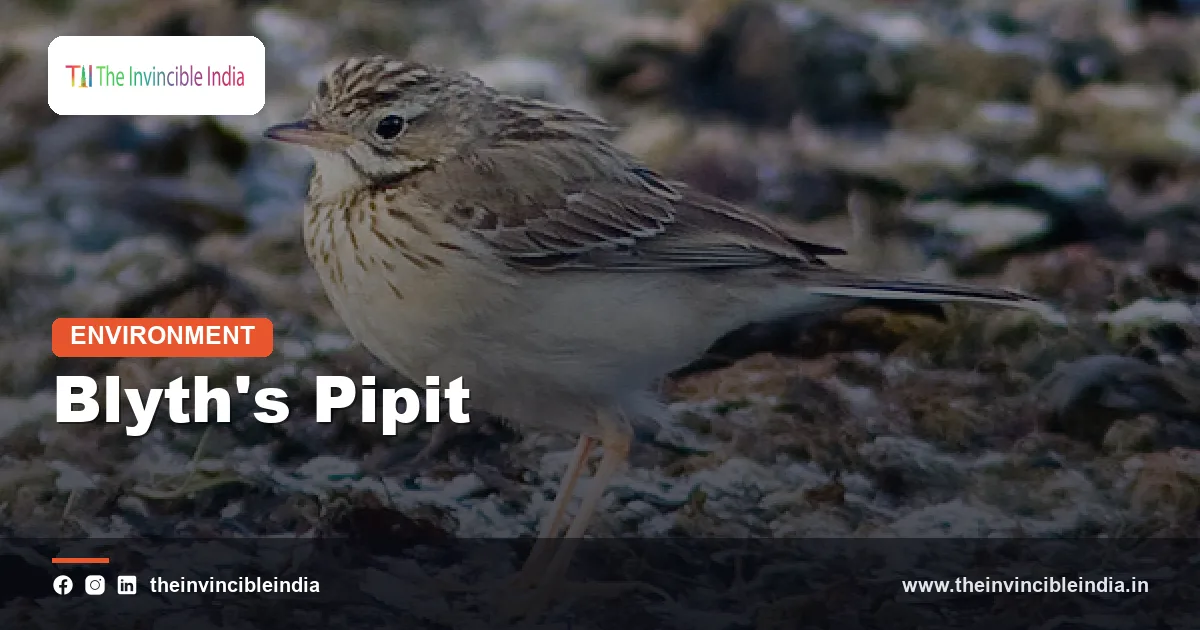
Blyth’s pipit (Anthus godlewskii) is a streaky, ground-walking songbird that breeds in Mongolia, southern Siberia and north-eastern China and spends the winter across open country in India, especially in dry grassland, stubble fields and the edges of wetlands. It is one of the several brown, streaked pipits that visit the subcontinent in the cold season, and it is famous among birdwatchers because it looks so much like the larger Richard’s pipit and the resident paddyfield pipit.
This guide explains what Blyth’s pipit is, how to recognise it, where and when it appears in India, what it eats, how it differs from similar pipits and why identification of the species has been a subject of careful study. It also explains how the bird is linked to the future of India’s open grassland habitats. Last updated: 30 October 2026.
| Attribute | Detail |
|---|---|
| Common name | Blyth’s pipit |
| Scientific name | Anthus godlewskii |
| Family | Motacillidae (pipits and wagtails) |
| Approximate length | About 16 to 17 cm |
| Status in India | Winter visitor, widespread in open country, especially peninsular and central India |
| Breeding range | Mongolia, southern Siberia (Transbaikalia) and north-eastern China |
| Typical habitat in India | Short grassland, stubble, fallow land, dry wetland margins |
| IUCN Red List category | Least Concern (global assessment) |
Key Takeaways
- Blyth’s pipit is a medium-small, streaky brown pipit that breeds in Mongolia, southern Siberia and north-eastern China and winters mainly in India and Sri Lanka.
- Blyth’s pipit is separated from the very similar Richard’s pipit by its shorter bill, shorter tail, more compact build and shorter hind claw.
- A key field mark of Blyth’s pipit is a dark-centred median covert with a sharply defined pale tip, which creates a neat bar on the folded wing.
- Blyth’s pipit feeds on the ground, eating insects, other small invertebrates and seeds picked up while walking through short grass and stubble.
- Blyth’s pipit is named after the English zoologist Edward Blyth, who worked in India, while the scientific name godlewskii honours the Polish naturalist Wiktor Godlewski.
- Blyth’s pipit is classified as Least Concern by the IUCN, but its winter habitat of open grassland and farmland is under steady pressure in India.
What is Blyth’s pipit?
Blyth’s pipit is a migratory pipit, a small insect-eating songbird of the family Motacillidae, which also includes the wagtails. Pipits are slender, long-legged birds that walk rather than hop and typically wag or bob their tails as they move across open ground.
The species was described in the nineteenth century from specimens collected in southern Siberia. Its English name commemorates Edward Blyth (1810-1873), a naturalist who served as curator of the museum of the Asiatic Society of Bengal in Calcutta and who made major contributions to the study of Indian birds and mammals. The scientific species name godlewskii recalls Wiktor Godlewski, a Polish naturalist who collected in Siberia.
For many years Blyth’s pipit was treated as a form of Richard’s pipit or confused with it. It was recognised as a distinct species after careful comparison of plumage, structure and voice. Even now it is one of the identification challenges for experienced observers in India, and many records rely on photographs and sound recordings.
How can you identify Blyth’s pipit?
Blyth’s pipit is identified by its streaked brown upperparts, a pale buff underside with streaks on the breast, a stout pinkish-yellow bill and, above all, by the dark-centred median coverts with sharply cut pale tips. Compared with Richard’s pipit, Blyth’s pipit looks smaller, more compact and shorter-tailed.
Observers use a combination of features:
- Wing pattern: The median coverts have dark, wedge-shaped or squarish centres and abrupt pale buff-white tips, forming a clean row of marks across the wing.
- Bill: The bill is relatively short and stubby, with a pale lower mandible, and appears less long and tapered than that of Richard’s pipit.
- Hind claw: The hind claw is short and gently curved, shorter than the claw of Richard’s pipit, though this is hard to see in the field.
- Face and head: The face is plain with a pale supercilium and a darker eye-stripe, and the head can look round and neckless.
- Breast streaking: Streaks on the breast are usually clear and more concentrated at the sides, often forming a dark necklace-like band.
- Posture and gait: Blyth’s pipit often stands with a slightly more horizontal body and walks with a crouching, deliberate gait.
The call is a useful clue. Blyth’s pipit often gives a sparrow-like “chip” or “tchup” note, which is generally shorter and less rasping than the explosive, drawn-out “shreep” of Richard’s pipit. Recording the call can help confirm identification.
Where does Blyth’s pipit live in India?
Blyth’s pipit winters across much of peninsular and central India and also occurs in parts of the north, favouring open dry grassland, stubble fields, fallow land and the margins of wetlands rather than forest. It is typically found in short vegetation where it can walk easily and see approaching danger.
The species is regularly reported from states such as Maharashtra, Karnataka, Tamil Nadu, Andhra Pradesh, Gujarat and Rajasthan, as well as from parts of eastern India. In Sri Lanka and southern India it is a regular winter visitor. Habitats used include:
- Grazed grassland and savannah-like scrub
- Harvested rice and wheat fields and fallow land
- Dry edges of tanks, ponds and reservoirs
- Airfield and roadside verges with short grass
- Coastal plains and open scrub
Birds are often found singly or in loose groups, and they may defend small feeding territories, particularly in good habitat. They tend to avoid tall, dense grass and wet marsh, which suit other pipits better.
When does Blyth’s pipit visit India?
Blyth’s pipit visits India in the cold season, arriving from about September to October and leaving by around April as the birds return to their breeding grounds in Central and East Asia. Individual arrival dates depend on weather and distance travelled.
The species undertakes a long migration, crossing the Himalayan region or its flanks and then spreading south across the subcontinent. The Indian wintering population is thought to be substantial, though exact numbers are not well known. Because of the difficulty of identification, early counts may have underestimated how common the bird is.
| Period | What Blyth’s pipit is doing |
|---|---|
| September to October | Arrival in India after the monsoon, as grass seeds ripen and insects are abundant |
| November to February | Settled wintering on open ground, feeding steadily |
| March to April | Departure north; some birds may sing or show breeding-type behaviour before leaving |
| May to August | Absent from India; breeding on grassland and steppe in Mongolia, Siberia and north-eastern China |
What does Blyth’s pipit eat?
Blyth’s pipit eats mainly insects and other small invertebrates, supplemented by seeds, all gathered from the ground or from low vegetation. This diet makes it a useful natural controller of insects in grassland and farmland.
The bird walks steadily through short grass, stopping to seize beetles, grasshoppers, ants, small flies, caterpillars and spiders. It may run a few steps to catch moving prey or leap briefly to snatch a flying insect. In cooler months, insects become less active and the proportion of seeds in the diet can rise. The short, slender-tipped bill is suited to picking small items from the soil surface.
Feeding is concentrated in the morning and late afternoon, with rest in the heat of the day. Birds may drink at shallow water and bathe in puddles or damp ground. Rich feeding sites include recently cut or ploughed fields and the fringes of drying wetlands, where insects and seeds are concentrated.
How does Blyth’s pipit behave?
Blyth’s pipit behaves as a wary, solitary or loosely social ground bird that walks, pauses, bobs its tail and flies up with a call when approached. When flushed, it often flies a short distance, circles and lands again, sometimes perching briefly on a fence, bush or termite mound.
Notable aspects of behaviour include:
- Tail wagging: The tail is moved up and down in a slow, deliberate way, a typical pipit habit.
- Upright alertness: The bird stretches its neck and stands tall to survey the surroundings.
- Short escape flights: Birds rise with a call, undulate in flight and drop back into cover.
- Territoriality in winter: Individuals often defend a small patch of good foraging ground against others of their kind.
- Song: On the breeding grounds, males perform a song-flight in which they rise, sing a repeated series of notes and parachute down. Some singing occurs in India shortly before departure.
The bird relies on its streaked plumage to blend into dry grass. It is preyed on by raptors, shrikes, cats and other predators.
How is Blyth’s pipit different from similar pipits?
Blyth’s pipit differs from similar pipits mainly in size, structure, wing pattern and voice: it is smaller and more compact than Richard’s pipit, bulkier and more heavily streaked than the paddyfield pipit and more streaked on the breast than adult tawny pipit. The differences are subtle, and experienced observers use several features together.
| Species | How it compares with Blyth’s pipit |
|---|---|
| Richard’s pipit | Larger and longer-legged, longer tail, longer bill and hind claw, more upright stance, loud rasping call |
| Paddyfield pipit | Slimmer, smaller and more uniform; resident across India, with a thinner bill and plainer wing coverts |
| Tawny pipit | Plainer sandy plumage with weak or no breast streaking in adults and a sharper, more slender look |
| Long-billed pipit | Larger and more uniform brown with a long bill; found in rocky hill country |
Because of these similarities, birdwatchers photograph the wing coverts, bill and hind claw and record the call. Online identification forums and regional checklists can help confirm unusual records.
Where does Blyth’s pipit breed?
Blyth’s pipit breeds in open grassland, steppe and meadow habitats in Mongolia, southern Siberia (especially Transbaikalia) and north-eastern China, far from India. The Indian birds therefore do not raise young in the country.
On the breeding grounds, the nest is a cup of grass built on the ground, usually concealed beneath a tussock of grass or a small plant. The female lays a clutch of speckled eggs, and both parents feed the young on insects. Males sing from the ground, from low perches or in flight to advertise their territories. After breeding, birds fatten and begin their long journey south, passing through Central Asia and the Himalayan region before reaching the Indian subcontinent.
The breeding range is remote and less studied than that of many European or North American birds, which is one reason why details about breeding success and population trends of Blyth’s pipit remain limited.
Is Blyth’s pipit threatened?
Blyth’s pipit is not globally threatened and is listed as Least Concern by the International Union for Conservation of Nature (IUCN), given its large range and apparently stable numbers. However, its winter habitats in India are subject to continued change.
Relevant pressures include:
- Grassland loss: Conversion of pasture and open scrub to cultivation, plantations or industrial use removes feeding ground.
- Intensive agriculture: Heavy pesticide use reduces insect prey, and uniform cropping removes field margins.
- Wetland drying and degradation: Many village tanks and ponds have been filled, polluted or built over.
- Overgrazing and burning: Excess grazing or frequent burning can degrade grass structure.
- Infrastructure development: Roads, buildings and energy projects fragment open habitats.
Since the bird uses common open habitats, it does not currently require species-specific protection, but it benefits from wider measures that conserve grasslands, commons and wetlands.
Why does Blyth’s pipit matter for birdwatching and science?
Blyth’s pipit matters because it is a model case of how careful field observation, photography and sound recording have resolved confusion among look-alike migrants, and because it shows how much remains to be learned about Asia’s grassland birds. It also gives winter birdwatchers in India a rewarding identification challenge.
The growth of digital photography and citizen-science platforms has produced thousands of new records of pipits in India. These data help clarify distribution, arrival and departure dates and habitat use. They also demonstrate how amateur observers contribute to science. Researchers use such data to map migration routes and to understand how climate and land-use change might alter the timing of migration.
For India, with its enormous variety of grassland and scrub, pipits and larks represent an under-appreciated component of biodiversity that depends on habitats often misclassified as wasteland.
How can you watch Blyth’s pipit in India?
The best way to watch Blyth’s pipit in India is to search short grassland, stubble fields and dry wetland margins between October and March in the morning or late afternoon, scanning for streaky pipits walking on the ground. Patience and good photographs are essential.
Practical suggestions include:
- Approach slowly, ideally from a vehicle, and keep a respectful distance.
- Photograph the bird from several angles, capturing the wing coverts, bill, legs and breast streaking.
- Record the call if possible, using a phone or recorder.
- Compare the bird with resident paddyfield pipits nearby to judge size and structure.
- Note habitat, location and date, and submit records to a citizen-science platform for review.
- Do not use playback excessively, as it can stress wintering birds.
Open grasslands, airfield edges and rural wetlands in Maharashtra, Karnataka, Tamil Nadu, Gujarat and Rajasthan are productive areas to try.
Bottom Line
Blyth’s pipit is a long-distance migrant that turns India’s winter grasslands and stubble into a feeding ground, and its close resemblance to other pipits makes it a favourite puzzle for birdwatchers. Protecting open grassland, field margins and village wetlands helps secure the habitat on which this and many other migrants depend.
Frequently Asked Questions
Is Blyth’s pipit a resident bird in India?
No, Blyth’s pipit is a winter visitor to India. It breeds in Mongolia, southern Siberia and north-eastern China and arrives in India from about September to October, leaving by around April.
How do you tell Blyth’s pipit from Richard’s pipit?
Blyth’s pipit is smaller and more compact, with a shorter bill, shorter tail and shorter hind claw than Richard’s pipit. It also has dark-centred median coverts with sharply defined pale tips and gives a shorter, less rasping call.
Where can I see Blyth’s pipit in India?
Blyth’s pipit can be seen on short grassland, stubble fields, fallow land and dry wetland margins across peninsular, central and western India. Maharashtra, Karnataka, Tamil Nadu, Gujarat and Rajasthan are among the regions where it is regularly reported in winter.
What does Blyth’s pipit eat?
Blyth’s pipit eats mainly insects and other small invertebrates, along with some seeds. It collects food by walking across open ground and picking items from the soil and low vegetation.
Who was Blyth’s pipit named after?
The common name honours Edward Blyth, a nineteenth-century English zoologist who curated the museum of the Asiatic Society of Bengal. The scientific name godlewskii honours the Polish naturalist Wiktor Godlewski.
Is Blyth’s pipit endangered?
No, Blyth’s pipit is classified as Least Concern by the IUCN because of its large range and population. Its wintering habitats of open grassland and farmland in India are nevertheless affected by land-use change.
{“@context”:”https://schema.org”,”@graph”:[{“@type”:”FAQPage”,”mainEntity”:[{“@type”:”Question”,”name”:”Is Blyth’s pipit a resident bird in India?”,”acceptedAnswer”:{“@type”:”Answer”,”text”:”No, Blyth’s pipit is a winter visitor to India. It breeds in Mongolia, southern Siberia and north-eastern China and arrives in India from about September to October, leaving by around April.”}},{“@type”:”Question”,”name”:”How do you tell Blyth’s pipit from Richard’s pipit?”,”acceptedAnswer”:{“@type”:”Answer”,”text”:”Blyth’s pipit is smaller and more compact, with a shorter bill, shorter tail and shorter hind claw than Richard’s pipit. It also has dark-centred median coverts with sharply defined pale tips and gives a shorter, less rasping call.”}},{“@type”:”Question”,”name”:”Where can I see Blyth’s pipit in India?”,”acceptedAnswer”:{“@type”:”Answer”,”text”:”Blyth’s pipit can be seen on short grassland, stubble fields, fallow land and dry wetland margins across peninsular, central and western India. Maharashtra, Karnataka, Tamil Nadu, Gujarat and Rajasthan are among the regions where it is regularly reported in winter.”}},{“@type”:”Question”,”name”:”What does Blyth’s pipit eat?”,”acceptedAnswer”:{“@type”:”Answer”,”text”:”Blyth’s pipit eats mainly insects and other small invertebrates, along with some seeds. It collects food by walking across open ground and picking items from the soil and low vegetation.”}},{“@type”:”Question”,”name”:”Who was Blyth’s pipit named after?”,”acceptedAnswer”:{“@type”:”Answer”,”text”:”The common name honours Edward Blyth, a nineteenth-century English zoologist who curated the museum of the Asiatic Society of Bengal. The scientific name godlewskii honours the Polish naturalist Wiktor Godlewski.”}},{“@type”:”Question”,”name”:”Is Blyth’s pipit endangered?”,”acceptedAnswer”:{“@type”:”Answer”,”text”:”No, Blyth’s pipit is classified as Least Concern by the IUCN because of its large range and population. Its wintering habitats of open grassland and farmland in India are nevertheless affected by land-use change.”}}]}]}


