

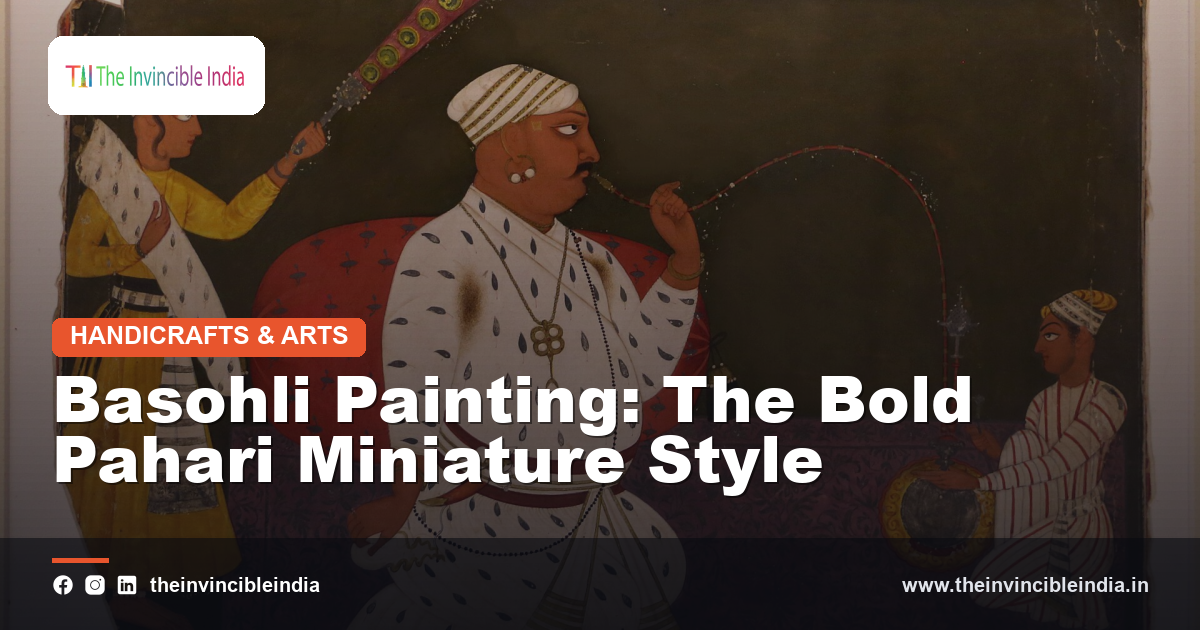
Basohli painting is the earliest and most dramatic of the Pahari miniature schools that flourished in the Himalayan foothills, instantly recognisable for its blazing colour, strong outlines and richly ornamented figures. Named after the small hill town of Basohli, in the region now part of Jammu and Kashmir, the style grew up under the patronage of local rulers and shaped the artistic language of neighbouring courts. Its flat, jewel-like compositions share a love of narrative with Madhubani painting, yet they belong to a refined courtly tradition rather than a household one. This guide explores the origins, palette, themes, techniques and enduring influence of Basohli painting, along with the efforts that keep it alive today.
Quick Facts
| Detail | Information |
|---|---|
| Type | Courtly miniature painting |
| School | Earliest of the Pahari schools |
| Origin | Basohli, Himalayan foothills of Jammu region |
| Signature | Bold colour, strong outlines, ornamented figures |
| Medium | Opaque mineral and vegetable pigments on paper |
| Legacy | Fed into the later Guler and Kangra styles |
What Is Basohli Painting
Basohli painting is a school of miniature art that emerged in the hill states of the western Himalayan foothills and is regarded as the earliest and boldest expression of the wider Pahari tradition. Its works are small in scale, painted in opaque pigments on paper, and designed to be held and viewed closely rather than displayed on a wall. What distinguishes Basohli from other Indian miniature styles is its sheer intensity, with flat fields of saturated colour, firm outlines and an almost architectural clarity of design. The paintings feel confident and unhesitating, creating a visual energy that has made the style one of the most easily identified in the entire family of Indian miniature art.
Origins in the Hill Country
The style takes its name from Basohli, a small town set among hills and river valleys in the foothills of the western Himalaya. Local rulers maintained a modest but ambitious court, and artists working there developed a distinctive manner that drew on older indigenous traditions of wall painting and manuscript illustration. Rather than appearing suddenly, Basohli painting is best understood as the result of a gradual blending of local taste with currents from the wider world of Indian courtly art. Its emergence in a remote hill setting is part of what gives the style its strong regional personality, a boldness that seems to reflect the landscape and the confidence of the courts that nurtured it.
Place Within the Pahari Schools
Pahari painting, meaning painting of the hills, is the collective name for the miniature traditions of the Himalayan foothill kingdoms, which developed a series of related but distinct styles over time. Basohli stands at the beginning of this story, and its vigorous manner sets a contrast with the softer and more lyrical styles that followed in later hill courts. Historians of Indian art often describe the Pahari tradition as a family, with Basohli as the elder sibling whose strong character shaped everything that came after. Seeing Basohli in this wider context helps explain how a regional court style could become the foundation for one of the most celebrated chapters in Indian miniature painting.
Royal Patronage and the Court Workshop
Like most Indian miniature traditions, Basohli painting depended on the patronage of the ruling court, which commissioned paintings for devotion, enjoyment and display of cultural refinement. Artists worked in workshops, often within families, where skills were passed from one generation to the next and where a master would lead a team in producing a single manuscript or series. Court taste influenced subject matter, favouring devotional themes, poetry and portraits of rulers. The steady support of local rulers allowed artists to refine their methods and develop a consistent house style. Without this stable patronage, the concentrated artistic flowering of the hill courts would hardly have been possible.
The Bold Colour Palette
The most striking feature of Basohli painting is its colour, built from rich, saturated hues laid down in broad, flat areas. Warm reds, deep yellows, strong blues and greens meet one another without soft transitions, producing a vibrant and sometimes dazzling effect. The backgrounds are often a single intense colour, which pushes the figures forward and gives the composition a poster-like clarity. These pigments were prepared from minerals and plant sources, then bound with a natural medium so that they would sit on the paper with a rich, matte density. The resulting palette is unmistakable, and it remains the first thing most viewers notice when encountering a Basohli painting.
Distinctive Figure Style
Basohli artists developed a recognisable way of drawing the human face and body that sets the school apart. Faces are typically shown in profile with a sloping forehead, a strong nose and large, expressive eyes, giving the figures an intense and slightly stylised presence. The bodies are drawn with firm contours and simplified forms, and gestures are clear and deliberate so that the story can be read at a glance. Rather than aiming at naturalistic portraiture, the artists favoured an idealised, emblematic type that carries emotion through posture and gaze. This consistent figure style acts like a signature, allowing even a quick glance to identify the work as part of the Basohli tradition.
Ornament and Jewel-Like Detail
Basohli paintings are celebrated for their lavish decorative detail, particularly in the rendering of jewellery, textiles and crowns. Ornaments are built up with raised dots of pigment that catch the light, creating a sense of depth and richness that rewards close inspection. In some works, tiny fragments of iridescent material were traditionally used to suggest the glitter of gems, adding a luminous accent to necklaces and headdresses. Garments are patterned with careful repeating motifs, and architectural elements are decorated with equal attention. This love of ornament turns each small painting into a kind of jewelled object, in which the craft of surface decoration is as important as the story being told.
Composition and Flattened Space
Basohli compositions rely on a flattened treatment of space rather than the receding perspective associated with European painting. Figures and objects are arranged in horizontal bands or within simple architectural frames, and colour planes stack against one another to create structure. Depth is suggested through overlap and placement rather than modelling or shading, which gives the images a graphic strength. Trees, curtains and pavilions are reduced to clear, rhythmic shapes that frame the main action. This deliberate flatness is not a limitation but a design choice, allowing the artist to organise colour and line with absolute precision and to create compositions that feel balanced, bold and immediately legible.
Rasamanjari and the Poetry of Love
One of the best known literary subjects of Basohli painting is the Rasamanjari, a Sanskrit poetic work that classifies types of heroines and lovers according to their emotional states. Artists illustrated its verses in series, translating the subtle psychology of longing, jealousy and reunion into pictorial form. These illustrations rely on gesture, setting and colour to convey emotion, so that a single image can express a complete mood. The tradition of linking poetry and painting is deeply rooted in Indian courtly culture, and Basohli artists brought to it a particularly intense emotional charge. The Rasamanjari series remain among the most admired achievements of the school.
Devotional Themes and Krishna
Devotional subjects form a central part of the Basohli repertoire, especially scenes drawn from the stories of Krishna and from the wider Vaishnava tradition. Episodes from the life of Krishna and his companions are presented with deep colour and emotional immediacy, while the Bhagavata Purana and the Gita Govinda offered rich narrative material. Scenes of divine love are set in stylised groves and pavilions, where the bold palette heightens the sense of devotion and wonder. Alongside Vaishnava themes, artists also painted subjects related to other deities and sacred stories. These religious paintings show how Basohli art served the spiritual life of the court as well as its appetite for beauty.
Portraits and Court Scenes
Alongside poetic and devotional works, Basohli artists produced portraits of rulers and scenes from court life. Royal figures are shown in profile, richly dressed and often accompanied by attendants, set against plain colour grounds that emphasise their status. These portraits blend individual identity with a conventional courtly ideal, recording who the patron was while presenting him in a dignified and idealised manner. Court scenes of audiences, music and leisure also appear, offering glimpses of the cultural world in which the paintings were made. Together these works show that Basohli painting was not only about religion and poetry but also about presenting and preserving the image of the court itself.
Materials and Painting Technique
Traditional Basohli painting begins with a sheet of paper prepared by layering and burnishing it until the surface is smooth and firm. The artist first sketches the composition in fine outline, then fills the shapes with flat opaque colour, building up darker contours and finer details in successive stages. Pigments of mineral and vegetable origin are ground and mixed with a natural binder, and brushes of extremely fine hair allow delicate lines and tiny ornaments. The work is slow and exacting, and the final surface is often burnished again to give it a soft sheen. Mastery of these methods is the foundation of the school’s polished and durable character.
Architecture and Landscape in the Paintings
Settings in Basohli painting are stylised rather than literal, using simple architectural frames and symbolic landscape elements to establish place. Pavilions with flat roofs and patterned walls frame romantic encounters, while trees and stylised flowering plants stand for gardens and forests. Skies may be rendered in bands or bursts of strong colour, evoking mood rather than describing weather. This abbreviated treatment keeps attention fixed on the figures and their emotional exchange while still giving the scene a clear sense of place. The decorative handling of architecture and nature also lets the artist balance colour across the page, so that every part of the composition contributes to the overall design.
Influence on Guler and Kangra
Basohli painting did not remain static, and over time its bold manner gave way to gentler styles in neighbouring hill courts. Artists trained in or influenced by Basohli carried their methods to other centres, where they blended them with fresh influences, softening the palette and refining the line. This process led to the graceful Guler style and ultimately to the celebrated Kangra school, famed for its lyrical tenderness. Basohli therefore serves as the starting point of a remarkable artistic evolution, from the intensity of the earliest hill paintings to the delicacy of later ones. Its influence is visible in the underlying structure and love of ornament that persisted through these changes.
Decline and Rediscovery
As political and economic conditions changed in the hill states, the patronage that had sustained Basohli workshops weakened, and the distinct style gradually faded as a living court tradition. Paintings were dispersed among collections, and for a long period the school received less attention than the better known Mughal and Rajput traditions. Interest revived as scholars and collectors recognised the originality of the hill schools and began to study Basohli work in its own right. This rediscovery established the style as a major chapter of Indian art history and encouraged museums to preserve and display surviving examples. The renewed appreciation continues to shape how Basohli painting is studied and valued today.
Collections and How to Appreciate the Art
Surviving Basohli paintings are preserved in museums and private collections in India and abroad, where they are valued as outstanding examples of hill miniature art. Because the works are small and delicate, they are usually displayed under controlled light and viewed from close range. Visitors can appreciate them by first absorbing the overall colour design, then moving to the contours of faces, the pattern of garments and the tiny raised ornaments. Reading the associated poem or story deepens understanding of the mood. Taking time with a single painting reveals how much thought lies behind its apparent simplicity, and why the school continues to command admiration.
Basohli Painting Today
Today Basohli painting survives through the work of contemporary artists and craft institutions who study surviving examples and practise the traditional methods of preparation, outlining and colouring. The style appears in prints, textile designs and decorative objects, bringing its distinctive palette to modern audiences, and it is a regular subject in exhibitions on Indian miniature art. Preserving the school involves training young painters and maintaining knowledge of pigments and technique. As one of the foundations of Pahari art, Basohli painting remains a living reminder of the creative ambition of the hill courts, and its bold colour and ornament continue to inspire admiration across India and beyond.
Sources & Further Reading
- Ministry of Culture, Government of India, on Indian painting traditions (indiaculture.gov.in).
- National Museum, New Delhi, on Indian miniature painting collections (nationalmuseumindia.gov.in).
Frequently Asked Questions
What is Basohli painting?
Basohli painting is the earliest school of Pahari miniature art, which developed in the Himalayan foothills of the Jammu region. It is known for bold colour, strong outlines and richly ornamented figures.
What makes Basohli painting distinctive?
Its flat fields of saturated colour, firm contours and stylised profile faces make it easy to recognise. Raised dots of pigment and jewel-like detail add to its decorative richness.
What subjects did Basohli artists paint?
Common subjects include illustrations of the Rasamanjari, scenes from the life of Krishna, devotional stories and portraits of rulers. Many works combine poetry and painting to express emotion.
How is Basohli connected to Guler and Kangra painting?
Basohli is regarded as the foundation of the Pahari tradition. Artists and ideas from Basohli influenced later hill styles, which softened its bold manner into the graceful Guler and Kangra schools.
Where can Basohli paintings be seen?
Examples are held in museums and private collections in India and abroad. Exhibitions on Indian miniature art often feature Basohli works alongside other Pahari and Rajput schools.


