

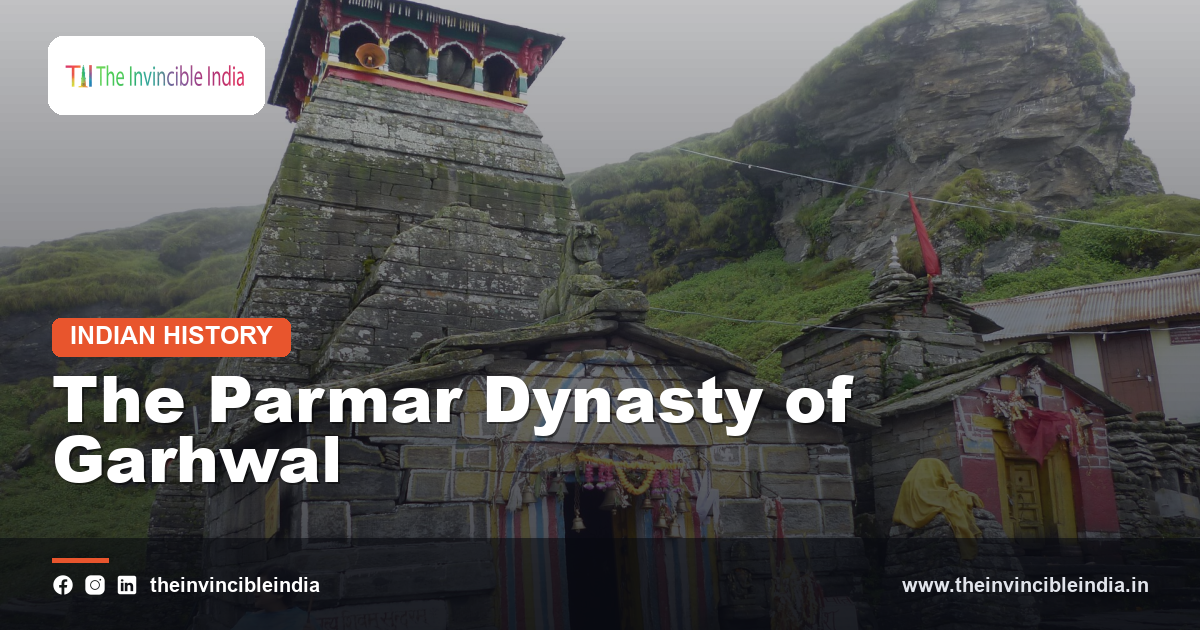
High in the central Himalayas, where the headwaters of the Ganga gather among forested ridges and snow peaks, a line of rulers known as the Parmars governed the kingdom of Garhwal for many generations. Their domain was a mosaic of small fort-centred territories that tradition says were eventually brought under a single crown. The dynasty ruled from successive capitals, patronised temples and learning, and gave its name to a celebrated school of miniature painting. Because the sources combine genealogies, inscriptions and folk memory, historians treat certain details with caution. For wider context on royal houses of the plains, readers may consult our guide to the Rajputs, and this article tells the Garhwal story in careful, general terms.
Quick Facts
| Detail | Information |
|---|---|
| Dynasty | Parmar (Panwar) rulers of Garhwal |
| Region | Garhwal Himalaya, present-day Uttarakhand |
| Capitals | Chandpur, Devalgarh and later Srinagar |
| Sacred Geography | Source regions of the Ganga and Yamuna, Badrinath and Kedarnath |
| Artistic Legacy | Garhwal school of Pahari painting |
| Later Status | Princely state of Tehri Garhwal before merger with India |
The Land of Garhwal
Garhwal occupies the western part of present-day Uttarakhand, a land of steep valleys, glacial rivers and some of the most revered pilgrimage sites in India. The headwaters of the Ganga and Yamuna rise within its borders, giving the region profound religious significance. Its geography fostered many small, self-contained communities, each centred on a hill fort known locally as a garh, which gave the country its name. Movement was difficult, and political unity was never easy to achieve. Yet the same mountains protected the region from many of the conflicts that swept the plains, allowing distinctive customs and beliefs to develop. This combination of sacred landscape and natural defence shaped the history of the kingdom and the rule of the Parmar dynasty.
Before the Parmars: Early Hill Polities
Long before the Parmar kings, the central Himalaya was home to organised communities and ruling houses whose traces survive in inscriptions, temples and tradition. The ancient region was linked with sacred geography described in older literature, and later kingdoms in the neighbouring Kumaon hills left a notable record of royal grants and temple building. In Garhwal itself, a patchwork of chieftains controlled individual forts and valleys, often tied by loyalty to larger neighbours. This fragmented pattern formed the political background against which the Parmar rise is usually told. Understanding the earlier hill polities helps explain why the later achievement of unifying many small territories under one crown was considered significant in the memory of the region.
Origins of the Parmar Line
Tradition holds that the Parmar line of Garhwal began with a prince who arrived in the hills from elsewhere in northern India, associated in later accounts with a pilgrimage and with the hill chieftain of the time. Names and dates given for the earliest rulers vary between chronicles, and modern scholars regard much of the early genealogy as uncertain. Some accounts link the family with the wider Paramara clan of Rajput tradition, while others stress its local rooting. What can be said with reasonable confidence is that a ruling house bearing the Parmar name gained prominence in the region and became the focus of later dynastic memory. The origins remain a matter of discussion, with legend and history interwoven in the surviving narratives.
Uniting the Garhs
A central theme of Garhwal tradition is the consolidation of numerous hill forts into a single kingdom. Popular accounts describe a ruler who, over time, subdued or persuaded the chieftains of the many garhs and established a centralised authority, a feat remembered with great respect. The traditional number of forts is often repeated in local narrative, but it is best treated as a symbolic figure rather than a precise count. Historians suggest that the process was gradual and relied on a mixture of force, diplomacy and alliance rather than a single campaign. Whatever the exact details, the idea of unification gave the dynasty its political identity and explains why Garhwal later appears as a coherent kingdom with a recognised royal seat.
Devalgarh and the Early Capital
The early Parmar rulers are associated with a series of capitals within the Alaknanda and Bhagirathi valleys. Chandpur, a fortified hill seat, is often named in tradition as an early centre of power, and Devalgarh later served as another important royal residence. The choice of defensible hilltop locations reflected the military conditions of the period, when rival chieftains and external raiders made security a priority. These capitals were small by plains standards, but they served as administrative centres, places of ceremony and homes of the royal household. Their ruins and remaining structures offer glimpses of the kingdom’s early organisation. The shifting of the capital over time also reveals how the rulers adapted to changing political and geographic circumstances.
Srinagar: The Royal Capital in the Valley
In later centuries the Parmar kings made Srinagar, on the banks of the Alaknanda, their principal seat. The town occupied a broader valley floor than the earlier hill capitals, and it became a centre of administration, trade and court life. Palaces, temples and gardens were built to suit the dignity of a growing kingdom, though much of the old town was later affected by natural disasters and changing fortunes. Srinagar’s position along the pilgrim route to the high Himalayan shrines also gave it religious importance, since travellers passed through on their way north. The move to Srinagar marked a mature phase of the kingdom, when the rulers could support a more elaborate courtly culture and a more settled administration.
Sacred Patronage: Badrinath, Kedarnath and the Pilgrim Routes
Garhwal contains some of the most famous pilgrimage destinations in India, and the rulers of the kingdom regarded the protection of these routes as a royal duty. Tradition credits the kings with endowing temples, supporting priests and ensuring the safety of devotees travelling through steep and sometimes dangerous terrain. The Himalayan shrines, which attract pilgrims from every part of the country, gave the kingdom an importance out of proportion to its size. Royal gifts to temples are recorded in local memory and in the continuing ritual links between ruling families and sacred institutions. This sacred patronage strengthened the legitimacy of the dynasty, presenting the rulers as guardians of holy places as well as lords of the land.
Court, Administration and Society
The administration of the Garhwal kingdom rested on a relatively simple structure, with royal officers overseeing districts and collecting dues from farming and pastoral households. The social order was shaped by hill agriculture, terraced fields and seasonal movement, and the royal court maintained relationships with local headmen and powerful families. Ministers and advisers from a few influential lineages played significant roles in court politics, and rivalries among them sometimes influenced royal succession. Despite its small scale, the court observed ceremony and ritual appropriate to a Hindu kingdom, with the king seen as protector of religion and law. This blend of simplicity and formality characterised life in the hills, where close personal ties between ruler and subjects mattered as much as formal institutions.
Relations with the Mughals and Neighbouring Rulers
Garhwal lay beyond the main routes of imperial armies, yet its rulers could not ignore the presence of larger powers in the plains. Traditional accounts describe contacts with the Mughal court, and the kingdom is sometimes remembered as having preserved its autonomy in part through its difficult terrain. Relations with neighbouring hill states, notably the Kumaon kingdom, alternated between rivalry and cooperation. Boundary disputes and competition for resources occasionally led to conflict. The kingdom’s diplomacy rested on the knowledge that mountain geography gave it security, but also on the willingness of its rulers to maintain channels of communication with external courts. This careful balance helped the dynasty endure through centuries of regional change.
Stories and Folk Memory of Garhwal Rulers
Garhwal tradition has preserved a rich body of stories about its rulers, their ministers and their queens. One of the best-known tales concerns a queen remembered for her firmness in resisting an external force during a period of regency, a story that is retold with pride in local culture. Folk songs and ballads sung in the Garhwali language keep alive memories of battles, fort defences and acts of loyalty. Such narratives are valuable cultural records, though historians treat them as traditions rather than precise documentation. They reveal how communities understood kingship and honour, and how the dynasty occupied a place in everyday imagination long after its political authority ended.
The Garhwal School of Painting
The Garhwal court is celebrated for its contribution to the Pahari miniature tradition. Artists working under royal patronage produced paintings of devotional themes, courtly scenes and lyrical subjects, marked by delicate drawing, soft colour and a poetic sensibility. A well-known figure of the school was an artist who was also remembered as a poet and chronicler, and whose reputation has long been tied to the court at Srinagar. While scholars debate attributions and the precise development of the style, the importance of Garhwal as a centre of hill painting is widely accepted. The paintings remain among the most treasured expressions of the region’s artistic life and are held in museums and collections.
Temple Architecture and Craft Traditions
Garhwal is dotted with temples built in styles adapted to the Himalayan climate, including stone sanctuaries with sloping roofs and carved wooden elements. Royal and community patronage supported the construction and upkeep of these shrines. Local artisans specialised in stone carving, woodwork and metal casting, and the same skills shaped domestic architecture, with houses decorated by carved doors and balconies. Woollen weaving and basketry supplemented the household economy. These traditions reflect a close relationship between available materials, climate and belief. Though modest in scale compared with the monuments of the plains, the temples and crafts of Garhwal form an important part of the cultural heritage that the Parmar rulers helped to sustain.
The Gorkha Conquest and the British Period
In the later stage of the kingdom’s history, the hills of the central Himalaya were overrun by the expansionist Gorkha power from the east, bringing a difficult period for the people of Garhwal and ending the rule of the old royal line in its traditional capital. The kingdom’s fortunes were later reshaped when the British intervened in the region, and a reduced portion of the former territory was restored to a member of the ruling family. A new capital was established in a different valley, and the state continued under British paramountcy. This turbulent chapter transformed the political map of the hills and marked the end of the old Garhwal kingdom as it had existed for centuries.
Tehri Garhwal and Integration with India
The restored principality came to be known as Tehri Garhwal, after its new seat, and it continued as a princely state during the later colonial period. Its rulers maintained internal administration while accepting the oversight of the imperial government, and the state experienced the wider currents of social and political change that swept the subcontinent. After Independence, Tehri Garhwal chose to merge with the Indian Union, and its territory became part of the larger political unit that later evolved into the state of Uttarakhand. This integration ended the formal rule of the dynasty, yet the cultural region of Garhwal retained its identity, language and traditions, which remain central to life in the Himalayan districts.
The Parmar Dynasty of Garhwal Today
Today the memory of the Parmar dynasty survives in the forts, temples and towns of Garhwal and in the continuing traditions of the region. Pilgrims on the Himalayan routes pass through landscapes that the kings once protected, and artists and scholars continue to study the Garhwal school of painting. Local folk songs, festivals and family genealogies preserve stories of rulers and ministers. Historians keep refining the account of the dynasty, acknowledging the uncertainties in its early chronology. The Garhwal kings show how a mountain kingdom, founded on the unification of scattered forts and sustained by sacred patronage, could shape a distinct regional identity that endures in the culture of Uttarakhand.
Sources & Further Reading
- Ministry of Culture, Government of India (indiaculture.gov.in).
- Archaeological Survey of India (asi.nic.in).
Frequently Asked Questions
Who were the Parmars of Garhwal?
The Parmars were the ruling dynasty of the Garhwal kingdom in the central Himalayas, in present-day Uttarakhand. Tradition says they unified many small hill forts into one kingdom, though details of the early chronology are debated.
Where were the capitals of the Garhwal kingdom?
Early capitals included fortified hill seats such as Chandpur and Devalgarh, while Srinagar on the Alaknanda later became the principal royal centre. After the Gorkha period, the restored state was governed from Tehri.
What is the Garhwal school of painting?
It is a branch of Pahari miniature painting associated with the Garhwal court, noted for delicate drawing, soft colour and lyrical themes. Scholars discuss its exact development, but its importance is widely recognised.
How did the Garhwal kingdom end?
The old kingdom was overrun by the Gorkhas, and later a reduced territory was restored under British influence as Tehri Garhwal. After Independence the state merged with the Indian Union.
Why was Garhwal important to pilgrims?
The region contains the source areas of the Ganga and Yamuna and major Himalayan shrines. The kings were remembered as protectors and patrons of these sacred routes.


