

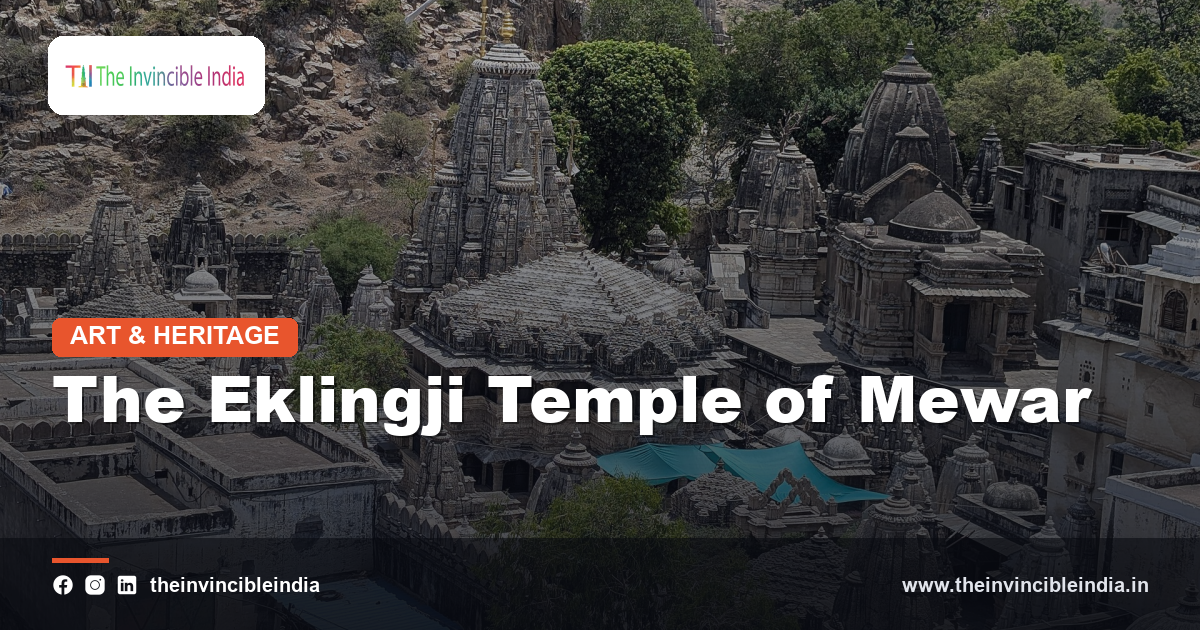
The Eklingji temple stands in the Aravalli foothills north of Udaipur, a walled complex of marble shrines dedicated to Shiva in his form as Eklingji, the Lord of Mewar. For centuries the Sisodia Maharanas have regarded themselves not as sovereigns in their own right but as stewards ruling on behalf of this deity, a conviction that gives the temple an unusual place in the political and spiritual life of Rajasthan. As with the grand monuments introduced in the guide to Indian temple architecture, its stones carry a history of faith, patronage and continuity that remains visible in daily worship.
Quick Facts
| Detail | Information |
|---|---|
| Location | Kailashpuri, near Udaipur, Rajasthan |
| Deity | Shiva as Eklingji |
| Region | Mewar |
| Material | Marble and sandstone |
| Patrons | Maharanas of Mewar |
| Status | Active place of worship |
A Temple at the Heart of Mewar
The Eklingji temple occupies a special place in the story of Mewar, the historic region around Udaipur in southern Rajasthan. While the region is better known to travellers for its lakes, palaces and hill forts, its spiritual centre of gravity has long been this temple complex set quietly among low hills. Eklingji is regarded as the family deity of the ruling house and, in tradition, as the actual sovereign of the land. Every Maharana ruled as his representative, and this idea shaped ceremony, law and statecraft for generations. The temple is therefore more than a regional shrine; it is a statement about how Indian kingship understood itself in relation to the divine. The complex continues to attract devotees from across Rajasthan and beyond, and it remains among the most revered Shiva sanctuaries of western India.
The Meaning of the Name Eklingji
The name Eklingji is generally understood to mean the one linga, a reference to the aniconic form in which Shiva is worshipped as a single sacred pillar. In Shaiva tradition the linga represents the formless, infinite aspect of the god, and a temple dedicated to a single linga signals devotion to Shiva as the supreme and sole lord of the place. The suffix ji is an honorific that reflects the affection and reverence of Rajasthani devotion. In Mewar the name carries an added political meaning, because it identifies the deity who is the true ruler and to whom the Maharanas owe their allegiance. Linguistic and religious meaning thus converge in the single word. The name captures the idea at the heart of the shrine, that one deity, present in one sacred form, presides over the destiny of an entire kingdom and its people.
Shiva as the Ruler and the Maharana as Dewan
One of the most distinctive features of Eklingji is the tradition that Shiva himself is the king of Mewar, while the Maharana holds the humbler title of dewan, or chief minister. This arrangement turned the ruler into a servant of the god, binding royal authority to religious duty. Edicts and formal acts were traditionally associated with the name of the deity, and the Maharana was expected to visit the temple and offer homage as part of his office. The idea gave the dynasty a powerful moral language, because a king who rules in the name of a god is answerable to something higher than himself. It also reinforced the legitimacy of the Sisodia line over many centuries. The relationship between deity and dynasty remains one of the most celebrated examples of sacred kingship in Indian history.
Origins in Tradition and Early History
The foundation of the Eklingji sanctuary is traditionally attributed to the early rulers of the Guhila lineage, the ancestors of the later Sisodia dynasty, and popular memory links it with the legendary founder Bappa Rawal. Such accounts belong to tradition rather than precise documentation, and historians treat the earliest centuries of the shrine with appropriate caution. What is clear is that the site has been a centre of Shaiva worship for a very long time and that it was patronised by successive rulers of the region. The temple was damaged and rebuilt more than once as political fortunes shifted, and the structure seen today reflects the work of later centuries layered over older foundations. This pattern of renewal is typical of living temples, whose continuity depends on repeated acts of restoration. The sanctuary therefore stands as both an ancient site and a repeatedly renewed monument.
The Pashupata Connection and Shaiva Lineages
The early religious life of the Eklingji area is associated with the Pashupata tradition, one of the oldest organised Shaiva movements in India. Ascetic teachers of this lineage are remembered as spiritual guides to the early rulers, and the sanctuary developed as a centre where such teachers lived and instructed. Later, the management of ritual passed into the hands of ascetic orders who served as custodians of the shrine. These lineages preserved forms of worship, scriptural learning and temple discipline that shaped the character of the place. The presence of a long-standing ascetic community distinguishes Eklingji from purely royal temples, because it ties the monument to a wider history of Shaiva philosophy and practice. The legacy of those teachers is still reflected in the structure of daily ritual and the dignified, restrained atmosphere that visitors often notice within the sanctuary.
The Walled Complex and Its Layout
The Eklingji complex is enclosed by high walls that separate the sacred precinct from the surrounding landscape. Within the enclosure stand the principal sanctuary and a large number of smaller shrines, arranged around courtyards and connected by paved passages. The sheer number of subsidiary temples gives the compound the feel of a small sacred city, each shrine dedicated to a different deity or associated with a particular tradition. The approach is orderly, moving from outer courts toward the inner sanctum in a sequence that prepares the worshipper gradually for the encounter with the main image. This planned progression from open space to enclosed darkness is a hallmark of Hindu temple design. The layout of Eklingji demonstrates how a large complex can be organised so that scale, ritual movement and quiet contemplation work together rather than compete.
Marble Architecture and the Temple Superstructure
The principal temple is built largely of marble, which gives the complex a pale, luminous quality that contrasts with the darker rock of the surrounding hills. Its design follows the northern Indian temple idiom, with a towering curvilinear spire, known as a shikhara, rising above the sanctum and a multi-pillared hall in front of it. The roof of the hall is composed of rising tiers that culminate in a pyramidal form, a feature common to temples of the western Indian tradition. Surfaces are enriched with carved mouldings, ornamental bands and sculpted figures, though the effect is one of balanced richness rather than crowded ornament. Because the structure has been rebuilt over time, it combines elements of different periods. The architecture of Eklingji thus offers a coherent visual expression of Rajput patronage working within an ancient and carefully preserved temple vocabulary.
The Four-Faced Linga
At the centre of the sanctum stands the main image of Eklingji, a linga carved in dark stone with four faces, each turned toward one of the cardinal directions. This form, known as a chaturmukha or four-faced linga, expresses the idea that the deity watches over all directions at once. In many interpretations the faces are associated with different aspects of Shiva, so that a single sculpted pillar holds multiple facets of the divine nature. The image is bathed, adorned and worshipped according to a fixed daily routine, and its appearance is changed through elaborate decoration on special occasions. For devotees, the sight of the four faces is the high point of the pilgrimage, a moment of direct encounter with the lord of Mewar. The image encapsulates the temple, a single sacred form that is both a theological symbol and the focus of an entire regional identity.
The Sanctum and the Hall of Assembly
The inner sanctum, or garbhagriha, is a small and dimly lit chamber that contains the main image, while the larger mandapa in front serves as a hall of assembly for worshippers. This division between the intimate sanctum and the more public hall is fundamental to temple planning across India. Devotees gather in the mandapa, where the sound of bells, chanting and ritual music creates a collective atmosphere, and they approach the threshold of the sanctum to receive a glimpse of the deity. The hall is supported by rows of carved pillars that give it a rhythmic, processional quality. Facing the sanctum is a sculpted figure of the bull Nandi, the traditional vehicle of Shiva, positioned as a permanent attendant gazing toward the god. Together, sanctum, hall and Nandi frame an experience of worship that has changed little in its basic structure over many generations.
Daily Worship and Ritual Life
The life of the temple unfolds through a daily cycle of rituals that begins at dawn and continues until the evening. Priests perform ablutions of the image, offer flowers, leaves and lamps, and recite the traditional hymns appropriate to each part of the day. The sanctum is opened and closed at fixed hours, and the intervals between ritual moments give the day a measured rhythm. Monday, the day traditionally associated with Shiva, is observed with particular devotion, and the temple becomes especially busy on that day. The personal visit of the head of the former royal house on Mondays has long been a recognised part of the ceremonial calendar. These routines are carried out with great regularity, and their steadiness is one of the qualities that gives the shrine its authority. Ritual here is not a performance for visitors but a continuous act of service to the deity.
Festivals and Pilgrimage Seasons
Festivals draw the largest crowds to Eklingji, and the most important of these is Mahashivratri, the great night devoted to Shiva. On such occasions the temple is crowded with pilgrims who observe fasts, keep night vigils and offer water, milk and sacred leaves to the linga. Devotees from villages across Mewar, as well as from neighbouring regions, travel to the complex as an act of piety, and the surrounding area takes on the character of a fair. Other Shaiva observances, as well as regional festivals of Rajasthan, are marked with processions and special decoration. Pilgrimage to Eklingji is often combined with visits to other sacred sites in the region, forming a sacred circuit. The festival calendar demonstrates that the temple is not an isolated monument but the focal point of a wide community of belief, held together by seasonal gatherings.
The Nagda Temples Nearby
A short distance from the main complex lie the ruins of Nagda, an ancient settlement associated with the early history of Mewar. Among its remains are old temples, some of which belong to the Vaishnava tradition and display fine early sculpture. These structures are often noted for the quality of their carving, which reflects the architectural confidence of the region in the early medieval period. Although many of the buildings are partly ruined, they provide valuable evidence of the religious and artistic life of the area before the rise of the later Rajput capitals. Visiting Nagda alongside Eklingji gives a fuller picture of the sacred landscape, in which Shaiva and Vaishnava traditions existed side by side. The nearby ruins deepen appreciation of Eklingji by showing the older world from which the great sanctuary and its royal patrons emerged.
Patronage of the Maharanas
The architectural growth of Eklingji owes much to the generosity of the rulers of Mewar, who regarded support for the temple as a primary royal duty. Successive Maharanas ordered repairs, additions and endowments, and the complex bears the marks of this long tradition of giving. Gifts of land and revenue helped sustain the priesthood and the daily rituals, while ceremonial offerings underlined the bond between dynasty and deity. This patronage was not merely an act of piety; it was also a way of demonstrating continuity and legitimacy, since a ruler who maintained the temple confirmed his place in a long line of devoted servants. The result is a sanctuary that functions as a record of royal attention across time. Its endurance reflects a partnership between sacred institution and ruling house that is rarely documented as vividly anywhere else in India.
Art, Sculpture and Decorative Detail
Within the complex, visitors encounter a wide range of sculpture and decorative art, from carved figures on temple walls to ornamental metalwork and inscribed panels. Marble allows crisp, delicate carving, and craftsmen of the region have long been admired for their skill in shaping it. Images of deities, guardian figures and floral patterns adorn doorways, pillars and ceilings. Some shrines contain sculptures of considerable antiquity, while others reflect the taste of later centuries. The combination gives the complex the character of an open-air museum of religious art, although every object remains in active devotional use. Appreciating these details rewards slow observation, since much of the beauty lies in repeated patterns and subtle variations. The artistic heritage of Eklingji shows how sacred sculpture in Rajasthan blended inherited convention with the individual skill of generations of local artisans.
Relationship with Udaipur and Mewar Culture
Eklingji is closely linked to Udaipur, the city that became the capital of Mewar and grew into one of the most admired cities of Rajasthan. While the palaces and lakes of Udaipur reflect the worldly side of Mewar court culture, Eklingji represents its devotional foundation. The two belong together, and the courtly rituals of the former royal family continue to acknowledge the primacy of the deity. This relationship is visible in ceremonies, in local folklore and in the pride that people of the region take in their heritage. Songs, stories and proverbs of Mewar frequently refer to Eklingji, showing how deeply the god is woven into everyday speech. Understanding Udaipur without Eklingji would leave out the spiritual core of the culture, which has shaped the region’s outlook on loyalty, honour and service to a higher authority.
Visiting the Temple with Respect
Eklingji is an active place of worship, and visitors are expected to observe the customs of the sanctuary. Modest clothing is appropriate, footwear is removed before entering the sacred precinct, and rules regarding photography and the carrying of certain items are generally enforced in the inner areas. The hours of opening follow the ritual schedule, with closed intervals during the day, so planning a visit around these timings is sensible. Quiet, patient behaviour is valued, especially during the busier moments of worship. Many travellers pair the visit with other heritage sites in the area, making it part of a wider journey through Mewar. Treating the complex as a living shrine rather than a tourist attraction allows visitors to experience its atmosphere as intended, and it honours the community of worshippers who continue to sustain the temple.
Eklingji Temple Today
Today the Eklingji temple remains a vibrant centre of devotion and a cherished symbol of Mewar identity. Its marble spire still rises above the quiet landscape, its rituals continue each day, and its association with the former royal house endures as a living tradition. The complex is cared for by a trust connected with the family that has served the deity for centuries, and it welcomes pilgrims and heritage travellers alike. As a monument it preserves layers of architecture, sculpture and ritual that illustrate the long history of Shaiva worship in western India. As an institution it demonstrates how religion, kingship and community can be woven together into a single enduring structure. Eklingji endures as one of the great sacred sites of Rajasthan, valued for its beauty, its history and the unbroken devotion that continues to fill it.
Sources & Further Reading
- Archaeological Survey of India (asi.nic.in).
- Ministry of Culture, Government of India (indiaculture.gov.in).
Frequently Asked Questions
Where is the Eklingji temple located?
The Eklingji temple is located at Kailashpuri in the Aravalli foothills north of Udaipur in Rajasthan. It lies within the historic region of Mewar and is easily combined with other sites in the area.
Who is worshipped at Eklingji?
The temple is dedicated to Shiva in the form of Eklingji, represented by a four-faced linga. He is regarded as the ruling deity of Mewar, and the Maharanas traditionally served as his representatives.
Why is Eklingji important to the rulers of Mewar?
The Sisodia rulers considered Eklingji to be the true king of Mewar and themselves to be his dewans, or ministers. This belief tied royal legitimacy to religious service and gave the temple a central place in state ceremony.
What is the architecture of the temple like?
The temple is built mainly of marble in the northern Indian style, with a curvilinear spire over the sanctum and a pillared hall in front. A large number of smaller shrines surround it within a walled enclosure.
When is the best time to visit Eklingji?
Many visitors prefer the cooler months, when the weather is comfortable for exploring the complex and nearby sites. Mondays and Mahashivratri are especially important for devotees, so those days are usually busier.


