

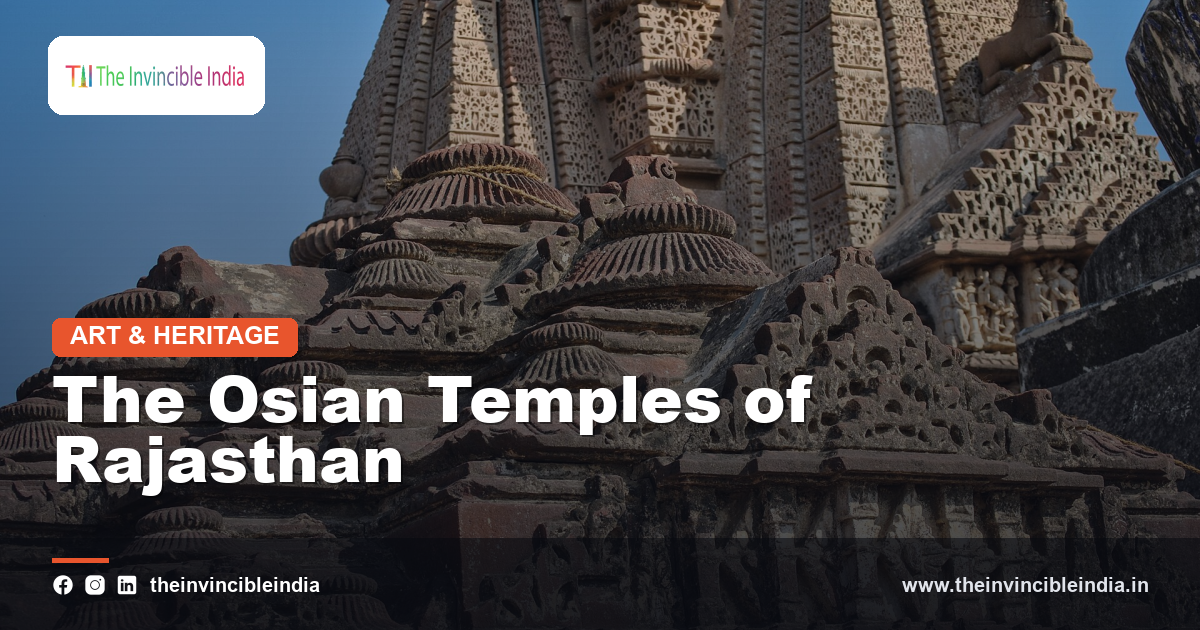
The village of Osian lies on the edge of the Thar Desert north of Jodhpur, yet it holds one of the most important groups of early medieval temples in Rajasthan. Hindu and Jain shrines stand here side by side, many of them carved in warm sandstone during the age of the Pratihara rulers and their contemporaries. Together they preserve a chapter of western Indian architecture that predates the great Rajput forts and palaces described in the guide to the great forts of India. Often described as the Khajuraho of Rajasthan, Osian offers a quieter, more intimate encounter with the early temple tradition of the desert region.
Quick Facts
| Detail | Information |
|---|---|
| Location | Osian, Jodhpur district, Rajasthan |
| Period | Early medieval, 8th century onward |
| Style | Maha-Maru and Gurjara-Pratihara |
| Faiths | Hindu and Jain |
| Material | Sandstone |
| Status | Active worship and protected monuments |
A Desert Town of Ancient Shrines
Osian is a small town in the Marwar region of Rajasthan, set among dry plains and rolling sand dunes that mark the beginning of the great Thar Desert. Despite its modest present size, it was once a prosperous settlement with a thriving religious and commercial life. The ruins and surviving temples around the town testify to a period when patrons funded the building of numerous shrines in a compact area. Today the temples rise unexpectedly from the village landscape, their carved spires and pillars contrasting with the plain surroundings. The town offers a rare opportunity to study an early medieval religious centre that has remained in continuous use. Osian therefore stands as an important window into the artistic and devotional life of western India before the rise of the later Rajput kingdoms, and it rewards visitors who seek heritage beyond the famous forts.
The Early History of Ukesh
In the early medieval period Osian was known by an older name, commonly given as Upkeshpur or Ukesh, and it formed part of the political world shaped by the Pratihara dynasty and local ruling families. The region lay on important trade and travel routes, and wealth from commerce supported the building of religious monuments. Inscriptions and later traditions connect the town with several rulers and merchant communities, although the details of its earliest history are difficult to reconstruct with certainty. What is evident from the temples themselves is a period of sustained architectural activity across several generations. The placement of so many shrines within one settlement suggests an urban culture in which religion played a central role. The history of Osian is therefore best understood as one of steady growth, in which commerce, royal patronage and devotion combined to create a lasting sacred centre.
The Pratihara Architectural Tradition
The Gurjara-Pratihara rulers presided over a large part of northern and western India in the early medieval centuries, and their patronage helped establish a distinctive temple style. Temples of this tradition are marked by a clear division between sanctum and entrance hall, a tall tower of curving profile, and a restrained but confident use of sculpture. Osian preserves some of the earliest surviving examples of this regional idiom, which is sometimes described as the Maha-Maru style after the old name for the Marwar region. The buildings show how architects of the period balanced geometry with ornament, creating forms that later influenced temple building across Rajasthan and Gujarat. Studying the Osian temples allows scholars to trace the development of the Nagara style in the west. They represent an important stage in the long evolution of Indian temple design, as distinct from the southern traditions of the peninsula.
The Harihara Temples
Among the Hindu monuments of Osian are the shrines known as the Harihara temples, dedicated to the composite deity who combines Vishnu and Shiva in a single form. The theme reflects an inclusive spirit in early medieval religion, in which devotees sought to bring together two great traditions rather than set them apart. The temples are modest in scale compared with the monumental complexes of later centuries, but their proportions are harmonious and their carving is skilful. Sculpted figures appear on the outer walls, set within niches and framed by decorative mouldings. The sanctum is crowned by a tower that rises in carefully measured tiers. The Harihara shrines illustrate how the Osian group is not a single monument but a collection of related buildings, each with its own character, and together they present a rich sample of the artistic ideas that circulated in the region.
The Surya and Other Hindu Shrines
The Hindu temples of Osian are dedicated to a range of deities, among them forms of Vishnu, Shiva, the Sun and the Goddess. The temples associated with Surya, the Sun god, are especially interesting because they reflect a tradition of solar worship that was widespread in western India during the early medieval centuries. Their carved walls often show a procession of divine figures and decorative bands that frame the sanctum. The variety of dedications shows that Osian was a place where different devotional currents coexisted. Each shrine was built by a separate patron, and each reflects the particular taste and resources of its sponsor. The survival of so many temples of different kinds in a single village makes Osian a remarkably complete record of the religious diversity of its age, and it deepens our understanding of how communities expressed their devotion through architecture.
Sculpture and Carved Detail
The beauty of the Osian temples lies largely in the quality of their sculpture. Pillars, doorframes and wall niches are covered with figures of gods and goddesses, celestial musicians, dancers and ornamental motifs drawn from the natural world. The carving is typically crisp, and the human figures display graceful poses and a sense of rhythm that animates the stone. Decorative friezes run along the bases and upper registers of the buildings, giving them a layered, textured appearance. Some of the figures illustrate episodes from well-known religious narratives, while others serve purely ornamental purposes. Weathering has softened some surfaces, but enough remains to show the skill of the early craftsmen. The sculpture of Osian forms an important part of the story told in the wider story of Indian sculpture, showing how regional workshops developed their own expressive language.
The Mahavira Jain Temple
The most celebrated Jain monument at Osian is the temple dedicated to Mahavira, the twenty-fourth Tirthankara. Tradition holds that it was founded in the early medieval period and later renovated several times, so its present form combines older elements with later restoration. The temple stands on a raised platform and is approached through a gateway that introduces the visitor to a world of finely carved marble and stone. Inside, the pillars and ceilings display elaborate ornament, and the central image of Mahavira receives regular worship from the Jain community. The building is among the most important places of pilgrimage for followers of the faith in Rajasthan. Its presence at Osian underlines the long and respected role of Jainism in the cultural life of the region, where merchant patrons supported the creation of beautiful and enduring sanctuaries.
Osian and the Oswal Community
Osian has a special significance for the Oswal community, a prominent Jain and merchant group whose name is derived from the town. According to tradition, the community originated here when a revered Jain teacher guided local families toward the Jain faith. While the historical details are passed down through tradition rather than precise records, the association is deeply cherished and gives Osian the character of an ancestral homeland. Families of Oswal origin, now settled in many cities across India and the world, regard the town as a place of spiritual belonging and often return on pilgrimage. This living connection explains why the temples are cared for with such devotion. The link between town and community shows how heritage is not only a matter of old stones but also of memory, identity and the continuing loyalty of people to their place of origin.
The Sachiya Mata Temple
Rising above the town on a hill is the temple of Sachiya Mata, a goddess regarded as the guardian deity of many families, including members of the Oswal community. The shrine has been renovated across the centuries, and its present appearance combines older stonework with later additions. Reaching it involves a climb up a flight of steps, and the view from the top extends over the roofs of Osian and the open desert beyond. The temple is a popular place of worship, particularly during festivals when large numbers of devotees gather to make offerings. Its importance illustrates the central place of the goddess in the religious life of western India, where family and clan deities guide daily conduct. The hilltop sanctuary also forms a natural conclusion to a visit, providing both spiritual significance and a commanding perspective on the landscape of the Osian heritage.
Other Notable Shrines of the Town
Beyond the best-known monuments, Osian contains several smaller temples that deserve attention, among them shrines dedicated to local goddesses and to various forms of Vishnu and Shiva. Some of these buildings occupy quiet corners of the village, reached by narrow lanes and surrounded by modest houses. They are often overlooked, yet their carved details and proportions reward careful observation. A few have been partly restored, while others show the effects of age and neglect. Together they contribute to the sense that the entire settlement is a layered sacred landscape rather than a single monument. Exploring the lesser-known shrines gives a more complete picture of how religious architecture was woven into everyday life. The smaller temples of Osian show that heritage lives in the ordinary spaces of the village as much as in its most celebrated landmarks.
Building Materials and Construction
The temples of Osian are built principally of local sandstone, a material that is readily available in the region and well suited to detailed carving. Blocks were cut and fitted with great precision, often without mortar, so that the weight of the structure itself holds the courses together. The warm colour of the stone changes with the light, appearing golden in the morning and deeper toward evening. Craftsmen used the material to create both the broad masses of the towers and the delicate patterns of the ornament. Over time, wind-blown sand and heat have taken their toll, and conservation work has become necessary to preserve the carvings. The choice of local stone also ties the monuments closely to their setting, making them seem to grow out of the desert landscape. The building techniques at Osian show the practical wisdom of early Indian architects, who worked with the materials at hand.
Hindu and Jain Coexistence
One of the most appealing aspects of Osian is the peaceful coexistence of Hindu and Jain temples within a single settlement. Shrines of both faiths share similar architectural vocabulary, which suggests that craftsmen and patrons moved freely between traditions. The same guilds may well have worked on temples for different communities, bringing common skills and decorative ideas to each commission. This shared artistic language shows that religious boundaries in the early medieval period were often porous at the level of art and building. Today the temples continue to serve their respective communities, and visitors encounter both traditions in one short walk. The harmony of Osian offers a gentle reminder that India’s heritage is plural by nature. The town stands as a model of cultural coexistence, expressed not in words but in the quiet neighbourliness of stone buildings.
The Desert Setting and Travel Context
Osian lies within easy reach of Jodhpur, the great blue-walled city of Marwar, and many travellers combine the two in a single excursion. The surrounding terrain is part of the western Rajasthan desert, with its distinctive scrub, sand dunes and open skies. Camel rides and desert experiences are offered in the vicinity, and the setting adds atmosphere to the temple visit. Yet the monuments are the true attraction, standing as evidence of a period long before the forts and palaces of the Rajput capitals. The contrast between the grand royal monuments of Jodhpur and the quiet early temples of Osian enriches a journey through the region. Placing the town within the wider context of Marwar helps visitors appreciate how different historical layers coexist in Rajasthan, from early medieval temples to the later imperial architecture of the Rajput kingdoms.
Conservation and Protection
Several of the Osian temples are protected as monuments of national importance, and conservation work has aimed to stabilise their structures and preserve their carvings. The challenges are considerable, since sandstone is vulnerable to erosion, salt action and the extremes of desert weather. Repairs must be carried out with care to avoid altering the original character of the buildings. Alongside formal protection, the local community plays an important role, because many of the temples remain places of active worship maintained by trusts and families. This partnership between official agencies and devotees has helped many structures survive. Ongoing documentation, cleaning and structural reinforcement continue to be necessary. The conservation of Osian illustrates the broader challenge of safeguarding India’s early monuments, which require both expert intervention and the sustained affection of the communities that still use them.
Visiting Osian with Care
A visit to Osian is best planned around the cooler months, when the desert climate is more comfortable for walking between temples. Visitors should dress modestly, remove footwear at the entrances to shrines, and follow local rules about photography inside active sanctuaries. Some temples have specific hours of opening, so a flexible schedule helps. Guides from the town can explain the history and iconography, adding depth to the experience. Because the monuments are scattered through the village and on the hill, comfortable footwear is useful for the walking and climbing involved. Respect for worshippers is essential, especially during festival days. Approached in this spirit, a visit to Osian becomes more than sightseeing; it becomes a thoughtful encounter with living traditions, where the past and present are joined by continuing devotion.
The Osian Temples Today
Today the Osian temples remain a treasured part of Rajasthan’s heritage, valued by historians, pilgrims and travellers alike. They preserve some of the earliest surviving examples of western Indian temple architecture, along with sculpture of lasting charm. They also continue to function as places of worship, so that the buildings are animated by prayer, festival and family tradition. The combination of Hindu and Jain monuments in one settlement gives the town unusual cultural depth. As interest in lesser-known heritage grows, Osian is increasingly recognised as a destination of real significance beyond the familiar circuit of forts and palaces. Its temples remind us that the architectural story of Rajasthan begins long before the Rajput courts, in the quiet devotion of early medieval communities. Osian endures as a remarkable sacred landscape on the edge of the desert.
Sources & Further Reading
- Archaeological Survey of India (asi.nic.in).
- Ministry of Culture, Government of India (indiaculture.gov.in).
Frequently Asked Questions
Where are the Osian temples located?
The Osian temples are located in the town of Osian in the Jodhpur district of Rajasthan, on the edge of the Thar Desert. The town lies north of Jodhpur and is commonly visited as an excursion from the city.
From which period do the Osian temples date?
The temples belong largely to the early medieval period, when the Pratihara dynasty and other regional powers patronised temple building. Many have been renovated since, so the monuments combine original fabric with later restoration.
Why is Osian important to the Jain community?
Osian is closely associated with the Oswal community, whose name is derived from the town. The Mahavira Jain temple here is a major place of pilgrimage for followers of the faith.
What is the Sachiya Mata temple?
It is a hilltop temple dedicated to Sachiya Mata, a goddess worshipped as a family deity by many communities. The shrine offers fine views over the town and the surrounding desert.
What architectural style do the temples follow?
They follow the early western Indian Nagara tradition, often called the Maha-Maru or Gurjara-Pratihara style. It is known for curving towers, clear plans and richly carved sandstone surfaces.


