

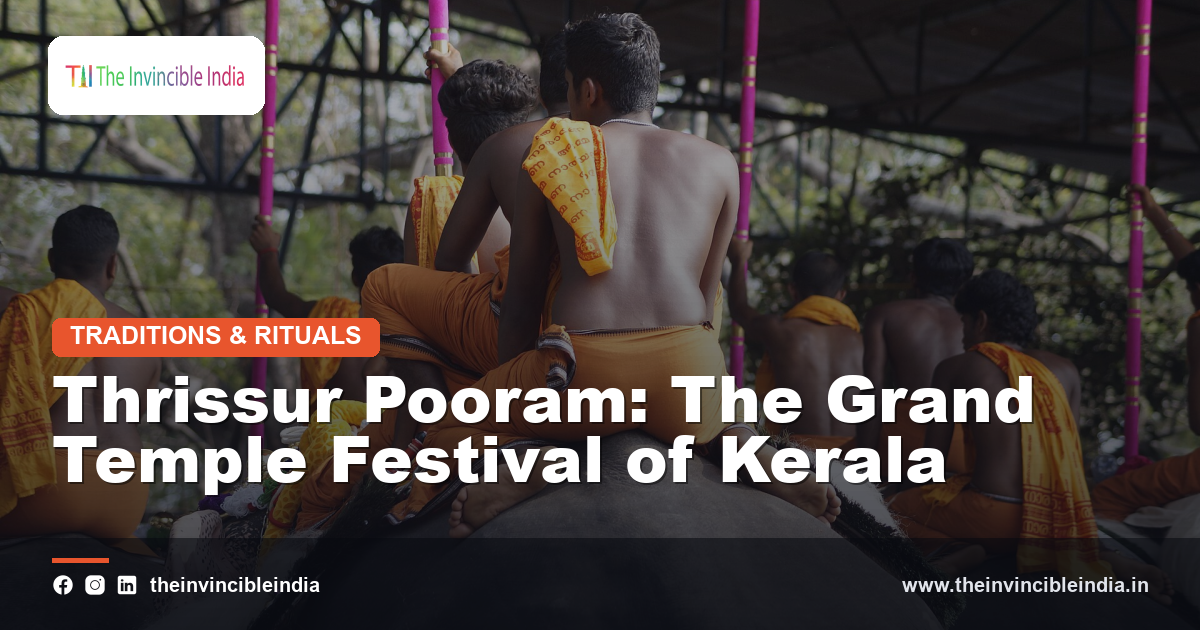
Thrissur Pooram is widely regarded as the grandest of Kerala’s temple festivals, a day-long celebration in which richly decorated elephants, rhythmic percussion ensembles and a sea of devotees gather around the Vadakkunnathan Temple in the heart of Thrissur. Rooted in devotion yet open to people of every background, the festival brings together neighbouring temples in a friendly, spirited contest of music, colour and craftsmanship. Like other great festivals of Kerala, it expresses the way faith, art and community life are woven together in the state’s cultural identity. This guide explains the origins, rituals, performances and enduring meaning of Thrissur Pooram.
Quick Facts
| Detail | Information |
|---|---|
| Festival | Thrissur Pooram |
| Location | Thrissur, Kerala |
| Venue | Around the Vadakkunnathan Temple |
| Season | Malayalam month of Medam (spring) |
| Highlights | Elephants, Kudamattam, percussion, fireworks |
| Character | Temple festival open to all visitors |
What Is Thrissur Pooram?
Thrissur Pooram is an annual temple festival held in the city of Thrissur in the Indian state of Kerala. The word pooram refers to a festival associated with a particular lunar asterism in the traditional calendar, and many temples in Kerala observe their own poorams. Among them, the Thrissur celebration has gained a special reputation as the most spectacular, drawing devotees, photographers, musicians and curious travellers from across the country and beyond.
At its core, the festival is a collective act of worship in which a number of temples bring their presiding deities in procession to the Vadakkunnathan Temple. The occasion combines ritual, music, pageantry and community hospitality in a manner that few other events in India can match. Understood simply, Thrissur Pooram is a devotional gathering that has grown into a living showcase of Kerala’s performing traditions and temple culture.
Origins and Historical Background
Tradition credits the ruler of the former princely state of Cochin, popularly remembered as Sakthan Thampuran, with organising the festival in its present form. According to the widely told account, he wished to create a single grand gathering that would unite the temples of the region under the roof of the Vadakkunnathan Temple, which lies at the centre of Thrissur.
Before this arrangement, local temples had celebrated their own festivals separately, and the new Pooram gave them a common stage. Over the generations, the event has evolved while keeping its basic structure of processions, exchanges and ceremonial display intact. Historians treat the finer details of its early years with caution, yet the broad outline of a royal initiative that gave Thrissur its signature festival remains a cherished part of local memory and identity.
The Vadakkunnathan Temple and the Thekkinkadu Maidan
The Vadakkunnathan Temple stands on a raised ground in the middle of Thrissur and is among the oldest and most respected Shiva temples of Kerala. Its architecture reflects the classic Kerala style, with sloping tiled roofs, wooden carvings and spacious courtyards that serve as natural arenas for ritual and performance.
Around the temple lies a wide open ground known as the Thekkinkadu Maidan, and it is here that much of the Pooram unfolds. Elephants line up in rows facing one another, and spectators fill every available space around the ground. The temple provides the spiritual centre of the festival, while the maidan provides the public stage. Together they form the setting in which a sacred precinct and a civic space merge into one shared celebration for the entire city.
The Participating Temples
The festival is organised around two principal participants, the Thiruvambadi Sri Krishna Temple and the Paramekkavu Bhagavathy Temple, each representing a large body of devotees and supporters within Thrissur. In addition, a number of smaller neighbouring temples send their own deities in procession, so that the Pooram becomes a gathering of many local shrines rather than a single event.
The two principal groups are often described as the eastern and western sides of the Pooram, and each prepares for months in advance. Their relationship is one of friendly rivalry, in which each tries to present the most striking display while both remain bound by a shared devotion. This cooperative competition is central to the festival, and it explains much of the energy, pride and creativity visible throughout the celebration.
Elephants and Caparisons
No image is more closely associated with Thrissur Pooram than the long line of decorated elephants standing in the open ground. Each elephant wears a golden caparison known in Malayalam as nettipattam, along with ornaments, bells and garlands that are prepared with great care. The animals carry priests or bearers holding ceremonial articles on their backs.
In Kerala, temple elephants have long held an honoured place in ritual life, and their presence at a festival is seen as an expression of grandeur and auspiciousness. Modern conversations around the festival also emphasise the welfare of the animals and the need for responsible handling, regulation and veterinary care. The elephant pageant therefore remains a defining spectacle, even as the community continues to discuss how best to honour both tradition and the well-being of the animals involved.
Kudamattam: The Exchange of Parasols
One of the most eagerly awaited moments of the Pooram is the Kudamattam, a ceremonial exchange of colourful parasols. Seated on the elephants, specially trained men raise and swap ornate silk umbrellas in swift, coordinated patterns, each one more striking than the last. The parasols are decorated with sequins, tassels and small ornaments that shimmer in the light.
The two sides respond to one another in turn, and the crowd reacts with cheers as new designs appear. The performance requires practice, agility and an eye for visual harmony. Although it looks like a playful contest, the Kudamattam is part of a ritual tradition in which colour and movement are offered as an act of celebration before the deities, making it a highlight of the festival day.
The Percussion Traditions
Music is the heartbeat of Thrissur Pooram. Two Kerala percussion traditions in particular define its soundscape. Panchavadyam is an ensemble of five instruments that includes the timila, maddalam, ilathalam, kombu and edakka, and it is performed in a measured, devotional manner. Pandi Melam, by contrast, is a larger orchestral form led by the chenda and associated with a grand, rising rhythm.
The performers, many of them masters of their craft, play in carefully structured stages that begin slowly and build toward a thunderous climax. Audiences often keep time with raised hands, moving together as the beats accelerate. The percussion at the Pooram is not mere background accompaniment but a central art form, preserving a musical heritage that connects generations of artists and listeners.
Ilanjithara Melam
Among the musical programmes of the festival, the Ilanjithara Melam holds a special place. It is a long percussion performance staged beneath an ancient tree within the temple compound, and it draws seasoned listeners who appreciate its sustained build-up and the coordination of dozens of artists playing together.
The Melam proceeds through successive stages of tempo, with the rhythm tightening gradually until it reaches an exhilarating peak. Spectators of all ages stand shoulder to shoulder, often for hours, absorbed in the music. The performance is respected as a test of skill for the lead artists and of precision for the ensemble. In this way, the Ilanjithara Melam showcases the discipline and artistry that underpin Kerala’s temple percussion and reinforces why the Pooram is cherished by music lovers.
The Pooram Procession and Daily Rhythm
The Pooram day follows a sequence of ceremonial movements. Smaller temples arrive in the early hours, each accompanied by its own musicians and attendants, and the deities are brought before the Vadakkunnathan Temple in turn. Later in the day the two principal groups assemble on the maidan, where the great elephant lines and the Kudamattam take place.
The pace of the day alternates between solemn ritual and joyous public celebration. Moments of quiet devotion inside the temple contrast with the loud rhythms and crowded grounds outside. Because the schedule is carefully choreographed, each stage leads naturally to the next, and participants and spectators alike feel the gradual build of anticipation. The festival thus functions as a single flowing narrative from dawn to the following morning.
Fireworks and the Night Spectacle
As night falls, the atmosphere of the Pooram shifts from daytime pageantry to a glowing, festive spectacle. The temples are lit with lamps, and the streets around the Swaraj Round remain busy with devotees, families and visitors. Late in the night and into the early hours, a celebrated display of fireworks lights the sky above Thrissur.
Traditional Kerala fireworks, known as vedikkettu, are valued for their loud reports and fiery colours, and the competing sides prepare their displays with much anticipation. Because fireworks involve real hazards, authorities regulate them closely, and organisers place emphasis on safety distances and crowd management. The night display remains a memorable closing act, adding sound and light to a festival already rich in sight and rhythm.
Community Participation and Hospitality
Thrissur Pooram is sustained by the participation of the entire city. Committees of volunteers manage preparations, craftspeople make parasols and ornaments, artists rehearse for months, and households welcome relatives and guests. The festival is a time when the town opens its doors, and hospitality is extended to visitors without distinction.
People of different communities take part in the preparations, and the festival has long been seen as a shared civic occasion as much as a religious one. Local businesses, food vendors and traditional craftspeople also contribute to the festive atmosphere. This broad participation explains why the Pooram is regarded as the pride of Thrissur and why many residents speak of it as an event that belongs to everyone who lives in or loves the city.
Art, Craft and Preparation
Long before the festival begins, a quiet industry of craftsmanship takes shape. Artisans prepare golden caparisons, decorative bells and ceremonial fans, while specialists design the parasols that will be exchanged during the Kudamattam. The work often follows methods handed down within families and guilds, and it demands patience, fine stitching and a keen sense of colour.
Musicians rehearse, fireworks makers prepare their materials under licence, and organisers plan routes, seating and safety arrangements. All of this effort reflects the festival’s character as a living craft tradition. By supporting these skills each year, the Pooram helps preserve livelihoods and techniques that might otherwise fade, ensuring that the visual and musical splendour of the festival continues to be renewed by each new generation.
Dress, Food and Local Flavour
Visitors to Thrissur during the Pooram often notice the festive dress of local people. Many wear the traditional off-white mundu or set-mundu with golden borders, which is common in Kerala and suits the warm climate of the season. The colours of silk parasols and caparisons stand out against the white attire of the crowd.
Food stalls and local eateries offer regional snacks and meals typical of Kerala, such as banana chips, sweet preparations and simple vegetarian fare, and many families prepare festive meals at home. Sharing food is a gesture of welcome that fits the spirit of the occasion. These small details of clothing and cuisine add warmth and texture to the festival, linking the grand public spectacle with ordinary family customs.
Regulation, Safety and Responsible Celebration
A festival of this scale brings significant responsibilities. Large crowds, tall elephants and fireworks require careful planning, and authorities, temple committees and volunteers work together on crowd control, medical support, traffic arrangements and fire safety. Rules concerning the handling of elephants and the conduct of fireworks are subject to legal and administrative oversight.
Debates about animal welfare, noise and public safety have become part of the wider conversation around the Pooram, and organisers have adapted arrangements over time in response. Visitors are encouraged to follow instructions, keep safe distances from the animals and the display areas, and respect the guidelines of the officials present. Responsible celebration allows the festival to continue while protecting people and the animals that take part.
Planning a Visit to Thrissur Pooram
Travellers who wish to experience the Pooram should plan well in advance, since accommodation in and around Thrissur can fill quickly and the city becomes very busy on the festival day. Thrissur is well connected by road and rail to other parts of Kerala, and the Vadakkunnathan Temple is easy to locate near the centre of town.
Comfortable footwear, sun protection and drinking water are sensible companions in the warm spring weather. Visitors should confirm the festival schedule through official local sources, arrive early for good viewing positions and remain patient in the crowds. Respectful behaviour inside temple premises, including appropriate dress and care with photography, helps ensure that the visit is enjoyable for everyone and honours the sacred nature of the occasion.
Nearby Places and Cultural Attractions
Thrissur is often described as the cultural capital of Kerala, and a visit to the Pooram can be combined with exploration of the surrounding region. The city is known for its temples, churches and mosques, its centres of classical performing arts, and its traditions of learning. Kerala Kalamandalam, a respected institution for classical arts, lies within the wider district.
Travellers also visit the coastal areas, waterfalls and forested landscapes within reach of the city, as well as the famous Guruvayur Temple not far away. Spending a few days in the region gives context to the festival, showing how music, dance, ritual and craft are part of everyday life in this corner of Kerala and enriching the experience of the Pooram itself.
Thrissur Pooram Today
Today Thrissur Pooram remains one of the most admired cultural events in India, attracting audiences from many countries while retaining its roots in local devotion. It continues to be organised by the temples and communities of Thrissur, and its customs have been passed down with remarkable continuity through changing times.
The festival faces contemporary questions about safety, the welfare of animals and the management of very large crowds, and the community continues to respond with new measures while safeguarding the core of the tradition. As a gathering that unites music, ritual, craftsmanship and civic pride, the Pooram stands as a vivid reminder of how living heritage can adapt, endure and bring people together every year in the heart of Kerala.
Sources & Further Reading
- Ministry of Culture, Government of India (indiaculture.gov.in).
- Kerala Tourism, Government of Kerala (keralatourism.org).
Frequently Asked Questions
Where is Thrissur Pooram held?
Thrissur Pooram is held in the city of Thrissur in Kerala, around the Vadakkunnathan Temple and the open Thekkinkadu Maidan that surrounds it. Processions from several neighbouring temples converge on this central location.
When does Thrissur Pooram take place?
The festival is observed in the Malayalam month of Medam, which falls in the spring season, on the day associated with the Pooram star. Because the exact date follows the traditional calendar and changes each year, visitors should check official local announcements.
Which temples take part in the festival?
The two principal participants are the Thiruvambadi Sri Krishna Temple and the Paramekkavu Bhagavathy Temple. Several smaller neighbouring temples also join the celebration with their own processions and musicians.
What is Kudamattam?
Kudamattam is a ceremonial exchange of colourful silk parasols performed by trained men seated on caparisoned elephants. The two sides take turns displaying and swapping decorative umbrellas as the crowd watches.
Can visitors of all faiths attend Thrissur Pooram?
Yes, the festival is a public celebration and visitors from all backgrounds attend as spectators. Guests are asked to respect temple customs, follow safety instructions and behave courteously within the premises.


