

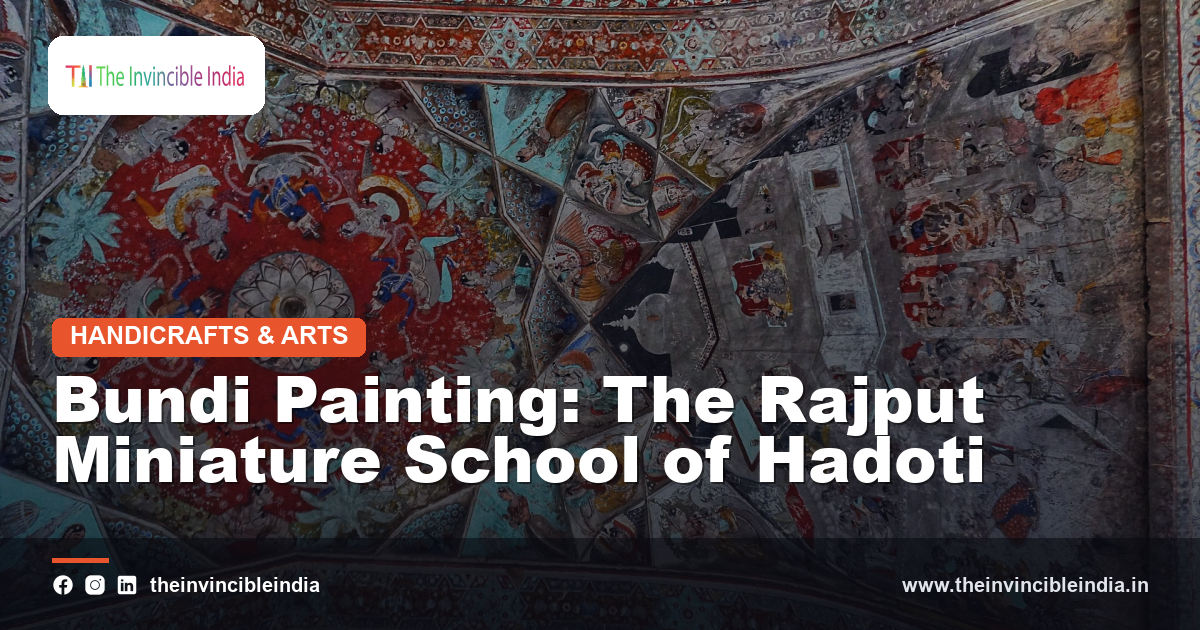
Bundi painting is one of the most poetic of the Rajput miniature schools, produced in the Hadoti region of southeastern Rajasthan, where the walled town of Bundi sits among hills, lakes and forested ravines. The school is known for its luxuriant greens, jewel-like colours, expressive faces and lively scenes of court life, hunting and monsoon skies. Its artists painted miniatures for manuscripts and albums as well as murals for palace walls, and the style later spread to nearby Kota. Where the traditional handicrafts of Rajasthan often celebrate the desert, Bundi painting celebrates a greener landscape. This guide examines the history, features, themes, techniques and continuing legacy of the Bundi school.
Quick Facts
| Detail | Information |
|---|---|
| Type | Rajput miniature and mural painting |
| Region | Hadoti, southeastern Rajasthan |
| Centres | Bundi, with a related school at Kota |
| Signature | Lush greenery, rich colour, lively figures |
| Famed mural site | The Chitrashala within Bundi palace |
| Common themes | Court life, hunting, Krishna, Ragamala |
What Is Bundi Painting
Bundi painting is a school of Rajput miniature art that developed at the court of Bundi in the Hadoti region of Rajasthan. Its works range from small manuscript and album paintings to large murals on palace walls, all sharing a vivid colour sense and a lively feeling for movement and nature. The school is often recognised by its dense, jewel-green foliage, its rich skies and the sense of energy in its figures. Although it belongs to the broader family of Rajput painting, Bundi developed enough character of its own to be counted as a distinct school. Its pictures convey a sense of abundance and vitality that sets them apart from the more austere traditions of desert Rajasthan.
The Hadoti Landscape and Setting
Hadoti is a region of southeastern Rajasthan marked by hills, rivers, lakes and green valleys, a landscape noticeably softer than the arid west of the state. The town of Bundi lies in a narrow cleft among the hills, with a fort and palace rising above the settlement. This natural setting has left a deep imprint on the local school of painting, whose artists took delight in depicting forests, water and monsoon clouds. The surroundings provided both subject matter and inspiration, since hunting parties, garden pavilions and lakeside scenes were part of daily court life. The painting tradition of Bundi is therefore inseparable from the green and watery landscape in which it grew.
Origins and Development of the School
The Bundi school emerged under the rulers of the Hada Rajput line, who governed the region and supported artists at their court. In its early phase, the style absorbed older Rajasthani conventions and gradually refined them into a recognisable manner of its own. Over successive generations of patronage, painters developed a stronger sense of naturalism, a more fluid line and a richer palette. The school did not spring from a single moment but matured as workshops trained apprentices and passed techniques along family lines. This steady development explains why Bundi works show both a connection with wider Rajput traditions and a clear regional individuality.
Court Patronage and the Workshop System
As in other Rajput courts, painting at Bundi was sustained by the patronage of the ruling family, which commissioned artworks for devotion, record and decoration. Painters worked in royal workshops where skills were inherited within families, and where a senior artist directed assistants who prepared paper, ground pigments and filled in outlines. Rulers chose subjects ranging from sacred stories to hunting expeditions and festivals, and their personal tastes shaped the direction of the school. The royal household also built palaces whose walls became large painted surfaces. This partnership between court and craftsman allowed Bundi painting to flourish as both a private art of the album and a public art of the palace.
Characteristic Colour and Palette
Colour is the signature of Bundi painting, which favours rich reds, deep blues, glowing oranges and especially a range of lush greens. Skies are often painted with vivid bands of red, orange or dark cloud, creating a dramatic backdrop for the figures below. Pigments were prepared from minerals and plants, and gold and silver were occasionally used to accent jewellery and decorative details. The overall effect is one of warmth and depth, with colours layered to create a sense of richness without losing clarity. This confident and luminous palette gives Bundi miniatures an instantly appealing quality and has made them favourites among those who study Rajput art.
Nature and the Lush Landscape
Perhaps no other Rajput school pays as much attention to nature as Bundi, whose painters populated their pictures with dense trees, flowering plants, birds and animals. Foliage is rendered in layers of green with tiny, rhythmic leaf patterns, while lotus ponds, streams and rocky outcrops add variety to the scene. Monsoon skies, with swirling clouds and flashes of lightning, are a particular favourite and lend scenes a sense of drama and mood. This sensitivity to the natural world gives Bundi paintings their distinctive freshness. Rather than treating landscape as a mere backdrop, the artists made it an active partner in the emotional and narrative content of the picture.
Figure Style and Facial Features
Figures in Bundi painting are typically depicted with rounded faces, expressive eyes and slender, graceful bodies in lively poses. Faces tend to be shown in profile or three-quarter view, with delicate features and a gentle expression that suits the poetic themes of the school. Costumes are carefully patterned and jewellery is painted with fine detail, while turbans and headdresses help identify rank. The figures are arranged in energetic compositions, whether engaged in a hunt or gathered at a festival. This blend of grace and animation gives the paintings a rhythm that guides the viewer across the scene, balancing individual character with the overall harmony of the composition.
Hunting Scenes and Animals
Hunting scenes are among the most characteristic subjects of Bundi painting, reflecting the importance of the chase in the life of the Rajput court. Riders pursue game through thick forests, elephants carry nobles across the terrain and animals are drawn with a sense of speed and tension. The artists were evidently fond of animals, painting elephants, deer, boar and birds with careful observation and lively movement. These pictures combine action with decoration, as the forest setting is rendered in rich pattern. Beyond recording a favourite royal pastime, hunting paintings allowed artists to display their command of movement, anatomy and landscape in a single, energetic composition.
Court Life, Festivals and Processions
Painters at Bundi also documented the ceremonial and social life of the court, depicting processions, durbar gatherings, music, dance and festival celebrations. Rulers appear enthroned or on horseback, surrounded by attendants and nobles in carefully ordered groups. Seasonal festivals and religious occasions are shown with colourful crowds and decorated settings. These scenes preserved a visual record of courtly ritual while also celebrating the splendour of the ruling house. Their detailed rendering of dress, architecture and ceremony provides valuable insight into the customs of the period. Through such paintings, Bundi art serves as a window onto the social world of the Hadoti court.
Religious Themes and Ragamala
Devotional subjects, especially stories of Krishna and Radha, form an important part of the Bundi repertoire, alongside illustrations of other sacred narratives. Artists also painted Ragamala series, in which musical modes are personified as figures set in scenes that evoke mood and season. In these paintings, the school’s love of natural imagery came into its own, as clouds, forests and gardens help express the emotional character of each raga. Poetry and music thus find visual form in the miniature, reflecting the close ties between the arts in Indian culture. Such works show that Bundi painting served spiritual and aesthetic purposes at the same time as celebrating courtly life.
The Chitrashala of Bundi Palace
One of the most celebrated treasures of the school is the Chitrashala, a painted gallery within the Bundi palace complex whose walls and ceilings are covered with murals. Its paintings depict themes such as Krishna legends, court scenes, festivals and decorative motifs, executed in vivid colour that has retained remarkable freshness. The gallery shows how Bundi painters could transfer the refined manner of the miniature to a much larger scale. For visitors, it offers a rare chance to see the school in its original architectural setting rather than in a museum case. The Chitrashala remains one of the most memorable monuments to the artistic ambition of the Hadoti court.
Materials and Technique
Traditional Bundi miniatures are painted on prepared paper, built from layers that are pressed and burnished to form a smooth, firm surface. The artist begins by drawing the composition in light outline, then applies colour in successive layers, moving from broad areas to finer details. Pigments from minerals and plants are ground and mixed with a natural binder, and extremely fine brushes are used for faces, jewellery and foliage. Gold and silver may be added to highlight ornament. Finished works are often burnished to produce a gentle lustre. Murals follow comparable principles on prepared plaster walls, which require rapid and confident handling by skilled painters.
Relationship with Kota and Other Schools
Bundi painting did not develop in isolation, and its relationship with neighbouring schools is an important part of its story. The nearby Kota school grew from Bundi traditions and became known for its own dramatic hunting scenes, showing how artistic ideas travelled within the Hadoti region. Bundi artists also absorbed influences from the Mughal court and from the Deccan, which shaped details of costume, naturalism and colour. Yet the school retained a strong identity grounded in its local landscape and taste. This pattern of exchange and adaptation is typical of Indian miniature painting, in which regional courts continually borrowed, reworked and reinvented shared artistic ideas.
Decline and Revival of Interest
With changing political and economic circumstances, the patronage that had sustained Bundi painting gradually weakened, and workshops contracted. Later paintings sometimes reflected new influences, while the older courtly tradition faded as a living practice. Over time, scholars, collectors and museums recognised the distinctive achievement of the Bundi school and began to document and preserve its works. Restoration of palace murals and the careful study of surviving miniatures have contributed to a renewed appreciation. This revival of interest has secured the school a respected place in the history of Indian art and encouraged efforts to keep its traditions visible for future generations.
Visiting Bundi and Seeing the Art
Travellers to Bundi can experience the painting tradition directly by visiting the palace and its murals, as well as local museums and craft shops. The town itself, with its stepwells, lakes, havelis and hillside fort, provides the atmosphere in which the school developed. When viewing the murals, visitors benefit from allowing time for the eyes to adjust and for the richness of detail to emerge. Local artists continue to produce miniature paintings in the traditional manner, and purchasing from them supports the craft directly. Seeing the art alongside its landscape helps visitors understand how closely the school was tied to its place.
Bundi Painting Today
Today Bundi painting continues through artists who produce miniatures using traditional pigments, paper and techniques, and through conservation work on historic murals. The style is taught in workshops and appears in decorative objects, prints and contemporary interpretations. It also remains a subject of study in museums and universities, where its landscape imagery and colour are admired. By preserving the methods and motifs of the Hadoti school, practitioners keep alive a tradition that celebrates nature, poetry and courtly life. Bundi painting therefore remains both a historical treasure and a living craft, offering a vivid reminder of the artistic richness of Rajasthan beyond the desert.
Sources & Further Reading
- Ministry of Culture, Government of India, on Indian painting traditions (indiaculture.gov.in).
- Rajasthan Tourism, on the heritage of Bundi and the Hadoti region (tourism.rajasthan.gov.in).
Frequently Asked Questions
What is Bundi painting?
Bundi painting is a Rajput miniature school from the Hadoti region of southeastern Rajasthan. It is known for lush greens, rich colour and lively scenes of court life, hunting and nature.
What makes Bundi painting different from other Rajput schools?
Its detailed treatment of landscape, especially dense foliage and monsoon skies, sets it apart. The figures are graceful and animated, and the palette is warm and luminous.
What is the Chitrashala in Bundi?
The Chitrashala is a painted gallery in the Bundi palace complex whose walls and ceilings are covered in murals. It shows the school’s style on an architectural scale.
What themes appear in Bundi paintings?
Common themes include hunting, court processions, festivals, Krishna legends and Ragamala series. Many works place figures in richly painted natural settings.
How is Bundi painting related to Kota painting?
The Kota school grew out of Bundi traditions and developed its own character, especially in dramatic hunting scenes. Both belong to the artistic culture of the Hadoti region.


