

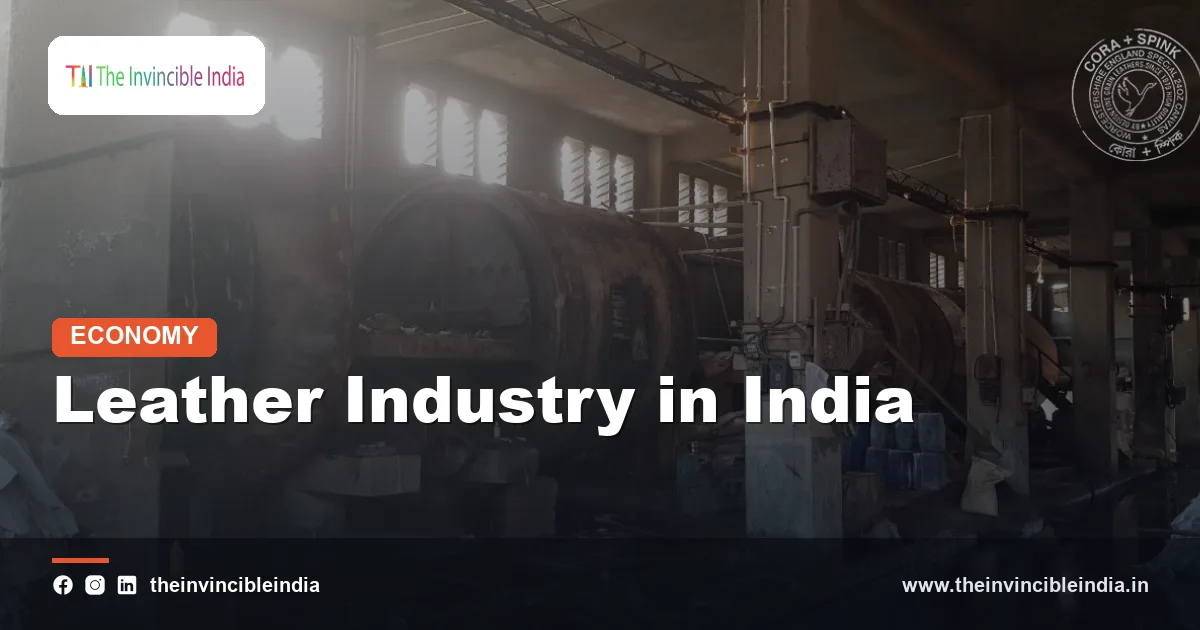
The leather industry in India is one of the country’s oldest manufacturing sectors and a major employer and exporter, covering the full chain from raw hides and skins through tanning to finished footwear, garments, bags, saddlery and other leather goods. India has one of the largest livestock populations in the world, which gives the industry a large domestic supply of raw material, and its products are sold to buyers across Europe, North America and Asia.
The leather industry in India is organised around well-known clusters in Tamil Nadu, Uttar Pradesh, West Bengal, Punjab and other states, and is promoted by the Council for Leather Exports (CLE) and the Ministry of Commerce and Industry. The sector is labour-intensive, has a high share of women and small-scale units, and faces long-standing questions about tannery pollution, raw material access and global competition.
| Attribute | Details |
|---|---|
| Sector | Leather, leather products and footwear |
| Nodal ministry | Ministry of Commerce and Industry (Department for Promotion of Industry and Internal Trade) |
| Export promotion body | Council for Leather Exports (CLE), headquartered in Chennai |
| Research institute | Central Leather Research Institute (CLRI), Chennai, a CSIR laboratory established in 1948 |
| Design and training institute | Footwear Design and Development Institute (FDDI), set up in 1986 with campuses in several cities |
| Major clusters | Kanpur and Unnao, Chennai, Ambur and Ranipet, Kolkata, Agra, Jalandhar |
| Main products | Finished leather, footwear, leather garments, handbags, belts, wallets, saddlery and harness |
| Main export markets | The United States, Germany, the United Kingdom, Italy, France and Spain |
Key Takeaways
- The leather industry in India is a labour-intensive sector that employs a large workforce, with a substantial share of women and a strong presence of micro, small and medium enterprises.
- India’s main leather clusters are Kanpur and Unnao in Uttar Pradesh, Chennai, Ambur and Ranipet in Tamil Nadu, Kolkata in West Bengal, Agra in Uttar Pradesh and Jalandhar in Punjab.
- The Council for Leather Exports (CLE), based in Chennai, is the main export promotion council for leather and footwear and works under the Ministry of Commerce and Industry.
- Footwear and footwear components make up the largest share of India’s leather product output, followed by finished leather, garments and accessories.
- Chrome tanning is the dominant tanning method in India and is also the main source of effluent concerns, which have led to court orders and investment in common effluent treatment plants.
- The industry’s main challenges are environmental compliance, competition from other producing countries, limits on raw hide availability and the effect of cattle-trade regulation on supply.
What is the leather industry in India?
The leather industry in India is the group of businesses that collect hides and skins, tan them into leather, and manufacture goods such as shoes, bags, jackets and saddlery for domestic sale and export. It is one of the country’s oldest crafts, and tanning and leatherwork have been practised in India for many centuries as both a village trade and an organised industry.
In the modern economy the industry is usually divided into three broad segments. The first is tanning and finishing, which converts raw hides and skins into stable leather. The second is footwear and footwear components, which is the largest end-use. The third is leather goods and garments, which include handbags, belts, wallets, gloves, jackets and saddlery. A related segment makes non-leather and synthetic footwear, which is often counted in the same policy framework.
The sector is important to the Indian economy for three reasons: it provides jobs to many people at modest levels of education, it earns export income from finished products, and it adds value to a by-product of the meat and dairy sectors that would otherwise have limited use.
How is leather made in India, from raw hide to finished product?
Leather in India is made by cleaning raw hides and skins, treating them with tanning agents to stop decay, and then dyeing, finishing and cutting the material into products. The steps are broadly similar across the world, but local practice varies between small village units and large export-oriented tanneries.
Stages of leather production
- Collection and preservation: Hides and skins from cattle, buffalo, goats and sheep are salted or otherwise preserved soon after flaying to prevent spoilage.
- Beam house operations: The raw material is soaked, limed, unhaired, fleshed and delimed to prepare it for tanning.
- Tanning: The hide is treated with chromium salts or vegetable tannins to convert it into leather that does not rot. Chrome-tanned leather at the intermediate stage is known as wet blue.
- Retanning, dyeing and fatliquoring: The leather is coloured and softened, and its feel and strength are adjusted for its end use.
- Finishing: Surface coatings and embossing give the leather its final look, and the result is called finished leather.
- Manufacturing: Finished leather is cut and stitched into footwear, bags, garments and other products, often in separate units from the tanneries.
Chrome tanning is faster and gives soft, durable leather, so it dominates the Indian industry. Vegetable tanning uses natural tannins from bark and plants, and it is traditional in parts of Tamil Nadu and in the production of sole leather, saddlery and some craft goods.
Which are the major leather clusters in India?
The major leather clusters in India are Kanpur and Unnao in Uttar Pradesh, Chennai, Ambur and Ranipet in Tamil Nadu, Kolkata in West Bengal, Agra in Uttar Pradesh and Jalandhar in Punjab. Each has a distinct specialisation that grew out of local history, labour and market access.
| Cluster | State | Known for |
|---|---|---|
| Kanpur and Unnao | Uttar Pradesh | Tanning, saddlery, harness and finished leather; one of the oldest industrial leather centres |
| Chennai, Ambur, Ranipet and Vaniyambadi | Tamil Nadu | Large tanning base, finished leather and footwear; the largest export-oriented concentration |
| Kolkata | West Bengal | Tanning, leather goods and footwear, with a planned leather complex at Bantala |
| Agra | Uttar Pradesh | Footwear manufacturing, especially shoes for domestic and export markets |
| Jalandhar | Punjab | Tanning, sports goods and leather-based products |
Other centres add to the picture. The Delhi National Capital Region, Noida, Ghaziabad and Karnal-Panipat in Haryana have footwear and accessories units. Mumbai has the Dharavi leather trade, Maharashtra’s Kolhapur is known for its traditional Kolhapuri chappals, which carry a Geographical Indication tag, and Bengaluru, Hyderabad and Dindigul have smaller clusters.
What does the leather industry produce?
The leather industry in India produces finished leather, footwear and its components, leather garments, handbags, small leather goods, saddlery and harness, and gloves. Footwear is the largest category by value and volume among leather products.
- Finished leather: Sold to domestic manufacturers and exported, including as semi-finished wet blue and crust leather.
- Footwear: Includes formal and casual shoes, sandals, safety shoes and uppers, with a large share produced for export brands.
- Footwear components: Soles, insoles, uppers and linings, which supply both domestic and foreign assemblers.
- Leather garments: Jackets, coats and fashion apparel, a segment where India is among the established global suppliers.
- Leather goods and accessories: Handbags, wallets, belts, travel goods and personal accessories.
- Saddlery and harness: Equestrian products, a specialty especially associated with Kanpur and Unnao.
A notable segment is the production of footwear that is not made of leather, using rubber, plastics and synthetic materials. India has a very large domestic market for such footwear, and several large Indian companies concentrate on it.
Who runs and promotes the leather industry?
The leather industry in India is promoted by the Council for Leather Exports (CLE) and supported by the Department for Promotion of Industry and Internal Trade under the Ministry of Commerce and Industry. These bodies provide export promotion, policy input, training and trade fair support, while the industry itself is made up mostly of private firms.
Key institutions
- Council for Leather Exports (CLE): The apex export promotion council for leather, leather products and footwear, headquartered in Chennai. It organises trade fairs, buyer-seller meets and delegations, and represents exporters before the Government.
- Central Leather Research Institute (CLRI): A laboratory of the Council of Scientific and Industrial Research (CSIR) in Chennai, founded in 1948, which carries out research on tanning, processing and cleaner technologies.
- Footwear Design and Development Institute (FDDI): An institute under the Government that trains designers and technicians for the footwear and leather sectors.
- Central Footwear Training Institute: Training bodies at centres such as Agra and Chennai that supply skilled workers.
- Leather Sector Skill Council: The sector skills body that sets training standards.
The Government has also run a programme for the development of the leather and footwear sector, which has supported new technology, common facilities, mega clusters and environmental upgrades. The broader industrial approach also uses initiatives such as Make in India and the production-linked incentive schemes, along with state-level policies in Tamil Nadu and Uttar Pradesh.
Which brands and buyers are linked to Indian leather?
Indian leather and footwear are linked to a mix of domestic brands, large Indian manufacturer-exporters and overseas fashion and footwear buyers who source from Indian factories. Many Indian exporters work as contract manufacturers for foreign labels instead of selling under their own names.
- Domestic and Indian brands: Bata India, Liberty Shoes, Metro Brands, Hidesign, Woodland, Red Tape, Lavie and Mirza International are widely known names in footwear and leather goods, and Relaxo is a major name in non-leather footwear.
- Large manufacturer-exporters: Companies in Chennai, Ambur, Kanpur and Agra supply finished leather and footwear to international brands.
- Overseas buyers: European and American footwear, fashion and luxury houses and department-store chains source leather, shoes and accessories from India.
- Export destinations: The United States, Germany, the United Kingdom, Italy, France and Spain are among the main markets for Indian leather products.
Hidesign, founded in Puducherry in 1978, is often cited as an example of an Indian brand that built an international profile in premium leather bags. Indian exporters have also benefited from preferential trade arrangements with some buying countries.
How big is the leather industry in India and who works in it?
The leather industry in India is among the country’s larger employment-generating manufacturing sectors, with a workforce that runs into the millions across tanning, footwear, components and goods, and it is also one of the larger earners of export income from labour-intensive manufacturing. India is generally ranked among the leading producers of footwear and leather garments in the world, and its large cattle, buffalo, goat and sheep population supplies a major share of the raw material.
The workforce has some distinct features. A large proportion of workers are women, especially in footwear and goods units in Tamil Nadu. Most enterprises are small or medium, and many work informally, which affects wages, safety and social security. Tanning and leatherwork have historically been associated with particular communities, and a sizeable part of the workforce comes from socially and economically disadvantaged groups, so job quality in this sector is closely linked to wider questions of social development.
What are the environmental challenges of the leather industry?
The main environmental challenge of the leather industry in India is wastewater from tanneries, which contains salts, organic matter, and in chrome tanning, chromium compounds that can contaminate rivers and groundwater. This has made tannery regulation one of the most visible issues in the sector.
- Effluent discharge: Clusters such as Jajmau in Kanpur on the Ganga and the Palar river belt in Tamil Nadu have faced long-running pollution concerns.
- Court and tribunal action: The Supreme Court, the National Green Tribunal and state pollution control boards have ordered closures, relocation or upgrades of tanneries that did not meet standards.
- Common effluent treatment plants (CETPs): Clusters use shared treatment plants to treat tannery wastewater, and several Tamil Nadu units have moved towards zero liquid discharge systems.
- Solid waste and chemicals: Fleshings, trimmings and chromium-bearing sludge need safe disposal, and workplace exposure to chemicals is a health concern.
- Compliance cost: Small tanneries struggle to afford treatment systems, which has pushed consolidation and relocation to planned leather complexes.
Research bodies such as the CLRI promote cleaner processes, including chrome recovery, salt-free preservation and less polluting chemicals. Global buyers increasingly ask for environmental certifications, so cleaner production has become a commercial requirement as well as a legal one.
What other challenges does the leather industry face?
The leather industry in India faces competition from other producing countries, pressure on raw material supply, changing consumer preferences and the need to improve productivity and design. Beyond pollution, these factors shape the future of the sector.
Competition and market access
Countries such as China, Vietnam, Bangladesh and Indonesia are major competitors in footwear and leather goods, often with larger scale or lower costs. Indian exporters therefore look for trade agreements that reduce import duties in key markets, and they seek to move from basic manufacturing toward design-led and higher-value products.
Raw material and cattle-trade issues
Hides and skins are by-products of the meat and dairy sectors, so their availability depends on animal slaughter, natural mortality and the rules governing cattle trade. State laws restricting cow slaughter and rules on cattle sale at animal markets have affected hide supply and the livelihoods of people involved in the trade, and these rules have been the subject of litigation and debate. The industry has relied on buffalo, goat and sheep hides as well as imports of some raw material and semi-finished leather.
Changing demand
Growing interest in synthetic and plant-based alternatives, sometimes marketed as vegan leather, adds a new element of competition. Fast-changing fashion, buyers’ compliance demands and the need for traceability also require investment that many small firms find hard to make.
What is the outlook for the leather industry in India?
The outlook for the leather industry in India depends on its ability to modernise, clean up production and move into higher-value goods while keeping its employment base. The sector has strong advantages in raw material, skills and a large domestic market for footwear.
- Government support has focused on mega leather and footwear clusters, common facilities and skill development.
- Tamil Nadu and Uttar Pradesh have promoted dedicated footwear and leather parks to attract investment.
- Exporters are trying to increase the share of finished products, which earn more than raw or semi-finished leather.
- Upgrading of effluent treatment and global certification is expected to remain a condition for access to major buyers.
- Design, branding and automation are seen as the ways to compete with lower-cost producers.
Industry bodies and policymakers generally treat footwear and leather as one of the sectors with the best potential to create formal jobs, particularly for women and for workers in smaller towns.
Bottom Line
The leather industry in India combines a deep craft tradition with a large export-oriented manufacturing base, clustered in a handful of well-known centres. Its future turns on cleaner tanning, reliable raw material, better design and a steady move up the value chain, while keeping the many jobs that make it important.
Frequently Asked Questions
What is the leather industry in India known for?
The leather industry in India is known for tanning, footwear, leather garments, bags and saddlery, and for employing a large and labour-intensive workforce. It is also an established exporter to Europe and North America. Footwear is the largest product category.
Which cities are the main centres of leather production in India?
The main centres are Kanpur and Unnao, Chennai, Ambur and Ranipet, Kolkata, Agra and Jalandhar. Tamil Nadu has the largest export-oriented concentration, Kanpur is known for saddlery and tanning, and Agra is a major footwear centre. Delhi NCR, Karnal, Kolhapur and Dindigul have smaller clusters.
What is the Council for Leather Exports?
The Council for Leather Exports (CLE) is the apex export promotion council for the leather, leather products and footwear sector and is based in Chennai. It works under the Ministry of Commerce and Industry. It organises trade fairs and buyer meetings and represents exporters in policy discussions.
Why is the leather industry in India criticised for pollution?
Tanneries produce wastewater containing salts, organic matter and, in chrome tanning, chromium compounds that can contaminate rivers and groundwater. Clusters such as Jajmau in Kanpur and parts of Tamil Nadu have faced court orders and closures. Common effluent treatment plants and zero liquid discharge systems are the main response.
Where does India get raw hides and skins for leather?
India’s raw hides and skins come mainly from cattle, buffalo, goats and sheep, as by-products of the meat and dairy sectors and of natural mortality. The country has one of the largest livestock populations in the world. Cattle-trade and slaughter regulations influence how much supply reaches tanneries.
Who are the main buyers of Indian leather products?
The main buyers are footwear, fashion and retail companies in the United States, Germany, the United Kingdom, Italy, France and Spain. Many Indian factories make products for foreign labels as contract manufacturers. Domestic demand is also large, served by brands such as Bata India, Liberty Shoes, Metro Brands and Hidesign.
{“@context”:”https://schema.org”,”@graph”:[{“@type”:”FAQPage”,”mainEntity”:[{“@type”:”Question”,”name”:”What is the leather industry in India known for?”,”acceptedAnswer”:{“@type”:”Answer”,”text”:”The leather industry in India is known for tanning, footwear, leather garments, bags and saddlery, and for employing a large and labour-intensive workforce. It is also an established exporter to Europe and North America. Footwear is the largest product category.”}},{“@type”:”Question”,”name”:”Which cities are the main centres of leather production in India?”,”acceptedAnswer”:{“@type”:”Answer”,”text”:”The main centres are Kanpur and Unnao, Chennai, Ambur and Ranipet, Kolkata, Agra and Jalandhar. Tamil Nadu has the largest export-oriented concentration, Kanpur is known for saddlery and tanning, and Agra is a major footwear centre. Delhi NCR, Karnal, Kolhapur and Dindigul have smaller clusters.”}},{“@type”:”Question”,”name”:”What is the Council for Leather Exports?”,”acceptedAnswer”:{“@type”:”Answer”,”text”:”The Council for Leather Exports (CLE) is the apex export promotion council for the leather, leather products and footwear sector and is based in Chennai. It works under the Ministry of Commerce and Industry. It organises trade fairs and buyer meetings and represents exporters in policy discussions.”}},{“@type”:”Question”,”name”:”Why is the leather industry in India criticised for pollution?”,”acceptedAnswer”:{“@type”:”Answer”,”text”:”Tanneries produce wastewater containing salts, organic matter and, in chrome tanning, chromium compounds that can contaminate rivers and groundwater. Clusters such as Jajmau in Kanpur and parts of Tamil Nadu have faced court orders and closures. Common effluent treatment plants and zero liquid discharge systems are the main response.”}},{“@type”:”Question”,”name”:”Where does India get raw hides and skins for leather?”,”acceptedAnswer”:{“@type”:”Answer”,”text”:”India’s raw hides and skins come mainly from cattle, buffalo, goats and sheep, as by-products of the meat and dairy sectors and of natural mortality. The country has one of the largest livestock populations in the world. Cattle-trade and slaughter regulations influence how much supply reaches tanneries.”}},{“@type”:”Question”,”name”:”Who are the main buyers of Indian leather products?”,”acceptedAnswer”:{“@type”:”Answer”,”text”:”The main buyers are footwear, fashion and retail companies in the United States, Germany, the United Kingdom, Italy, France and Spain. Many Indian factories make products for foreign labels as contract manufacturers. Domestic demand is also large, served by brands such as Bata India, Liberty Shoes, Metro Brands and Hidesign.”}}]}]}


