

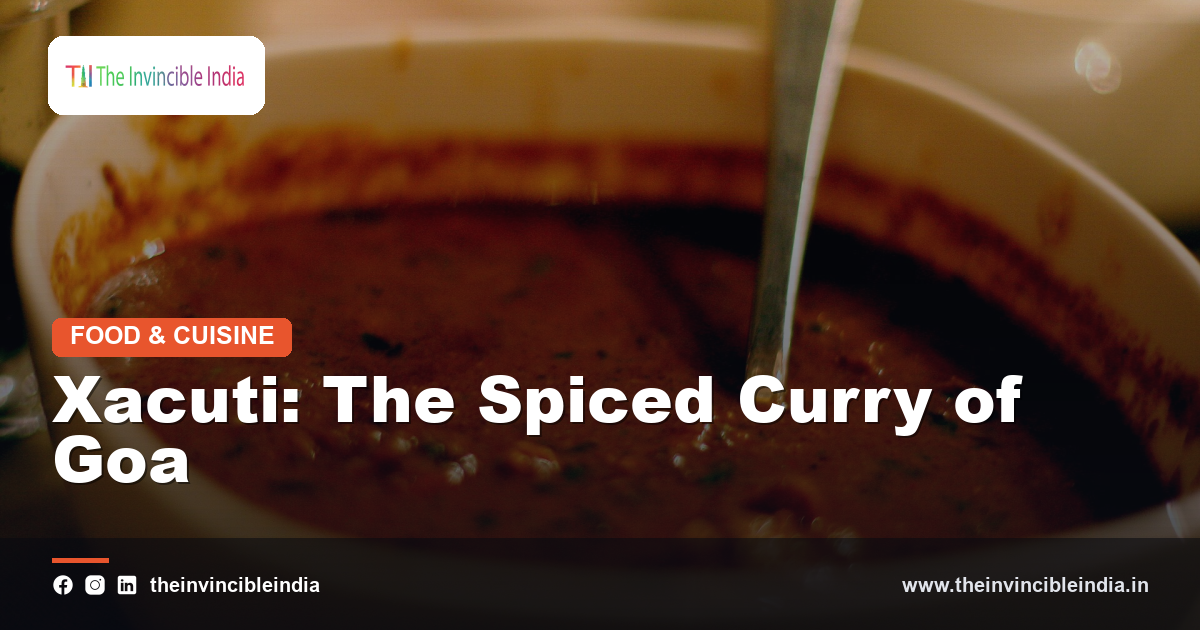
Few dishes capture the layered character of Goan cooking as completely as xacuti, a dark, aromatic curry whose flavour comes from freshly roasted coconut, poppy seeds and a generous blend of whole spices. Pronounced roughly as shaa-koo-tee, the dish is a celebration of the Konkan coast, where coconut, chillies and fragrant spices meet the culinary influences brought by centuries of trade and cultural contact. It is a dish for festive tables and Sunday lunches alike, and its complexity rewards patience in the kitchen. Much as the many spices explored in the Indian spices guide define the country’s cooking, the spice blend defines xacuti. This guide examines its heritage, ingredients, technique and enduring place in Goan food.
Quick Facts
| Detail | Information |
|---|---|
| Dish Type | Spiced coconut-based curry |
| Region | Goa, Konkan coast |
| Key Ingredients | Roasted coconut, poppy seeds, chillies |
| Common Protein | Chicken, also lamb, mutton, seafood |
| Typical Accompaniment | Pao bread or steamed rice |
| Flavour Profile | Rich, nutty, aromatic, moderately hot |
What Is Xacuti
Xacuti is a richly spiced curry from Goa, defined by a thick gravy made from roasted grated coconut, white poppy seeds, dried red chillies and a wide assortment of whole spices. Unlike simpler coconut curries, its masala is dry roasted before grinding, which gives the sauce a deep brown colour, a nutty fragrance and a distinctly complex flavour. The dish is most commonly prepared with chicken, though lamb, mutton, seafood and vegetables are also used. It is generally moderately hot, and its warmth is balanced by the sweetness of coconut and the tang of tamarind. Xacuti occupies a special position among Goan curries as one of the most elaborate and flavourful. This combination of roasted coconut, aromatic spices and careful balance is what defines xacuti and makes it a standout dish of the coastal state.
Name and Pronunciation
The name xacuti is spelled in the Portuguese-influenced manner common to many Goan words, in which the letter x represents a soft sh sound. It is therefore pronounced approximately as shaa-koo-tee, and it is also written in some places as shagoti, sacuti or shacuti. This spelling reflects the long period of Portuguese presence on the Goan coast, which left its mark on language, religion, architecture and cuisine alike. Many Goan dishes carry names that blend Konkani and Portuguese elements, and xacuti is one of the best-known examples. Understanding the name helps visitors and readers approach the dish correctly and appreciate the layered history behind it. The unusual spelling of xacuti is itself a small reminder of Goa’s mixed cultural heritage, in which local and European influences have long been woven together.
Goan Culinary Heritage
Goan cuisine is a distinctive regional tradition shaped by geography, religion and history. The coastal setting provides abundant coconut, rice and seafood, while the state’s Hindu and Catholic communities have each developed their own culinary customs, sharing many dishes while differing in others. The centuries of contact with Portuguese traders and settlers introduced new techniques, ingredients and tastes, which were absorbed and transformed by local cooks. The result is a cuisine that is recognisably Indian yet clearly different from the food of neighbouring regions, with its own balance of heat, sourness and sweetness. Xacuti belongs to this tradition and reflects its blending of local ingredients with wider influences. The curry stands as an expression of Goa’s culinary heritage, in which coastal produce, community customs and historical exchange combine to create flavours found nowhere else.
Origins and Influences
The exact origins of xacuti are not firmly documented, and food historians generally describe the dish in broad terms as a product of Goan kitchens. Its base of coconut and ground spices is closely related to the cooking traditions of the Konkan coast, while its spelling and some aspects of its presentation reflect the Portuguese era. Some accounts suggest that the dish was developed in Goan households that wished to showcase spices as a mark of hospitality and prosperity, though such stories are best treated as tradition rather than established fact. What is clear is that xacuti has been a part of Goan celebrations and family meals for generations. The uncertainty about its precise beginnings does not diminish its importance, and the origins of xacuti are best understood as a gradual evolution within Goan kitchens rather than the invention of any single moment.
Coconut as the Foundation
Coconut is the backbone of xacuti, as it is of much cooking along India’s western coast. Freshly grated coconut is dry roasted until it turns a deep golden brown, a step that transforms its raw sweetness into a toasty, almost smoky richness. When ground with spices, the roasted coconut forms the thick, creamy body of the gravy and carries the aromatic flavours throughout the dish. The degree of roasting matters greatly, because under-roasted coconut tastes bland, while over-roasted coconut turns bitter. Cooks watch the colour and fragrance closely to catch the exact moment of readiness. The careful treatment of coconut in xacuti shows how a single ingredient can be given new depth through technique, and it explains why the roasted coconut base is regarded as the foundation of the curry’s character.
The Spice Mix
The distinguishing feature of xacuti is its abundant and varied masala. Coriander seeds, cumin, black peppercorns, cloves, cinnamon, star anise, nutmeg, fennel and turmeric are among the spices commonly included, along with dried red chillies for heat and colour. Not every household uses precisely the same combination, and many families guard their own proportions as a point of pride. Together the spices produce a flavour that is warm, sweet, peppery and faintly floral all at once, with no single note dominating. Because many of the spices are used whole and roasted before grinding, their essential oils are released and their aromas intensified. The rich and balanced spice mix is the soul of xacuti, and it is this carefully assembled masala that gives the curry its unmistakable fragrance and sets it apart from other Goan dishes.
Chillies and Poppy Seeds
Two ingredients deserve particular mention for their role in xacuti. Dried red chillies, often of milder, deeply coloured varieties, provide warmth and the dish’s characteristic russet tone without overwhelming the other spices. White poppy seeds, known as khus khus, are lightly roasted and ground with the masala, where they thicken the gravy and lend a subtle, nutty creaminess. Their use is one of the features that separates xacuti from many other coconut curries and contributes to its velvety consistency. Tamarind or a similar souring agent is added to balance the richness with a gentle tang. The interplay of chillies, poppy seeds and tamarind gives xacuti its rounded character, and understanding how these ingredients work together is key to appreciating why the curry feels both rich and lively on the palate.
Roasting and Grinding
The preparation of the masala is the most labour-intensive and important stage of making xacuti. Each spice, along with the coconut and poppy seeds, is typically roasted separately in a dry pan so that it reaches its ideal aroma without burning, since different ingredients roast at different speeds. The roasted components are then ground, traditionally on a stone, with a little water or tamarind liquid to form a smooth, fragrant paste. Stone grinding is valued for the texture and flavour it produces, although modern kitchens commonly use electric grinders. The paste is the heart of the dish, and its quality determines the quality of the curry. This patient work of roasting and grinding, performed with attention to each ingredient, is what transforms a list of spices into the deep, harmonious masala that defines xacuti.
Cooking the Curry
Once the masala is ready, the cooking itself is relatively straightforward. Onions are fried in oil or ghee until soft and golden, often with ginger and garlic, and the meat is added and browned lightly. The ground masala is then stirred in and cooked until the oil begins to separate, a sign that the raw flavours have mellowed and blended. Water or coconut milk is added to form the gravy, and the curry is simmered gently until the meat is tender and the sauce has thickened to a rich consistency. A final adjustment of salt and tamarind completes the dish. The sequence of frying, browning, adding the masala and simmering slowly allows the flavours to develop fully, and this steady, patient method of cooking the curry ensures a gravy of depth and balance.
Chicken Xacuti and Other Proteins
Chicken is the most popular choice for xacuti, and chicken xacuti is the version most widely served in homes and restaurants. The meat absorbs the masala well, and its mild flavour allows the spices to shine. Lamb and mutton are also used, producing a heartier and more robust curry that requires longer cooking, and some households prepare the dish with beef or pork, in keeping with the customs of particular communities. Duck and other meats appear in some festive preparations. The choice of protein affects cooking time and the intensity of the final dish, but the masala remains the common thread. The flexibility of xacuti across different meats shows that the curry is defined more by its spice paste than by any one ingredient, allowing it to suit a wide variety of tables and occasions.
Seafood and Vegetarian Versions
Given Goa’s coastal setting, xacuti is also prepared with seafood, including prawns and fish, though the cooking time is shorter and the masala may be adjusted so that it does not overpower the delicate flesh. Vegetarian versions use ingredients such as potatoes, cauliflower, mushrooms, peas or seasonal vegetables, which absorb the rich gravy well and make a satisfying meatless meal. Some cooks adapt the masala slightly for these versions, reducing the chilli or adding a little extra coconut. These variations make xacuti accessible to a wider range of diners and demonstrate the adaptability of the underlying masala. The existence of seafood and vegetarian forms of the curry shows how a classic preparation can be extended while preserving its essential flavour, giving everyone a way to enjoy the aroma and richness of xacuti.
Flavour Profile and Colour
A well-made xacuti is dark brown to deep reddish in colour, with a thick, clinging gravy that coats the meat. The flavour opens with the toasty sweetness of roasted coconut, followed by the warmth of chillies and pepper, the fragrance of cloves, cinnamon and star anise, and a gentle tang from tamarind. The poppy seeds contribute a smooth, nutty undertone that rounds out the sauce. The dish is spicy but not harsh, and its heat is meant to be a part of a larger harmony rather than the dominant note. Each spoonful reveals a slightly different combination of flavours as the spices unfold. The distinctive colour, depth and balance of xacuti are the visible and tasteable results of careful roasting, and they define the sensory identity of this celebrated Goan curry.
Pao, Rice and Accompaniments
Xacuti is traditionally enjoyed with soft Goan bread rolls known as pao, which are torn and used to mop up the rich gravy, or with plain steamed rice that offers a neutral base for the intense sauce. In some households it is served with other breads or with rotis. A simple side of sliced onions, lemon wedges and a fresh salad provides crisp contrast to the richness of the curry. The mildness of the bread and rice tempers the heat and allows the layered spice flavours to be appreciated slowly. Pairing is an important part of Goan dining, and xacuti is rarely eaten without a suitable accompaniment. The combination of the robust curry with soft bread or rice completes the meal and demonstrates the care with which Goan cooks balance flavour, texture and comfort.
Xacuti Among Goan Curries
Goa has a rich repertoire of curries and meat dishes, each with its own flavour profile. Vindaloo is known for its sharp tang and heat, cafreal for its green herb marinade, and sorpotel for its rich, tangy blend of meats, while the everyday fish curry relies on coconut and a sour note of kokum or tamarind. Xacuti stands apart for its dark, roasted, nutty masala and its comparatively mellow, aromatic warmth. Each dish occupies its own place at the table, and Goan cooks often serve several together at festive meals. Comparing these preparations helps clarify what is unique about each. Within this wider family of curries, xacuti holds a distinguished place as the most spice-rich and aromatic, admired for the complexity that its roasted masala brings to the Goan table.
Festive and Everyday Occasions
Xacuti is commonly prepared for celebrations, family gatherings and weekend meals, when cooks have time to prepare the masala properly. It features on tables during festivals and community occasions, and many families associate it with special Sunday lunches. Restaurants in Goa and in other parts of India list it as one of the dishes visitors should try, and it appears on menus alongside other regional favourites. Because of the effort required, it has often been regarded as a dish of occasion rather than an everyday staple, though ready-made masalas have made it easier to prepare. Whether served at a feast or a quiet family meal, xacuti carries a sense of care and generosity, and its close association with festive and weekend dining reinforces its status as a dish meant to be shared and savoured.
Home Kitchens and Regional Adaptations
In Goan homes, the recipe for xacuti is often handed down from one generation to the next, with each family adjusting the proportions of spices, the level of heat and the degree of roasting to suit its own taste. Restaurants outside Goa have also adapted the dish, sometimes making it milder or using prepared masala pastes, and as a result the version found in a distant city may differ from the one served in a Goan village. Some cooks add coconut milk, others a touch of jaggery, and still others vary the souring agent. These adaptations show the vitality of the dish and its capacity to travel. The variation between home kitchens and restaurants demonstrates that xacuti is a living tradition, continually reinterpreted while keeping the roasted coconut and spice masala at its centre.
Xacuti Today
Today xacuti remains one of the most admired dishes of Goan cuisine, enjoyed by residents, visitors and the wider Goan diaspora alike. It is served in homes, beach-side restaurants and fine dining establishments, and its popularity has carried it into menus across India and abroad. Food writers and chefs continue to explore and reinterpret the dish, while many families work to preserve traditional methods of roasting and grinding the masala by hand. The curry also serves as a gateway to understanding Goa’s broader culinary heritage, in which coastal ingredients, community customs and historical exchange meet. As interest in regional Indian food grows, xacuti is increasingly recognised as a masterpiece of spice craft. In its continuing popularity and the care devoted to its preparation, xacuti today stands as a flavourful symbol of Goa’s living food heritage.
Sources & Further Reading
- Ministry of Tourism, Government of India, on the cuisines of India (tourism.gov.in).
- Goa Tourism, Government of Goa (goatourism.gov.in).
Frequently Asked Questions
What is xacuti?
Xacuti is a Goan curry made with a masala of roasted coconut, white poppy seeds, dried red chillies and whole spices. It has a thick, dark gravy and a rich, aromatic flavour, and it is most commonly prepared with chicken.
How do you pronounce xacuti?
Xacuti is pronounced approximately as shaa-koo-tee, because the letter x in Portuguese-influenced Goan spelling represents a sh sound. The dish is also sometimes written as shagoti or shacuti.
What makes xacuti different from other Goan curries?
Xacuti is distinguished by its dry-roasted coconut and large blend of whole spices, along with the use of poppy seeds. This gives it a darker colour and a nuttier, more complex flavour than simpler coconut-based curries.
Is xacuti very spicy?
Xacuti is moderately hot, with warmth from dried red chillies and black pepper, but the heat is balanced by coconut, poppy seeds and tamarind. The level of chilli can be adjusted according to taste.
What is xacuti usually eaten with?
Xacuti is traditionally eaten with Goan pao bread, which is used to scoop up the gravy, or with steamed rice. A salad of sliced onion and lemon wedges often accompanies it.


