

Rising abruptly from the flat plain beside the Kaveri River, the great rock of Tiruchirapalli is among the most recognisable landmarks in Tamil Nadu. The Rockfort Temple complex, as it is commonly called, is not one monument but a layered sacred and strategic landscape, combining ancient cave shrines, a Shiva temple set into the hillside and a Ganesha temple crowning the summit. Its story runs from early rock-cut architecture through the Pallava, Chola, Nayak and later periods, and it belongs to the same lineage of monumental stone heritage described in the guide to rock-cut architecture in India. This guide explores the rock, its shrines, its legends and its continuing role in the life of the city.
Quick Facts
| Detail | Information |
|---|---|
| Location | Tiruchirapalli, Tamil Nadu |
| Type | Rock fort and temple complex |
| Summit Shrine | Ucchi Pillayar (Ganesha) Temple |
| Mid-Level Shrine | Thayumanaswamy Temple (Shiva) |
| Early Caves | Pallava-era rock-cut shrines |
| Nearby River | Kaveri |
An Overview of the Rockfort
The Rockfort of Tiruchirapalli is a massive outcrop of ancient rock that dominates the skyline of the city and gives it its most enduring image. Rather than a single building, the complex is a sequence of shrines, stairways, pillared halls and fortified walls distributed across the rock from its base to its summit. Visitors ascend through a covered approach lined with shops and small shrines before the stone steps begin in earnest, and each level of the climb introduces a different chapter of the site’s history. The rock has served as a place of worship, a royal stronghold and a lookout over the surrounding country for well over a thousand years. This combination of sacred and military functions is what makes the Rockfort distinctive, and it explains why the complex is treated as a landmark of both religious devotion and regional heritage.
The Geological Setting of the Rock
The rock on which the complex stands is part of the very old crystalline bedrock that underlies much of peninsular India, and it survives here as an isolated mass because the softer surrounding ground has been worn away over an immense span of time. Such standing outcrops are a familiar feature of the Tamil country, and many of them became natural sites for shrines and fortresses. At Tiruchirapalli the rock is large, steep and smooth enough to have made both defence and carving practical, since builders could cut chambers and steps directly into the stone instead of hauling material to a high position. The hard, weathered surface also gives the hill its characteristic pale, rounded appearance against the green of the Kaveri valley. The geology of the rock is therefore inseparable from its later history, because the stone itself invited the temples and fortifications that came to crown it.
Tiruchirapalli and the Kaveri Plain
Tiruchirapalli sits at a crossing of routes on the fertile plain watered by the Kaveri River, and its position has long given it importance in the politics of the south. The river supported rich agriculture, which in turn sustained kingdoms, temple towns and trade, and the Rockfort stood at the centre of this landscape as a visible marker of power and piety. Nearby stands the island temple town of Srirangam, one of the great centres of Vaishnava devotion, which shares the same river setting and is visible from the heights of the rock. The proximity of these two famous sacred places helped shape the region’s identity as a meeting point of Shaiva and Vaishnava traditions. The location of the Rockfort, between river, plain and pilgrimage town, explains much of its long prominence.
Early History and the Cave Temples
The earliest layer of built heritage at the Rockfort consists of cave temples cut into the rock, which place the site within the wider story of early rock-cut architecture in South India. These excavated shrines belong to a tradition in which sanctuaries were carved directly from living stone, with pillars, cells and sculpted panels shaped from the hillside itself. Such work required careful planning, because the carver could not add material once it had been removed, and the resulting chambers remain among the most compact and elegant expressions of the early southern style. The caves at Tiruchirapalli are associated with the early medieval rulers who patronised temple building in the region, and they show that the rock was sacred long before it became a fortress. The cave temples form the historical foundation upon which the later shrines and defences were layered.
The Pallava Rock-Cut Caves
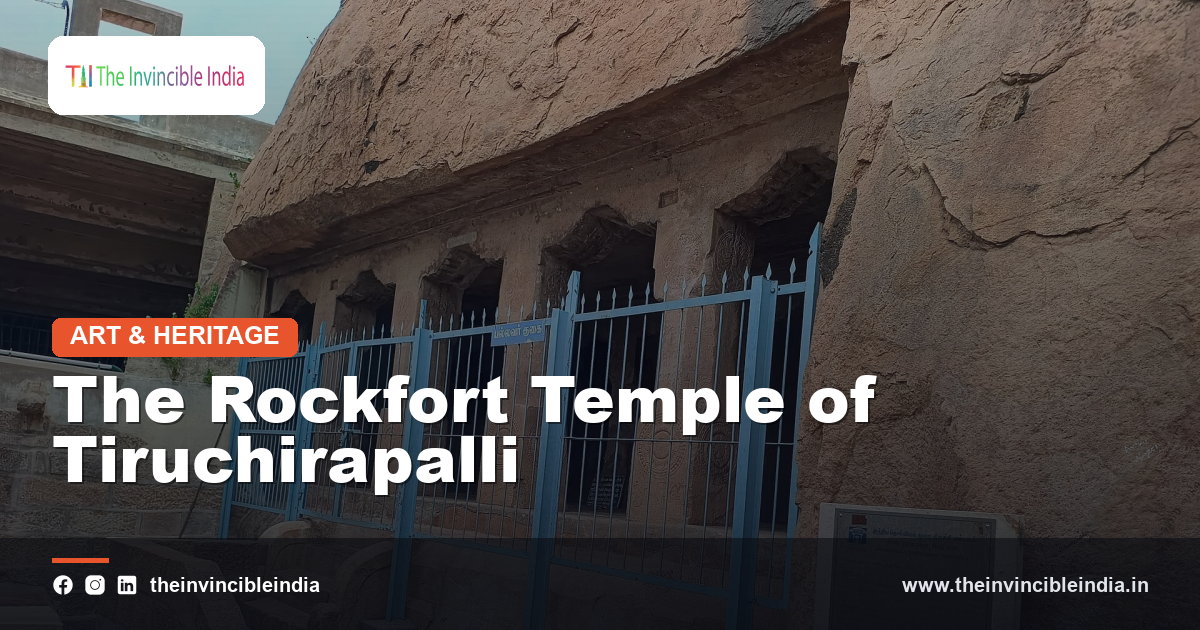
The cave temples of the Rockfort are commonly linked with the Pallava dynasty, whose rulers are celebrated for introducing durable stone architecture to the Tamil country. Pallava cave shrines are typically simple in plan, with a columned front, a modest hall and one or more sanctum cells, and they rely on proportion and restrained carving rather than elaborate ornament. The lower cave at Tiruchirapalli, reached at the foot of the rock, preserves this character and includes sculpted panels and inscriptions that have interested historians and epigraphists. Its pillars and carved figures demonstrate the early confidence of a style that would later grow into the great structural temples of the south. Viewed beside the more famous Pallava monuments elsewhere, the Rockfort caves show how the same architectural ideas reached the interior river valleys. The Pallava caves remain the earliest artistic core of the complex.
The Thayumanaswamy Temple
Midway up the rock stands the Thayumanaswamy Temple, a major Shiva shrine that gives the complex its principal Shaiva identity. The deity is worshipped here in a form whose name and story are closely connected with local devotion, and the temple has long drawn pilgrims who combine the ascent with prayer at the sanctum. Much of the temple is integrated into the hillside, with halls, corridors and shrines adapted to the contours of the rock instead of laid out on level ground. This gives the complex an unusual atmosphere, since visitors move through spaces that feel carved from the hill even where built structures have been added. The temple reflects the long tradition of Shaiva worship in the Tamil country and the patronage it received from successive rulers. As a living place of worship, the Thayumanaswamy Temple anchors the religious life of the rock.
The Ucchi Pillayar Temple at the Summit
At the very top of the rock stands the Ucchi Pillayar Temple, a shrine to Ganesha, the elephant-headed deity revered as the remover of obstacles. The name Ucchi Pillayar means roughly the Ganesha of the summit, and the temple is the destination that most pilgrims and visitors aim for when they begin the long climb. The shrine is small compared with the great temple towers of the south, yet its location gives it extraordinary presence, since it occupies the highest point of a rock that can be seen from far across the city. Devotees regard the climb as an act of devotion in itself, and many offer prayers on reaching the top. The temple is also a popular viewpoint, because the open platform around it commands a wide panorama. The summit shrine is the emotional and visual culmination of the Rockfort experience.
The Legend of Vibhishana and Ganesha
A well-known local tradition connects the summit shrine with an episode from the Ramayana. According to the story, Vibhishana, the brother of Ravana, was given a sacred image of Ranganatha by Rama and was told not to set it on the ground until he reached his destination. The gods, anxious that the image should remain in the land of the Kaveri, sought the help of Ganesha, who appeared as a young cowherd beside the river and was asked to hold the image briefly. The boy placed it on the ground, where it became fixed and later became the focus of worship at Srirangam. When Vibhishana pursued him in anger, the boy climbed the rock and revealed himself as Ganesha. Such legends do more than entertain, for they tie the landscape to the epic tradition and give the rock a sacred narrative that pilgrims continue to retell.
The Rock-Cut Steps and the Climb
The ascent of the Rockfort is an experience shaped by its stairways, which are cut into the rock and wind upward between walls, pillars and shrines. The steps are broad in some places and narrow in others, following the natural slope of the stone, and resting points along the way allow visitors to pause and look out over the town. The climb is a physical reminder of the defensive purpose the hill once served, because the narrow, steep approaches would have made a hostile advance difficult and exposed attackers to those above. At the same time, the route functions as a processional path, taking pilgrims past successive shrines before they reach the summit. This dual character, part military stairway and part sacred ascent, is characteristic of many hill temples in India. The steps therefore link the practical and devotional purposes that define the whole site.
Nayak Rulers and the Fortress
Although the rock had served as a fortified position in earlier centuries, it is often associated in popular memory with the Nayak rulers of Madurai, who held the region after the decline of the Vijayanagara empire. The Nayaks strengthened the defences of the citadel, added walls and gateways, and made the town an important secondary seat of power. Their patronage was not limited to military works, for they also supported temple building and endowments throughout the Tamil country, and several of the structures on the rock reflect this combined interest in religion and governance. The Nayak period represents the moment when the Rockfort was most fully developed as a fortress while continuing to function as a sacred site. The legacy of these rulers can still be read in the layered walls and gateways that surround the base of the hill. The Nayak phase completed the rock’s transformation into both citadel and sanctuary.
The Rock in Later Regional History
In the centuries that followed, the Rockfort continued to matter in the contests that reshaped southern India. Its commanding height and its position on the Kaveri plain made it a prize for rival powers, and it was used as a strategic stronghold during the conflicts of the eighteenth century, when regional rulers and European trading companies competed for influence in the Carnatic. The rock’s role in these events illustrates how a site of devotion could also become a pivot of political and military history. After the fighting ended, the fortress lost its military function, and the hill gradually returned to being chiefly a religious and civic landmark. Its buildings were adapted to new uses, and the temples that had always occupied the rock regained their central place in its life. The later history of the Rockfort shows a monument that passed from war back to worship.
Architecture and Stone Craft
The architecture of the Rockfort combines several building traditions in a single setting. The earliest caves show the clean lines and columned fronts of early rock-cut work, while later additions introduce the pillared halls, gateways and sculpted stonework typical of the mature Dravidian style. Because the structures are built against and into the rock, the builders had to adapt conventional temple planning to the irregular hillside, producing corridors, terraces and shrines that follow the terrain. Carved pillars, brackets and sculpted figures appear at several levels, and the quality of the stonework reflects the skill of the temple craftsmen of the region. The broader tradition is described in the guide to Dravidian temple architecture, and the Rockfort offers a rare example of that tradition expressed on a natural citadel. The result is a complex in which architecture and geology are fused.
Views of Srirangam and the Kaveri
One of the lasting pleasures of the climb is the view from the upper levels and the summit platform. From this height the city of Tiruchirapalli spreads out below, and the Kaveri River and its neighbouring channel can be traced across the plain as they flow past the island of Srirangam. The towers of the great Srirangam temple complex are a prominent feature of the skyline, and the contrast between that enormous temple town and the compact shrines of the rock gives visitors a sense of the region’s religious geography. The panorama also helps explain why the rock was valued as a watchtower, since anyone stationed on the summit could observe movement across a wide area. For photographers, pilgrims and historians alike, the outlook is as memorable as the monuments themselves. The view from the top connects the rock to the wider sacred landscape around it.
Worship, Festivals and Daily Ritual
The Rockfort is not a preserved ruin but an active centre of worship, and its rhythm is set by daily rituals, seasonal observances and the arrival of pilgrims. Priests perform the customary services at the Shiva and Ganesha shrines, and devotees climb at all times of day to offer prayers, coconuts and flowers. Festivals dedicated to Ganesha and Shiva draw larger crowds, and the climb becomes a shared act of devotion for families and groups. The presence of these observances gives the stone steps and halls a continuity with the past that a museum could not provide, because the same gestures of worship have been repeated on the rock across many generations. The living ritual also supports the local economy of flower sellers, traders and guides who work along the approach. Worship is therefore the force that keeps the Rockfort alive as a cultural landmark.
The Teppakulam and the Old City
At the foot of the rock lies a large temple tank, the Teppakulam, which forms part of the traditional setting of the complex. Temple tanks in the Tamil country served ritual, social and practical purposes, offering a place for ceremonial bathing, festival processions and the storage of water, and this one is framed by the rock rising behind it. The streets around the tank and the base of the hill belong to the old commercial quarter of the city, with bazaars and small shops that have long supplied pilgrims and townspeople. Walking through this area, visitors can appreciate how closely the religious monument and the everyday life of the city are intertwined. The tank and the bazaars show that the Rockfort was never isolated from the community around it, and they remain an essential part of the experience of visiting the hill.
Visiting and Conserving the Rockfort
Visitors to the Rockfort should plan for a steady climb on uneven stone steps, preferably in the cooler hours of the day, and should observe the customs that apply at active temples, including modest dress and the removal of footwear at the shrines. Because the complex includes both working temples and protected historical structures, its care involves religious institutions and public heritage authorities, and the balance between devotion, tourism and preservation requires continuing attention. Crowding, weathering of the stone and the wear of countless footsteps are persistent concerns, and careful maintenance is needed to protect the carved surfaces and the old walls. Responsible visitors contribute to this effort by respecting signage, avoiding damage to the stone and treating the site as both a sacred place and an irreplaceable record of the past. Conservation of the Rockfort depends on this shared responsibility.
The Rockfort Temple Today
Today the Rockfort Temple of Tiruchirapalli remains the defining landmark of the city and one of the most visited heritage sites in Tamil Nadu. Its cave temples preserve the early artistry of the southern rock-cut tradition, its Shiva shrine continues to receive worshippers, and its summit temple of Ucchi Pillayar still draws pilgrims who make the climb in devotion. The legends attached to the rock keep it connected with the epic tradition, while its walls and stairways recall its time as a fortress. Few sites in India combine geology, sacred history, military heritage and living worship so completely in a single hill. For students of architecture, history and religion alike, the Rockfort offers a compact lesson in how a natural formation can become a cultural monument. The rock endures as a symbol of the city and of the long heritage of the Tamil country.
Sources & Further Reading
- Archaeological Survey of India (asi.nic.in).
- Ministry of Culture, Government of India (indiaculture.gov.in).
Frequently Asked Questions
Where is the Rockfort Temple located?
The Rockfort Temple complex stands on a large rock outcrop in the city of Tiruchirapalli, in Tamil Nadu, close to the Kaveri River. It is one of the most prominent landmarks in the city and can be seen from many parts of the surrounding plain.
What is the Ucchi Pillayar Temple?
Ucchi Pillayar is a shrine to Ganesha at the summit of the rock, and the name refers to the Ganesha of the top. It is the destination most visitors aim for when they climb, and it offers wide views over the city and the river.
What is the Thayumanaswamy Temple?
It is a major Shiva temple built into the hillside partway up the rock. The shrine has long been a centre of Shaiva devotion and is an important stop on the pilgrim route to the summit.
Who built the cave temples at the Rockfort?
The early cave temples are generally associated with the Pallava rulers, who introduced durable rock-cut and stone temple architecture to the Tamil country. Later dynasties and rulers, including the Nayaks, added to the complex and its fortifications.
Is the climb difficult for visitors?
The ascent involves many rock-cut steps on uneven surfaces, so it requires a moderate level of fitness and is best undertaken in the cooler hours. Visitors are advised to wear comfortable clothing, follow temple customs and take rest breaks at the landings along the way.


